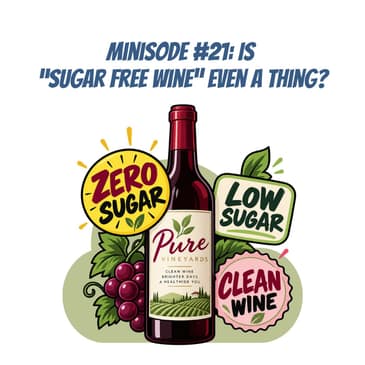
You hear claims about zero-sugar wines, low sugar wines, and clean wines and you think, hey, that sounds like a good thing. But, what does it really mean? The truth is, not much. We dig into the facts to give you the skinny. Turns out, much of that no-sugar language is just fancy marketing speak for stuff that has always been true about wine. Guess what? In the fermentation process, sugar gets turned into alcohol, and in most cases, very little residual sugar is left behind. Even more, there are no regulations or laws in the U.S. that dictate what can or cannot be stated in these claims. In other words, brands can say anything they want about low sugar or zero sugar or clean. So, what are we supposed to do now? Listen to this minisode to find out. And relax. It’s just wine.
Send us a Text Message and we'll respond in our next episode!
Contact The Wine Pair Podcast - we’d love to hear from you!
Visit our website, leave a review, and reach out to us: https://thewinepairpodcast.com/
Follow and DM us on Instagram: https://www.instagram.com/thewinepairpodcast/
Send us an email: joe@thewinepairpodcast.com
Show Notes
Minisode #21: Is "Sugar-Free Wine" Even a Real Thing?
________________________
KEY QUESTIONS
- Is "sugar-free" or "zero sugar" wine marketing actually meaningful, or is it mostly a sales pitch?
- Is "clean wine" a scientifically defined or regulated term?
- What actually counts as a "dry" wine, and is there an official definition?
- Does wine actually have a lot of calories or carbs?
- Why does "extra dry" Prosecco taste sweet?
- Are "clean wine" brands like Scout & Cellar, Dry Farm Wines, or Avaline really different from “regular” wine?
- What does "residual sugar" mean in wine?
________________________
FULL TRANSCRIPT
Joe: 00:07
Hi everyone and welcome to this special mini sode of the Wine Pear Podcast. We haven't done one of these for a while, but I'm Joe, your Simolier of reasonably priced wine, and for this mini soda, I am flying solo and I'm giving Carmelo the week off, so you'll just get my wit and charm today if you can take it. If you're new to the Wine Pear podcast, these mini sodes are just shorter versions of the regular podcast that we put on during weeks where we might be traveling or handling other life stuff. And instead of tasting and reviewing two wines under $25 that should be easy for you to find, which is what we usually do in our regular episodes, in these mini sodes, we focus more on things like wine etiquette, wine education, wine tips, things like that. So it's a bit of a break from our regularly scheduled program where we can focus on something a little different. And for our faithful listeners, we love it if you just send us some feedback on this format and what you think. Okay, friends, today we're gonna talk about something that you have probably noticed popping up here and there in wine marketing and ads or on stickers or end caps in the stores or in your email, and that's the concept of sugar-free wine or zero sugar wine. So the question is this, is that a real thing? And like us, you probably can't help but see ads on Instagram for zero sugar or low sugar wine from direct-to-consumer wine clubs like Scout and Cellar that show up in your feed or email, and those wine clubs often function like Avon or Tupperware, and I almost got sucked into one of them one time, thank God I didn't. And I even find that if I go into natural wine shops or similar types of wine shops, I get confused by conversations around low sugar and low intervention and no additives, or even my least favorite of all, clean wine. Like, who's selling dirty wine? Anyway, I digress. How should we feel about all of that, especially this low sugar or zero sugar stuff? I mean, look, all of us, me, Carmilla included, we're trying to be a little more healthy in our food choices. We're protein maxing, right? Fiber maxing, right? And it's not a coincidence that GLP1 drugs are selling like hot cakes. Most of us are pretty conscious of things like carbs. We don't need or want a bunch of added sugar in our diets and our food. Carmilla and I look at food labels and we talk about those kinds of things, and we try to look for things like how much added sugar does a food have, and how many grams of sugar or carbs are in it. And so it's not like sugar-free is a bad thing. That's not what I'm trying to say here. But here's the thing when it comes to wine. Most of the time, calling a wine sugar-free or calling it out that it has no added sugars is not really telling us nearly as much as the marketers want us to think it's telling us. And yes, it is the marketers who are pushing this stuff. And I'm not just saying that as an opinion. It's fact. It's fact. We're gonna talk about the facts. But we need to back up just a little bit and get to the basic question. Is there sugar in wine or is there added sugar in wine? Because that's what we all want to know. To understand some of this, we need to talk about some basics around winemaking that you probably know but are worth revisiting. When grapes are picked for harvest, the juice is full of natural sugar. In fact, there is a tool winemakers use and it lets them know how much sugar a grape has in it, and it's one of the ways they determine when to pick the grapes. One of the main reasons they do that is to determine the alcohol level the wine will eventually have based on the sugar in the grapes. And note that warmer weather or the longer the grapes are left in the vine, the more sugar a grape can have. But that's a, again, a bit of a tangent. And then during the fermentation process, yeast eats the sugar and converts most of it, or all of it, into alcohol. And the amount of sugar left behind from the fermentation process is called residual sugar, which is measured in grams per liter, something you can sometimes find on a wine label or a tech sheet. If the yeast is left to finish the job, you end up with what winemakers call a dry wine, which means there's very little to no residual sugar left over. Sometimes a wine will tell you if it's dry or sweet, sometimes not, but you can often tell by the amount of alcohol in the wine. So in general, wines under 11% alcohol generally have more residual sugar left in them. But here's the thing: this would be much easier to manage if wine had nutrition labels like the other foods and beverages we have, right? Well, in the US, the law only requires nutrition labeling on products under 7% alcohol, which is one of the reasons it's often opaque, because most wines are above 7% alcohol. And in the US, there's also no law that regulates how a wine is defined as dry, which kind of sucks because that means it's up to the winemaker or the brand, and they can say basically anything they want. And yes, there are certain accepted norms around what constitutes dry or semi-dry, but there are no laws around it. The European Union does legally define a dry wine as one with less than four grams per liter of residual sugar. And generally in the wine industry is that bone-dry wines are zero to one gram of residual sugar, dry is zero to four grams, and semi-dry is four to twelve grams of residual sugar. So why do we bring all this up? Well, it turns out that most of the wines that you buy in the grocery store or at a wine shop are already dry, meaning they're already zero sugar or low sugar. They may or may not label themselves that way, but technically they are no sugar, zero sugar, or low sugar wines. And in case you were wondering, the brands that do market themselves as no sugar or low sugar generally so no sugar, they generally put the threshold at 0.5 grams of residual sugar per liter. And wines marketed as low sugar generally are in the one to two grams of residual sugar range. But again, what that indicates is that the label is really about marketing, because the average typical wine you're going to be buying at the store is at the same level or about the same level residual sugar as a low-to-no-sugar wine. And it's always been that way. In fact, to show how unremarkable low-to-no sugar is, one wine industry research firm put dry wine at 68% of global wine consumption in 2025. So almost 70%. That's a lot. And a separate research, citing some group called Grand View Research, whoever they are, put all wine from bone-dry to off-dry at nearly 82% of the global market. And so these are not peer-reviewed studies. They are, you know, they're not perfect. But we do have two separate studies that land in roughly the same neighborhood saying that somewhere between two-thirds and four-fifths of all wine you're going to buy would generally be in the no sugar or low sugar range anyway, even if they didn't tell you or put that in their marketing. So what we're saying is don't buy the hype. You're going to be in okay shape drinking most wines if you're trying to watch your sugar or carb intake. And we'll talk more about that in a minute, because I want to go on a bit of a tangent again on a related topic. And that is what I mentioned earlier, clean wine, which is one of my least favorite food and beverage terms because I'm just not sure, again, who is saying they create or sell dirty wine or dirty food. When Panera Bread started using clean food in all of their ads, I wanted to throw my shoe at the TV, but that's again, I digress. Most of the claims around clean wine that brands like Scout and Cellar and Dry Farm Wines and Avilene are making is that their wine is made from organically grown grapes, minimal seller intervention, no added sugars, no artificial dyes, no synthetic chemicals. But again, here's the thing: the vast majority of wines that you're gonna buy or drink are already made that way. So, yes, it's not the big cheap grocery store brands, you know, the big mass market ones that are super cheap. Those do often have additives and sugar and that kind of stuff. But most of the wines you're gonna be drinking, most of the wines we cover in our podcast, fall into that group of not having any of those things anyway. So these are, again, marketing ploys that are meant to make you worried. In most of the wine, there are no artificial dyes. There is minimal seller intervention, there are no added sugars. So don't get all hyped up about it. So how do we know it's just a ploy to make us worried? Well, in April of 2022, so not that long ago, the Federal Alcohol and Tobacco Tax and Trade Bureau, the TTB, which is the agency that regulates alcohol labeling in the U.S., put out an official bulletin specifically about the word clean on alcohol labels. They said the term isn't defined anywhere in their regulations, and if a brand uses clean or similar language in a way that implies a health benefit, the TTP said flat out they consider that a misleading health claim. In other words, there are no regulations around what clean means and no real rules around it. So anyone can say clean and it means anything they want it to, and it doesn't mean much of anything. So our POV on this is that it's mostly crap. And what we say is just be careful about brands making these kinds of claims. Not because they're necessarily lying, but they may be leading you to believe things that are either not as insidious or not as meaningful as they seem, and probably making you pay more or getting suckered into their stupid mail order programs by convincing you that only their wines or the wines they sell are made in this pure, clean way. So when someone tries to tell you about how their wine is clean or that they only drink clean wines, you can just feel comfortable that there is not a lot of sugar hanging around in your wine to try and mess you up, and you can just tell them that. And to linger on claims for just a minute, because it's kind of fun, I want to share what an online publication called Heal Nourish Grow said in an article covering what they called the best healthy, sugar-free, and organic wine brands, which you can find on the interwebs if you look for it. The article makes it sound like most wines are chock full of added sugar and chemicals and additives. And the truth is that most wines, particularly wines that are not mass-produced, but instead made by smaller, more artisanal, and or family winemakers, are already made in ways that reduce the addition of sugars and other additives, which is one of the reasons why in our regular episodes, when we select wines, we try to point people past the mass-produced wines on the store shelf, which often again do have some crap added into them. Now, another thing I just want to chat about with you that many people are focused on is not just sugar, but calories that come from carbs. It turns out that most of the calories in wine don't come from sugar, which is of course a carb. They come from alcohol and wine in general, especially dry wines, are very low in carbs. In fact, lower in carbs is one of the reasons why I mostly stopped drinking beer and instead have wine when I go out, because beer can have five times as many carbs per serving as wine. So stick to the wine. And here's another thing on a related topic to carbs and calories and sugar that has to do with quality. When a wine brand says that it's low calorie, what's usually happening is they're picking less ripe grapes, which means less sugar is available to convert into alcohol, which results in lower alcohol by volume, which results in lower calories. But as a result, they may create a lower calorie and lower alcohol wine that in all likelihood is going to taste like crap because of the lower quality and lower sugar grapes they use, as well as the low alcohol in the wine, because alcohol creates one of the most important aspects of wine called body. And body impacts our experience of wine and our taste of wine. And it's something we covered in a previous mini sode, by the way. Now, low calories is a different claim than sugar free, but brands do often blur the line on those two together on purpose, so it reads like one big healthy halo. Now, one more fact that is generally useful dry doesn't always mean that it doesn't have some sweetness when you taste it. A wine can have zero or close to zero residual sugar and still taste fruity or a little sweet, so your brain reads that as sweetness, even though there's little or no sugar actually left in it. And I find that true of many like sparkling wines and still white wines. There's sweetness and fruitiness in the wine, even if there's not much, if any, sugar. Now, the one exception I will call out, as long as we're digressing, just to be careful of, is prosecco, which tends to have higher sugar. And one of the reasons why I don't actually drink it as often anymore. Remember, a sparkling wine that says dry or extra dry on the bottle, which prosecco often does, is confusing because dry in a sparkling wine means slightly sweet. Brute is actually dry in a sparkling wine. I know, it's kind of fed up, but you just have to know it. So, my friends, what's the actual takeaway for all of you out there in listening land after all of this stuff? If a wine says sugar free and it's a normal dry red or white, you're probably not getting anything new. And you may be paying extra for a label or marketing, restating a fact. That's already true about most wines, anyway. If you actually care about sugar content, look at alcohol content or ABV, which you can often find on a bottle. And remember, a wine under 11% alcohol is often on the sweeter side. So the next time you see sugar free on a fancy bottle, you know enough to be able to say it doesn't really mean much of anything. But let us know what you think. Do you think we're full of crap? Do you agree with us or do you disagree with us? We'd love to know what you think. And we'd love to know if you like this different format for a mini sode. Look, again, we know you prefer it when Carmela is with me, but if I have to give her a break, does this work for you? Let us know. We'd love to hear from you guys. And if you want to see the sources for our content today and find the links to learn more, come to our website, look for this mini sode, and open up the show notes and you'll find the links. And remember, you can check out our other mini sodes or regular sized episodes on our website or wherever you get your podcasts. You can follow us on Instagram and Blue Sky and TikTok at the WinePair Podcast. You can visit our website, thewinepairpodcast.com, and in any of those places, you can reach out to us directly, and you can also send us an email at Joe with the WinePearpodcast.com. So tell us what you're drinking. Tell us ideas you have for episodes and mini sodes and wines. Tell us if you like the slightly adjusted mini sod format. Let us know. We just want to shoot the breeze. And if you visit our website, you can also sign up for our email newsletter there, which we just sent out. So if you missed it, send me a note at joaththewinepairpodcast.com. I'll get you on the mailing list. I'll get you the email, I'll hand deliver it to your email inbox. And you can also shop on our website for our top-rated wines, the wines that we rate as buys in each episode. And then please follow or subscribe to our podcast, give us a five-star rating and review as a free way to support us, and help us grow listeners, and we thank you so much to all of you who have already done that. We really appreciate it. And we really appreciate you listening to us and spending time with us. And we look forward to you listening to us again every week. And as we like to say, at the end of every episode, life is short. So stop drinking shitty wine. Goodbye.
________________________
FREQUENTLY ASKED QUESTIONS
Q. Is "sugar-free" or "zero sugar" wine marketing actually meaningful, or is it mostly a sales pitch?
A. Mostly a sales pitch. Fermentation already converts most grape sugar into alcohol, so an ordinary dry wine typically sits in the same near-zero range brands charge extra for labeling "sugar-free." Skip the markup and check the ABV instead. Wines under 11% ABV tend to have more residual sugar left in them.
Q. Is "clean wine" a scientifically defined or regulated term?
A. No. The US Alcohol and Tobacco Tax and Trade Bureau stated in an April 2022 bulletin that "clean" has no regulatory definition, and using it to imply a health benefit is a misleading claim. It's a marketing label, not a certified production standard.
Q. What actually counts as a "dry" wine, and is there an official definition?
A. The EU legally defines dry wine as under 4 grams of residual sugar per liter. The US has no legal definition. The generally accepted (non-binding) tiers are bone-dry at 0-1 g/L, dry at 0-4 g/L, and semi-dry at 4-12 g/L.
Q. Does wine actually have a lot of calories or carbs?
A. Not much, if it's dry. Most of wine's calories come from alcohol, not sugar or carbs, and dry wine is generally low-carb. Beer can carry up to five times the carbs of wine per serving. Sweet wines are the exception, since they carry more sugar.
Q. Why does "extra dry" Prosecco taste sweet?
A. Because sparkling wine labeling doesn't follow normal usage. On a Prosecco label, "dry" and "extra dry" both mean slightly sweet. "Brut" is the term that actually means dry in sparkling wine. Prosecco also tends to run higher in sugar than most still wines generally.
Q. Are "clean wine" brands like Scout & Cellar, Dry Farm Wines, or Avaline really different from “regular” wine?
A. Not as much as the marketing suggests. Their claims, organic grapes, minimal cellar intervention, no added sugar or synthetic additives, mostly describe how smaller, artisanal, family wineries already make wine. It's mass-produced grocery-store wine with additives that's the exception, not the norm.
Q. What does "residual sugar" mean in wine?
A. Residual sugar is the grape sugar left over after fermentation, when yeast doesn't convert all of it into alcohol. It's measured in grams per liter (g/L). The less sugar converted, the more residual sugar remains, which is part of why lower-alcohol wines often taste sweeter.
________________________
ARTICLES AND LINKS
- https://www.wineenthusiast.com/culture/wine/are-no-sugar-wines-healthy/
- https://vinepair.com/articles/industry-clean-wine-reckoning/
- https://wineinstitute.org/news-alerts/ttb-issues-statement-on-clean-wine-claims/
- https://www.thedrinksbusiness.com/2022/04/clean-wine-is-a-misleading-term-and-should-not-be-used-by-brands-us-federal-government-says/
- https://en.wikipedia.org/wiki/Sugars_in_wine
- https://winemakermag.com/technique/501-measuring-residual-sugar-techniques
- https://www.marketdataforecast.com/market-reports/wine-market
- https://www.winedeals.com/blog/post/wine-sweetness-levels
________________________
Support The Wine Pair Podcast by heading to our website and shopping for the wines we give our highest ratings to in our Shop Wines section. Just click on this link - you pay the same price, and we may get a small amount of compensation.
You can also support us by clicking on this affiliate link to wine.com and find great wines under $20!
And, if you are looking for a great website builder for your podcast, click on this link to use the service we use and love: Beamly, formerly known as Podcastpage.io