
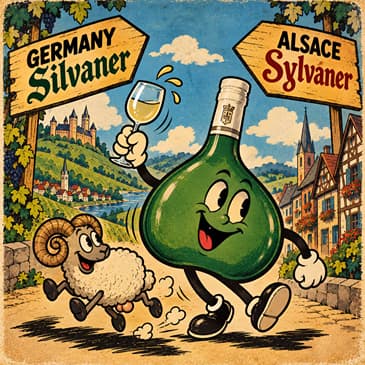
If beer ain’t your jam for Oktoberfest, then maybe the great Bavarian German wine called Sylvaner (or is it Silvaner?!?) is the wine you should be enjoying with your pretzels and bratwurst this season. Yes, there are two spellings of Sylvaner, and yes it matters because the style of Silvaner spelled with an “i” is the German version, and it is a crisp, acidic wine that goes well with German foods, while the version with the “y,” most famously from Alsace, France, is a different, richer wine. The other thing to know is that there is a classic bottle shape for Silvaner from Franken, Germany that is just, frankly, odd. The bottle shape is called Bocksbeutel, and let’s just say the name is for a body part that is, well, delicate. But you have to listen to the episode to learn more. We had a lot of fun getting “exposed” to this different type of wine and wine bottle, and we think you will enjoy it, too. Wines reviewed in this episode: 2022 Domaine Mann Vignoble des 3 Terres Mouton Bleu Sylvaner, 2023 Hans Wirsching Iphofer Silvaner
Send us a Text Message and we'll respond in our next episode!
Contact The Wine Pair Podcast - we’d love to hear from you!
Visit our website, leave a review, and reach out to us: https://thewinepairpodcast.com/
Follow and DM us on Instagram: https://www.instagram.com/thewinepairpodcast/
Send us an email: joe@thewinepairpodcast.com
Show Notes
Episode #237: WTF is Sylvaner? Your Oktoberfest wine? 00:00
________________________
KEY QUESTIONS
- What is Sylvaner wine?
- Is Sylvaner a good wine for Oktoberfest?
- What is the difference between German Silvaner and Alsace Sylvaner?
- Why is Sylvaner sometimes spelled Silvaner?
- What food pairs with Silvaner?
- Why do some Silvaner wines come in a flat, round bottle?
________________________
Episode Overview and First Thoughts on Sylvaner 00:35
Hello fellow wine wienfreunds (wine friend or enthusiast)! And welcome to The Wine Pair Podcast. I’m Joe, your sommelier of reasonably priced wine, and this is my wife and my wine pairing partner in crime, Carmela. And we are The Wine Pair!
If you're new to our podcast, here's what we do: Every week we buy wines under $25 with our own money, taste them, and give you our brutally honest opinion on whether they're worth buying. Nobody pays us to review specific wines, we don't accept free bottles from wineries, and we're not afraid to call out a bad wine when we taste one. Decanter Magazine calls us fun, irreverent, chatty, and entertaining - so if that sounds like your vibe, welcome to our tribe of wine lovers.
Carmela, the tribe name I came up with today is a German word that means wine friend or wine enthusiast, weinfreund, and I chose it because today we are going to do one of our beloved WTF episodes and learn about a wine called Sylvaner, which can be spelled with an “i” or a “y.”
Now, you may ask, why is it that Sylvaner can be spelled these different ways? Well, it depends a bit on where it is from and what language is being used. Silvaner (with an "i") is the official standard spelling in Germany, and its official varietal name is Grüner Silvaner. You may recognize the word Grüner from another wine we love called Grüner Veltliner. Grüner means “green” in German, and so has to do with the color of the grapes. So, put that in your brain box.
In case you were wondering, there are varieties of Sylvaner that are not green, and so let’s do a little German language lesson. There is Gelber Silvaner (Yellow), Blauer Silvaner (Blue), and Roter Silvaner (Red). So, don’t say you never learn anything on this podcast because we just gave you a German lesson, ok?!?
Interestingly, Sylvaner was spelled with a “y” in German originally, but they switched to the "i" officially after World War I. I guess that’s interesting to me because I am a word nerd. Evidently, starting in the late 1800s, there was a push to “Germanize” the language, so they started to respell words that had foreign looking spellings. This happened over decades, and it wasn’t until after WWI that they got around to grapes, I guess. If there are any language experts out there who know more about this, please let us know.
Slvaner is still spelled with a “y” in many places like Alsace, France, in Switzerland, Austria, and most international and English language publications. So, for instance, in the UK and the US and Canada, you will generally see it spelled with a “y.”
The name Sylvaner comes from the name Sylvanus who is the Roman god of forests and shepherds. In the 17th century, Cistercian monks, of course, it’s the monks, made the name popular, and early growers believed the grape was directly linked to wild forest vines.
About 70% of the world’s Sylvaner is from Germany, and within Germany it is in the Franken region that the grape was first documented in 1659, and Franken is considered its home, and is the largest planted grape in the area. However, the largest acreage for Sylvaner in the world is in Rheinhassen, and other areas in Germany where they grow it and make it are Pfalz, Baden, and Saale-Unstrut.
Outside of Germany, they make it in France in Alsace, and there is actually a Grand Cru site in Alsace for Sylvaner, they make it in Alto Adige in Northern Italy, in Switzerland, where is it known locally as Johannisbert, and there are smaller pockets of it in Austria, Croatia, Slovakia, Romania, and in the US, you can find it in California, Oregon, Washington, the Finger Lakes of New York, Michigan, and Ohio among other places.
One kind of funny story about Sylvaner that seems appropriate now that we are in October, is that before modern genetic testing, many wine historians assumed that Sylvaner originated in Transylvania simply because the name sounds similar. So, although there is no actual connection, you can freak out your friends, family, and children by claiming that you are going to drink the wine that Count Dracula drank. Or not.
And, speaking of October and Germany, this wine would make a great Oktoberfest Beer. It’s German. It’s dry. And it’s supposed to go great with the German foods that one would expect for Oktoberest like pretzels and bratwurst and stuff like that. So . . . if you are going to an Oktoberfest party and beer is not your jam, perhaps look for, or bring, Sylvaner with you and you might be the talk of the party.
But we are not here to talk about vampires or German beer parties or that kind of stuff. We are here to talk about Sylvaner, and we have two Sylvaner wines we are going to drink today, one from Germany and one from Alsace, France, and we are going to taste and review them to see if either or both of them belong on your dinner table . . .
But first . . . we have to do our shameless plug
Thank you for listening to us and for supporting our show, and know that we buy all of the wine we taste and review every week so that we can give you real and honest reviews. If you like what you’re hearing, please subscribe to our podcast and leave us a five star rating and review so we can grow listeners.
We also love to hear from you and we always respond so you can follow us on Instagram and Bluesky and TikTok at thewinepairpodcast. You can contact us on our website thewinepairpodcast.com, and you can sign up for our email newsletter there and you can also send us a note at joe@thewinepairpodcast.com and let us know about wines your want us to review or just shoot the breeze, we love chatting it up.
And, as we do every week, we’ll tell you someone we think you should recommend The Wine Pair Podcast to - because the best way for us to grow listeners is when you tell your family and friends about us - and this week, we want you to recommend us to anyone who likes to try new white wines that are off of the beaten path or who prefers wine to beer, because this may be their chance to really try something new!
Topic: WTF is Sylvaner? 10:16
Carmela, let’s find out just what the eff Sylvaner is, shall we?
First, you should know that genetic testing has proven that Sylvaner is the grape love child of Traminer and Österreichisch-Weiß (uu-ster-ish vise). Traminer is sort of the parent of Gewürztraminer, which is technically a genetic mutation of Traminer. White Traminer is genetically identical to Savignin Blanc (not Sauvignon) which is a famous wine in Jura, France, and the ancestor to many European wines. Österreichisch-Weiß literally means "Austrian White" in German and is an ancient, rare white wine grape variety indigenous to Austria. It was once very prominent in Austrian viticulture, but today, it is almost entirely extinct.
There wasn't a ton written about Sylvaner until the 17th century. Vineyards in Germany were in very bad shape after the Thirty Years’ War, which was a war between Catholic and Protestant leaders and clergy in Europe, and mostly impacted the areas of Germany, Austria, and the Czech Republic. After the war, German farmers and winemakers wanted to find reliable varieties in building back the crops.
In 1659, an administrator for the County of Castell in Franken, which is in Bavaria, purchased 25 Austrian wine grape cuttings, and planted them at the foot of Schlossberg hill in Germany, and this was the first documented planting. Then in 1665, Abbot Alberich Degen of the Cistercian Monastery of Ebrach imported Austrian cuttings and planted them in the famous Würzburger Stein vineyard in Franken
During the 19th and early 20th centuries, Sylvaner expanded quickly across Central Europe because it was reliable and ripened early. Fast forward a bit, and by the 1960s and 1970s, Sylvaner was Germany's #1 most grown wine grape, and made up about 30% of all the vineyard area in Germany, and 25% of the vineyard area in Alsace, France.
And then, in a story that we have to tell quite often, in the 1970s, Silvaner's reputation took a hit because the grape was over-produced, and because it is already not a super aromatic wine, the resulting wine that was created was considered bland and “characterless.” Something you do not want to be called. Huge quantities of German Sylvaner were blended into cheap, mass-market sweet wines. And at about that same time, Müller-Thurgau and Riesling overtook Sylvaner in popularity, so German growers started replacing Sylvaner with those wine grapes, and the 30% of vineyard area went down to about 5%, which is where it is today.
But wait, there's more! In 1985, Austria was at the center of a major scandal: some Austrian producers had been illegally adding diethylene glycol, an ingredient in antifreeze, along with sugar, to fake the richness and sweetness of late-harvest wines. Some of that tainted wine got blended in bulk into German wine by West German importers, so German wine took a reputational hit too, even though the fraud itself started in Austria. The result was that sweet German and Austrian wines both lost consumers' trust almost overnight. What does that have to do with Sylvaner? Well, before that time, most Sylvaner was made as a sweet wine
Franken, Germany came through it in better shape than most of these regions that were impacted by the scandal. German wine law had already started pushing growers toward dry, Trocken-style wines (Trocken means dry) a few years earlier, and Franken leaned hard into that dry, higher quality style instead of competing on cheap sweet blends. That bet paid off: in 2019, Sylvaner officially overtook Müller-Thurgau to regain its crown as Franken's most planted grape variety
Alsace also helped the reputation of Sylvaner to bounce back. Wine grape growers in the village of Mittelbergheim spent decades proving that old-vine Sylvaner could produce some great wines, and so in 2005 the government officially gave Grand Cru status to Zotzenberg Sylvaner, and that is the only place in France where they can label Sylvaner as Grand Cru.
Today, winemakers are taking a lot of steps to make sure their Sylvaner is high quality including controlling the yield of crops, harvesting earlier so they get more acidy and crisp wine because, remember, as grapes ripen the sugar increases and the acidity goes away. They are also doing a lot of organic and biodynamic farming, and focusing on what are called “heritage” clones, meaning they are bringing back more traditional cuttings of the grape.
In terms of differences between the wine in Germany and France, In Franken, Germany, winemakers focus on a strictly bone-dry Trocken style and harvest earlier to preserve a crisp acidity and ferment predominantly in stainless steel or large neutral oak casks to prevent oak or residual sugar from masking the grape. This is a crisp, fruity wine in general. By contrast, in Alsace, France, winemakers more frequently use extended lees contact, subtle skin maceration, and sometimes oak aging to build richness and mouthfeel. Something akin to what we talked about with Pinot Gris where in Alsace they make a much different, richer version than the wine made by the same grape in Italy called Pinot Grigio.
One last thing I want to talk about is the very strange bottle shape you see often in Sylvaner from Germany. You will not believe it when you see it, Carmela. The bottle shape is called Bocksbeutel, and it's a squat, flattened, round-bodied bottle with a short neck that resembles a rounded flask. It is the iconic signature packaging of the Franken region in Germany, again the home of Sylvaner.
Now, some people say the name Bocksbeutel comes either from a medieval leather pouch used to carry prayer books or literally from the German words for a ram's scrotum “Bocks-beutell’” which is inspired by its rounded shape.
The bottle shape of a ram’s scrotum is legally protected under European Union regulations, restricting its official use almost exclusively to wines from Franken and a few specific neighboring regions. And, while the Bocksbeutel serves as an instant badge of quality and authenticity on a restaurant table, its plump, flat shape makes it somewhat impractical, which I can attest to. It does not fit into conventional wine bottle racks and creates logistics challenges for long-distance shipping and retail storage.
But that’s enough information. I think it’s time to learn a little more about the specific wines we are drinking today. Whaddya say?
Sylvaner Wines We Chose for This Episode 19:15
One of the wines we have chosen for this episode is under $25 and the other is just over that price, and they should be relatively easy to find because I bought them at wine.com. You should be able to find Sylvaner at wine shops and stores with good wine sections, especially if they have good selections of German, Alsace, or Austrian wines. And, as always, talk to your local wine shop and they will be more than happy to help you.
The first wine we are going to drink is the 2022 Domaine Mann Vignoble des 3 Terres Mouton Bleu Sylvaner from Alsace, France. This wine got a 90 from Wine Enthusiast. I did find a tech sheet for this wine, but it didn’t give a ton of information. Here is what I know.
- It is sustainably farmed, organic, and biodynamic
- The soils are granite, sandstone, and limestone
- The grapes are hand-picked, then gently pressed and they use native yeast for fermentation.
- They also age on the lees, which again is the left over yeast and stuff from the fermentation process, so this should have some mouthfeel to it. Which we would expect from an Alsace Sylvaner
Other than that, there is not much to say other than the wine comes in the classic Alsace long, thin flute bottle.
The second wine we are going to drink is the 2023 Hans Wirsching Iphofer Silvaner, and this one is from Franken, Germany, comes in the classic weird flat flask-like bottle which I am really excited for you to see, Carmela, and not just because it is named after a scrotum, and it got a 90 rating from Wine Spectator. So, it is fun we are having wines from both of the most famous regions for Sylvaner.
This one was also hard to find out much about. What I can tell you from their website is that they follow sustainable practices as well as environmental protection. They ban glyphosate and insecticides from their vineyards, and they harvest by hand. I believe they also avoid oak, which we would expect for German Sylvaner. But that is about it!
So, I think that is enough information - let’s get to drinking! We’ll take a quick break and be right back. And, if you have these wines or similar wines, drink along with us to get some participation points, which you can trade-in for free stickers. You just need to send me an email with your mailing address, and I will get those “I drink with The Wine Pair Podcast” stickers over to you!
LINKS TO SOURCES FOR THESE SPECIFIC WINES
- https://www.mwines.com/product/mann-bleu/?print-products=pdf
- https://www.fieldblendselections.com/hans-wirsching
- https://www.wirsching-shop.de/vdp.ortsweine/808/516-2025-iphoefer-silvaner-trocken-vdp.ortswein?c=99
2022 Domaine Mann Vignoble des 3 Terres Mouton Bleu Sylvaner, 2023 Hans Wirsching Iphofer Silvaner Wine Tasting, Pairing, and Review 21:50
Wine: Domaine Mann Vignoble des 3 Terres Mouton Bleu Sylvaner (Click here to find this wine on wine.com. We may be compensated if you purchase)
Region: France, Alsace
Vintage: 2022
Price: $21.99
Retailer: wine.com
Alcohol: 13%
Grapes: Sylvaner
Professional Rating: WE 90 Vivino
What we tasted and smelled in this Domaine Mann Vignoble des 3 Terres Mouton Bleu Sylvaner:
- Color: Creamy yellow, honey yellow, a touch of green
- On the nose: Honey, not very aromatic, apple, pear, rain water, sea spray, peach, stone fruit, sweetness, a bit of astringency
- In the mouth: Astringent, fruity start, almost no acidity, viscous, almost syrupy, cough syrup, herbal, hard alcohol tasting almost needs a mixer, salty
Food to pair with this Domaine Mann Vignoble des 3 Terres Mouton Bleu Sylvaner: Salty foods, bratwurst, big soft pretzel, German foods, chicken, sandwiches
As a reminder on our rating scale, we rate on a scale of 1-10, with no half points, where 7 and above means that we would buy it, and 4 and below means that we are likely to pour it down the sink, and a 5 or 6 means we are likely to drink it and finish it, but we are probably not going to buy it.
Domaine Mann Vignoble des 3 Terres Mouton Bleu Sylvaner Wine Rating:
- Joe: 5/10
- Carmela: 5/10
Wine: Hans Wirsching Iphofer Silvaner (Click here to find this wine on wine.com. We may be compensated if you purchase)
Region: Germany, Franken
Vintage: 2023
Price: $28.97
Retailer: wine.com
Alcohol: 12.5%
Grapes: Sylvaner
Professional Rating: WS 90 Vivino
What we tasted and smelled in this Hans Wirsching Iphofer Silvaner:
- Color: Lemon yellow
- On the nose: Gasoline, apple, pear, saline, lemon, lime, peach
- In the mouth: Super citrusy, lemon, lime, tart acidity, puckering, like sucking on a lemon, Granny Smith apple, quince, bandaid, steely, stone, salt, low sugar lemonade, very dry
Food to pair with this Hans Wirsching Iphofer Silvaner: Good food wine, versatile, soft pretzel, fish and chips, fried foods, schnitzel with lemon, prawns, shellfish with butter sauce, spaghetti carbonara, white pizza, salty cheeses, bratwurst
Hans Wirsching Iphofer Silvaner Wine Rating:
- Joe: 7/10
- Carmela: 7/10
Which one of these are you finishing tonight?
- Carmela: Hans Wirsching Iphofer Silvaner
- Joe: Hans Wirsching Iphofer Silvaner
The Test: Did we nail the taste profiles expected from Sylvaner? 35:35
- General
- Will vary depending on where it is from, either Germany or Alsace
- Domaine Mann Vignoble des 3 Terres Mouton Bleu Sylvaner
- Winery: I could not find a description
- WE: A graceful version, this wine is smooth and medium bodied, with subtle, well integrated flavors of quince, orange blossom, fleur de sel and lemon zest. This is all about the texture.
- Hans Wirsching Iphofer Silvaner
- Winery: It has a light and fresh character with an unobtrusive acidity. Its fine minerality and discreet fruity aromas of apple and quince make it a pleasure to drink.
- WS: A mineral-driven style, with a savory tang to the delicate orchard fruit and lime notes, all matched to a silky-textured, energetic frame. Mouthwatering and bright, showing streaks of salt and hay.
What is our verdict on Sylvaner? 37:00
Need to try more, not a go-to at this point. Much more interested in the German version than the Alsace version. Love the bottle.
And now it is time to head over to our news desk so that we can cover our wine in the news this week segment.
Wine in the news this week:AI row breaks out at wine writing awards 37:45
- https://henryjeffreys.substack.com/p/ai-row-breaks-out-at-wine-writing
- https://feiring.substack.com/p/the-wine-writing-worlds-ai-problem
- https://www.1winedude.com/ai-casts-a-pall-over-the-wine-writing-world-and-its-mostly-your-our-fault/
Our wine in the news this week comes from Henry Jeffreys writing for his Substack called Drinking Culture, and the article is entitled "AI row breaks out at wine writing awards." And I have the feeling we are going to be hearing more and more about things like this. By the way, the links to this article and all of the articles we use for research are in the show notes as always.
There is something called the 67 Pall Mall Global Wine Communicator Awards, and according to Henry Jeffreys, they are the most prestigious awards for wine communications. We have never been invited, by the way. Each winner takes home 3,000 pounds in British money. This year's winner for short-form writing was a London-based sommelier named Fikayo Ifaturoti, and her winning piece has evidently set off a pretty big fight in the wine writing world, because a number of well-known writers, including Jeffreys, believe it was written by, you guessed it, AI, or as someone who knows very little about it wants us to call it, Super Intelligence. But I digress.
The piece that Ifaturoti wrote paired a Stradivarius violin with a 1969 Bollinger Champagne, which sounds weird, but the issue is not the subject matter, it is the style of writing. It sounds like the communication was written in what I would consider “AI tells,” using things like very short sentences, sets of threes constructions, and the thing that I hate the most which is “smart-sounding” writing that kind of doesn’t really say much of anything. Oh, and em-dashes.
It wasn’t just Henry Jeffreys who was convinced it was AI slop, there were several others including Alice Feiring, who is also a wine writer, and several others. In fact Jeffreys and Feiring used an AI detecting tool called Pangram, and it came back saying that there was a 100% likelihood it was written by AI.
Interestingly, the people behind the awards are standing by Ifaturoti’s writing, which is surprising to me, although they may just be embarrassed. Richard Hemming, the Master of Wine who founded the awards, says he does not believe the piece was written by AI, and that the terse writing style is typical for younger writers. Yeah, I am not sure about that at all. And, the chair of the judges, Elaine Chukan Brown, said something to the effect of AI detectors may mistake actual writing for AI writing. Again, I am not convinced. I feel like I can tell relatively easily when something is written by AI.
While Henry admits that it is possible the writing was legit, it turns out he did once judge a poetry contest where they could tell which were written by AI because they all contained the words “amber hue” which to me means that it is very likely that the creators of the contest put something in the contest rules or instructions that would be hidden to humans but that AI would pick up to ensure the poem contained those words (like clear text). My guess, but that is likely.
Carmela, what do you think? Do you think people should be more suspicious of writing anymore? And it seems to me if AI is involved, the person should be disqualified immediately. I just worry about AI getting good enough that the tells go away.
By the way, I put this wine in the news this week article through Pangram and it came back with the writing being 100% human written.
Listener Shoutouts 41:42
- Hasini: loved the newsletter, thinks Mabel is cute, and told us about an experiment she tried where she checked wine lists at fancy restaurants to see if she could find the same wines for a lot less. It didn’t work great because the wines were niche, but I think talking to the sommelier could help. Also, she submitted a name for the tribe related to the fact that monks are always showing up in history around wine and alcohol.
- The newsletter was such a pleasure to read, and how cute is Mabel?! I’m just catching up on a couple of episodes now, and it’s hilarious hearing her in the background. I’d also like to report the results of a little high-QPR wine experiment 😂 I thought I found a hack: check out wine lists from fancy restaurants, then buy the bottle myself for a fraction of the markup. Unfortunately, I couldn’t find a single one I like that was available for delivery online, because they were all either tiny-production wines, incredibly obscure, or from some faraway place that apparently does not ship. So I guess that’s their trick. The wines may be relatively affordable, but they’re so hard to track down. I’m listening to the Cru Beaujolais episode right now, which also reminded me to submit a tribe name: The Monks, an homage to Carmela’s catchphrase, “If you want to find the wine, follow the monks.” And finally, I had to share what we’re drinking today: a Domaine Raffaitin-Planchon Sancerre. It’s so delicious. Incredibly light, a little salty and mineral, and citrusy. So good!
- Doug T: Let us know even before he started listening to us he had his doubts about James Suckling, and we are glad we found a fell Suckling hater
- Long before listening to The Wine Pair (first time this week - listened to two episodes) I developed the same (I think) opinion as you of Mr. Suckling. A James Suckling rating of 90 means “run, don’t buy”. I might buy a 92 but only if somebody else gave the wine a good rating. I don’t think anyone has ever paid him enough to get a 94. Enjoyed the podcasts. Keep up the good work
- Timmy (email from newsletteR): loved our newsletter which just came out, said Mabel was cute, and asked if we have done a Cote du Rhone episode outside of our Costco one. We have not, but maybe there is one in the future
- Once again, I am so impressed by these newsletters. It’s clear you put a lot of effort into them. And that dog is CUUUTE. Have you guys done a dedicated Cote du Rhone episode? I think you did a Costco one. But those wines generally fit your profile cost-wise. And probably style-wise (lighter, more elegant reds). Might be worth a look. Not sure whether you follow Konstantin Baum, but he’s a German MW and has a very good YouTube channel
- Chef Paul (email newsletter): Also would add Wisconsin and Minnesota to the list of places to visit and sip delicious wines I would add Marquette, LaCrescent,Brianna and St.Pepin to the list of must tries, especially the dry versions. For so many years wine makers made overly sweet versions which turned so many people off of these grapes. It’s the Zinfandel vs White Zinfandel syndrome
- Adrienne on Insta sent an article that there are still 20,000 bottles of wine that people bought and are storing at the now defunct Sherry-Lehman wine shop that have been unclaimed. There are people with too much money!
Wines coming up in future episodes in case you want to drink along with us 44:09
- Loire Crémant: Gratien Meyer Cremant de Loire Brut, Langlois Cremant de Loire Brut Rose
- Valdiguie: Cruse Wine Co. Rancho Chimiles Vineyard Valdiguie 2023, Optik French Camp Valdiguie 2022
- Juliet boxed wine: Pinot Noir, Sauvignon Blanc
Outro and how to find The Wine Pair Podcast 44:33
Thank you for listening to us and for supporting our show, and remember, we buy all of our own wine and we do all of the writing and recording and editing to bring you a show every week because we absolutely love doing it, and our small little ask for you is that you please follow or subscribe to our podcast and also please leave us a nice rating and review to help us grow our listeners - and a huge thank you to all of you who have done so already!
You can also follow us on Instagram and Bluesky and TikTok at thewinepairpodcast. You can contact us on our website thewinepairpodcast.com, and you can sign up for our email newsletter there and you can also visit our “Shop Wine” section where you can find links to buy the wines that we rate as buys in each episode. I will also note that on our website, if you are curious about a wine we have covered in the past, we do have a pretty good search functionality, so you can use that find wines you want to know more about.
And we want to make content you care about and you like, so send us a note or DM us and give us some feedback or let us know if there are wines you want us to try or wine making areas of the world you are curious about - and we’ll take care of it! joe@thewinepairpodcast.com
Alright, with that, we are going to sign off, so thanks again, and we will see you next time. And, as we say, life is short, so stop drinking shitty wine.
________________________
FREQUENTLY ASKED QUESTIONS
Q. What is Sylvaner wine?
A. Sylvaner, spelled Silvaner in Germany, is a white grape that usually makes a dry, not especially aromatic wine. DNA testing shows it is a cross of Traminer and Österreichisch Weiss. Germany grows over 70% of the world's Sylvaner, mostly in Rheinhessen and Franken, where it was first documented in Germany in 1659. Alsace, France, also makes a famous version of it.
Q. Is Sylvaner a good wine for Oktoberfest?
A. Yes, especially a dry German Silvaner, for people who would rather not drink beer. Silvaner from Franken, Germany, is typically made dry. A tart, lemony, dry 2023 Franken Silvaner scored 7/10 from both hosts, who paired it with soft pretzels, bratwurst, schnitzel with lemon and fried foods.
Q. What is the difference between German Silvaner and Alsace Sylvaner?
A. Style follows place, not spelling, although they are related. Franken Silvaner from Germany tends to be dry and structured, while Alsace Sylvaner can be softer and rounder, with lees aging. If you want a crisp white wine, German Silvaner is your choice.
Q. Why is Sylvaner sometimes spelled Silvaner?
A. They are the same grape. Germany officially spells it with an "i" (Grüner Silvaner), a change made after World War I, while Alsace, Austria and Switzerland use Sylvaner with a "y." The spelling mostly tells you where the wine comes from.
Q. What food pairs with Silvaner?
A. A dry, tart Franken Silvaner proved a versatile food wine with salty and fried dishes: soft pretzels, bratwurst, fish and chips, schnitzel with lemon, prawns or shellfish in butter sauce, spaghetti carbonara, white pizza and salty cheeses. A low-acid, almost syrupy Alsace Sylvaner suited salty foods, bratwurst, pretzels, chicken and sandwiches.
Q. Why do some Silvaner wines come in a flat, round bottle?
A. That squat, flattened bottle is the Bocksbeutel, the traditional bottle of Franken, Germany, the region most closely tied to Silvaner. Its use is protected under European Union rules. The name is often traced either to a pouch for carrying prayer books or to the German for a ram's scrotum. Both hosts loved the bottle.
________________________
RESEARCH ARTICLES AND LINKS FOR THIS EPISODE
- https://winefolly.com/grapes/silvaner/
- https://en.wikipedia.org/wiki/Silvaner
- https://www.wine-searcher.com/grape-470-silvaner?srsltid=AU7gw4Uo1cD6b_wvWebPcNWAV13vUJwPEOdXDHIest_qq29KTDxJnUWa
- https://www.youtube.com/watch?v=Pat0LwNew1k
- https://www.youtube.com/watch?v=7iFG1dWoXlQ
- https://www.jancisrobinson.com/learn/grape-varieties/white/sylvaner
- https://www.austrianwine.com/our-wine/grape-varieties/white-wine/sylvaner
- https://www.wineandmore.com/stories/sylvaner-wine-a-comprehensive-guide-to-this-underrated-white-gem/
- https://www.winesofgermany.com/our-wine/grape-varieties/grape-variety/108/silvaner
- https://www.thegrapegrind.com/grapes/all-you-need-to-know-about-sylvaner-a-quick-guide/?srsltid=AU7gw4WMWQZsgICwkJiTtGl2S6pemJxDj-5O5f17nQ0blj8CXD_WBJ9F
- https://www.wineenthusiast.com/basics/sylvaner-wine-guide/?srsltid=AU7gw4VPJ68vogXC44g13yWHM0eKT6ZDMZ-UENtbsRCGaqfti_Apn_U9
- https://daily.sevenfifty.com/silvaners-plantings-are-dropping-but-its-reputation-is-rising/
- wineberserkers.com/t/silvaner-a-lovely-yet-unloved-spring-wine-needs-friends-nytimes/143030
- https://medium.com/@samuel.petersson01/guide-to-the-grape-silvaner-4fba342c49f6
- https://romana-echensperger.de/en/2024/01/06/silvaner-from-7-decades/
- https://germanwineusa.com/simply-stunning-german-silvaner/
- https://www.guildsomm.com/public_content/features/articles/b/romana-echensperger/posts/in-search-of-silvaner
- https://winejournal.robertparker.com/a-brief-history-of-the-sylvaner-grape
- https://www.winerambler.net/blog/350-years-silvaner-grape-germany.html
- https://bottlestops.com/spirit-of-sylvaner/
- https://www.grapeguru.de/en/knowledge/grape-varieties/silvaner
- https://cellarfella.com/2012/10/11/sylvaner-forgotten-grape-kofererhof-adige/
- https://thatusefulwinesite.com/varietals/whites/Silvaner.php
________________________
Support The Wine Pair Podcast by heading to our website and shopping for the wines we give our highest ratings to in our Shop Wines section. Just click on this link - you pay the same price, and we may get a small amount of compensation.
You can also support us by clicking on this affiliate link to wine.com and find great wines under $20!
And, if you are looking for a great website builder for your podcast, click on this link to use the service we use and love: Beamly, formerly known as Podcastpage.io
________________________
FULL TRANSCRIPT
Joe: 00:00
You know, Carmela, you can spell Sylvanor with an I or a Y. I've heard. And it matters.
Carmela: 00:07
I guess so.
Joe: 00:07
Because depending on where the wine is made, the versions are quite different from each other.
Carmela: 00:13
For sure.
Joe: 00:13
The other thing is, one of these wines has got a crazy shaped bottle. Totally nuts. So if you want to learn Speaking of Nuts. If you want to learn more about what that references to, stick with us and you'll find out exactly what nuts has to do with it. Hello, fellow wine friends, and welcome to the Wine Fair Podcast. I'm Joe, your Samolier of Reasonably Priced Wine, and this is my wife and my wine pairing partner in Crime Carmela.
Carmela: 00:46
Hi there.
Joe: 00:47
And we are the Wine Pair. Woo! If you're new to our podcast, here's what we do. Every week we buy wines under $25 with our own money. We taste them and we give you our brutally honest opinion on whether they're worth buying or not. Nobody pays us to review specific wines. We don't accept free bottles from wineries, and we're not afraid to call out a bad wine when we taste one. And Decanter magazine causes fun, irreverent, chatting, and entertaining. So if that sounds like your vibe, welcome to our tribe of wine freunds.
Carmela: 01:16
Oh my.
Joe: 01:16
So, Carmelo, the tribe name I came up with today is a German word, and it means wine friend or wine enthusiast. Okay. Winefreund.
Carmela: 01:27
And I chose Freund.
Joe: 01:29
Weinfreund.
Carmela: 01:30
How do I do? You did good. Weinfreund.
Joe: 01:32
You did. I mean, that's like I think you're total, totally German. No, yeah. Okay, but I chose it because today we're going to be doing one of our beloved WTF episodes. The F stands for, by the way. And learn about a wine called Sylvaner.
Carmela: 01:47
So it's not what the Freund?
Joe: 01:49
No, actually, but I like that. What the Freund. Anyway, Sylvaner can be spelled with an I or a Y. Now you may ask, why is it that Sylvaner can be spelled in these different ways?
Carmela: 02:00
Yeah, why is it, Joe?
Joe: 02:01
Well, it depends a bit on where it's from and what language is being used. Sylvanor with an I is the official standard spelling in Germany, and its official varietal name is actually Grune Silvaner.
Speaker 3: 02:14
Oh.
Joe: 02:14
You may recognize the word Gruner from another wine we love called Gruner Feldliner. And we love Gruner Feldliner. Right. We do. And Gruner means green in German, if you didn't know. And it has to do with the color of the grapes. So put that in your brain box. Wow. But in case you were wondering, there are varieties of Silvaner that are not green. And so let's do a little German language lesson. Are you ready?
Carmela: 02:38
I'm ready.
Joe: 02:39
There's gelbe Silvaner, which is yellow. And blaue Silvener, which is blue, and rote Silvener, which is red. So don't say you never learn anything on this podcast because we just gave you a German lesson.
Carmela: 02:53
Oh my God. You're so good. I know, thank you. You do a lot of research, don't you?
Joe: 02:57
I I do. Now, interestingly, Carmela Silvaner was spelled with a Y in Germany originally, but then switched, they switched it to an I officially after World War I. And I guess that's interesting to me because I'm a word nerd. What you call a word nerd. Evidently, starting in the late 1800s, there was a push in Germany to Germanize the language. So they started to re-spell words that had foreign-looking spellings, and this happened over many decades. And they didn't really get around to wine grapes, I guess, until after World War I.
Carmela: 03:25
This wasn't priority. Right, right.
Joe: 03:26
And if there's language experts out there who know more about it, please let me know because I there must be. And I love this.
Carmela: 03:32
No, too much.
Joe: 03:33
Too much. Now, Sylvanor is spelled with a Y in many places like Alsace, France.
Carmela: 03:40
Why do we need to know this?
Joe: 03:41
Because sometimes you may see it. Is it's the same not know? Yeah, it's like, oh, Sylvanor, I thought it was with an I, or I thought it was with an Y. And you may not know the difference.
Carmela: 03:48
Maybe not. But I think you might be able to infer, but maybe not. Okay, go ahead and go ahead.
Joe: 03:53
Anyway, in Alsace, France, in Switzerland, and Austria, and most international and English language publications, it's spelled with a Y. So like in the UK and the US and Canada, you'll generally see it spelled with Y. Okay. So that's one way to tell.
Carmela: 04:06
And this will actually be in those places.
Joe: 04:08
That's right. But there's actually going to be something a little bit more coming up because there is a difference in style between German and non-German.
Carmela: 04:16
Like the Y and the I.
Joe: 04:18
That's that's right.
Carmela: 04:19
But I mean, is it does that distinguish the type of differences in the wine too? Like do the Y wines.
Joe: 04:26
It's not based on the spelling. It said the spelling is related to the place where they're made.
Carmela: 04:31
But like one could be fake. No?
Joe: 04:33
Can we just keep going here? Okay. The name Sylvanor comes from the name Sylvanus. That that does end in Anus, by the way, who is the Roman god of forests and shepherds.
Carmela: 04:44
I mean, I knew that was coming. Did you guys know that was coming? Do you guys know Joe well enough to know that he had to point that out? Because I knew. I knew he couldn't let that one just go.
Joe: 04:54
And then in the 17th century, Cistercian monks, of course, it's the monks. Wow. It's the monks.
Carmela: 04:59
They'll never let us down.
Joe: 05:00
No, they made the name popular because it had anus in it. And early growers believed the grape was directly linked to wild forest vines. Now, about 70% of the world's Sylvanor is from Germany. And within Germany, it's in the Franken region, which is in Bavaria, that the grape was first documented in 1659. And Franken is considered the home of Silvaner. And it's the largest planted grape in Franken. However, the largest acreage for Sylvaner in the world is actually in Reinhassen. And then other areas in Germany where they grow it are Falz, Baden, and Saleunstrut. Now, outside of Germany, they make it in Alsace, France, where there's actually a Grand Cruise site in Alsace for Sylvanor. So we'll talk about that more in a second. They make it in Alto Adige in northern Italy, where our daughter and her and her partner were just there. In Switzerland, they make it. It's known locally there as Johannesbutt.
Speaker 3: 05:58
Oh.
Joe: 05:59
Or probably Johannesbutt.
Speaker 3: 06:01
Oh.
Joe: 06:02
Right, because the J, they anyway. And there are smaller pockets of it in Austria, Croatia, Slovakia, Romania, and in the U.S., you can find it in California, Oregon, the great state of Washington, the Finger Lakes, the Finger Lakes of New York, Michigan, and Ohio, among other places.
Carmela: 06:19
Got it.
Joe: 06:19
And if hey, if if you got Sylvanor in your backyard, literally in your backyard, let us know. Now, one kind of funny story about Sylvanor that seems appropriate now that we are in October, Carmela, is that before modern genetic testing, many wine historians assumed that Sylvanor originated from Transylvania.
Speaker 3: 06:37
Oh.
Joe: 06:38
So although there is no actual connection, you can freak out your friends, family, and children by claiming that you're going to drink the wine that Count Dracula drank.
Carmela: 06:46
You could, but you'd be lying.
Joe: 06:47
You'd be a liar, but it would be fine.
Carmela: 06:48
Yeah, you mean this is the time of year to try and spook people.
Joe: 06:51
It is. Also, speaking of October and Germany, where our daughter and her partner just were, it's Oktoberfest time.
Carmela: 06:59
Now she calls them her partner.
Joe: 07:00
I know. That's why we can't say boyfriend anymore.
Carmela: 07:03
No, no, we can't. We can, we can't. She just referred German as so now we're like, oh.
Joe: 07:06
We're gonna do that. We're gonna be proper.
Carmela: 07:07
Is that the next step, do you think?
Joe: 07:08
I hope not. Okay. Now, this wine would make a great Oktoberfest wine.
Carmela: 07:14
Okay.
Joe: 07:14
So it's German, it's dry, and it's supposed to go great with German foods that one would expect for Oktoberfest. Oh my gods and bratwurst and stuff like that.
Carmela: 07:23
I love it.
Joe: 07:24
So if you're going to an October Schnitzel and Liederhosen, so if you're going to an Oktoberfest party and beer is not your jam, perhaps look for or bring a Sylvaner with you, and you might be the talk of the party.
Carmela: 07:38
I love it.
Joe: 07:38
Right? Be popular.
Carmela: 07:40
Right.
Joe: 07:40
But we're not here to talk about vampires or being popular. Or being popular or German beer parties or any of that kind of stuff. We're here to talk about Sylvaner. And we have two Sylvaner wines we're going to drink today, one from Germany and one from All Sauce. And so we're going to taste and review them to see if either or both of them belong. I was just, I'm laughing because Carmela had no reaction to that. But with either or both of them belong in your dinner table, but first.
Carmela: 08:04
You gotta do our shameless plug.
Joe: 08:07
She was just waiting for that. Okay.
Carmela: 08:08
I was like, is that how the line goes? I forgot. I don't know if I remember. If you asked me that, and like if you prompted me, like outside of the podcast, I might not know. You might not know. She might not know. What?
Joe: 08:19
She has to have headphones on and be in front of a microphone. Right.
Carmela: 08:21
Okay, thank you. Because it is the worst line of the whole show. No, it's anyway.
Joe: 08:25
It's the best line. Okay, thank you for listening to us and supporting our show. And remember, we buy all the wine that we taste and review every week so that we can give you real and honest reviews. So if you like what you're hearing, please subscribe to our podcast and leave us a five-star rating and review so we can grow listeners. And thanks to everybody who's done that. We also love to hear from you and we always respond and we give you shout outs in our episodes. So you can follow us on Instagram and Blue Sky and TikTok at the WinePair Podcast. Contact us on our website, thewinepairpodcast.com. You can sign up for our email newsletter there, which you just missed. But if you email me at Joe at the winepairpodcast.com, I will personally hand deliver it to your email inbox. And you can always just send a note to Joe at the winepairpodcast.com and let us know wines you're drinking, or are you doing Oktoberfest? Do you prefer wine over beer for Oktoberfest? Let us know.
Carmela: 09:14
And you know what it is? It is fall, and it is also spider season. Yeah. And this is like the third week in a row. The same spider is outside our window.
Joe: 09:23
Yes. Saying hi. Just saying hi.
Carmela: 09:24
It's been there and it's not one that you can like bat down with a broom.
Joe: 09:28
No.
Carmela: 09:28
And I keep looking at it every week. And I just thought you guys should know that because it is spooky season, and spiders equal spooky season.
Joe: 09:35
They do, but he's just saying hi. Or it could be a sheep.
Carmela: 09:37
Well, and it's eating bugs. I've been watching it eat bugs. So if I'm a little distracted, it's not Mabel. It's not Mabel. It's Charlotte in the corner of my window.
Joe: 09:44
Ooh, I like Charlotte. I like that you named her or him.
Carmela: 09:47
Well, because Charlotte's Webb.
Joe: 09:49
Yes, you're right. And as we do every week, we'll tell you someone we think you should recommend the wine pair podcast to because that's the best way for us to grow listeners when you tell your family and friends about us. And this week we want you to recommend us to anyone who likes to try new white wines that are off the beaten path or who prefers wine to beer, because this may be their chance to really try something new. Plus, they'll hear the word anus more than once.
Carmela: 10:12
Okay.
Joe: 10:12
But nobody else will notice it but you. That's right. But she said, but okay. Carmella, let's find out just what the f Sylvanor is, shall we? Let's do it. Well, first you should know that genetic testing has proven that Sylvaner is the grape love child of Treminer and Usterisch Weiss. I I had to practice that. Tremener is sort of the parent of Gewürz Demeiner, which is Treminer's in that, which is technically a genetic mutation of Treminer. Now, white Treminer is genetically identical to Savignin, not Sauvignon but Savignine Blanc, which is a famous wine in Jura, France, and the ancestor to many European wines. Usrich Weiss literally means Austrian white in German, and is an ancient rare white grape variety indigenous to Austria, and it was once very prominent in Austrian viticulture, but today it is almost entirely extinct. Now there wasn't a ton written about Sylvanor until the 17th century, which we mentioned. Vineyards in Germany were in very bad shape after the Thirty Years' War. And if you're not a historian, that was a war between Catholic and Protestant leaders and clergy in Europe, and mostly impacted the areas of Germany, Austria, and the Czech Republic. And after the war, German farmers and winemakers wanted to find reliable varieties in building back the crops. So in 1659, an administrator for the county of Castel in Franken, again, which is in Bavaria, purchased 25 Austrian wine grape cuttings, planted them at the foot of Schlossberg Hill in Germany, and this was the first documented planting, Carmilla. And then in 1665, Abbot Albrecht Degen of the Cistercian Monastery, of course, of Ibrack imported Austrian cuttings and planted them in the famous Utzburgerstein vineyard in Franken.
Carmela: 12:03
Wow. Is that how you think they speak?
Joe: 12:05
Well, you have to, if you're going to speak German, that has to be very forceful. You can't be like Utzburgerstein. You have to be Witzburgerstein. Really? Oh absolutely. Now during the 19th century. Thank you. Thank you. During the 19th and 20th centuries, Sylvanor expanded quickly across Central Europe because it was right reliable and ripened early. So that was good because it can get cold there. Fast forward a bit, and by the 1960s and 1970s, Sylvanor was Germany's number one most grown grape. Wow. Made up about 30% of all vineyard area in Germany and 25% of the vineyard area in Alsace, France.
Carmela: 12:42
Oh my goodness.
Joe: 12:43
And then, Carmela, in a story that we have to tell quite often in the 1970s, Sylvaner's reputation took a hit because the grape was overproduced, and because it's already not a super aromatic wine. The resulting wine that was created was considered bland and characterless. Something you don't want to be called. You don't want to be bland and characterless. That would cut really deep. It would. Sometimes she says that about me.
Carmela: 13:12
No, I never ever have. You've never been bland. Or characterless?
Joe: 13:18
Characterless ever. Well, that's very nice. Either of you. Oh, thanks. No, I'm not lying. Anyway, Carmilla, huge quantities of German Sylvanor were blended into cheap mass market sweet wines. And about that same time, Mulethugau and Riesling overtook Sylvanor in popularity. So German growers started replacing Sylvanor with those wine grapes, and 30% of the vineyard area went down to about 5% where it is today. So the 30% of the vineyard area was Sylvanor today, it's 5%.
Speaker 1: 13:49
Wow.
Joe: 13:49
But wait, there's more. Because Carmela, in 1985, Austria was at the center of a major scandal. Some Austrian producers had been illegally adding diethylene glycol, an ingredient in antifreeze. Oh no. Along with sugar to fake the richness and sweetness of late harvest wine.
Carmela: 14:10
They could have killed people.
Joe: 14:11
They could have killed people. Oh my. And some of that tainted wine got blended into bulk German wine by West German producers. So German wine took a reputational hit too, even though the fraud itself started in Austria. The result was that Sweet German and Austrian wines both lost customers' trust almost overnight.
Carmela: 14:28
I bet.
Joe: 14:29
And what does that have to do with Sylvanor Kermella?
Carmela: 14:32
What does it have to do with Sylvanor Joe?
Joe: 14:34
Well, before that time, most Sylvaner was made into a sweet wine. So kind of all sweet wines were getting like in that area were getting painted by the same brush. However, Franken Germany thankfully came through it in better shape than most of these regions that were impacted by this scandal. German wine law had already started pushing growers toward dry, also known as trakken. So if you that's something to remember for German wines, tracken means dry. They had pushed them down that path a few years earlier, and Franken leaned hard into that dry, higher quality style instead of competing on cheap sweet blends. And that bet paid off because in 2019, Sylvanor officially overtook Mulithau to regain its crown as Franken's most planted grape variety.
Carmela: 15:19
Woo! Victory!
Joe: 15:21
You're so right. And it's probably Franken. I think I'm saying it wrong, but it's fine.
Carmela: 15:26
All of that, like German oxen. I know. You're getting the Franken wrong.
Joe: 15:30
Franken. I get okay, whatever. I'll fix it. It's probably somebody out there is like, please stop saying that. Okay, all sauce also helped the reputation of Sylvanor to bounce back. Wine grape growers in the village of Mittelburgheim spent decades proving that old vine Sylvanor could produce some great wines. And so in 2005, the government of France officially gave Grand Cru status to Zotzenburg Sylvanor. And that is the only place in France where they can label Sylvanor as Grand Cru. Now, today winemakers are taking a lot of steps to make sure Sylvanor is high quality, including controlling the yield of crops, harvesting earlier so they get more acid y and crisp. Because remember, as grapes ripen, the sugar increases and the acidity goes away. They're also doing a lot of organic and biodynamic farming and focusing on what are called heritage clones, meaning they're trying to bring back some of the traditional clones of the grape. Now, we've talked about this before, the I versus the why, in terms of differences between the wine made in Germany and France in Franken. I'm going to say Franken now, just to bug everybody. Winemakers focus on this very bone-dry trokken style. They harvest the grapes earlier to preserve a crisp acidity and ferment predominantly in stainless steel or neutral oak, which again is used oak. And then it's so it's a crisp and fruity wine. By contrast, in all sauce fronts, winemakers more frequently use extended lees contact, subtle skin maceration, which sounds dirty, but it's not, and sometimes oak aging to build richness and mouthfeel. Something similar. Remember, we had the episode on Pinot Gris, and we were talking about how Pinot Gris from All Sauce is different than Pinot Grigio from Italy. Same thing. Okay. It's a richer style of wine. Now, one last thing I want to talk about is the very strange bottle shape you often see in Sylvaner from Germany. And you will not believe it when you see it, Carmela.
Carmela: 17:25
Oh, I can't wait.
Joe: 17:26
You are not gonna believe it. The bottle shape is called Boxbutel, and it's squat, flattened. It's a rounded bottle with a short note.
Carmela: 17:35
That's what I was imagining.
Joe: 17:36
No, and it resembles kind of a flask. It's the iconic signature packaging of the Franken, I'm gonna say Franken region in Germany, the home of Sylvaner. Now, some people say that the name Boxbutel comes either from a medieval leather pouch used to carry prayer books, or literally from the German words Boxbutel, which translates to ram scrotum.
Carmela: 18:00
No. Yes. What?
Joe: 18:02
Inspired by its rounded shape. So we've talked about anus and scrotum in the screen.
Carmela: 18:06
These aren't your kind of people.
Joe: 18:07
Yes, they are.
Carmela: 18:08
Naming something after somebody's scrotum. That's jeez, I can't believe she said it. I said it, guys.
Joe: 18:15
Now the bottle shape of a ram scrotum is legally protected under European Union regulations. Restricting its official use almost.
Carmela: 18:25
Yes. Shock treatment. Every once in a while, it's all shock treatment.
Joe: 18:28
You don't understand it. She didn't even say that about our children's anatomy. Okay. They restricted its official use almost exclusively to wines from Franken and a few specific neighboring regions. And while the box butle serves as an instant badge of quality and authenticity on a restaurant table, where else would you want a ram scrotum? It's plump flat shape makes it somewhat impractical, which I can attest to. When you see it, you'll know exactly what my what I mean because it doesn't fit into normal wine bottle racks. It's difficult to transport. It's not, it's not, it's like kind of interesting looking, but once you like think about it practically, you're like, bruh.
Speaker 3: 19:06
Right.
Joe: 19:07
Maybe you shouldn't have done that. But you know what, Carmilla? That's enough information. It's enough about RAM stuff and all that. Let's let's talk about the wines we're gonna drink today. What do you say? Let's do it. Okay, one of the wines we have chosen for this episode is under $25, and the other is just over that price. And they should be relatively easy to find because I bought them both at wine.com. And you should be able to find Sylvanor at wine shops and stores with good wine sections, especially if they have good selections of German, Allsauce, or Austrian wines. And as always, talk to your local wine merchant, ask about Sylvanor, they'll be happy to find it for you. This also may be a wine that you find like in natural wine shops as well. The first wine we're going to drink is the 2022 Domain Mon Vignoble des Traits Mouton Bleu Sylvaner from Alsace, France. This wine got a 90 from Wine Enthusiast, and I did find a tech sheet for it, but it didn't give a ton of information. So here's what I nailed.
Carmela: 20:01
Okay.
Joe: 20:02
It's sustainably farmed, organic, and biodynamic. The soils are granite, sandstone, and limestone. The grapes are handpicked, then gently pressed, and they use native yeasts for fermentation. And they also age on the leaves, which again is the leftover yeast and stuff from the fermentation process. So we should expect this wine to have some mouthfeel to it. And that is what we would expect from an all-sauce sylvaner. Other than that, there's not much to say, other than the wine comes in that classic all-sauce long kind of flute wine bottle.
Carmela: 20:31
I like those.
Joe: 20:32
So these wine bottles, you're gonna see too, they're totally different from each other.
Carmela: 20:35
But that's what I was picturing.
Joe: 20:36
Yeah, it's totally, it's gonna be totally different. The second wine we're gonna drink is the 2023 Hans Visching Eiphoffer Sylvanna. And this one is from Franck, and I'm now I'm stuck on it. Germany, and it comes in the classic weird, flat, flask-like bottle, which is named after a scrotum, which I'm really again excited for you to see, Carmela. Not the scrotum, the bottle. And it got a 90 rating from wine spectator. So I think it's kind of fun that we're having a wine from Germany and a wine from an I and a Y wine, right? This one was also hard to find out too much about. What I can tell you from their website is that they follow sustainable practices as well as environmental protection. They ban glyphosate and insecticides from their vineyards and they harvest by hand. I believe that they also avoid oak, which again we would expect from a German Sylvaner, but that's about it. So I think that's enough information. We should get to drinking wines. I love it. And so if you have a sylvaner with an I or a Y, just drink along with us. Right. If you don't, just pick up a German wine or any other wine or some white wine that you have at home and drink along with us. And we will be right back. All right. Okay, we are back and we are ready to try our first wine. This is the Domain Man Vignoble de Tri Teres Mouton Bleu Sylvaner. I don't know how to say it. Name. It's from Alsace France. It's the 2022 vintage. It was $21.99 at wine.com. 13% alcohol. So that's quite a bit. 100% Sylvanor. And again, wine enthusiasts gave this wine a 90 rating. Before we talk about the color, let's talk about the bottle.
Carmela: 22:16
It's very pretty.
Joe: 22:17
Very pretty. Cute little label. But yeah.
Carmela: 22:19
I see. Yeah. It's long and lean. And I like it. I like it. It is cute. It's funny. It has a little lamb on it.
Joe: 22:27
Mm-hmm.
Carmela: 22:28
Little lamb. Cute. It's almost like these bottles. I always find them very elegant.
Joe: 22:32
Yes, I agree.
Carmela: 22:32
Very table ready, you know? Yes. But the label's a little, you know, a little childish.
Joe: 22:38
Yeah, it's a little kind of cute. Whimsical.
Carmela: 22:41
Exactly. Same page.
Joe: 22:43
Okay, let's talk about the color.
Carmela: 22:44
Um, it's pretty light. I mean, it's not like super light.
Joe: 22:48
I think it's kind of a creamy yellow.
Carmela: 22:49
Yeah. I mean, my I have less in my glass, but yeah, yours does look kind of honey like almost.
Joe: 22:54
Honey. I think honey is a really good description of the color.
Carmela: 22:57
A little lighter, lighter than honey, but yeah.
Joe: 23:00
And it does have a little greener, it does have a little green tinge to it, maybe just a touch, at least in my glass. Okay, let's smell it and see what we think.
Carmela: 23:08
It's nice. I actually the reason I said that it looked like honey is honey is something that I smell. You're smelling.
Joe: 23:14
Yeah. It's not super aromatic, like it doesn't totally lift out of the glass. You kind of get to get your nose in there, but I've got like apple or pear. I've got like kind of like orchard fruit.
Carmela: 23:25
Right. Uh, I'm also though getting there's a little bit of like rainwater on it or something. You know?
Joe: 23:32
Is it salty or no?
Carmela: 23:34
Maybe a little bit.
Joe: 23:35
It just has a little bit of that freshness of I don't know why it's you so you're thinking more fresh than like salty.
Carmela: 23:42
Yeah, almost like, or maybe it is a little salty. I'm thinking rainwater, but maybe it is a little bit like sea mist. See, yeah, exactly. Like if you're walking along the ocean and it's a little misty. I like that. Sea mist. I like that.
Joe: 23:57
It's it's very pretty smelling. I think I'm getting a little bit of peach or you know, like stone fruit as well on it.
Carmela: 24:04
I'm really getting honey for some reason.
Joe: 24:05
You are getting a lot of sweetness, huh? Yeah. Well, let's um, I I feel like I I do have to say I'm getting a tiny bit of astringency on it, like a little bit of heat, a little bit of alcohol on it. Okay, let's taste it and see what we think.
unknown: 24:18
Okay.
Joe: 24:20
I gotta say that that astringency really comes across. Like it's got a fruity start, but it's got a really astringent end.
Carmela: 24:27
There's no acidity in this, I don't feel like.
Joe: 24:29
No, and it's like sharp.
Carmela: 24:31
It's sharp, but it's also kind of um alcohol-y. Alcohol-y, but it's also sort of like um kind of I this is gonna sound weird, but it's almost sort of like it's kind of thick, like viscous.
Joe: 24:45
It is thick. It's definitely thick.
Carmela: 24:47
Yeah, it I I want to say it's syrupy in some ways, but I don't know what kind of syrup because I'm not really getting like a ton of fruit on it.
Joe: 24:57
I think it's cough syrup-y.
Carmela: 24:58
Oh, okay.
Joe: 24:59
Because it's got it's so alcohol, it tastes really alcohol-y at the end. It's interesting, it's got a nice fruity front, but the middle, it's actually not quite the end. It's like the middle, it's a long middle, and there's a lot of alcohol. And then on the end, it kind of ends fruity again.
Carmela: 25:15
Well, it's a little bit simple syrup, like if you had an infused simple syrup, you know.
Joe: 25:20
Almost like an alcohol-y simple syrup.
Carmela: 25:22
Yeah, I know. I'm trying to think like, oh, or I mean maybe it's a little herby. There might be a little bit of like, I don't know, rosemary or it's just not as fruity as I want it to be.
Joe: 25:33
Yeah, it's kind of disappointing, I think, from that perspective.
Carmela: 25:36
I think we had one of these wines recently where it tastes like vodka. Yeah. Like it's a little bit al like hard alcohol-like. Like you almost want to mix this with something.
Joe: 25:46
Yeah, like ice cubes.
Carmela: 25:48
Maybe ice cubes, or even like cranberry juice.
Joe: 25:52
Ooh.
Carmela: 25:52
You know what I mean?
Joe: 25:53
Yeah, you almost want to use it. A little compari. Maybe put a little compari in it.
Carmela: 25:56
Yeah, if it had the sparkle in it. Yeah. But I think you could, I mean, it feels like a hard alcohol drink.
Joe: 26:03
Actually, you know, a mixer. A little sparkling water or something a little sparkling might be kind of nice with it.
Carmela: 26:08
Yeah, yeah. Okay. Because it is a little flat when you think about the taste.
Joe: 26:12
It kind of is. Yeah. Let's talk about the food that we'd pair with Stomain Man vignoble.
Carmela: 26:16
Well, I do think it would be good with salty food, like broth, you know. Like a like a big pretzel, like a doughy, delicious, salty pretzel. Wait, how come when our daughter was just there, she didn't get any salt, like cheese or mustard with her pretzel?
Joe: 26:33
I don't know that they do that. I don't know. Okay, well then you don't I don't know. I don't know if that's a German thing or not. It might be an American thing. I don't know. People let us know. We don't know. We haven't spent a lot of time in Germany.
Carmela: 26:44
I thought I had something like mustard on my pretzel.
Joe: 26:47
When you went to Hofburg House?
Carmela: 26:49
Yeah, long time ago.
Joe: 26:50
I mean, like three, four years ago when she was in college.
Speaker 3: 26:53
Right.
Joe: 26:54
I think I think you're right though, like bratwurst, sausages, salty foods. I think this would go well with German foods. You know, like heavier foods, potatoes, kind of, you know, like those kinds of spitzel or whatever that I don't think you're gonna eat fish with this. No, I don't think so either.
Carmela: 27:11
Yeah. You could do like chicken, a chicken dish.
Joe: 27:14
Yeah. I think you could do like sandwiches, but I do think I'm like keep going back to what you're saying, like salty foods, and it almost does have saltiness in it. I think it does have saltiness in the flavor of the wine. Well, okay, we're gonna rate this wine. As a reminder, on a rating scale, we rate it on a scale of one to ten. We don't give half points. Seven and above means we'd buy it. Four below means we're gonna pour it down the sink, and five or six means we're likely gonna we're gonna drink it and we're gonna finish it, but we're not gonna buy it. So, what rating are you gonna give this wine?
Carmela: 27:42
Well, we've had such great wines recently. I'm having a hard time with this.
Joe: 27:46
I I really am too.
Carmela: 27:47
Yeah, I mean, I don't I just feel like it's not in the top tier for me. Like I'm just not sure I'm gonna run out of the room.
Joe: 27:54
I'm not even sure it's in the middle tier, though.
Carmela: 27:56
Well, I know. I mean, I'm gonna give it I think I'm gonna give it a five.
Joe: 28:00
Yeah, I I mean, I think I'm totally with you. Um it's a very, very, very generous five. I'm on the verge of giving it a four.
Carmela: 28:09
You really don't like it.
Joe: 28:10
Well, I just don't know if I'm gonna drink it. I just don't know if I'm gonna drink any more of it.
Carmela: 28:14
No. Like I don't I might give you a headache. It it might. I think it's coming on.
Joe: 28:20
I agree.
Carmela: 28:21
Yeah. So I don't know. How much alcohol on this baby?
Joe: 28:24
13. It's a lot. Okay, yeah. So for that, you know, just drink it and get crunk. You know, just stuff you plug your. Yeah, don't start with it. Yeah. You might might not make it through. Yeah, I don't know. I I maybe we're being too nice on this, but I'm not, I I don't love this wine.
Speaker 2: 28:43
No.
Joe: 28:44
Darn it. Okay, well, we're gonna take a break and we'll be right back with the crazy wine bottle.
Speaker 2: 28:49
Woo!
Joe: 28:53
Okay, we are back and we are ready to try our next wine. This is the Hans Virsching Ipotha Sylvaner from, and it is spelled with an I, by the way, from Franken Germany. It's the 2023 vintage, $28.97 at wine.com. 12. I don't know, 12.5% alcohol, 100% Sylvaner, and wine spectator give this wine a 90. But Carmela, let's talk talk about the bottle first.
Carmela: 29:17
Oh, it's so funny. I mean, it is kind of a cool gift wine.
Joe: 29:20
Yeah.
Carmela: 29:21
If you're going to somewhere for Oktoberfest, this would be very appropriate.
Joe: 29:25
But if you saw that, would you say, oh, that's a wine?
Carmela: 29:27
No, I thought it was like Amaretto, or I don't even know what I would think it it is.
Joe: 29:32
It's not, it's it is not a traditional wine bottle at all, and you would not expect, like for being non-German people, I would not expect wine to come out of that bottle.
Carmela: 29:41
I kind of think it feels German though, and I don't even know why.
Joe: 29:44
The like the bottle shape.
Carmela: 29:46
Well, because you know the label hat is German and everything too, so it just kind of looks kind of cool.
Joe: 29:51
Yeah.
Carmela: 29:51
And it's a screw cap.
Joe: 29:52
It's a screw cap. So what more do you want?
Carmela: 29:55
Throws us off a little bit. Yeah, too.
Joe: 29:57
We love a good screw cap, though.
Carmela: 29:58
Yeah, I don't know what it is. I just don't know what to make of it, but it's very cool.
Joe: 30:02
It is kind of cool, it's different, that's for sure. It's it is a conversation piece.
Carmela: 30:06
Right.
Joe: 30:06
Let's put it that way. You will be the talk of the party. Okay, let's talk about the color.
Carmela: 30:11
Um, could it be a touch? Lighter.
Joe: 30:14
It's lighter. I thought it was much lighter when I poured it out, but now in the glass, it does have a little bit more like yellow, greenish, kind of not even greenish, like a yellow, lemony yellow hue. But it's lighter, it's lighter than the last one.
Carmela: 30:27
Yeah, I think so too.
Joe: 30:29
Okay, let's smell it and see what we think. I think you're gonna have the same reaction as me.
Carmela: 30:32
Gasoline.
Joe: 30:33
Little gasoline. It's got that kind of classic, you know, sometimes like a Riesling or something will have that sort of classic German gasoline smell.
Carmela: 30:41
Let's see when we swirl it. I haven't swirled it yet.
Joe: 30:43
But I will say when you get your nose in there, you get a little bit of apple with that gasoline or pear. What about you? Well, you're just getting gasoline.
Carmela: 30:52
Yeah, let me see. I'm gonna give it another try.
Joe: 30:54
It is a Riesling smell. For sure. That carousel. For sure. You're not getting any fruit?
Carmela: 31:00
I mean, I'm trying here.
Joe: 31:02
I'm getting a little lemon too, maybe.
Carmela: 31:03
Yeah, I think I'm getting more citrus than I am. And maybe even lime. Okay. A little bit of lime. Uh, but I'm not really getting a lot of apple. Did you say pear too?
Joe: 31:12
Yeah.
Carmela: 31:13
Okay.
Joe: 31:13
And maybe a little peach again as well. Okay. I'm getting everything. I like it. I got it all. Well, let's uh let's taste it and see what we think. It tastes different than it smells.
Carmela: 31:23
It's super citrusy.
Joe: 31:26
Super citrusy.
Carmela: 31:27
Lemon lime.
Joe: 31:28
Yeah, it does, it's got like that tart acidity on the end, like almost like puckering.
Carmela: 31:34
Exactly. Almost like you just sucked on a lemon.
Joe: 31:37
Yeah. It's really different than the smell.
Carmela: 31:39
Yeah. I don't taste any apple on it, really.
Joe: 31:42
Uh, maybe a little bit, I do. I have to be honest, you know.
Carmela: 31:46
You should be honest.
Joe: 31:46
Like a granny Smith.
Carmela: 31:47
I think a little bit. I guess I guess, yeah. I guess it would be a very tart apple. You you're yeah, truly you're like pursing your lips when you drink this.
Joe: 31:56
Yeah. Quince. I don't even know what a quince is. I've never had a quince, but I think it tastes like a quince. Okay.
Carmela: 32:02
I like it.
Joe: 32:03
It actually, I take it back. There is a little bit of like band-aid on it.
Carmela: 32:07
Oh.
Joe: 32:07
But there is a little bit of like what I think.
Carmela: 32:09
A little bit of like plastic?
Joe: 32:11
Yeah, it's just kind of that alcohol-y, but I would say it's more steely, stone, like mineral and salt. I'm getting salt on this wine. Are you getting any salt on this wine?
Carmela: 32:22
Yes, I am getting some salt on this wine. Because I smelled it too.
Joe: 32:26
Yeah, you did.
Carmela: 32:27
But you know what? I almost feel like it is a very, very low sugar lemonade.
Joe: 32:35
Yeah, I agree.
Carmela: 32:36
I mean, it just is just tart.
Joe: 32:39
And it's super like what's funny is this is a classic tart and it's got some sweetness in it, but it's dry. Like it is a dry wine.
Carmela: 32:46
For sure.
Joe: 32:47
It it's cleans off the tongue. It's very like uh let's talk about food because I actually think this would be a good food wine. What do you think?
Carmela: 32:54
Um, I think okay, I think you could do like a nice big fluffy pretzel.
Joe: 32:59
Okay. You're going back to the German food.
Carmela: 33:01
Carbs, yeah. You can just thinking about that, but I also think you could do fish and chips.
Joe: 33:06
Totally.
Carmela: 33:06
Something fried with this schnitzel.
Joe: 33:09
Be great with schnitzel. You put a little put a little lemon on it, squeeze a little lemon on it.
Carmela: 33:13
That would be really nice, yeah. I also think that like any type of prawns or like shellfish, right? Right, shellfish would be really good. There's something you know buttery about those shellfish that would be, but if you did like a buttery sauce with the shellfish, it would be very good. You could even do as much as like a spaghetti carbonara.
Joe: 33:34
Oh, I think so too.
Carmela: 33:35
I think that like a crispy panchetta with it would be really good.
Joe: 33:40
And you're kind of thinking salty too. I think you're not. That's what I was thinking, like um a white pizza.
Carmela: 33:49
I think it's so tangy and citrusy. It's really gonna, it's going to pair well with something fried or salty.
Joe: 33:58
I was thinking salty cheeses, you know, even like a romano, asiago, like something like that would be really nice.
Carmela: 34:05
On a white pizza, that would be so good.
Joe: 34:07
Totally. Okay, anything else?
Carmela: 34:09
Um I don't know. What do you think?
Joe: 34:11
No, I I think that's good. Okay. So let's I think a nice bratwurst. How about that?
Carmela: 34:15
Yeah.
Joe: 34:15
Let's rate this wine. What are you gonna rate it?
Carmela: 34:18
I would I'm gonna give it a seven because of the bottle.
Joe: 34:21
I'm gonna, I I, you know, I like it too. I give it a seven for a few reasons. I agree. The bottle because it's so fun.
Carmela: 34:29
It's actually really cool.
Joe: 34:30
I think it would be fun to bring to a party or put it on the table. And I think it would, it's it's pretty versatile with those kinds of foods. Like it's it'd be a good um apertif charcuterie wine, too.
Carmela: 34:42
True, true. And it is one of those things that it doesn't like to me, it's not like a white wine that I go back to a lot, like really to enjoy the wine so much. I think it could be a little dangerous though, because it's almost like I said, it's kind of a lemonade flair to it.
Speaker 3: 34:56
Yeah.
Carmela: 34:56
So yeah, but just the bottle itself is seven for sure. I mean, I would give the the bottles a ten.
Joe: 35:02
Bottles a ten. I gotta, you know, you're trying to balance it out a little bit.
Carmela: 35:05
Exactly.
Joe: 35:06
All right, Carmelo, which of these wines are you finishing tonight? I don't think there's any question about it.
Carmela: 35:10
No question. The Huns.
Joe: 35:11
Yeah, I mean, I'm getting back to the point where I like, I feel like I should give the first one a four. I mean, I'm not going to, but I do feel like I should. Okay. I'm surprised that wine enthusiasts gave it a 90. I just maybe we got a bad bottle. It's not that old. Like, I don't, I don't know, but it's it was not different taste, though.
Carmela: 35:26
Again, back to totally different. You know, if it's just it's just nothing that that struck a chord with us.
Joe: 35:31
Yeah. We've so far we've liked I better than the Y.
Carmela: 35:34
Let's just put it that way.
Joe: 35:36
Okay, let's talk about the taste profiles and see if we nailed them from Sylvanor. And there aren't general because it depends on where the wine is from. The Domain Man, the winery, I couldn't find a description. Wine enthusiasts said a graceful version. Wow. This wine is smooth and medium-bodied with subtle integrated flavors of quince, orange blossom, fleur de sel, and lemon zest. I think they're talking about the other wine.
Carmela: 35:58
I don't know. Don't you think so?
Joe: 36:01
Fleur de sel is like, you know, salt. So we did, I guess we get did get some saltiness on it. The Hans Wirsching, the winery said it has a light and fresh character with an unobtrusive acidity. I don't know.
Carmela: 36:12
Oh, it's in your face acidity.
Joe: 36:15
Exactly. It's fine minerality and discrete fruity aromas of apple and quince. Woo! Make it a pleasure to drink. Again, I don't even know what a quince really is. I mean, I I've had a quince. It's a super tart, apple-y looking fruit. Uh, Y Inspectator says a mineral-driven style with a savory tang to the delicate orchard fruit and lime notes. You said lime, all matched to a silky textured, energetic frame. I think it's energetic. I don't know if I call it silky quite.
Speaker 1: 36:45
No.
Joe: 36:45
Mouth watering, yes, and bright, showing streaks of salt and hay. Hay is kind of interesting.
Carmela: 36:52
Oh, I was like, what? And then you were like, and hay. Like you were gonna say, guess what? But instead, you meant actually. Ram scroled them. Hey. Oh.
Joe: 37:00
No.
unknown: 37:00
Okay.
Joe: 37:01
Okay, what's the verdict on Sylvanor?
Carmela: 37:03
Well, I think we need to try more. I'm not convinced that it's gonna be a go-to at this point for our taste, but I would be down to try more. What about you?
Joe: 37:13
Yeah, I think so. Well, first of all, I think I would lean towards the German side rather than the all sauce side. Agree, agree. I want to try more. I if it's if there are more versions like the German one that are like tart and acid y and you know, kind of have the I like that kind of lemony wine. And I just like the bottle.
Carmela: 37:31
I want it served out of this type of bottle.
Joe: 37:33
The bottle alone is worth the price of admin.
Carmela: 37:36
Come on. Love it.
Joe: 37:37
Okay, Carmilla, now it's time to head over to our news desk so that we can cover our wine in the news this week segment. Wine in the news this week. Our wine in the news this week comes from Henry Jeffries, writing for his Substack called Drinking Culture. And the article is entitled AI Row Breaks Out at Wine Writing Awards. Oh. And I have a feeling that we're probably going to be hearing more about this kind of stuff in the future. But again, links to this article and all the articles we use for research are in our show notes, as always. Okay, there's Carmelo, there's something called the 67 Paul Mall Global Wine Communicator Awards. And according to Henry Jeffries, they are the most prestigious awards for wine communications. We have never been invited, by the way. I just want you guys to know that. Each winner takes home 3,000 pounds. That's British money. And this year's winner for short form writing was a London-based simolier named Ficao Ifaturoti, and her winning piece has evidently set off a pretty big fight in the wine writing world because a number of well-known writers, including Jeffreys, believe it was written by, and you guessed it, AI.
Speaker 2: 38:46
Oh boy.
Joe: 38:47
Or as someone who knows very little about it wants us to call it, superintelligence. Right. Okay, I digress. The piece that Afaturoti, I don't know how to say her name exactly, wrote about, paired a Stradivarius violin with a 1969 Bollinger champagne, which sounds weird, but the issue is not the subject matter. It's the style of writing. It sounds like the communication was written in what I would consider AI tells. I talk about this all the time in other formats or forums, but using things like very short sentences, sets of threes, and the in the sentence construction. And one of the things that I hate the most, which is smart sounding writing, but that doesn't actually say anything. And then the big tell, M-dashes. If you see M-dashes, might be AI. Now it wasn't just Henry Jeffries who was convinced it was AI. There were several others, including Alice Farring, who's also a wine writer, and others. In fact, Jeffries and Faring used an AI detecting tool called Pangram, and it came back saying that there was a 100% likelihood that it was written by AI.
Carmela: 39:48
Oh that's that's a lot. Right. That there's just no arguing there then.
Joe: 39:52
No. Interestingly, though, the people behind the awards are standing by the writer's writing, which is surprising to me, although it might just be because they're they feel embarrassed. Richard Hemming, the master of wine, who founded the awards, says he does not believe the piece was written by AI and that the terse writing style is typical for younger writers. Yeah, right, buddy. And the chair of the judges, Elaine Chukin Brown, said something to the effect of AI detectors may mistake actual writing for AI writing. What? And I'm not convinced about that.
Carmela: 40:22
I'm not buying it.
Joe: 40:23
Yeah, I feel like I can tell relatively easily when it's AI or not, but whatever. While Henry admits that it is possible the writing was legit, it turns out he did once judge a poetry contest where they could tell which poems were written by AI because they all contained the words amber hue, which to me means that it's very likely that the creators of the contest put something in the contest rules or the instructions that would be hidden to humans, but that AI would pick up so that it would say amber hue in it. So anyway, Carmela, what do you think? Do you think people should be more suspicious of writing?
Carmela: 40:57
Oh, absolutely. I don't think there's any question.
Joe: 41:00
And don't you think that if somebody is like detective, there's some detection that it's AI that probably they should be disqualified?
Carmela: 41:08
I think so. It's not your work. I don't think it counts.
Joe: 41:12
I I agree.
Carmela: 41:13
Yeah, what do you think?
Joe: 41:14
Well, I I agree with you. And by the way, I put this wine in the news this week segment into Pangram. I went to Pangram and it came back, and I have a I'll have an image in the show notes if I can get it in the into the uh the tool that we use. It says it was 100% written by a human.
Carmela: 41:28
Woo! I believe.
Joe: 41:31
100%.
Carmela: 41:32
See, it does work then.
Joe: 41:34
It says 100% of this text is written, is human written.
Carmela: 41:38
That is hilarious.
Joe: 41:38
Not written by a human, human written.
Carmela: 41:40
Human written. Oh my.
Joe: 41:41
Which sounds like AI wrote that.
Carmela: 41:42
Right.
Joe: 41:43
Okay, time for some listener shout-outs, Carmela. We've got a number of them this week. Hassini wrote she loved the newsletter. She thinks Mabel is cute. And she told us about an experiment she tried where she checked wine lists at fancy restaurants to see if she could find the same wines for a lot less somewhere else. But it was harder than she thought because a lot of the wines were kind of niche and hard to find. So I suggested maybe just chat with the Smolly. They may be able to tell you like where they source the water.
Carmela: 42:07
Oh, but keep us posted, Hassini.
Joe: 42:09
Exactly. And she also submitted a name for the tribe related to the fact that monks always show up around alcohol in Europe. So we'll use that in the future. Love it. Doug T wrote to us an email and he said that even before he started listening to us, he had his doubts about James Suckling.
Carmela: 42:25
Oh, that's so good.
Joe: 42:26
So we're happy to welcome another James Suckling hater into the tribe.
Carmela: 42:30
Not a hater.
Joe: 42:30
Oh no, we're haters.
Carmela: 42:32
Oh, wait a minute. I just think we're skeptics.
Joe: 42:35
You're a skep. Skep. You're a skep. I'm a hater.
Carmela: 42:37
Oh boy.
Joe: 42:38
Okay, boy.
Carmela: 42:39
That's funny though. He already had that sense.
Joe: 42:41
It is. It's true. Thanks, Doug. Timmy! He wrote he wrote uh an email after the newsletter. He loved the newsletter. He said Mabel was really cute. And then he asked us if we've done a Cote Ron episode outside of our Costco one. We haven't. So maybe, Timmy, in the future, we will do one. Normal, good old Cote Ron. Okay. And then Chef Paul, remember he gave us the Right.
Carmela: 43:01
He did the interview last week.
Joe: 43:02
Yeah, exactly. He said he would add Wisconsin and Minnesota. I had a list of wine grapes in the newsletter that are sort of off the beaten path, but are well like our American grapes or American wine grapes. And he said he would add Wisconsin and Minnesota to the list of places to visit and sip delicious wines. And he would add Marquette, La Croissante, Brianna, and Saint Pepin or Saint Peppen to the list of must-try wine grapes. Okay. So there you go. And then Adrian on Insta sent an article that evidently said that there are still 20,000 bottles of wine that people bought and were storing at the now defunct Sherry Lemmon wine shop in New York that they just have abandoned. What? 20,000 bottles.
Carmela: 43:45
How come nobody is just going after them?
Joe: 43:47
Well, the thing that it's like what I wrote back to her, I'm like, some people just have too much money, I guess.
Carmela: 43:51
I guess so.
Joe: 43:52
Because they bought all this wine and they're like, Wow, what a problem to have. I mean, I I can't even I we drove down to Oregon so I could pick up wine. Like I wouldn't let it sit.
Carmela: 44:01
No, that's crazy. Crazy.
Joe: 44:04
It is totally crazy. Well, thanks everybody for the shout-outs, and we love it when you reach out to us, so please keep doing that. Wine's coming up in future episodes in case you want to drink along with us. And in our show notes, we have the exact wines. We have links to some of them if you want to purchase them and drink with us, you know, while we're while we're doing our tasting. We're gonna do Loire Cremont, we're gonna do Val Day, and we're gonna do Juliet Boxed Wine. But after that, we're kind of open, like we're open for ideas. If you have ideas about wines, maybe we'll do the Cote Ron, bring it on. We'll we're happy to exactly we love doing that. But thank you for listening to us and supporting our show. And remember, we buy all of our own wine and we do all of the writing and recording and editing to bring you a show every week because we absolutely love doing it. And our small tiny little ask of you is that you please follow or subscribe to our podcast, and also please leave us a nice five-star rating and review to help us grow our listeners. And again, thanks to everybody who's done that. It means a ton to us. Follow us on Instagram at Blue Sky and TikTok at the WinePair Podcast. Contact us on our website, thewinepairpodcast.com, sign up for our email newsletter there. Send me a note if you want to join our email newsletter list and get the last one. I'm happy to send it to you. Visit our shop wine section on the website where you can buy the wines that we rate as buys in every episode. And we always want to make content that you care about, so send us a DM, give us some feedback, send us a note, reach out to us at Joe at the WinePairpodcast.com. We'd love to hear from you. But with that, we're gonna sign off. So thank you once again. We'll see you next time. And if we like to stay live and short, so stop drinking shitty wine. I'll be the same.