
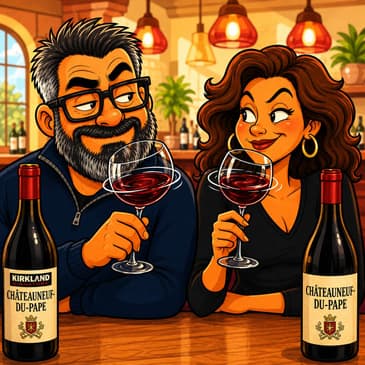
Châteauneuf-du-Pape is one of the world’s great wines, but many people haven’t tried it because it can be darn expensive. So, when Costco drops their Kirkland Signature version of the wine, the natural question is “should I buy it?” Well, we are here to help you make that decision. Châteauneuf-du-Pape has a rather remarkable history, harkening back to a time when the papacy was in France, not Rome, and even a period when there were two popes for a longer period than you might expect. We talk about that history, as well as some of the rules and restrictions around Châteauneuf-du-Pape. But, what you really want to know is “should I buy it?!?” and that is what we will help you decide in this episode. And just to make sure we are giving you good advice, we compare the Costco Kirkland version to a well regarded and highly rated version of the wine just to make sure. We don’t want to spoil it, but the Kirkland version compares very well. As an extra bonus, we talk about the hot new wine trend called blouge. Wines reviewed in this episode: 2024 Costco Kirkland Signature Châteauneuf-du-Pape, 2023 Domaine du Vieux Lazaret Châteauneuf-du-Pape.
Send us a Text Message and we'll respond in our next episode!
Contact The Wine Pair Podcast - we’d love to hear from you!
Visit our website, leave a review, and reach out to us: https://thewinepairpodcast.com/
Follow and DM us on Instagram: https://www.instagram.com/thewinepairpodcast/
Send us an email: joe@thewinepairpodcast.com
Show Notes
Episode #231: Costco Kirkland Signature Châteauneuf-du-Pape Challenge! 00:00
________________________
KEY QUESTIONS
- Is the Kirkland Signature Châteauneuf-du-Pape worth buying?
- Why is Kirkland Signature Châteauneuf-du-Pape so much cheaper than other Châteauneuf-du-Pape wines?
- Should you age Kirkland Signature Châteauneuf-du-Pape before drinking it?
- Who makes Kirkland Signature Châteauneuf-du-Pape?
- What does Kirkland Signature Châteauneuf-du-Pape taste like?
- What food pairs well with Châteauneuf-du-Pape?
________________________
Episode Overview and First Thoughts on Châteauneuf-du-Pape 00:36
Hello fellow wine fanatics! And welcome to The Wine Pair Podcast. I’m Joe, your sommelier of reasonably priced wine, and this is my wife and my wine pairing partner in crime, Carmela. And we are The Wine Pair!
If you're new to our podcast, here's what we do: Every week we buy wines under $25 with our own money, taste them, and give you our brutally honest opinion on whether they're worth buying. Nobody pays us to review specific wines, we don't accept free bottles from wineries, and we're not afraid to call out a bad wine when we taste one. Decanter Magazine calls us fun, irreverent, chatty, and entertaining - so if that sounds like your vibe, welcome to our tribe of wine lovers.
It has been a while since the two of us have recorded an episode. Although you all in listening land will not know it, it’s been about three weeks! So I am excited to get back at it! And, today we are joined by the newest member of our family, our 16 week old Yorkie puppy named Mabel, so if you hear whining in the background, it’s probably not Carmela. It’s probably Mabel.
Carmela, we are going to do a wine today that we have covered before in an episode a little more than a year ago called Châteauneuf-du-Pape, but we are revisiting it again for a couple of really important reasons. The first is that people really love this wine, and it is considered one of the highest regarded red wine blends in the world. Seriously. Some people are nuts about this wine. The second is that this Châteauneuf-du-Pape has a really cool history, which we covered a little bit in the previous episode, and that has to do with its connection to a second Papacy that was in France rather than Rome. So, hold tight because we are going to spend more time on that fascinating history in a couple of minutes.
But the third reason is that we are doing a Costco Kirkland Signature Brand wine challenge, episodes that lots of our listeners love, because we want to see if the Kirkland Brand Châteauneuf-du-Pape is worth buying and to see how it compares to another Châteauneuf-du-Pape that ain’t as cheap as the Costco version. Now, Châteauneuf-du-Pape is not the kind of a wine that we would not normally do on our podcast because it is almost impossible to find under $25, so when Costco comes out with a Kirkland Signature version of a wine like Châteauneuf-du-Pape or like Barolo or like Brunello, or Gigondas, which we did a few weeks ago, or Napa Cabs, we feel like we have to cover it!
So, we have two wines, one from Costco’s Kirkland brand and one from another label that we are going to go over in more depth in a bit, but let’s dig in a little deeper into the fascinating history of this wine.
The history of Châteauneuf-du-Pape wine is fundamentally tied to the Avignon Papacy, a period in the 14th century when the head of the Roman Catholic Church was moved from Rome to France. That is something not many people know about, but at the time, was kind of a big deal.
The story begins in the early 1300s, when Pope Boniface VIII and King Philip IV of France were having a bit of a spat over who had more power. In these kinds of cases, it usually comes down to money, and this story is no exception. King Philip wanted to tax the clergy in France to help pay for his wars, and Pope Boniface said the king didn’t have the right to do that without the his approval, and he believed that even kings had to answer to the pope. Which the King of France didn’t like to hear.
Things got ugly in 1303, when French agents and the pope’s Italian enemies stormed Pope Boniface’s home, captured him, and held him prisoner for several days. He was freed, but he died about a month later. A few years later, and yes, I said years, the cardinals elected Clement V, a Frenchman who had been the archbishop of Bordeaux. King Philip, no surprise, supported Clement’s candidacy. At that time, the election of popes was pretty political.
Clement decided to remain outside of Italy, which is kind of big deal because the pope is also the bishop of Rome in addition to being head of the church. However, Clement never established himself in Rome and eventually moved the whole papal court to Avignon in 1309, in a bid to be closer to the French royalty and their power and protection. At this point, you’re probably wondering what the fuck this has to do with Châteauneuf-du-Pape, and here’s why it matters: Avignon just happens to be in the Rhône Valley, not far from where Châteauneuf-du-Pape is made. So hang on to that tidbit, and we’ll get back to it in a second.
This move of the papacy from Rome to Avignon may have started out to look like a temporary thing, but it actually lasted for nearly 70 years. Seven popes ruled from Avignon, and every one of them was French. Not surprisingly, this made a lot of people believe that the papacy had become a tool of the French monarchy. The papal court in Avignon also gained a reputation for wealth, luxury, and aggressive fundraising. It collected taxes and fees from churches across Europe, and during this period, the popes built the enormous Palace of the Popes, which still stands in Avignon still today.
In 1377, Pope Gregory XI finally brought the papal court back to Rome. But instead of solving everything, the move was followed by an even bigger mess. Poep Gregory died in the next year, and the cardinals elected a new pope in Rome. Then a group of mostly French cardinals rejected that election, claimed they had voted under pressure, and elected a second pope.
One pope ruled from Rome, while the other set up his court in, you guessed it, Avignon. Europe split between them, with different kingdoms supporting different popes. And because apparently two popes were not confusing enough, at one point three men claimed to be the true pope. The crisis, known as the Western Schism, lasted almost 40 years. It finally ended in 1417, when the Council of Constance elected Martin V as pope and reunited most of the Western Church under the one pope in Rome.
But, again, what does any of this have to do with Châteauneuf-du-Pape? To figure that out, we need to go back to John XXII, who was the pope who came right after Clement V, and remember that Clement was the first Avignon pope. John was a big supporter of the wines near Avignon. He bought the wines for the papal court, served them to guests, and helped spread their reputation.
He also ordered the construction of the Palace of the Popes above the nearby village of Châteauneuf. The local wine became known as the Pope’s Wine, and centuries later the village officially took the name Châteauneuf-du-Pape, which literally means “the pope’s new castle.”
Even today, the papal legacy is still part of the wine. Many Châteauneuf-du-Pape producers use a distinctive bottle with an emblem embossed on the glass. It shows a papal tiara above the crossed keys of Saint Peter, who was considered the first pope. The bottle itself was created in 1937, so it was not something the popes were drinking out of back in the 1300s.
So, there you have it. The crazy history of Châteauneuf-du-Pape and the popes.
But we’re not here to talk about popes and papal castles and all that jazz. We are here to talk about Châteauneuf-du-Pape, and we have two Châteauneuf-du-Pape wines to drink including one from Costco’s Kirkland Signature Brand, and we are going to find out how it stands up to a more standard bottle of Châteauneuf-du-Pape to see if it is worth picking up on your next Costco run, or as we call them, dates . . .
But first . . . we have to do our shameless plug.
Thank you for listening to us and for supporting our show, and know that we buy all of the wine we taste and review every week so that we can give you real and honest reviews. If you like what you’re hearing, please subscribe to our podcast and leave us a five star rating and review so we can grow listeners.
We also love to hear from you and we always respond so you can follow us on Instagram and Bluesky and TikTok at thewinepairpodcast. You can contact us on our website thewinepairpodcast.com, and you can sign up for our email newsletter there and you can also send us a note at joe@thewinepairpodcast.com and let us know about wines your want us to review or just shoot the breeze, we love chatting it up.
And, as we do every week, we’ll tell you someone we think you should recommend The Wine Pair Podcast to - because the best way for us to grow listeners is when you tell your family and friends about us - and this week, we want you to recommend us to anyone who loves Châteauneuf-du-Pape but doesn’t love the price tag because this may be the episode for them!
Topic: WTF IS Châteauneuf-du-Pape? 13:10
Carmela, let’s find out just what the eff Châteauneuf-du-Pape is, shall we?
Since we have done an episode on Châteauneuf-du-Pape in the not so distant past, and we just did an episode on Gigondas which is a very similar wine from the same region and is made from the same core GSM or Grenache Syrah, Mourvèdre grapes, we are not going to spend a ton of time on it. I did, however, want to review a couple of fun facts to put into your brain box that you can use to impress your nerdy friends at your next nerdy dinner party
- Châteauneuf-du-Pape became the very first official wine appellation (AOC) in France in 1936 to protect the region from fraud.
- The landscape around Châteauneuf-du-Pape is very challenging for grape vines, which, as we often say, is good for making great wine grapes. The top layer of the soil consists of smooth, rounded stones called Galets Roulés which translates to Rolled Pebbles. Not only do these stones help to create water stress, they also act as natural radiators by absorbing the heat of the sun during the day and keeping warm at night, creating very concentrated fruit.
- The rules around Châteauneuf-du-Pape blends are actually pretty permissive compared to other regions, which I was surprised by. Officially, the appellation permits 13 different grape varieties. Red wines are heavily dominated by Grenache, but winemakers can legally blend any combination of red and white varieties they choose. The classic blend is GSM: Grenache Syrah, Mourvèdre, however, there is not even a requirement about how to blend or even to blend, and some wines are 100% Grenache, for instance. And, it is not unusual to have a winery, like the is a famous winery called Château de Beaucastel, to consistently blend all 13 originally permitted grapes
- One thing Châteauneuf-du-Pape is strict about is low harvest yields, which they do to keep the quality of the grapes as high as possible, and in fact, they allow about half of what Bordeaux allows in terms of yield.
- Châteauneuf-du-Pape reds wines are known for being bold and rich, but another thing they are noted for is an aroma wine dorks call garrigue but what normal people call herbs, specifically thyme, rosemary, sage, and lavender. We’ll see if we find that today.
- The heavy wine bottle that is used for Châteauneuf-du-Pape is, as we mentioned above, famously embossed with a papal tiara above the crossed keys of St. Peter, framed by the words "Châteauneuf-du-Pape contrôlé" written in Gothic letters. By law, only registered producers within the official appellation are allowed to use this specific embossed glass. So, you will know the wine is real based on the bottle itself. If it ain’t embossed, it ain’t official.
- And one odd fun fact, there is a strange local law that was set in 1954 in which the local authorities do not allow flying saucers to fly or land in Châteauneuf-du-Pape airspace, and law was passed to protect the vineyards. The law is on the books to this day. And that is not a joke.
But that’s enough information. I think it’s time to learn a little more about the specific wines we are drinking today. Whaddya say?
Châteauneuf-du-Pape Wines We Chose for This Episode 17:30
Usually, the wines we select for our podcast are under $25, but, quite honestly, it is nearly impossible to find a Châteauneuf-du-Pape wine outside of the Costco Kirkland Signature wine for under about $35, so we have one that is under and one that is over that price. Typically, Châteauneuf-du-Pape is not hard to find if you go to a good wine shop or a store with a very good wine selection. You are not going to find these wines at 7-11. But you may find them at a high end grocery store. And, as usual, go to your local wine shop and ask them to help, and they will be happy to. And if you have not had a Châteauneuf-du-Pape before, it really is a wine that needs to be on your wine list. It is one of the great wines.
I should also mention, before we get to the tasting, that these bigger red wines are not always our favorite wines, so just keep that in mind when we do our tasting. If we don’t rate something super high, that may not mean that you won’t like it. In fact, it may mean that you love it. You just have to keep in mind how our palates work.
The first wine we are going to taste and review today is the 2024 Costco Kirkland Signature Châteauneuf-du-Pape, and, like some Costco wines, there is actually some information we can get about this wine from the wine label. As we have mentioned, sometimes it is hard to find out who makes a Kirkland wine, and other times the name of the winemaker is clear.
In this case, the wine is made by Guillaume Gonnet who is a third-generation winemaker from Châteauneuf-du-Pape. Note that previous vintages of the wine were made by Domaine de Nalys, but that changed in 2018 when they switched to Gonnet.
Gonnet’s grandfather Etienne Gonnet founded Domaine Font de Michelle in Châteauneuf-du-Pape in 1950, his father Michel and uncle Jean took over in the 1970s, and Guillaume grew up in the family wine business. Before coming back to Châteauneuf, he worked harvests and made wine in places like Bordeaux, Burgundy, Napa, New Zealand, and Australia. Today, he and his Australian wife Kelly (so I guess that was a good trip he made there) they make wines under the Guillaume Gonnet name from all over the Southern Rhône, including Gigondas, Vacqueyras, and Châteauneuf-du-Pape. Gonnet is a well-respected winemaker whose top wines have received scores in the mid-to-high 90s from major critics. So, while the Kirkland wines are made specifically for Costco, there is a very legit Châteauneuf winemaker behind them.
The label also indicates the blend of this wine which is 70% Grenache, 10% Syrah, 10% Cinsault and 10% Mourvèdre, and, like most Châteauneuf-du-Pape wines, it is high in alcohol at 15%. I will also note that it is a 2024, so it is really young, and I would highly recommend that you let this wine sit for at least 5-10 years. I did open these wines before we started recording the podcast to give them some air.
I can’t really tell you much more about how the wine is made or any of that fun stuff, so let’s head over to our second wine.
The next wine we are going to drink is the 2023 Domaine du Vieux Lazaret Châteauneuf-du-Pape, and this wine is one of those wines that has a whole bunch of grapes in it. I don’t have the exact percentages from the tech sheet, but it says the wine includes Cinsault, Counoise, Grenache, Mourvèdre, Muscardin, Syrah, Terret noir, Vaccarèse. Another source online I found said that it is 67% Grenache, 22% Syrah, 5% Mourvèdre, and 6% total of everything else, so maybe that’s true. Not sure, but interesting if it is.
This wine also got a 92 rating from Wine Spectator, a 92 from Wine Enthusiast, and a 90 from James sucky Suckling
The tech sheet for this wine was a little rough based on the translation, but I did get this: The grapes are completely destemmed, and they macerate by pumping over twice a day for 2 to 3 weeks in concrete vats. The wine is matured for 18 months in vats and barrels (15%).
In terms of all of those grapes they use, they say: “Our plots are spread all around the village, which allows us to benefit of the advantages the Appellation area can offer in terms of climatological varieties, terroirs and exposure. All 13 traditional allowed grape varieties are cultivated on our lands. This allows us balanced wines, all in finesse.” For a bit of history, the winery says the Domaine dates back to 1748 and that in the 19th century the Quiot family bought an old Lazarett which was a quarantine hospital for highly contagious diseases, and in the 1720 plague, about a third of the village died. Which is an historical note I couldn’t not mention.
But, I think that is enough information - let’s get to drinking! We’ll take a quick break and be right back. And, if you have these wines or similar wines, drink along with us to get some participation points, which you can trade-in for free stickers. You just need to send me an email with your mailing address, and I will get those “I drink with The Wine Pair Podcast” stickers over to you!
LINKS TO SOURCES FOR THESE SPECIFIC WINES
- https://www.reversewinesnob.com/kirkland-signature-chateauneuf-du-pape
- https://m.famillequiot.com/29I63E
- https://vinofino.co.nz/product-pdf/domaine-du-vieux-lazaret-chateauneuf-du-pape-2023/?srsltid=AfmBOorbPnfId-Z9hcYelofqiEWNkvf45MZlNquHoATqO4zWuhm61QSB
2024 Costco Kirkland Signature Châteauneuf-du-Pape, 2023 Domaine du Vieux Lazaret Châteauneuf-du-Pape Wine Tasting, Pairing, and Review 24:06
Wine: Costco Kirkland Signature Châteauneuf-du-Pape
Region: France, Châteauneuf-du-Pape, Rhône
Vintage: 2024
Price: $20.99
Retailer: Costco
Alcohol: 15%
Grapes: 70% Grenache, 10% Syrah, 10% Mourvèdre, 10% Cinsault
Professional Rating: CWB: 92, RWS 6.8 (cost) Vivino
What we tasted and smelled in this Costco Kirkland Signature Châteauneuf-du-Pape:
- Color: Dark red, translucent, blueberry syrup
- On the nose: Lifted around, nice smell, dark cherry, plum, smoky, spicy, black licorice, salty, olive, earth, blackberry bramble
- In the mouth: Big, hot, young, almost stingy in the mouth, needs time to mellow out, rough, astringent, big bodied, black cherry, spice, black fruit, a lot of potential, grippy tannins
Food to pair with this Costco Kirkland Signature Châteauneuf-du-Pape: Needs food, red meat, chicken, pork tenderloin with hot mustard, spicy foods, American Chinese food, cheeseburger, steak frites
As a reminder on our rating scale, we rate on a scale of 1-10, with no half points, where 7 and above means that we would buy it, and 4 and below means that we are likely to pour it down the sink, and a 5 or 6 means we are likely to drink it and finish it, but we are probably not going to buy it.
Costco Kirkland Signature Châteauneuf-du-Pape Wine Rating:
- Joe: 7/10
- Carmela: 6/10
Wine: Domaine du Vieux Lazaret Châteauneuf-du-Pape (Click here to find this wine on wine.com. We may be compensated if you purchase)
Region: France, Châteauneuf-du-Pape Rhône
Vintage: 2023
Price: $36.97
Retailer: wine.com
Alcohol: 15%
Grapes: Cinsault, Counoise, Grenache, Mourvèdre, Muscardin, Syrah, Terret noir, Vaccarèse
Professional Rating: WS 92, WE 92, JS 90 Vivino
What we tasted and smelled in this Domaine du Vieux Lazaret Châteauneuf-du-Pape:
- Color: Dark red on the verge of purple with burgundy hues
- On the nose: Vegetable, tomato sauce, earth, very herby, rosemary, astringent, not a lot of fruit, smoky, spice, needs to be opened early and aerated, wood, cedar
- In the mouth: A bit tangy and tart, cherry tomato with balsamic vinegar and salt, arugula, very under-ripe cherry, sweet strawberry, raspberry, black pepper
Food to pair with this Domaine du Vieux Lazaret Châteauneuf-du-Pape: Chicken, pork, fried foods, General Tso’s chicken, chow mein, fried chicken,
Domaine du Vieux Lazaret Châteauneuf-du-Pape Wine Rating:
- Joe: 7/10
- Carmela: 6/10
Which one of these are you finishing tonight?
- Carmela: Costco Kirkland Signature Châteauneuf-du-Pape
- Joe: Domaine du Vieux Lazaret Châteauneuf-du-Pape
The Test: Did we nail the taste profiles expected from Châteauneuf-du-Pape? 38:14
- General
- Full bodied, rich, high in alcohol
- ripe, sweet red fruits like strawberry, raspberry, and cherry liqueur, with dark plum and blackberry
- wild scent of Mediterranean herbs (thyme, rosemary, lavender, and sage) and spices like black pepper and licorice
- When aged, savory notes of leather, game, tar, roasted meats, and a characteristic touch of rustic "funk"
- Costco Kirkland Signature Châteauneuf-du-Pape
- Winery: The bouquet reveals notes of violet, grenadine, blackcurrant, black olive, cassis, fresh thyme and liquorice. The mouthfeel is generous with black and red wild berries, plus fine, elegant tannins
- CWB: aromas of dried red and black fruit, herbs and leather; medium in body with rich tannins, good acidity; flavors of black cherry, raspberry, plum; notes of clove, spice; dry, lingering finish.
- Domaine du Vieux Lazaret Châteauneuf-du-Pape
- Winery: aromas of ripe black fruits evolving into spicy notes. Its smoothness, persistence, and aromatic breadth are its defining features. With age, it transforms, revealing aromas of spiced ripe fruits that develop into compote-like nuances, reminiscent of prunes, licorice, and hints of black pepper
- WS: High-toned notes of cherry and anise are silky and fluid in this modern Châteauneuf. There are no rough edges here. Polished tannins glide through, supporting rooibos tea and sandalwood smoke elements. A pretty, sleek style, with real elegance.
What is the verdict on the Costco version of Châteauneuf-du-Pape? 40:15
Today it stood up to the competition, a good idea to try, recommend it. This is a great wine to have if you are curious about Châteauneuf-du-Pape. Needs five or ten years to age and mellow out.
And now it is time to head over to our news desk so that we can cover our wine in the news this week segment.
Wine in the news this week: California's next big wine craze is breaking all the rules 41:33
- https://www.vinography.com/2026/07/wine-news-what-im-reading-the-week-of-7-26-26
- https://manofmany.com/culture/drinks/what-is-blouge-wine
Our wine in the news this week comes via the Vinography blog written by Alder Yarrow, and the story he flagged in his weekly roundup was originally reported by Jess Lander at the San Francisco Chronicle, but that’s behind a paywall, so we are focusing on the blog. The article is entitled "California's next big wine craze is breaking all the rules." For those of you who want to read the full story, we have also linked to a very good piece on the same topic over at Man of Many by Ally Burnie, which is not paywalled and honestly covers most of the same ground.
Okay, so, there is apparently a new wine trend sweeping California, and it is called blouge wine. The word is mash-up of the French words for white (blanc) and red (rouge), and it is probably what you think it is.
Blouge wines are made by fermenting red and white grapes together in the same tank. Now, that sounds strange, but it is, like many things that sound new, a very traditional winemaking technique. For instance, northern Rhône winemakers have put a little Viognier into Syrah for years to add more aroma. And, Portuguese winemakers have a traditional style called palhete that dates back to the 12th century in which they co-ferment red and white wines together.
While this is an old way of making wine, what is new is the name being used (blouge), the volume of white grapes involved, and that these wines are specifically being created as wines meant to be lighter than a pure red wine, and are intended to be chilled. A lecturer at Cornell named Cheryl Stanley has described it as "the White Zinfandel of today, but without the residual sugar," which, depending on your take, may not be such a bad thing.
The rise of blouge is being driven by two very different forces. On one hand, it is a response to climate change. Red grapes are ripening too fast in the warming climate and coming in with too much sugar and not enough acidity, so mixing in early-picked white grapes brings back some of the balance. On the other hand, it is a bit of a marketing stunt meant to appeal to younger drinkers who are looking for lighter, chillable wines to drink. One of the articles states that the wine is something you "don't take it seriously” and has “good time kinda vibes."
To me, the wines sound intriguing. We like lighter-bodied reds that you can chill, and we love a lot of wines like sparkling that are a mix of red and white grapes. So, I am more than willing to give it a try. But the name is kind of silly.
And, frankly, blouge kind of strikes me as being in the same vein as orange wine. Orange wine is just white wine left on the skins too long, which is actually a very ancient winemaking technique, but is sold today as something new and natural. Blouge feels similar. We are taking a winemaking technique that is as old as winemaking itself and trying to claim it as something new so the cool kids can feel hip. We actually really like orange wine, but treating it like it’s some sort of revelation just strikes me as a bit ignorant, as does blouge. That being said, if it brings more people into wine, and we can find good versions of the wine, we don’t need to yuck anyone else’s yum.
How easily you can find these wines is another question. They are still mostly a natural wine bar and indie bottle shop thing in the US like orange wine, and are showing up under labels with names like Wabi-Sabi, Lucas Madonia, and Maison Advinam. So if you are the kind of person who likes to walk into a small wine shop and ask the owner what is weird and interesting right now, this is your moment.
So, Carmela, what do you think of blouge? Would you try it? Does it sound appealing?
Listener Shoutouts 46:23
As we mentioned, it’s been a while since we’ve recorded an episode, so we need to get to some long overdue shoutouts, so here are some shoutouts:
- Ashley (email): started doing the 20/20 rule on my dry reds but I also have been decanting. Is it proper to decant in the fridge or does the cooler temps affect the aeration? I attached a photo of my newly acquired "decanter". I also attached a photo of my pups since you are getting a pup and also just because
- Jeff: Discovered Gigondas 8 years ago on a French bike tour - were staying at a Gigondas Vineyard owner of the vineyard. He was quite bitter by the fact that his wines were better than those less than a mile away that received 100% plus price premium. There are many wines from Gigondas that are better than more expensive neighbor. If you can find it at Costco their Gigondas is great vs the sub $20 price.
- Emma on Instagram (100proofemma) who passed her sommelier exam!!!
- Chef Paul: Wisconsin summer salad with a LaCrescent wine - great acid , medium body perfect for summer salad
- Hasini: (From our newsletter where the main article was on wine and health) Excellent take! I really enjoyed this topic because the intersection of wine and health is something I think about kind of a lot. I also really appreciated how you presented both sides of the debate. I’ve noticed that when I hydrate well, eat healthy, and exercise, I actually feel great after my Saturday bottle of wine. If I don’t, I definitely don’t. I’m of the belief that if it nets out as adding to your quality of life, then it’s “healthy” in that sense; if not, it’s not. Maybe it’s all connected somehow. Also, omg Mabel is so cute! 🥹 Hope y’all have the best time welcoming her today!
- Justin: I'm excited for your episode on Schiava. I tried one last fall and knowing the style of reds you like I think it will be a hit. A couple other summer whites to try would be Grillo from Italy and Malagousia from Greece. I've been drinking a bottle of Malagousia the past couple days and its honestly one of the best whites I've ever had! Very rich and complex while still being nice and fresh. I highly recommend seeking it out.
- Adam: I loved the interview with Angelos, very jealous you got to speak with him as they make some of my favorite Greek wines! Talked about some of his hobbies and a wine he is saving, and wished us nice National White Wine Day
- Howie: left a comment on the website “Looking for a similar taste to Frescobaldi Pomino Rosso” and so I gave him some other wines that are similar Sangiovese, Pinot Nero, and Merlot blends, which you can see on the website
Wines coming up in future episodes in case you want to drink along with us 48:08
- Gamay - Beaujolais, Morgon: 2023 Domaine Gaget Cote du Py Morgon, 2024 Domaine Yohan Lardy Moulin-a-Vent Cru Beaujolais Les Michelons
- Decoy wines: 2023 Decoy California Cabernet Sauvignon, 2025 Decoy Sauvignon Blanc
- Algianico Rosé: 2024 Feudi di San Gregorio San Greg Rosato, 2024 San Salvatore Vetere Rosato
- Schiava: 2024 Alois Lageder Schiava, 2022 Elena Walch Schiava
- Loire Crémant: Gratien Meyer Cremant de Loire Brut, Langlois Cremant de Loire Brut Rose
- British bubbly: 2018 Henners Brut Vintage
Outro and how to find The Wine Pair Podcast 48:18
Thank you for listening to us and for supporting our show, and remember, we buy all of our own wine and we do all of the writing and recording and editing to bring you a show every week because we absolutely love doing it, and our small little ask for you is that you please follow or subscribe to our podcast and also please leave us a nice rating and review to help us grow our listeners - and a huge thank you to all of you who have done so already!
You can also follow us on Instagram and Bluesky and TikTok at thewinepairpodcast. You can contact us on our website thewinepairpodcast.com, and you can sign up for our email newsletter there and you can also visit our “Shop Wine” section where you can find links to buy the wines that we rate as buys in each episode. I will also note that on our website, if you are curious about a wine we have covered in the past, we do have a pretty good search functionality, so you can use that find wines you want to know more about.
And we want to make content you care about and you like, so send us a note or DM us and give us some feedback or let us know if there are wines you want us to try or wine making areas of the world you are curious about - and we’ll take care of it! joe@thewinepairpodcast.com
Alright, with that, we are going to sign off, so thanks again, and we will see you next time. And, as we say, life is short, so stop drinking shitty wine.
________________________
FREQUENTLY ASKED QUESTIONS
Q. Is the Kirkland Signature Châteauneuf-du-Pape worth buying?
A. At $20.99, it's a solid buy if you're patient. This bottle rates around a 7 out of 10, with real potential but a young, big, grippy tannin structure fresh off the shelf. Give it 5 to 10 years to soften, or serve it now with steak, cheeseburgers, or spicy Chinese food to tame the tannins.
Q. Why is Kirkland Signature Châteauneuf-du-Pape so much cheaper than other Châteauneuf-du-Pape wines?
A. Mostly distribution, not quality. Costco buys directly from the producer, skips middlemen, and caps markup, the model that keeps Kirkland Signature wines priced well below comparable bottles. This one comes from Guillaume Gonnet, a third-generation Châteauneuf-du-Pape winemaker who also bottles wine under his own label.
Q. Should you age Kirkland Signature Châteauneuf-du-Pape before drinking it?
A. Yes, if you can wait. Right out of the bottle it's big, hot, and grippy with tannin, almost stingy in the mouth. Cellaring it 5 to 10 years should let the tannins mellow and the fruit open up. Drinking it now works best paired with something rich, like steak or spicy food.
Q. Who makes Kirkland Signature Châteauneuf-du-Pape?
A. Guillaume Gonnet, a third-generation Châteauneuf-du-Pape winemaker who also sells wine under his own label, Guillaume Gonnet, Vigneron. Costco's version was previously produced by Domaine de Nalys before switching to Gonnet in 2018. The current blend is 70 percent Grenache with Syrah, Mourvèdre, and Cinsault rounding it out.
Q. What does Kirkland Signature Châteauneuf-du-Pape taste like?
A. Big, young, and a little rough right now. Expect dark cherry, plum, blackberry bramble, and black licorice on the nose, with smoky, earthy, and faintly salty olive notes. On the palate it's hot, tannic, and almost stingy, more like a wine with strong future potential than one that's fully settled today.
Q. What food pairs well with Châteauneuf-du-Pape?
A. Match the pairing to the wine's style. A young, tannic, fruit-forward Châteauneuf-du-Pape wants rich, fatty food, think red meat, cheeseburgers, steak frites, or spicy Chinese takeout to soften the grip. A more savory, herby, tomato-and-pepper style pairs lighter, with chicken, pork, or fried food like General Tso's chicken and chow mein.
________________________
RESEARCH ARTICLES AND LINKS FOR THIS EPISODE
- https://winefolly.com/deep-dive/all-you-ever-wanted-to-know-about-chateauneuf-du-pape-wine-and-more/
- https://en.wikipedia.org/wiki/Ch%C3%A2teauneuf-du-Pape_AOC
- https://www.coravin.com/blogs/community/whats-so-special-about-chateauneuf-du-pape
- https://www.foodandwine.com/wine/a-crush-on-chateauneuf-du-pape
- https://www.youtube.com/watch?v=aLCocZki2tA&t=10s
- https://www.youtube.com/watch?v=g_bPzOu-BFo
- https://www.youtube.com/watch?v=lTjA4RS2Cgc
- https://lastbottlewines.com/blogs/learn-wine/chateauneuf-du-pape?srsltid=AfmBOorIF_rkn9o60PIjhUjuX39dYoqYRAWt1DeaQsV3-KyBjU4L2oPR
- https://www.winescholarguild.com/blog/regions-and-producers/chateauneuf-du-pape-a-user-guide
- https://www.jjbuckley.com/wine-knowledge/blog/what-you-should-know-about-chateauneuf-du-pape/1157?srsltid=AfmBOorKBNdR0G_9d3sudxpcSt8sk5xcDewFqeCoA2PQ_TMd0VP-YS3X
- https://en.wikipedia.org/wiki/Ch%C3%A2teauneuf-du-Pape
- https://foodandwineaesthetics.com/2020/02/27/some-expensive-wines-are-worth-their-price/
- https://en.chateauneuf.com/appellation-chateauneuf-du-pape/history-chateauneuf-du-pape/origin-chateauneuf-du-pape/
- https://flatiron-wines.com/blogs/the-latest/history-chateauneuf-du-pape
- https://www.forbes.com/sites/karlsson/2016/07/07/chateauneuf-du-pape-rich-and-spicy-wines-with-a-rich-historical-heritage/
- https://www.reversewinesnob.com/kirkland-signature-chateauneuf-du-pape
- https://costcowineblog.com/who-are-the-real-producers-behind-costcos-kirkland-signature-wines/
- https://www.guillaumegonnet.com/history.php
- https://heritagecellars.co.uk/region/guillaume-gonnet/
- https://www.winetourism.com/winery/famille-gonnet-rhone/
- https://8wines.com/blog/guide-to-the-chateauneuf-du-pape-wine-region
- https://www.winekeller.com/blog/visit-chateauneuf-du-pape
- https://www.youtube.com/watch?v=2msMmx1-b-4
- https://www.youtube.com/watch?v=g6zETBI-kGc
- https://www.youtube.com/watch?v=-M0KUZJh8JM
- https://www.youtube.com/watch?v=ezGZIB0WxLg
- https://www.youtube.com/watch?v=ylOHUKwfie0
- https://www.youtube.com/watch?v=JAg4zs8Opj8
- https://www.youtube.com/watch?v=4T3cM22ooEM
________________________
Support The Wine Pair Podcast by heading to our website and shopping for the wines we give our highest ratings to in our Shop Wines section. Just click on this link - you pay the same price, and we may get a small amount of compensation.
You can also support us by clicking on this affiliate link to wine.com and find great wines under $20!
And, if you are looking for a great website builder for your podcast, click on this link to use the service we use and love: Beamly, formerly known as Podcastpage.io
________________________
FULL TRANSCRIPT
Joe: 00:00
Carmela, you know that Chateau Neuf-de-Pop refers to the Pope's.
Carmela: 00:04
What?
Joe: 00:05
I know, but what does that have to do with the wine, you ask?
Carmela: 00:08
I wanna know.
Joe: 00:08
A lot.
Carmela: 00:09
Tell me.
Joe: 00:10
But well, you gotta listen to find out. But also, we tried two Chateau Neuf-de-Pop wines, one from Costco's Kirkland brand and one from another brand. And what did we think about the Costco one?
Carmela: 00:21
I think it's standing up to the Lazarette.
Joe: 00:24
That's right, but we're not gonna tell you the whole thing now. No, no. You gotta listen to find out. Hello, fellow wine fanatics, and welcome to the Wine Pair Podcast. I'm Joe, your simolier of reasonably priced wine, and this is my wife and my wine pairing partner in Crime Carmela.
Carmela: 00:46
Hi there.
Joe: 00:47
And we are the Wine Pair! Woo! If you're new if you're new to our podcast, here's what we do. Every week we buy wines under $25 with our own money, taste them, and give you our brutally honest opinion on whether they're worth buying. Nobody pays us to review specific wines. We don't accept free bottles from wineries, and we're not afraid to call out a bad wine when we taste one. And Decanture magazine calls us fun, irreverent, chatty, and entertaining. So if that sounds like your vibe, welcome to our tribe of wine fanatics. Love it. Okay. That's j I made that one up. Oh. You don't love it. Okay. Oh, I love it. Thanks. Carmela, it's been a while since the two of us have recorded an episode. That's true. Although you and Listening Land will not know it, may not know it. It's been about three weeks. Really? Yeah. So I'm excited to get back at it. And today we are joined by the newest member of our wine podcast crew and family, our 16-week-old Yorkie puppy named Mabel. That's right. And she's really good at this. She's good at this.
Carmela: 01:45
And she's really good at ad-libbing, too. Super good. She doesn't need a script.
Joe: 01:49
No. And if you hear whining in the background, people, it's entirely likely that it's Mabel and not Carmela.
Carmela: 01:55
I was just going to say, it could be me. I mean, Joe edits all that out. That's true.
Joe: 01:59
All your whining, I cut it out. Right. Okay, Carmela, we're going to do a wine today that we have actually covered before in an episode a little more than a year ago called Chateauneuf de Pop. Nice. But we're revisiting it again for a couple of really important reasons. And the first is that people really love this wine, and it's considered one of the highest regarded red wines in the whole wide world. So some people are kind of nuts about it. The second is that Chateauneuf de Pop has a really cool history, which we covered a little bit in the previous episode that we covered Chateauneuf-de-Pop in. And that it has this crazy connection to a second papacy that was in France rather than Rome. So hold tight because we're going to spend more time on that fascinating history in a couple of minutes. But the third reason is that we're doing a Costco Kirkland signature brand wine challenge.
Speaker: 02:46
Yes.
Joe: 02:47
And these are episodes that our listeners love because we see if the Kirkland brand wine is worth buying and we see how it compares to another Chateau Neuf-de-Pop. I mean, that's so cool. Yeah.
Carmela: 02:58
Come on, Costco. I love that.
Joe: 02:59
Yeah, and the wines aren't as cheap as the Costco version. And so we see how they stand up.
Speaker 4: 03:04
Okay.
Joe: 03:05
Now, Chateau Neuf-de-Pop, although we've done it in the past, it's really not the kind of wine that we would normally do in our podcast because it's almost impossible to find for under $25. So when Costco comes out with a Kirkland signature version of a wine like Chateau Neuf-de-Pop or Barolo or Brunello or Gigondas, like we did a couple of weeks ago, or Napa Cabs, we kind of have to cover it.
Carmela: 03:24
Yeah, I love that. It's kind of a requirement. I do love that. I mean, Costco is working for us. They are working for us. They're making things accessible. They always do.
Joe: 03:34
I fully agree.
Carmela: 03:35
I'm not sponsored by Costco.
Joe: 03:37
No, we are not. We are just appreciative of what Costco does for us.
Speaker: 03:42
Right.
Joe: 03:42
So we do have these two wines, one from Costco and one from another label that we're gonna cover in a in a bit more depth in a bit, but let's dig a little deeper into the fascinating history of this wine. What do you say, Carmela? Let's do it. Okay, so the history of Chateauneuf-de-Pop is fundamentally tied to the Avignon Papacy, a period in the 14th century when the head of the Roman Catholic Church moved from Rome to France.
Carmela: 04:06
Okay, how come?
Joe: 04:07
Now, and and it's such a good question. And it's yes, no, you can only guess why. Wine. No, it's not actually because of wine, but wine does play a part. But that's something I think a lot of people don't know about, that the papacy for a while was not in Rome. Oh, that's amazing. He knew what was what was right, though. Who who knows? Even today. I don't even know what's right.
Carmela: 04:27
No, what I'm saying is that the papacy figured it out. Like where, okay, I'm biased, but where they really should be.
Joe: 04:34
Well, there's more of a story to it than that, Carmela. It's really you're kind of like, I think that's wishful thinking, but here's the facts. Okay. You ready? Yeah. The story begins in the early 1300s when Pope Boniface VIII and King Philip IV of France were having a bit of a spat over who had more power. And in these kinds of cases, Carmela, it usually comes down to money. And that's the way it was in this case, too. King Philip, he wanted to tax the clergy in France to help pay for his wars, and Pope Boniface was like, You don't have the right to do that. And he believed that even kings had to bow down to the Pope. Of course. So the King of France did not like that. So things got ugly in 1303 when French agents and the Pope's Italian enemies stormed Pope Boniface's home, captured him, and held him prison for several days. Wow. Now he was freed, but he did die about a month later.
Carmela: 05:26
Oh my god. Yeah. All the stress.
Joe: 05:28
All the stress. Exactly.
Carmela: 05:30
I mean, I'd be stressed out. Kidnapped? All that stuff.
Joe: 05:34
So a few years later, and yes, I said a few years, the cardinals elected Clement V. He was a French guy. He had been the Archbishop of Bordeaux, so I guess he knew something about wine. And King Philip, this shouldn't be a surprise, supported Clement's candidacy. Because, you know, I I don't know if it is today, but at the time, election of popes was a was very political.
Carmela: 05:55
Right.
Joe: 05:55
Clement, Clement, Clement was the name of our dentist. I know. Pope Clement decided to remain outside of Italy, which is kind of a big deal because the Pope is also the Bishop of Rome, in addition to being a head of the Catholic Church. But Clement never established himself in Rome and eventually moved the whole papal court to Avignon in 1309.
Carmela: 06:17
Wow.
Joe: 06:18
In a bid to be closer to the French royalty and their power and their protection.
Carmela: 06:22
And they just wanted a little cheese, a little bit.
Joe: 06:25
No, no. I bet you're asking great cheese. They do, but I bet you're asking yourself, what the f does this have to do with Chateau Neuf de Pop? I mean, kind of. Well, here's something, and we'll get more into it. But Avignon just happens to be in the Rhone Valley, not far from where Chateau Neuf de Pop is made. So hang on to that tidbit and we'll get back to it in a second. But anyway, the move of the papacy from Rome to Avignon may have started out to look kind of kind of like a temporary thing, but it actually lasted for 70 years. Oh wow. 70 years. Okay, that's a lifetime. Back then, several lifetimes. Right. In fact, in fact, it's such a good segue, Grammarica. Seven popes ruled Avignon during that 70 years. And every darn one of them was French.
Carmela: 07:09
Well, gosh, it doesn't sound like they were living well.
Joe: 07:12
They weren't healthy.
Carmela: 07:14
Right. That's kind of insane.
Joe: 07:16
Yeah. But not surprisingly, this made a lot of people think the papacy had become a tool for the French monarchy. And the papal court in Avignon also gained a reputation for wealth and luxury and aggressive fundraising, things you don't normally associate with church-going people. No. But this no fundraising. Okay, all right, fair enough. I don't think they mean fundraising like raising money for charity. I think I think it was like taxes to build like really nice churches and stuff. Anyway, they collected taxes and fees from churches across Europe. And during this period, the popes built the enormous Palace of the Pope, which still stands in Avignon today. Nice. We could go visit it then. Definitely. Okay. In fact, if anybody has, let us know. In 1377, Pope Gregory the Eleventh, you can probably hear Mabel in the background, finally brought the papal court back to Rome. But that didn't solve the problem, Carmela. It actually created a bigger mess. Because Pope Gregory died the next year. He uh these guys are just not healthy. They're either being killed or they're his own.
Carmela: 08:17
France is just not good for them.
Joe: 08:19
He was back in Rome.
Carmela: 08:20
Oh, by that point. Yeah. Exactly. Okay. Well, maybe France was not good for them, and then when he got back, it was just mort.
Joe: 08:26
Mort. But so Gregory died, and the cardinals elected a new pope in Rome, but a group of mostly French cardinals rejected that election, and they claimed that they had voted under pressure, and they elected a second pope.
Speaker: 08:40
Oh my.
Joe: 08:40
There were two popes.
Carmela: 08:41
That doesn't has that ever happened before? Or ever since?
Joe: 08:45
I you know, I don't know the full history, but I think it's unusual. So you had one pope in Rome, another one in Avignon, and Europe was kind of split between them, and different kingdoms supported different popes. And because apparently two popes wasn't enough, there was at one point three people that claimed to be the Pope.
Carmela: 09:02
What it was were the real Pope, please stand up.
Joe: 09:06
Yeah. This crisis was known as the Western Schism, and it lasted almost 40 years.
Carmela: 09:11
Whoa. Yeah. Another lifetime.
Joe: 09:12
Yep. And it finally ended in 1417 when the Council of Constance elected Martin V. I'm sure it was Martin or something, wasn't it? Martin. Uh he was the Pope and it re he reunited the Western Church under one pope in Rome. But again, your question is, Carmella, what the f does this have to do with Chateauneuf-departs.
Carmela: 09:31
I mean, really, what the F.
Joe: 09:33
Exactly. So to figure that out, we need to go back to John the XXII, who was the Pope who came right after Clement. And remember that Clement was that's not our dentist. No, not Clemenza. He's the Pope that was the first Avignon Pope. This Pope John is the next one, and he was a big supporter of the wines near Avignon. He bought the wines for the papal court. He served them to guests and he helped spread their reputation. He's also the guy that started the construction of the Palace of the Popes in Chateauneuf. And the local wine became known as the Pope's wine. And centuries later, the village officially took the name of Chateauneuf de Pope, which literally means the Pope's new castle. So that's what it has to do.
Carmela: 10:14
I get it. I get it. Thank you. That was really a lot of story.
Joe: 10:18
But it was a good story.
Carmela: 10:19
Yeah, I actually enjoyed it.
Joe: 10:21
Popes, popes dying, lots of lifetimes, I guess.
Carmela: 10:23
Right. Money. Yep.
Joe: 10:25
But you know what? Even today, Carmel, the papal legacy is still part of the wine. Many Chateau Neuf-de-Pas producers use a distinctive bottle, which, if you've seen the wine, you know, it'll have an emblem embossed in the glass. It usually shows a papal tiara above crossed keys of Saint Peter, who was considered the first pope. And the bottle itself was created in 1937. So this wasn't something that the popes at the, you know, during Avignon Papacy were drinking out of. But you know, the same wine.
Speaker: 10:52
Right.
Joe: 10:53
So that's it. The crazy history of Chateau Neuf-de-Pop. Okay. But you know what, Carmela? We're not here to talk about popes and papal castles. Oh, yeah, but I think we are. Oh, okay. Okay. We'll do it. But we really want to talk about Châteauneuf-de-Pop, and we have again two Chateau Neuf-de-Pop wines to drink, including one from Costco's Kirkland signature brand. And we're going to find out how it stacks up to a more standard bottle of Chateau Neuf-de-Pop and see if it's worth picking up on your next Costco run, or as we call them, dates.
Carmela: 11:21
Our favorite time of the month.
Joe: 11:23
Well, that sounded really weird.
Carmela: 11:25
Well, don't you think we go like once a month? And it's a date. You get a hot dog.
Joe: 11:32
There's so much stuff going on in my head right now. Anyway.
Carmela: 11:34
I'm trying to watch this dog, okay? People are a little distracted.
Joe: 11:37
She's more distracted than usual.
Carmela: 11:39
We're in the middle of house training, okay?
Joe: 11:41
And she's not doing awesome. We love her. She's about three and a half pounds.
Carmela: 11:46
She was like, gonna be a little bit more.
Joe: 11:47
I'm gonna pee. And I'll say, she's again, she's about three and a half pounds, and every day she pees about three and a half pounds in the house.
Carmela: 11:52
She's ruining our rug, our carpet, our rug. No, it's rug. Now look, look, look. But first, you gotta do our shameless plugs.
Joe: 12:00
Thank you for listening to us and supporting our show. And we buy all the wine we taste and review every week so that we can give you a real and honest reviews. So if you like what you're hearing, please subscribe to our podcast and leave us a five-star rating review so we can grow listeners. We also love to hear from you and we always respond. So you can follow us on Instagram and Blue Sky and TikTok at the Wine Pair Podcast. You can contact us on our website, thewinepairpodcast.com, sign up for our email newsletter there, and just send us a note at Joe at the WinePair Podcast.com and just shoot the breeze. We just want to know how you're doing.
Carmela: 12:31
Keep them company a little bit.
Joe: 12:33
If you got a new dog, Chateau Neuf to Pop, whatever. Popes, if you're the Pope, reach out. Wow.
Carmela: 12:38
If you live during that time, if you've been to France.
Joe: 12:42
If you've seen the Palace of the Popes, let us know.
Carmela: 12:44
Yeah, true.
Joe: 12:45
And as we do every week, we'll tell you someone we think you should recommend the Wine Pear Podcast to because the best way for us to grow listeners is when you tell your family and friends about us. And this week we want you to recommend us to anyone who loves Chateau Neuf to Pop, but doesn't love the price tag because this may be the episode for them.
Carmela: 13:02
Awesome.
Joe: 13:03
I love your little squeaks and stuff. I hope you guys can hear that.
Carmela: 13:06
Yeah, I love the fact that we may not have a rug any longer.
Joe: 13:09
Yeah, she's totally eating the carpet. Okay, Carmela, let's find out just what the f Chateau Neuf de Pop is, shall we? Let's do it. Carmela is so distracted. Okay, since we've done an episode on Chateau Neuf de Pop in the not so distant past, and we just did an this is gonna be amazing, and we just did an episode on Gigonas, which is a very similar wine from a very similar region, and it's made from the same core GSM or Grenache Saramu Vedra grapes. We're not gonna spend a ton of time on it. I did, however, want to review a couple of fun facts to put into your brain box that you can impress your nerdy friends with at your next nerdy dinner party. Because I'm sure you have nerdy dinner parties like we do.
Carmela: 13:51
We do?
Joe: 13:52
We just know a lot of nerds.
Carmela: 13:54
Oh, we too?
Joe: 13:55
We're related to a lot of nerds.
Carmela: 13:56
Okay, true. I guess I will agree with that.
Joe: 13:58
Okay. Chateau Neuf de Pop became the very first official wine appellation or AOC in France in 1936, and it was done to protect the region from fraud. Oh, wow. There you go. The landscape around Chateau Neuf-de-Pop is very challenging for grape vines, which, as we often say, is good for making great wine grapes. The top layer of the soil consists of smooth, rounded stones called galerules. I don't know if I'm saying that right, but it translates to rolled pebbles. So not only do these stones help to create water stress, they also act as natural radiators. They absorb the heat of the sun during the day and they keep the vines warm at night. And that concentrates the fruit. Wow. Yeah. Now, interesting, the rules around Chateau Neuf de Pop blends are actually pretty permissive, especially compared to other regions, because some are really strict. And I was surprised by this. So officially, the Appalachian permits 13 different grape varieties in the wine. Wow. Now red wines are dominated usually by Grenache, but winemakers can legally blend any combination of the varieties that they choose. The classic blend is, as I mentioned, GSM Grenache Syrah Maudre, but there's not even a requirement about how to blend or even to blend. So some wines are like 100% Grenache, and other wines, like a famous wine called Chateau des Bell Castel, blend all 13 grapes. That's insane. So they can do whatever they want.
Carmela: 15:22
It seems kind of excessive. It's a free-for-all. Can you imagine? I mean, then does every time you make that wine you have to have all 13 grapes?
Joe: 15:28
Well, they can choose to do whatever they want. They can do whatever they want. Wow. It's called freedom, Carmo. It's called liberty. Okay. Okay. One thing Chateau Neuf-de-Pop is strict about is low harvest yields, which they do to keep the quality of the grapes as high as possible. And in fact, they allow half of what Bordeaux allows in terms of yield. So take that, Bordeaux. Whoa. Chateau Neuf de Pop red wines are known for being bold and rich, but another thing they're noted for is an aroma wine dorks call garrigue.
Speaker 5: 16:00
Oh.
Joe: 16:00
But normal people just call herbs, specifically thyme, rosemary, sage, and lavender. Oh. So we'll see if we smell or taste any of that today. But garig is a good wine nerd term, if you will.
Carmela: 16:12
Yeah, exactly. A little vocab for you. Yeah.
Joe: 16:15
Now, Carmela, remember we talked about the wine bottle?
Carmela: 16:18
Yes.
Joe: 16:18
Well, that heavy wine bottle that's used in Chateau Neuf-de-Pop and famously embossed with the tiara or crown and the crossed keys of St. Peter, and it often says Chateau Neuf de Pop control or whatever, written in Gothic letters, by law. Only registered producers within the official appellation are allowed to use this specific embossed glass. So that's how you know if it's official.
Carmela: 16:42
Right. Okay. Good to know.
Joe: 16:44
Yep. And one odd fun fact, Carmella, there is a strange local law that was passed in 1954 in which the local authorities do not allow flying saucers to fly or land in Chateau Neuf-de-Pop airspace.
Carmela: 16:59
Okay, wait a minute. If somebody's seeing flying saucers, it's a real law. I'm going.
Joe: 17:03
It's a real law and it's on the books today.
Carmela: 17:06
That's ridiculous.
Joe: 17:06
Well, they're trying to protect the vineyards.
Carmela: 17:08
I mean, you really have to put that in law.
Joe: 17:10
Well, they felt like it was important to protect the vineyards.
Carmela: 17:12
There's a threat.
Joe: 17:13
There's a threat. A risk. There's a risk of flying saucers. Okay. It's real.
Carmela: 17:18
Can we get that here?
Joe: 17:19
Nice. Sometimes I wish we had them here. But Carmela, I think that's enough information. I think it's time to learn a little bit more about the wines that we are drinking today. What do you say? Let's do it. Okay. Usually the wines we select for our podcast are under $25 each, but quite honestly, it is nearly impossible to find a Chateau Neuf de Pop outside of this Costco Kirkland signature wine for under about $35.
Carmela: 17:44
Okay.
Joe: 17:44
So we have one that's under $25 and one that is over that price. Maybe they average out. Sure. Maybe they average out. But typically a Chateau Neuf de Pop is not hard to find if you go to a good wine shop or a store with a very good wine selection. Look, you ain't gonna find these wines at 7-Eleven, all right? Unless I guess it's a 7-Eleven in France, maybe. Right. But you may find them at a high-end grocery store. And as usual, go to your local wine shop and ask them to help, and they will be happy to. And if you haven't had a Chateau Neuf-de-Pop before, this really is a wine that needs to be on your wine list. As we mentioned before, it is considered one of the great wines of the world. So, you know, uh, splurge or go to Costco. How about that?
Carmela: 18:24
Right. We'll tell you if you should anyway.
Joe: 18:26
Exactly. Now I should also mention that before we get to the tasting, these bigger red wines are not always our cup of tea. So just keep that in mind when we're doing the tasting.
Speaker 5: 18:36
Right.
Joe: 18:36
If we rate something super high or we don't rate it super high, that may not mean anything to you, or it may just mean like whatever they say, I say the opposite.
Carmela: 18:46
Right. Then you might be delighted. Yeah, we don't know.
Joe: 18:48
Exactly. So just keep that in mind. And the other thing is, I'll mention this again, but both of these wines are pretty young. So I actually opened up these wines before we started recording so they could get a little air. Okay. Because this is a bigger wine and it needs some time to yeah, it needs some exposure. The first wine we're going to taste and review today is the 2024 Costco Kirkland signature Chateau-to-Pop. And like some Costco wines, there's actually some information we can get about this wine from the wine label, which is always cool. Sometimes it's hard to find out who makes Costco wines, and sometimes they put it right on the label. So that's helpful. In this case, the wine is made by Guillaume Gonnet, who is a third-generation winemaker from Chateau Neuf-de-Pop. Previous vintages of this wine were made by Domain de Nali, but that changed in 2018 when they switched to Gonnay. Gonnay's grandfather, Etienne Gonnet, founded Domain Font de Michel in Chateauneuf-de-Pap in 1950. His father, Michel and Uncle Jean, took over in the 1970s. And so Guillaume grew up in the family business. And before coming back to Chateauneuf-de-Pop, he worked harvests and made wine in places like Bordeaux, Burgundy, Napa, New Zealand, and Australia. And today he and his Australian wife, Kelly, so I guess that trip to Australia was pretty good. They make wines under the Guillaume Gonnet name from all over Southern Rhone, including Gigondas, Vicera, and Chateau Neuf-to-Pap. And Gonet is a well-respected winemaker. Some of his top wines have scored in the mid-90s by you know by a major wine critics. So while Kirkland wines are made specifically for Costco, he is a very legit Chateau-to-Pop winemaker.
Speaker 4: 20:26
Okay.
Joe: 20:27
The label also indicates the blend of this wine. It's 70% Grenache. So again, we should expect most of these wines are Grenache heavy, 10% Syrah, 10% Sanso, and 10% Mouvedra. So it is that classic GSM blend, but they added some Sanseau. And like most Chateauneuf-de-Pop, these wines are high in alcohol. So this one is 15%. I think they're both 15%. Exactly. And again, 2024 vintage, so I opened this one ahead of time. And I do think these wines usually need, you know, five to ten years to age a little bit before they're really, really ready. But I can't tell you much more about this wine or how it's made or any of that fun stuff. So let's hove head over to the next one. Okay. Okay. So the next wine we're going to drink is the 2023 Domain du Vieux Lazare Chateauf de Pope. And this is one of those wines that has a whole bunch of grapes in it. Now I'm not sure if I have 13. Not 13, but close. I'm not sure I have the exact percentages. When I looked at the tech sheet, this is what the text sheet said. It includes Sanso, Cunhois, Grenache, Mouvedre, Mouscardine, Syrah, Terra Noir, and Vacarez. Another source online I found said that it's 67% Grenache, 22% Syrah, 5% Mudvedre, so there's your GSM, and then 6% total of everything else. So it might be that all those grapes are in there, but that like the long tail is in total adds up to 6%. But I'm not sure if that's totally the case, but it is a lot of grapes in this wine. Right. So it's uh let me count. There's eight grapes in this wine. It's quite a few. The wine also got a ninety two rating from wine spectator, a ninety-two from wine enthusiasts, and you never will guess this. A ninety from Sucky James Suckling.
Carmela: 22:14
What? I know. I mean again, he consistency. Yeah, it's best. We can definitely rely on him.
Joe: 22:20
Uh totally reliable and sucky. Okay, the text sheet for this wine was a little rough. It had a little rough translation, but I did get this. The grapes are completely destemmed. They macerate by pumping over twice a day for two to three weeks in concrete vats. That's a lot. But then the wine is matured, like I probably should be, for 18 months in vats and barrels. It says 15%. So I'm assuming what they mean is like 15% of it is matured in oak barrels. In terms of all those grapes they use, what this is what they say. Our plots are spread all around the village, which allows us to benefit of the advantages the Appalachian area can offer in terms of climatological varieties, tabois, and exposure. All 13 traditional allowed grape varieties are cultivated on our lands. So they do grow all 13 of them. This allows balanced wines all in finesse. Now, for a bit of history, the winery says the domain dates back to 1748. And in the 19th century, the Cuyot family bought an old Lazarette, so that's in the name, which was a quarantine hospital for highly contagious diseases. That's what a lazarette was. And in the 1720 plague, about a third of the village died.
Carmela: 23:35
Oh my goodness.
Joe: 23:36
That was a fun fact that it was not really a fun fact. That was a fact.
Carmela: 23:39
Oh not very fun at all.
Joe: 23:40
I couldn't avoid throwing in there because it's fascinating. But Carmela, you know what? I think that's enough information. I think we should get to drinking these wines. What do you say?
Carmela: 23:49
I think so. I think Mabel thinks so.
Joe: 23:51
I think Mabel's like, get on with it, folks. Uh but if you have a Chateau Neuf-de-Pop or any Rhone blander, just you know what? If you got a wine, just drink along with us and see if you agree with our tasting notes, and we will be right back. Okay, we're back and we're ready to try our first wine. This is the Costco Kirkland signature Chateau Neuf-de-Pop. It's from France from Chateau Neuf-de-Pop in the Rhone Valley. It's a 2024 vintage, $20.99 at Costco, obviously, 15% alcohol. As we mentioned, 70% Grenache, 10% Syrah, 10%, 10% Mouvedra, and 10% Sanso. And the Costco wine blog gave it a 92, and the reverse wine snob gave it a 6.8, but that's mostly because of cost. They're very cost conscious, so they'll rate lower when it's more expensive. But first of all, pretty bottle, right? I think the bottle's nice.
Carmela: 24:43
But I I just feel like, and I know this is just like not, it's barking up the wrong tree. I wish Costco would drop the Kirkland label. You don't like Kirkland. No, I love it, but like I still think it should be on this beautiful bottle that's supposed to be like in competition with a more expensive bottle. I know they need it, but maybe even put it on the back.
Joe: 25:04
Just on the back.
Carmela: 25:05
Yeah, because it's just like I don't mind people knowing it's from Kirkland. Anyway, that's just my rant.
Joe: 25:09
People out there tell us what you think.
Carmela: 25:11
Yeah, I mean it's not that big of a deal, but then it's like if you're trying to be a little fancier.
Joe: 25:16
Yeah, I'm with you.
Carmela: 25:17
I don't know.
Joe: 25:17
I hear you. I hear you.
Carmela: 25:18
I'm curious what people think about that. I just think they could slap it on the back.
Joe: 25:22
Slap it, baby. That's right. Okay, speaking of slapping, I don't know that is what do you think about the color?
Carmela: 25:27
Um, it's pretty dark.
Joe: 25:29
It's dark, it's inky, but it's not like totally opaque.
Carmela: 25:32
Yeah. In fact, like I always have a little less than you. When I'm looking at yours, yours looks super dark.
Joe: 25:38
But it's like I can see through, like if I if I, you know, tilt the glass up, I can see through it. It's not opaque. Yeah, but it's pretty. It's a dark red burgundy. Oh, I like that. I like that. Yeah. Okay, let's smell it. And I will say this is what we call a lifted aroma because it's coming out of the glass.
Carmela: 25:56
Yeah, it's making me cough.
Joe: 25:57
It's it's really nice smelling. It's kind of got dark cherry, maybe some plum. What do you think?
Carmela: 26:02
I agree with both of those. And I also think it's a little smoky.
Joe: 26:05
Smoky, spicy.
Carmela: 26:07
Spicy, a little bit of like black licorice on it, yeah, too. Do you think?
Joe: 26:11
Yep. Almost maybe a little uh salty too. Maybe it's got a little salt, like a little olivey.
Carmela: 26:18
Maybe a little briny.
Joe: 26:19
Yeah.
Carmela: 26:20
Yeah.
Joe: 26:20
Do you smell any of the gorig? Do you smell any herbs?
Carmela: 26:24
Herbs. Well, let me think. Yeah, I mean, maybe there's like a hint of earth, you know.
Joe: 26:28
That's what I would say. There's more herbs.
Carmela: 26:31
Yeah, more than like, I'm not really getting a specific herb that I can come up with right now, but maybe like a bramble, you know, like a blackberry bramble or something like that.
Joe: 26:40
Like the dirt and the leaves and all that put together. Okay, well, let's uh let's I it's got a beautiful, I think it smells really nice. Very nice, yeah. Let's taste it and see what we think. Okay. It's a pretty big wine. It's it's hot. Like I think it's young. We've had this wine open for almost an hour, and I'd say it's still hot and young. Yeah. Hot young, baby. Woo! Yeah, but it's it's like stingy in the mouth. It's so young.
Carmela: 27:08
Yeah, you can, yes, I agree. You can taste the youth on it.
Joe: 27:12
I think it needs time to mellow out. I'd probably open this. If you want to drink this wine now, I'd probably open it for a couple hours and aerate it.
Carmela: 27:19
Because it's but you could hold on to this. No, totally.
Joe: 27:22
That's what I'm saying. If you want to drink it now, right, right.
Carmela: 27:25
You would want to certainly, yeah, probably open it up quite a bit earlier. But I mean, I'm just trying to, I mean, it's just it's a big wine. It's very full-bodied.
Joe: 27:35
I just think it's a little rough. It's rough right now. It doesn't, it's not smooth, it hasn't balanced out. It's almost got a little bit of um nail polish. Almost. It's it's it's almost astringent. Astringent. Yes. Astringent. Yeah. Like I can taste some black cherry, I can taste some spice, I can taste some like black fruit, but I kind of can't get past the astringency of it.
Carmela: 27:58
It needs to be tamed a little bit, yeah. Or something, kind of reined in.
Joe: 28:01
I just think it's it's too young. Yeah. It's a nice wine. I just think it's too young.
Carmela: 28:05
Actually, it does smell beautifully. Like you're almost fooled by how it smells because the taste is a it's just a little bit, yeah, it's hot.
Joe: 28:13
It's hot. It's too I that's why I say like you can tell from the smell that it's got a lot of potential. I just think it's too young. This is a great example. I think that people often I I shouldn't, you know, overgeneralize, but I do think that people drink wines like this too young, Barolo's too young, big wines too young, and it's a big, it's a big mistake from my perspective. Uh, anything else that you got? I mean, the tan I will say one last thing is the tannins are super grippy.
Carmela: 28:38
Yes.
Joe: 28:39
Like super grippy. So this wine just needs time to mellow out and balance out. Anything else you would say?
Carmela: 28:44
I don't think so.
Joe: 28:45
Okay. Well, let's talk about the food that we would pair.
Carmela: 28:48
Okay, what would you have?
Joe: 28:49
Well, I think this needs food, especially right now. It needs food.
Carmela: 28:52
Yeah.
Joe: 28:53
It's a red meat wine. It's a also, I think, a chicken. I think you could have chicken. Sure and pork. Uh-huh.
Carmela: 28:58
Like a pork tenderloin.
Joe: 28:59
I actually think this would do okay. Maybe it'll it'll mellow out and not be so uh not as much, but like spicy foods would do really well. Right, right. I could see like a you know, Chi American Chinese food would be really good with it. But a cheeseburger, awesome.
Carmela: 29:13
Yeah, I know I for whatever reason this is stuck in my head now, but I could see doing like those, like a pork tenderloin with like a hot mustard. Yeah. Those mustardy I think that would be really good. It would kind of cut on both sides, you know. I think that I don't know why. Maybe I'm maybe because we have a pork tenderloin sitting in our refrigerator.
Joe: 29:31
Yeah, two. We got two. I know it was a two. It was a twofer. It was a twofer, it was a bO go, it was a bO go.
Carmela: 29:35
Now we gotta, I gotta make them though.
Joe: 29:37
Yeah, it's true. Maybe we'll make them. Maybe Mabel can make them. Okay. And uh I would also say like good steak frit, that kind of stuff. I think this is a kind of a meat and potatoes kind of wine. Okay. I think we rate it as a and this is gonna be a tough one for me because I think I might have to rate it on potential rather than what it is today. But as a reminder on a rating scale, we rate on a scale of one to ten. We don't give half points. Seven and above means we'd buy it. Four and below means we're gonna pour it down the sink, and a five or six means we'd drink it and we'd finish it, but we're not gonna buy it. So, Carmela, this is a tough one. What what rating are you gonna give it?
Carmela: 30:09
Oh, I'm having a hard time too. Um I mean, part of me, I look, I love a Costco Kirkland bottle. So part of me is like, I'll give it a seven, but I'm also thinking, and because of the price point too, but I could easily give it a six, too. Yeah.
Joe: 30:26
What do you think you're gonna do?
Carmela: 30:27
I'm gonna give it a six. See how the other one is.
Joe: 30:29
I kind of I kind of put I penciled that in that you were gonna give it a six. Really?
Carmela: 30:33
Yeah, are you guessing my rating now?
Joe: 30:35
Yeah, because honestly, uh, and I agree with you, based on where it is today, it's a six. Yeah, it's it's okay. Like it's I'm giving it a seven based on its potential. Love it. I mean, maybe some of you out there would be like, oh my god, I love this wine. But I think a lot of you, if you drank this today, you might go, it's not that great. But I bet if you waited five years, you'd go, this is amazing.
Carmela: 30:56
So it might be a plan ahead wine. Like go and stock up or get a few bottles, whatever, and you can try them out in five years. You know what?
Joe: 31:03
Be patient, people.
Carmela: 31:04
Right. Wine is about patience.
Joe: 31:06
Yeah, it's like if your dog is peeing in the house, be patient.
Carmela: 31:11
Don't yell at the dog. You shouldn't. You shouldn't.
Joe: 31:13
You gotta be patient. You it's it's on you to train that dog. It's not the dog's fault.
Carmela: 31:17
No, right, right.
unknown: 31:19
Okay.
Joe: 31:20
On that note, speaking of pee, I don't know, I don't know what that is. We're gonna take a break and then we're gonna try our next wine.
unknown: 31:26
Okay.
Joe: 31:29
Okay, we're back and we're ready to try our second wine. This is the Domain du Dieu Lazare Chateauneuf-de-pop wine. This is the, I don't know why I said wine, Chateauneuf-de-pop. It's from France, again, Chateauneuf-de-Pap region in Rhone. This is a 2023 vintage, so a little bit older. It was $36.97 at wine.com. I know, I know. But again, it's super hard to find these wines for under $35. 15% alcohol, and again, it's a mix of Sanso, cunois, grenache, muvedre, mouscardine, Syrah, Terra Noir, and Vacarez. And wine spectator gave it a 92, wine enthusiast a 92, James Sucky Suckley a 90. But Carmela, what is something that we noticed about this bottle right off the bat?
Carmela: 32:14
It's heavy.
Joe: 32:16
Heavy.
Carmela: 32:17
Really heavy.
Joe: 32:18
Like these wine bottles, the Costco one was pretty thick. This one was really thick.
Carmela: 32:22
You can just see, they're just like a meaty bottle. There's yeah, even look at the top.
Joe: 32:27
It's just I I was surprised how heavy. I felt like I was lifting weights.
Carmela: 32:31
Oh, okay. I didn't. I didn't.
Joe: 32:32
Okay, let's talk about the color.
Carmela: 32:35
Um, I think it's similar. I don't know. I don't think it's I mean, maybe it's not quite as dark. Or do you I don't know.
Joe: 32:42
I think it's almost exactly the same. It doesn't seem quite as like trans, maybe not quite as translucent as the Costco one, but it's about the same. It's this pretty similar, huh? Yeah, dark red wine almost on the verge of purple, but it's it's got definitely like burgundy hues.
Carmela: 32:57
Right, right. Definitely a red wine.
Joe: 32:59
Yeah, for sure.
Carmela: 33:00
More more red than purple, I feel like.
Joe: 33:01
Yeah, yeah, for sure. For sure. Okay, let's smell it and see what we think.
Carmela: 33:05
My first whiff, I was like, whoo, this is tough. Like it, I was getting vegetable, tomato sauce, um, earth.
Joe: 33:13
Super herby. Like this is an earthy, herby wine. Like, I'm smelling rosemary. Yeah, like a lot of like this is an herbal wine, but I'm with you also some astringency. Like it's probably young as well. Not as much fruit, I don't think.
Carmela: 33:30
No, that's why, like, yeah, definitely when I smelled it, it was it was a little bit like woo, like kind of taken aback. It was a little aggressive, but not on the fruit side of things. So smoky.
Joe: 33:39
Smoky, some spice.
Carmela: 33:40
It's calmed down, actually. So I mean, I know you've had it open, but even when I first poured it in the glass, I was like, ooh, this is kind of aggressive.
Joe: 33:47
And wood. I think don't you think like cedar as well? Okay, I I'm a little bit nervous about this wine. I think it's gonna be also again kind of strong and not not quite ready yet, but let's try it and see what we think.
Carmela: 33:59
Okay. Ooh, it's kind of tangy or something.
Joe: 34:04
Yeah, it is. There's something in it that's like almost um tart.
Carmela: 34:08
Yeah, I don't know. It's almost like really red cherry. Like not dark cherry, but like, you know, it's just a very under-ripe cherry.
Joe: 34:16
You know what I'm getting is strawberry. I'm getting a lot of strawberry.
Carmela: 34:20
Oh, really?
Joe: 34:20
Yeah, like sweet strawberry.
unknown: 34:23
Huh.
Joe: 34:23
Like a strawberry ice cream. Oh, it's very sweet and tangy to me.
Carmela: 34:29
Yeah, it's tangy. I'm getting that, mmm, I don't even know. Or like, yeah, like, or even just a like raspberry or something. Because raspberries to me sometimes are a little tangier or a little sour.
Joe: 34:39
Yeah.
Carmela: 34:40
This is a little sour.
Joe: 34:41
Yeah, I mean, it's it's like I was thinking, you know, it should be dark fruits, but this is actually more like red fruits.
Carmela: 34:48
Yeah, and I'm not getting that same like earthy vegetable in the mouth? Not really. I feel like I am getting that.
Joe: 34:56
You know, you said tomato.
Carmela: 34:57
Yeah.
Joe: 34:57
I feel like I'm getting some tomato in the mouth. Yeah.
Carmela: 35:00
I definitely smelled that, but I just I don't know. I'm kind of it's so, it's so tart to me right now.
Joe: 35:06
Well, taste it and see if you get a little cherry tomato. I feel like that's what I'm getting. Yeah, maybe. I totally am getting like I'm telling you what I'm getting. Okay. Cherry tomato with salt and balsamic. I don't know why, but I'm getting like a really kind of that's that tartness.
Carmela: 35:21
Yes. Oh my gosh.
Joe: 35:23
Yeah, and maybe even a little arugula because it's a little spicy too.
Carmela: 35:27
Okay, I love that. That's a great little uh picture in my brain, you know, like thinking about that. The taste profiles are kind of coming out now. And pepper, even like a little peppery.
Joe: 35:37
Yes, yes, vinegary, a little bit. Like I kind of like it. It's kind of weird. I kind of like it.
Carmela: 35:43
It's a little weird.
Joe: 35:44
Yeah, but I kind of am liking it. Yeah, maybe it's all those crazy grapes they just threw together and like, let's just try it.
Carmela: 35:50
I'm not understanding that, but yes, eight grapes, right? Eight grapes is good enough. What food would you pair with this vinyl? Well, I think pretty pretty similar, you know, menu. I think you could do things like a white chicken. You could do white, you know, meat, chicken, pork. Because pork's the other white meat, right? It totally is.
Joe: 36:09
And what and spicy too, yeah?
Carmela: 36:11
Yeah. I think so. And like fried food, like even like I don't know. Something fried right now.
Joe: 36:16
Fried chicken.
Carmela: 36:17
Like general so chicken. Ooh, might have to get that tonight. Whoa. Joe loves general so and a little chow mean. That's whatever. That's always on Joe's mind on Fridays.
Joe: 36:29
I'm sorry. It's always on my mind.
Carmela: 36:31
Always on his mind. Always on his mind all day long. No, but truly, and I'm like, that but he always is patient and will say, So what do you what would what do you want tonight? Like if we if we're gonna order.
Joe: 36:40
And this I know all of you, this is something typical for couples, but I'll say, What do you feel like? And she's like, I don't care anything. And they'll say, How about this? And she's like, I don't know. And then so finally it just comes in. Fish tacos? Okay.
Carmela: 36:52
No, it doesn't, that's not at all what happens. I almost like probably eight times out of ten, I just let Joe do.
Joe: 36:59
You are very kind. I'm always like, because I know what to do. You're being kind.
Carmela: 37:03
Well, because I don't always, you know, me, I actually don't know what I feel like.
Speaker 2: 37:07
She's a pleaser, people. She's a pleaser.
Carmela: 37:09
Well, and sometimes I'm like, do I want the fish tacos? Do I I always want something fish? And Joe's not a big fish eater. We've talked about this before. His mom used to make him an egg when everybody else had fish. So he's not big on fish. But I do like general souls chicken and chow makes.
Joe: 37:25
So there you go.
Carmela: 37:26
Anyway, okay, so back to the show.
Joe: 37:28
Let's rate, let's rate this wine. What are you gonna rate this wine?
Carmela: 37:31
I'm gonna I'm gonna give it a six.
Joe: 37:33
Oh, another one. I'm giving this one a seven again. So you're not you know what? Here's the deal. Again, remember, these are not totally our type of wine. Although I will say these were not quite. I mean, the first one, the Costco one was a little bolder, like bigger, flabber wine.
Carmela: 37:48
Yeah, and more fruit. I mean, not a ton, but but this one's different.
Joe: 37:51
Like it's different than I expected. And again, what I would say is give it five years. I think you might have a different wine.
Carmela: 37:57
Right.
Joe: 37:57
But I'm gonna give it a seven, you're giving a six. Which of these two would you finish?
Carmela: 38:00
Oh, I think the first, the Costco one. Really? I think I would drink the Costco one. I think I'd drink this one. Okay, well, good look at us.
Joe: 38:07
But I gave them both sevens, so I'm good with either.
Carmela: 38:10
Right, right. Well, I gave them both sixes, so I guess I'm good with either.
Joe: 38:13
I guess so. Let's talk about the taste profiles expected from Chateau Neuf de Pop. They're usually full-bodied, rich, and high in alcohol. This is true. Ripe, sweet red fruits like strawberry, raspberry, and cherry liqueur. Cherry liqueur is a good one.
Carmela: 38:28
I like that, yeah.
Joe: 38:29
Dark plum and blackberry, so we were getting that. Wild scent of Mediterranean herbs, thyme, rosemary, lavender, and sage. I said rosemary. I sure did. And spices like black pepper and licorice, which you brought up.
Speaker 4: 38:41
Uh-huh.
Joe: 38:41
Savory notes when it's aged of leather, game, tar, roasted meats, and funk. I don't think these were old enough to kind of have those.
Carmela: 38:48
They're still on kind of some a little bit of meatiness on the second one.
Joe: 38:52
I think so. I think you're right. The Costco Kirkland signature, the winery says the bouquet reveals notes of violet, grenadine. That's good. Oh. Black currant, black olive, cassis, fresh thyme, and the licorice. The mouthfeel is generous with black and red wild berries, plus fine, elegant tannins. The Costco wine blog said aromas of dried red and black fruit, herbs and leather, medium and body with rich tannins, good acidity, flavors of black cherry, raspberry, plum, notes of clove, spice, dry lingering finish. I like clove. I think clove is a good one. We missed that. The Domain de Vie Lazare, the winery said aromas of ripe black fruits evolving into spicy notes. We definitely got spicy. Its smoothness, I didn't think it was smooth, persistence and aromatic breath are its defining features. With age, I think it does need age, it transforms, revealing aromas of spiced ripe fruits that develop into compote-like nuances, reminiscent of prunes licorice and hitza black pepper.
Carmela: 39:50
Okay.
Joe: 39:50
And then the wine spectator says high tone notes of cherry and anise, so you're getting that licorice are silky and fluid in this modern Chateau Neuf. There are no rough edges. I mean, it's young. I think it had some rough edges and it would it would mellow out. Right. Polished tannins, I do think it had good tannins glide through, supporting Rubiose tea and sandalwood smoke elements. So, you know, we did okay. I think so. Okay, I I think Chateau Neuf de Pop, we've talked about it before. What's your verdict on the Costco version?
Carmela: 40:22
Well, I feel like I mean I haven't had enough Chateau Neuf de Pop. Really? But I feel like today it stood up to this other bottle for sure. Like I again, I'm gonna be drinking the Kirkland one tonight. So I um I think that it is um, I think it's a good idea. If people wanted to try this, go for it. Like this would be, I would recommend.
Joe: 40:44
I agree. And I think again, Chateauneuf de Pop can be very expensive or on the more expensive end of wines. Right. And so if you are kind of curious about it, maybe you haven't tried it before, or you just want to like buy some bottles and like put them in your in your wine closet, but you don't want to, you know, you kind of want to sit on them. Like that's a great deal. Like it's great. And I do think, again, we we rated it. She gave it Carmela gave it a six, I gave it a seven, but I think I gave it a seven on the promise. I think in five years it's gonna five or ten years is gonna be great.
Carmela: 41:14
Right, right. And I think they're I just I'm I'm just thinking to myself, they're just like a like um maybe a six to me right now with these, or like it's an average bottle, like it's not like gonna knock your socks off today. Yeah. Yes, my thoughts.
Joe: 41:29
I like your thoughts.
Carmela: 41:30
Oh, of course.
Joe: 41:30
I always like your thoughts. No, you don't. Okay, now it's time to head over to our news desk so that we can cover our wine in the news this week. Wine in the news this week. Our wine in the news this week comes via the Venography blog. I like that name, written by Alder Yarrow, which also is a great name. And the story he flagged in his weekly roundup was originally reported by Jess Lander at the San Francisco Chronicle, but that's behind a paywall, so we're gonna focus on the blog. And the article is entitled California's Next Big Wine Craze is Breaking All the Rules. Intrigued? Totes. Okay, so you can get links to some of these articles in our show notes, but here's the story. There's apparently a new wine trend sweeping California, and it's called Bluge wine. Wow. I'm not kidding. The word is a mashup of French words for white or blanc and rouge for red. Got it. Bluge. And it's probably what you think it is.
Carmela: 42:32
Okay.
Joe: 42:33
So bluge wines are made by fermenting red and white grapes together.
Carmela: 42:38
What are we thinking about this?
Joe: 42:40
What are we thinking? That's what we're gonna talk about.
Carmela: 42:42
It's not just rose.
Joe: 42:43
No. Oh, Carmilla, you know better than that.
Carmela: 42:46
Of course I do. I wanted to get a reaction.
Joe: 42:48
Yeah, don't be fooled, people. That's not what rose is. That's we've got lots of episodes on that if you want to know more. But anyway, it may sound strange, but like many things that sound new and strange, it's actually very old school. With northern Rhone wines, for instance, winemakers have put a little bit of viognier into Syrah for centuries. Okay. To give it a little more aroma. And Portuguese winemakers have a traditional style called palete, I don't know if I'm saying that right, that dates back all the way to the 12th century, in which they co-ferment red and white wine grapes together. So it's not new. So while this is an old way of making wine, what's new about it is the name Belouge, which is kind of dumb, and the volume of white grapes involved, and that these wines are being specifically created as wines meant to be lighter than a pure red wine and intended to be chilled. Got it. Which we like.
Speaker: 43:39
Right.
Joe: 43:40
So a lecturer at Cornell named Cheryl Stanley, I would like to be a wine lecturer at Cornell, by the way. She described it as the white Zinfandel of today, but without the residual sugar. So depending on where you are, that's either a compliment or it's a horrible uh comparison. Now the rise of Bluge is being driven by two very different forces. On one hand, it's a response to climate change. Red grapes are ripening too fast in the warming climate and coming in with too much sugar and not enough acidity. So mixing them with white grapes that are picked a little bit earlier brings back some of that balance. And then on the other hand, it's kind of a marketing thing.
Carmela: 44:18
Right.
Joe: 44:18
It's meant to appeal to younger drinkers.
Carmela: 44:20
I knew it.
Joe: 44:21
Yeah, looking for the colours. I mean, I love it.
Carmela: 44:23
Yeah. In some ways. I don't love it, but I'm like, of course, they've got to come up. They've have to have something of their own.
Joe: 44:28
Yeah, and and the thing's like, remember, we went a few months ago when we're in San Francisco. We went to a wine bar with our daughter. And what do we have? Chilled red wines. Right. That's what the that's what the kids are drinking today.
Carmela: 44:37
I you know what? Let them do their thing. Yeah. One of the articles. It's kind of dumb. Yeah. That's okay.
Joe: 44:43
It's okay. One of the articles states that the wine is something you don't take seriously and has some good time kind of vibes.
Speaker: 44:49
Okay. I get it. And I think that's okay. Like we always say you don't have to take wine so seriously.
Joe: 44:55
Yeah, and by the way, we do like chillable red wines, but we also like wines that are a mix of red and white, like champagne and a lot of sparkling wines.
Carmela: 45:02
Right.
Joe: 45:03
So don't think it's all crazy peeps.
Carmela: 45:04
No, right.
Joe: 45:05
If you have a champagne, guess what? It's got Pinot Noir and Chardonnay in it. So stop freaking out.
Carmela: 45:10
Right. Okay.
Speaker: 45:10
Stop freaking.
Joe: 45:11
I do think Bluge kind of strikes me as in the same vein as orange wine. So remember, orange wine is just white wine that's left on the skins for too long. Right. But it's actually kind of a very ancient winemaking technique, but it's sold today as something new. And Bluege wine feels kind of similar. We're taking a winemaking technique that's basically as old as winemaking itself and trying to claim it's that it's like something new. So the cool kids can feel hipped. Well, sure. But now we can feel like we're one of the cool kids. Now, how easily you can find these wines is another question. They are unsurprisingly still mostly a natural wine bar and indie bottle shop kind of thing in the US, like orange wine. So if you're the kind of person who likes to walk into a small wine shop and ask the owner what's weird and interesting right now, this could be your moment. Sure. There you go. So Carmela, what do you think? What do you think of the whole bluge wine movement?
Carmela: 46:03
I mean, I just I'm like kind of indifferent. I'm like, Would you try it? Would you try? Sure. I'm up for anything. And I'm not gonna be judging anybody for whatever they choose to do or call something. And you know what? It's not our job. No.
Joe: 46:16
It's not our job to yuck your yum.
Carmela: 46:18
Never.
Joe: 46:19
If you've tried it, let us know though, because we're kind of curious about it.
Carmela: 46:22
Right.
Joe: 46:23
Okay, now as we mentioned, it's been a while since we recorded an episode, so we need to get to some long overdue shout-outs. So here are some. Ashley sent us an email. She said she's starting to do the 2020 rule, which is you know, you put your red wines in and all kind of stuff. But she's also been decanting, and she asked if it's proper to decant in the fridge or do the cooler temperatures affect the aeration. And I and what the the answer is it's fine to aerate and then put in the fridge. That's totally fine. Jeff sent us a note. He discovered Gigondas eight years ago on a French bike tour. That's kind of cool. Emma on Instagram passed her smooth exam. She sent us a note to let us know about that. I know, it's kind of a big deal. Awesome. Chef Paul sent us a note about a Wisconsin summer salad with La Crescent wine, which is cool. Cool. I know. Thanks, Chef Paul. Hassini read our newsletter and she really liked it because uh the main article was about wine and health. Oh, okay. And she was like, she really liked it. She said it's something wine and health is something that she thinks about a lot. And I think you'd agree with this. I know I do. It's like as we get a little bit older, as long as we hydrate well and maybe don't drink so heavily, we're gonna be in much better shape. Right, right.
Carmela: 47:30
I mean, again, it wine is meant to be enjoyed with food and in moderation.
Joe: 47:36
I'm totally with you. She also liked our picture of Mabel. Justin sent us a note that he's excited for the Schiava episode and he gave us uh some ideas from other whites that we should try. So I like that. Adam loved the interview with Angelos that we did a few weeks ago. Uh he was jealous that we got to speak to him, and uh he wished us a happy national wine day. Oh, cool. I didn't even know that was it. And Howie left a comment on the website. He said he was looking for a similar taste to fresco baldi pomino rosso. So I give him some wines that maybe would be similar.
Speaker: 48:07
Nice.
Joe: 48:07
Uh wines coming up in future episodes in case you want to drink along with us. We're gonna do a Game episode, decoy wines, Alianico Rose, Schiava, Loire, Cremont, some British bubbly. But with that, Carmela, we're gonna say thank you. Thank you for listening to us and supporting our show. And remember, we buy all our own wine and we do all the writing and recording and editing to bring you a show every week because we love doing it. And our small little ask for you is that you please follow or subscribe to our podcast. And also please leave us a nice rating review to help us grow listeners. And a huge thank you to all of you who have already done that. You can follow us on Instagram and Blue Sky and TikTok at the WinePair Podcast. You can contact us on our website, thewinepairpodcast.com, sign up for our email newsletter, and you can also visit our shop wine section on our website where you can find links to buy the wines that we rate as buys. And again, you can always send us a note at Joe at the WinePair Podcast or DM us, tell us about wines you want us to try or wines that you're curious about or just things that you're drinking, and we we will always respond to you. But with that, we're gonna sign off. So thank you once again. We'll see you next time, as we'd like to say. Life is short, so stop drinking shitty wine. Goodbye.