
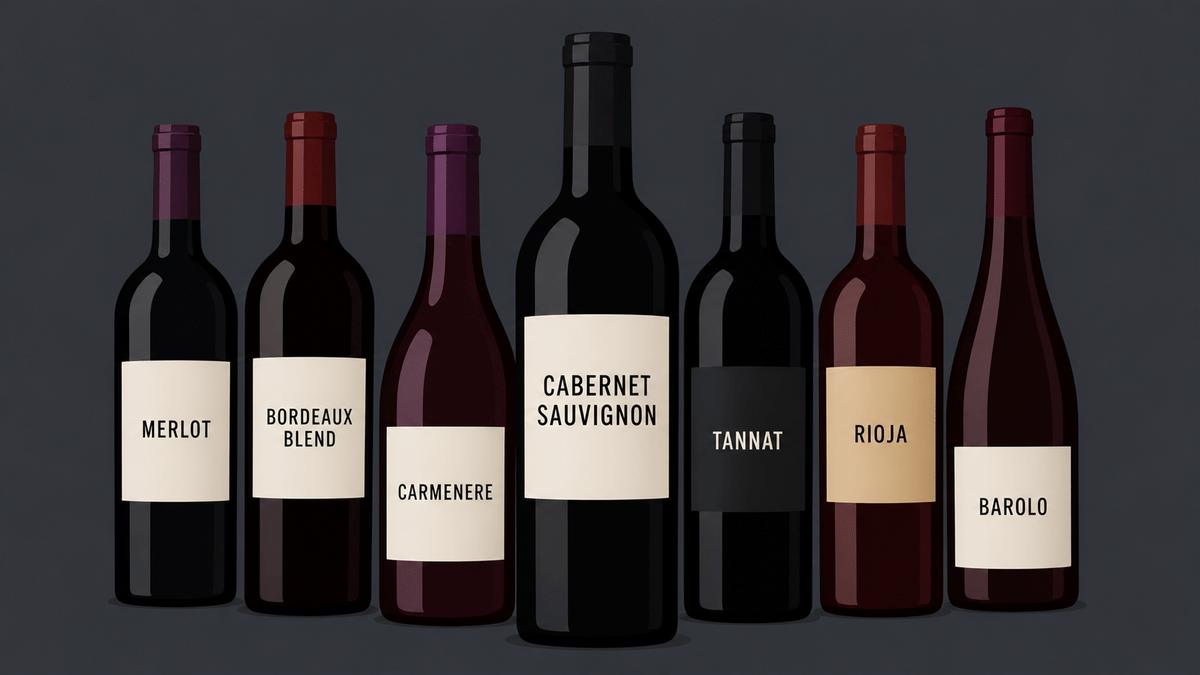
Wines Similar to Cabernet Sauvignon: Cabernet Lovers Love These Wines, Too
If Cabernet Sauvignon is your wine, you already know what you want: structure, tannin, dark fruit that fills the whole mouth, and a finish that sticks around. Cab is the most planted red grape in the world. Those who love it love it because it delivers the kind of wine that makes a great steak better and a pot roast shine.
The wines on this list all share Cab's core logic in different ways. Some are from the same family. Some are built on the same structural DNA. Some are what Cab drinkers discover when they follow the grape's history backward. None of them are the same wine, but all of them will make sense to someone who already drinks Cabernet.
Cabernet Sauvignon
Cabernet Sauvignon
Napa Valley / Bordeaux / ChileFull body, firm tannin, built to age. Blackberry, cassis, cedar. The most planted red grape in the world, and the reason Napa Valley is famous.
Cabernet Sauvignon is the benchmark bold red. Grown almost everywhere wine is made but at its best in Bordeaux, Napa Valley, and Chile, Cab is defined by its tannin structure: firm, gripping, and built to last. The flavor profile runs toward blackberry and cassis, with cedar, pencil shavings, and a hint of espresso from the barrel. Young Cab can be aggressive. Given time or paired with fat and protein, it opens into something genuinely excellent.
Napa Valley Cab is the gold standard for most American drinkers: riper, more fruit-forward, and more polished than its French counterpart. Chilean Cab gives you much of the same at half the price. Bordeaux adds more earthiness and complexity. All of them share the structural backbone that makes the grape what it is.
Our Cabernet Sauvignon episodes:
Trader Joe's Diamond Reserve vs. Costco Kirkland Signature Oakville Cabernet Sauvignon (Episode 164)
Merlot
Merlot
Bordeaux, France / CaliforniaMedium-full body, velvety tannin, no decanter required. Plum, black cherry, chocolate. The gentler path through the same Bordeaux dark-fruit territory.
What you'll recognize from Cabernet Sauvignon: Dark fruit in the same neighborhood: plum, black cherry, a little chocolate. Similar body and oak character. Along with Cabernet Sauvignon, it is one of the two classic grapes in a Bordeaux blend. The two grapes are closely related and blended together constantly.
What's different: Merlot has softer, more velvety tannins. Less grip, more plush and round. Where Cab makes you work a little, Merlot is smooth and easy. The fruit leans toward plum and fig rather than black currant and blackberry. It's also more immediately drinkable without needing the decanter to open it up.
Try this if: You like the dark fruit and body of Cab but want something you can open without a decanter and drink with lighter food. Merlot is what most Cab drinkers reach for first when they want to branch out without going far. Right Bank Bordeaux (Saint-Emilion, Pomerol) is where Merlot gets serious; California Merlot is where it gets easy and approachable.
Our Merlot episode: Is Merlot Making a Comeback? (Episode 76)
Bordeaux Blend
Bordeaux Blend
Bordeaux, France / Napa ValleyFull body, firm tannin, layered blend structure. Blackberry, cedar, graphite. Cab in its natural habitat, with more moving parts.
What you'll recognize from Cabernet Sauvignon: The structure and the flavor profile. A Cab-dominant Bordeaux blend is essentially Cabernet in its natural habitat: blackberry, cedar, graphite, long finish. This is where Cabernet Sauvignon was born, and it is always blended with other grapes.
What's different: A blend adds complexity that a straight Cab usually doesn't have. Merlot softens the tannin and adds plum. Cabernet Franc brings a herbal, violet edge. Petit Verdot adds spice and color. The result has more moving parts than a single-varietal Cab. Left Bank Bordeaux (Medoc, Haut-Medoc, Pauillac) is where this style was invented. Good value Bordeaux blends exist well under $20.
Try this if: You drink Cab regularly but haven't tried a Left Bank Bordeaux or a good value Bordeaux blend yet. Most people don't realize how much of what they love about Cab is actually the Bordeaux formula. A $15-20 Bordeaux blend is one of the best value plays in wine.
Our Bordeaux episodes:
Carménère
Carménère
ChileMedium-full body, softer tannin, green pepper as the signature note. Dark cherry, tobacco, plum. Chile's own grape, and one of the most underappreciated reds anywhere.
What you'll recognize from Cabernet Sauvignon: Dark fruit, medium-firm tannin, a similar weight in the glass. Carménère and Cabernet Sauvignon are half-siblings, both descended from Cabernet Franc; Carménère was planted in Chilean vineyards in the 1800s and mistaken for Merlot until a French ampelographer identified it visually in 1994, with DNA testing confirming it in 1997.
What's different: Carménère has a distinctive green pepper and tobacco note that Cab doesn't carry. The tannin is a bit softer, the body slightly lighter. It's less demanding than a big Napa Cab and more forgiving without food. Chile makes the best examples, and they are almost always well under $20.
Try this if: You like Cab's dark fruit and structure but want something more forgiving and with a flavor the others on this list don't have. Carménère's green pepper and tobacco note gives it a distinctive edge, and at under $15 it's the easiest upgrade on the page.
Our Carménère episode: WTF is Carménère? (Red wine find, great red wine alternative, mistaken for Merlot, a wine mystery revealed, who is Julien Miquel?)
Tannat
Tannat
Uruguay / Madiran, FranceFull body, maximum tannin, built for food. Blackberry, blackcurrant, leather. The wine that makes Cab look easy.
What you'll recognize from Cabernet Sauvignon: The tannin structure is immediately familiar. Tannat has some of the highest tannin content of any red grape, right there with Nebbiolo, alongside the same dark fruit and full body that Cab drinkers expect. It's a wine built on the same logic.
What's different: Tannat is earthier and more rustic than Napa Cab. The fruit goes toward blackberry, blackcurrant, and dried plum with leather and tobacco underneath. Madiran from Southwest France is the original style: austere and built to age. Uruguayan Tannat is more approachable: softer, more fruit-forward, but still has real structure and character. Less polished than Cab, more distinctive.
Try this if: You like Cab's tannin and dark fruit but want something with more edge and less commercial finish. Uruguayan Tannat is one of the best-value bottles on this list, and the episode we did on it says it plainly.
Our Tannat episode: If You Like Cabernet, You'll Love Tannat! (Episode 69)
Rioja (Tempranillo)
Rioja (Tempranillo)
Rioja, SpainMedium-full body, firm tannin, defined by American oak aging. Cherry, tobacco, vanilla. One of the best value propositions in wine.
What you'll recognize from Cabernet Sauvignon: Real structure and oak presence. Rioja Reserva is a wine with backbone: tannin you can feel, a long finish, and the unmistakable character of time in barrel. Cab drinkers recognize the seriousness immediately.
What's different: The fruit profile is completely different. Rioja runs toward cherry, tobacco, and vanilla rather than blackberry and cedar. It's earthier and more old-world. Tempranillo also has higher acidity than Cab, which makes it more food-flexible and gives it a brighter finish.
Try this if: You want Cab's structure at better prices. Rioja Reserva under $20 is one of the best deals in wine. If you've never tried Rioja with lamb, that's the fix.
Our Rioja episode: Costco Kirkland Signature 2019 Rioja Reserva Challenge! (Episode 119)
Barolo
Barolo
Piedmont, ItalyFull body, massive tannin, high acidity. Dried cherry, rose, truffle. The wine Cab drinkers end up at when they want more.
What you'll recognize from Cabernet Sauvignon: The tannin. Barolo is made from Nebbiolo in Piedmont, which carries some of the most powerful tannins of any red grape. Long finish. A wine that needs food and rewards patience. Cab drinkers recognize the weight immediately.
What's different: Barolo is more complex and more demanding. The fruit character goes toward dried cherry and rose rather than blackberry and cassis. There's truffle, tar, and leather underneath. Higher acidity. It asks more of the drinker than Cab does: it needs food, it rewards time in the glass, and a young bottle can be tannic to the point of austerity. Entry-level Barolo from Costco or Trader Joe's is a legitimate starting point.
Try this if: You drink Cab with steak and want to see what that same structural logic looks like through an Italian lens. Barolo with a braised short rib, mushroom ragu, or aged hard cheese is a different experience than anything on this list. Start with an entry-level bottle from Costco or Trader Joe's.
Our Barolo episode: Barolo Battle! Costco Kirkland vs. Trader Joe's Diamond Reserve! (Episode 192)
Food pairings that work across the group
Cabernet Sauvignon's high tannin is the key to its food-pairing logic. Tannin binds to protein and fat, which is why Cab with a ribeye is one of the classic combinations in wine: the tannin grips the fat, the fat softens the tannin, and both get better. That logic runs across most of the wines on this list.
Merlot and Carmenere handle lighter red meat a little better. Rioja adds versatility with duck, lamb, and herb-heavy dishes. Tannat is built for the most robust food on the list: braised lamb shoulder, cassoulet, aged hard cheese, anything slow-cooked. Barolo, with strong acidity, is the most versatile, and is the best of the group with truffle and mushroom-heavy dishes. Bordeaux blends belong next to anything you'd put on the grill.
Pairings that work for all six:
Ribeye or New York strip steak, grilled or roasted
Burgers (the juicier the better)
Lamb chops, rack of lamb, leg of lamb
Brisket, short rib, slow-braised beef
Hard aged cheese: aged cheddar, manchego, aged gouda, pecorino
Mushroom dishes: risotto, pasta with mushroom ragu
Listen to the episodes
We've covered most of these wines on the show. Good places to start:
Trader Joe's Diamond Reserve vs. Costco Kirkland Oakville Cabernet Sauvignon (Episode 164)
Costco Kirkland Signature Rioja Reserva Challenge! (Episode 119)
Barolo Battle! Costco Kirkland vs. Trader Joe's (Episode 192)
Frequently Asked Questions
Q. What wine is similar to Cabernet Sauvignon but easier to drink?
A. Merlot. It's in the same Bordeaux family, uses the same dark fruit vocabulary (plum, black cherry, chocolate), and has similar body. But the tannins are softer and rounder. Where Cab needs food or time to open up, Merlot is soft. If you like Cab but find it sometimes a bit too strong, astringent, or punch-you-in-the-face, try a bottle of Right Bank Bordeaux or a good Washington State Merlot first.
Q. Is a Bordeaux blend the same as Cabernet Sauvignon?
A. Close but not identical. A Left Bank Bordeaux blend is typically Cabernet-dominant, with Merlot and sometimes Cabernet Franc or Petit Verdot blended in to add complexity. The result is Cab in its place of birth: same dark fruit, same structure, but with more layers. Most people don't realize this until they try one. Good value examples exist well under $20.
Q. Is Cabernet Franc the same as Cabernet Sauvignon?
A. No, despite the shared name. Cabernet Franc is one of the two parent grapes of Cabernet Sauvignon (the other is Sauvignon Blanc), but the wines taste quite different. Cabernet Franc is lighter in body, higher in acidity, and has a distinctive herbal and violet note that Cab Sauv doesn't typically show. If you open a Cab Franc expecting it to drink like Cabernet Sauvignon, you'll be surprised. It's worth trying on its own terms, but it's a different wine.
Q. What should I try after Cabernet Sauvignon?
A. Start with Rioja or Carmenere if you want something familiar with a different angle. Both are well-structured, easy to find, and usually well under $20. When you're ready for something more demanding, Barolo is where most serious Cab drinkers end up. Same tannin weight, completely different flavor profile. Start with an entry-level bottle from Costco or Trader Joe's.
Q. Are there good Cabernet Sauvignon alternatives under $20?
A. Yes. Carmenere from Chile is the best value on this list: similar dark fruit and structure, its own distinctive character, and good bottles regularly under $15. Rioja Reserva is another strong play in that range: real structure, real oak aging. Both overdeliver for the price.