
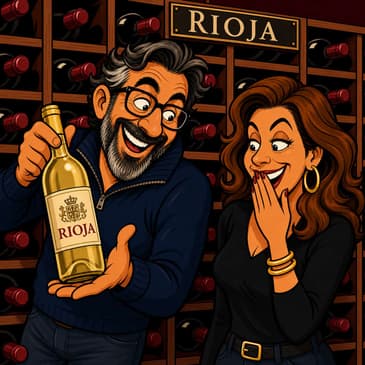
It may be shocking to find out that there is such a thing as White Rioja, but what may be even more shocking is that a wine this good is hardly known outside of Spain! In this episode we focus on Rioja Blanco made solely from the grape Viura, known as the Queen of White Rioja, and we are here to tell you that while it is probably not on your radar today, it should be. Talk about an underrated wine! Often compared to White Burgundy, people in the know consider it a great value alternative to those much more expensive wines. And, trust us, if you bring this to your next dinner party, your family and friends will be wowed. We also talk about the history of white wines from Rioja, and what the blending requirements are for White Rioja - and as you can probably guess, they do allow single varietals, but only from certain grapes. If you are looking for a new white wine to add to your list, or you have just not found a white wine you love yet, this is the episode for you. Wines reviewed in this episode: 2024 CVNE Monopole, 2024 Sierra de Tolono Rioja Blanco
Send us a Text Message and we'll respond in our next episode!
Contact The Wine Pair Podcast - we’d love to hear from you!
Visit our website, leave a review, and reach out to us: https://thewinepairpodcast.com/
Follow and DM us on Instagram: https://www.instagram.com/thewinepairpodcast/
Send us an email: joe@thewinepairpodcast.com
Show Notes
Episode #216: Viura: The Great White Wine Hiding in Rioja’s Red Wine Shadow! 00:00
KEY QUESTIONS ANSWERED IN THIS EPISODE
- What is Viura wine?
- What is White Rioja?
- Is White Rioja good?
- What does Viura wine taste like?
- How does White Rioja compare to White Burgundy?
- What is the difference between Viura and Macabeo?
- What food pairs with White Rioja?
- What does Crianza mean on a wine label?
- Is the 2024 CVNE Monopole worth buying?
- Is the 2024 Sierra de Tolono Rioja Blanco worth buying?
- Where can I find White Rioja in the US?
Episode Overview and First Thoughts on Viura 00:38
Hello fellow Pair Pals! And welcome to The Wine Pair Podcast. I’m Joe, your sommelier of reasonably priced wine, and this is my wife and my wine pairing partner in crime, Carmela. And we are The Wine Pair!
If you're new to our podcast, here's what we do: Every week we buy two wines under $25 with our own money, taste them, and give you our brutally honest view on whether they're worth buying. Nobody pays us to review specific wines, we don't accept free bottles from wineries, and we're not afraid to call out a bad wine when we taste one. Decanter Magazine calls us fun, irreverent, chatty, and entertaining - so if that sounds like your vibe, welcome to our tribe of wine lovers.
Just so you know, the tribe name this week came to us from listener Gus. Thank you Gus for the name. And, please keep the tribe names coming and we’ll ask you if you want to be on the pod.
Today, Carmela, we are talking about White Rioja wines. Now, it may surprise some of our listeners that there is such a thing as White Rioja wines because the wine we are most familiar with from Rioja are red wines that are centered on the great wine grape Tempranillo. But, we are here to tell you that there are some great wines being made in the Rioja area of Spain that are white, or, as the Spanish would call them, Rioja Blanco.
The main grape in White Rioja is Viura (pronounced Byoo-rah in Spain) which goes by another name that some of you may be familiar with, or not, called Macabeo, and that is actually a very important grape in the great Spanish sparkling wines called Cava. And we will spend some time talking about Viura in more depth in a few minutes, but first, let’s talk a bit more about White Rioja in general so we can get acclimated.
There are actually 9 indigenous grapes, including Viura, that are allowed in Rioja Blanco, and also 3 international of foreign grapes that are allowed.
The indigenous grapes are
- Viura (Macabeo):, often referred to as the "Queen" of the region's white varieties. It must comprise a minimum of 51% of any white blend
- Malvasía de Rioja
- Garnacha Blanca - or white Grenache
- Tempranillo Blanco A natural mutation of the red Tempranillo grape discovered in 1988
- Maturana Blanca: Which was recently allowed in blends but is actually the oldest known grape variety recorded in Rioja, dating back to 1622
- Turruntés de Rioja: A rediscovered local variety not to be confused with Torrontés grapes grown in other parts of Spain and Argentina
And the international and foreign grapes they allow in White Rioja are Chardonnay, Sauvignon Blanc, and Verdejo. Verdejo is actually a Spanish grape, not an international grape, but it is considered a “foreign” grape for Rioja.
As with most wine regions, there are rules for what the blends can be, and so the rules on blending in Rioja for white wines are
- International varieties (Chardonnay, Sauvignon Blanc, and Verdejo) cannot be the predominant variety in a final blend and collectively may not exceed 49% of the wine
- If grape varieties are listed on the label, an indigenous variety must always be listed first
- Winemakers are permitted to produce 100% single-varietal wines from any of the indigenous grapes
And, on that note, both of the wines we are drinking today are single varietal White Rioja’s made from only the Viura grape. So, we are covering both bases today - Rioja Blanco and Viura. Just know that this is one of the reasons why wines from Europe can be a little tricky to understand because many of them are named after the regions, like Rioja, or Bordeaux, or Chianti, and not the grapes, and many of them are blends rather than single varietals. That means, even if a region is known for a particular style of wine, you can get a lot of variation based on the grapes in the blend. That seems obvious, but it does require you to do some studying if you want to really know what is in your wine bottle because, it matters.
One more quick thing to cover is that there are two pretty different aging requirements in Rioja for white wines. Joven or fresh wines have no aging requirements, and, as you would guess, they are pretty fresh and fruity. If you see no additional information on the wine, such as Crianza, Reserva, or Gran Reserva, you can be sure it is a Joven or fresh wine.
That means that wines labeled as Crianza, Reserva, and Gran Reserva all have aging requirements, and this is good to know because those words, especially Crianza, may fool people into thinking that is a grape or even a region, but it is not. Crianza are wines that are aged for a minimum of 18 months, Reserva are aged for a minimum of 2 years, and Gran Reserva are aged for 4 years, and all of these must be aged for at least 6 months in 225-liter oak barrels. So, if you see a White Rioja with one of these labels, you are going to get an oaky wine. So, when you see Crianza on a bottle, now you know what it means.
We should note that traditionally, Viura has been added to Rioja Blanco blends to add freshness and acidity, so that is what we should expect from these wines.
On that note, today, we have to White Rioja wines, both that are made in the Joven or fresh style, although one has some oak on it, and both are 100% Viura. We are going to taste and review these wines today to see if we think either or both of them are worth running out and buying . . .
But first . . . we have to do our shameless plug.
Thank you for listening to us and for supporting our show, and know that we buy all of the wine we taste and review every week so that we can give you real and honest reviews. If you like what you’re hearing, please subscribe to our podcast and leave us a five star rating and review so we can grow listeners.
We also love to hear from you and we always respond so you can follow us on Instagram and Bluesky at thewinepairpodcast. You can contact us on our website thewinepairpodcast.com, and you can sign up for our email newsletter there and you can also send us a note at joe@thewinepairpodcast.com and let us know about wines your want us to review or just shoot the breeze, we love chatting it up.
And, as we do every week, we’ll tell you someone we think you should recommend The Wine Pair Podcast to - because the best way for us to grow listeners is when you tell your family and friends about us - and this week, we want you to recommend us to anyone who thinks they only make red Rioja wines, or who wants to find a new, crisp white wine to enjoy as we head into summer and eating al fresco. That means outside for you non-Italians.
Topic: WTF is Viura? 09:48
Ok, Carmela, it’s time to find out just what the eff Viura is all about! Ok?!?
First, Viura, AKA Macabeo, is believed to be indigenous to the Iberian Peninsula, which is the section of Europe where Spain and Portugal are located, and specifically from the Ebro Valley in north-eastern Spain. DNA study has found that its parents are the Hebén and Brustiano faux grapes neither of which I have ever heard of, and I understand that Brustiano faux is basically extinct, and that Hebén is the parent of many other grapes from that area. So, I think Hebén was getting around if you know what I mean.
Before the late 19th century, it is believed that white grapes may have been the majority in Rioja vineyards. However, when phylloxera devastated French and other European vineyards in the mid-1800s, Bordeaux winemakers came to Rioja seeking red wine grapes, which triggered a major regional shift toward red grape plantings to meet international demand.
After phylloxera, as the region's vineyards were replanted in the early 20th century, growers favored Viura as a white grape variety in the region for two very practical reasons:
High Yields: Its tendency to produce large crops made it highly profitable for farmers.
Oxidation Resistance: The grape has a natural resistance to oxidation (partly due to high levels of the antioxidant resveratrol), which allowed it to outlast traditional rivals like Garnacha Blanca and Malvasia in the cellar.
For those of you who may be curious, Resveratrol is a natural polyphenol found in grapes, red wine, and berries that acts as a potent antioxidant and anti-inflammatory compound. It is widely used to potentially support heart health, improve insulin sensitivity, reduce cancer risk, and aid longevity by protecting cells against age-related decline. So, goddam it, I think we are going to drink us a shit load of Viura!
Back to history. When the Rioja Regulating Council was founded in 1925, and I am not making that up, Viura was officially listed as one of only three authorized white varieties. As we mentioned earlier, in Catalonia, the grape is known as Macabeo or Macabeu and has been a vital backbone of Cava sparkling wine since the 19th century alongside the grapes Xarel·lo and Parellada.
By the mid-1960s, Viura had become so dominant that almost no other white vines were being grown in Rioja. In 1974, the Regulating Council stepped in again, and further encouraged its planting by offering subsidies of five pesetas per vine. Which is not a lot, but for farmers, it’s more than nothing.
The 1970s also brought a major stylistic revolution in which temperature-controlled stainless steel fermentation started to be used more widely. This allowed for the production of "fresh" or young Viura wines, moving away from the heavy, intentionally oxidized, and long-aged styles that had defined the region for decades.
Despite its historical importance, white grape plantings in Rioja fell to a low of approximately 5% to 7% by the mid-2000s as red wine continued to dominate the market. However, the variety is currently experiencing what some are calling a renaissance, and white plantings in Rioja have increased by 50% since 2015, driven by a growing international interest in fresher and less heavy white wines and a growing prestige of high-quality, aged White Rioja.
So, look, what we are doing by exposing you to Viura and White Rioja is actually just making you cool so that you can impress your wine nerd friends when you bust out a bottle of it. They’ll be like “what is that” and you’ll be like “it’s a Rioja” and then be like ‘uh-uh, Rioja is red” and you’ll be like “no, buddy, they make White Rioja, too” and they’ll be like, “woah” and then you’ll be like “let me tell you about Viura cause I just learned about it on this kick-ass podcast” and then you can be like the king or queen of the nerds.
I should mention that despite being the queen of Rioja white wine grapes, it didn’t always have an awesome reputation. For a lot of the late 20th century, both critics and consumers considered it kind of bland, unexciting, simple, and flabby. In wine, so you know, flabby means that it doesn’t seem to have structure and lacks balance, and that typically means a wine with low acidity and high in pH or alkaline.
Some of this was due to the fact that it was just overproduced and that often leads to less careful winemaking practices. In truth, however, winemakers often compare it to Chardonnay because it is a highly adaptable wine, taking on the character the winemaker wants, from steely, dry, fresh styles to powerfully structured, creamy, oaked versions. Something you may not know about Chardonnay because in the US it is predominantly overly oaked, vanilla tasting bullshit. But I digress.
Today, Viura is now seen as a "gem" for collectors and oenophiles seeking a high-quality, value-driven alternative to aged white Burgundy. Its reputation has shifted toward being a gastronomic wine. Which we really like, because it means it can stand up to a lot of foods and really shines when paired with food which is very much how we think of wine.
But that’s enough information. I think it’s time to learn a little more about the specific wines we are drinking today. Whaddya say?
Viura Wines We Chose for This Episode 18:14
As usual, the wines we have chosen for this episode are under $25, and they should be relatively easy to find because I bought them at wine.com. You are going to have to dig around a little bit to find a White Rioja, and that means you will have to go to either a larger wine store, a store that specializes in Spanish wines, or, as always, go to your local wine shop and ask the owner to help you find some, and they will be more than happy to help you.
The first wine we are going to drink today is the 2024 CVNE (pronounced Coo-nay) Monopole White Rioja and it is 100% Viura. I can see that this wine has some professional ratings and reviews but they are hidden behind paywalls. Which is a bummer, so I can’t give you the actual ratings. Note that the word “seco” appears on the label, and that means “dry” in Spanish. An important thing to know!
CVNE stands for Compañia Vinicola del Norte de España, and the company was founded in 1879 in the town of Haro in Rioja. The winery was started by two brothers and today is still controlled by their direct descendants. The French architect Aleixadre Gustave Eifell—of Eifell Tower fame—designed the winery’s first cellar using steel trusses. A little trivia for you. This wine was first registered in 1915, making it the oldest white wine registered in Spain.
There was a tech sheet for the wine, so what I can tell you is that they hand-harvest the grapes, they cold macerate the wine on its skins for 8 hours before they ferment, which sounds like a long time to macerate (ha-ha) but is intended to help get some texture and aromas on the juice. Then they press the grapes and ferment in stainless steel tanks, using only the free run juice (think of that as first press like in olive oil, what is supposed to be the best part).
The winery also noted some challenging conditions in the growing season and harvest for this wine, and they ended up with one of the smallest harvests they have ever had, but that the grapes were excellent.
Given that there is no oak on this wine and the ways they produced it, I expect a crisp and fruity wine.
The next wine we are going to taste and review is the 2024 Sierra de Tolono Rioja Blanco, and this is going to be a different wine because they do use a little bit of oak on it, so it will be fun to see how these two wines compare. This wine is also pretty low in alcohol at only 11.5% versus the 13% on the first one, so I am really curious about how similar or different they will be!
This wine got two strong ratings of 92, one from the Wine Advocate, which I am kind of mid on because they like oak wines, and Vinous which I tend to agree with.
The winery makes the wines using indigenous yeasts, the grapes are 100% destemmed, they ferment 90% of the wine in stainless steel at a low temperature, and then put 10% in French oak, so some oak, but not a ton. In fact, the winemaker specifically says she wants the wines fresh and not oaky. They also keep the wine on the lees, which is the dead yeast left over from fermentation, and so that should add some creaminess to the wine and also a little bit of funkiness. They say the wine is silky, so we’ll see.
The winery says they biodynamically farm their vineyards, and they try to use minimal intervention. The winemaker is a woman named Sandra Bravo, and she worked in France, New Zealand, Italy, and Priorat in Spain before making her way to Sierra de Tolono. She says Priorat really influenced her, and we think that Priorat is an underrated wine region for sure.
But, I think that is enough information - let’s get to drinking! We’ll take a quick break and be right back. And, if you have these wines or similar wines, drink along with us to get some participation points, which you can trade-in for free stickers. You just need to send me an email with your mailing address, and I will get those “I drink with The Wine Pair Podcast” stickers over to you!
LINKS TO SOURCES FOR THESE SPECIFIC WINES
- https://www.gusclemensonwine.com/cvne-monopole-blanco-seco-rioja-doca-2024/
- https://cvne.com/wp-content/uploads/2021/03/MONOPOLE-BLANCO-2024-ENG.pdf
- https://www.bowlerwine.com/sites/default/files/tech-sheets/Tech_Sheet_-_Sierra_de_Tolono_Rioja_Blanco.pdf
2024 CVNE Monopole, 2024 Sierra de Tolono Rioja Blanco Wine Tasting, Pairing, and Review 23:32
Wine: CVNE Monopole (Click here to find this wine on wine.com. We may be compensated if you purchase)
Region: Spain, Rioja
Year: 2024
Price: $14.97
Retailer: wine.com
Alcohol: 13%
Grapes: Viura
Professional Rating: Vivino
What we tasted and smelled in this CVNE Monopole:
- Color: Light straw yellow, sunshine yellow, marigold
- On the nose: Fruity, green apple, pear, white peach, nectarine, creamy, vanilla car freshener
- In the mouth: Very fresh and fruity, apple on the front, grapefruit, lime or lemon, seashell and rock on the end, easy drinking, white wine drinkers will love it, crowd pleaser
Food to pair with this CVNE Monopole: Seafood, shrimp scampi pasta, shellfish, pasta con vongole, bowl of clams, Filet o’ Fish, sushi, fish and chips, spicy food, very good food wine
As a reminder on our rating scale, we rate on a scale of 1-10, with no half points, where 7 and above means that we would buy it, and 4 and below means that we are likely to pour it down the sink, and a 5 or 6 means we are likely to drink it and finish it, but we are probably not going to buy it.
CVNE Monopole Wine Rating:
- Joe: 7/10
- Carmela: 8/10
Wine: Sierra de Tolono Rioja Blanco (Click here to find this wine on wine.com. We may be compensated if you purchase)
Region: Spain, Rioja
Year: 2024
Price: $24.97
Retailer: wine.com
Alcohol: 11.5%
Grapes: Viura
Professional Rating: WA 92, V 92 Vivino
What we tasted and smelled in this Sierra de Tolono Rioja Blanco:
- Color: Mustard yellow
- On the nose: Caramel, candied orange, Cosmic Crisp apple, richer, creamy, vanilla, apple pie filling, cantaloupe, honeydew melon
- In the mouth: Really, nice, baking spice, rich, fruity and fresh, medium bodied, apple on the front, citrus on the back and ends clean, seashell, stone
Food to pair with this Sierra de Tolono Rioja Blanco: Seafood, creamy pasta, pesto pasta, chicken, Pad Thai, grilled meats, scalloped potatoes,
Sierra de Tolono Rioja Blanco Wine Rating:
- Joe: 8/10
- Carmela: 8/10
Which one of these are you finishing tonight?
- Carmela: Sierra de Tolono Rioja Blanco
- Joe: Sierra de Tolono Rioja Blanco
The Test: Did we nail the taste profiles expected from Viura? 34:38
- General
- Fresh: Citrusy and lean, with lime peel, lemon verbena, and honeydew melon. Floral scents with herbs like marjoram, tarragon, and anise. Can have salinity, and honeycomb as well. Usually bone dry with high acidity, even tingly
- When aged and oxidized, may be more like roasted pineapple, caramelized honey, preserved lime, and candied tarragon as well as nougat and butterscotch. Chewy, waxy, big in the mouth.
- CVNE Monopole
- Winery: Pale yellow in color, this wine reveals clean, precise aromas of white flowers and fresh fruits such as pineapple, banana, and apple. On the palate, it shines with balance and harmony, offering a smooth, approachable texture and a lingering floral and fruity finish.
- Skurnik: Seductive scents of spring, white flowers and fresh tropical fruit lead into a luxurious palate with just the right amount of acidity to convey a lasting freshness.
- Sierra de Tolono Rioja Blanco
- Winery: On the nose, the wine is very floral with slight “toasted” notes. There is a silky aspect on the pallet with big acidity which makes for a long finish
- WA: The white 2024 Blanco de Sierra de Toloño is clean, fresh and herbal, with notes of fennel and aniseed, and has some floral notes.
- V: Fennel, wild herbs and a note of soft green apple lead the nose. On the palate, it is intense, precise and fresh, with a lightly creamy texture gently shaped by soft chalky tension. The profile leans modern for the region, balancing a crisp edge with subtle creaminess and clear flavor definition
What is the verdict on White Rioja / Viura? 36:15
A great wine that needs to be on our wine list. Very underrated, needs to be better known. Very nice wine.
And now it is time to head over to our new desk so that we can cover our wine in the news this week segment.
Wine in the news this week: Rare wines, stashed away in castle’s cellar for a century and once considered undrinkable, head to sale 36:50
This week our wine in the news comes to us from Lianne Kolirin writing for CNN. And the article is entitled “Rare wines, stashed away in castle’s cellar for a century and once considered undrinkable, head to sale”
Right away, this feels like a great story, and the short version of the story is this: two bottles of 1870 Château Lafite were found sitting in the catacombs of a Scottish castle, and they are about to sell at auction for up to fifty thousand dollars each.
Now let me back up, because there are some details here that are too good to skip.
Glamis Castle — which is in Scotland, about twelve miles from Dundee, and is where Queen Elizabeth the Second's mother grew up and where Princess Margaret was actually born — has a wine cellar they literally call the catacombs. It was built in 1765. And somewhere in those catacombs, the 13th Earl of Strathmore had been sitting on 48 bottles of 1870 Château Lafite that he purchased in 1878.
But wait, it gets more interesting. When they first opened some of these bottles back in the 1970s, the verdict was: undrinkable. Too astringent. Hard pass. So they just... put them back.
Fast forward to now, and a wine expert named Michael Broadbent from Christie's — who described the cellar as an Aladdin's cave, which is honestly the most exciting way anyone has ever described a wine cellar — determined that these bottles have reached "balance and flavour perfection."
Two of the surviving magnums are heading to Sotheby's as part of an auction called Immortal Vintages, which features over 250 lots of Bordeaux spanning two centuries. The two Lafite magnums alone are estimated to sell for thirty to fifty thousand dollars. Each.
And here is the part that I find genuinely fascinating. This is a pre-phylloxera wine. Phylloxera was an insect epidemic in the late 1800s that wiped out most of Europe's vineyards. The vines these grapes came from no longer exist. Nobody knows exactly what that style of wine tasted like. And apparently two bottles of it have been quietly aging in a Scottish castle for 156 years, waiting for someone to decide they were finally ready.
Carmela, if you found two bottles of 1870 Château Lafite in a catacomb, do you open them or do you sell them?
Listener Shoutouts 39:47
We have some fun listener shoutouts for this week, and we so appreciate when you reach out to use and tell us what you think, or what you are drinking, and so here are some shoutouts:
- East Idaho Foodies - asked us about doing an episode on wines from Idaho, called out Scoria specifically
- Hasini - said the Rainboat Pet Nat was not as mousey as we said
- Adrienne - who did not know those wig looking things on microphones on social media were wind screens
- Janyne - thanked us for the Oregon Pinot Noir episode because she and her husband are in the midst planning a trip to the Willamette Valley
- Bud - Recently purchased a sherry to try over ice cream as you recommended and it was great. He and his wife are headed to Portugal & Spain on a Viking Cruise in a few weeks and was looking for ideas, and gave us an idea for wine in the news
- Timmy and Adam responded to our newsletter! Timmy just got back from Burgundy and Champagne, so, yeah
- Fred sent us a voice message on our website and mentioned that he had some 1973 Chateau Mouton Rothschild, and from what I could tell, it sounds like he may want to sell it if anyone is interested
Wines coming up in future episodes in case you want to drink along with us 41:52
- Frappato
- 2 Buck Chuck
- 2023 Charles Shaw California Chardonnay
- 2023 Charles Shaw California Cabernet Sauvignon
- Lebanese wines
- Italian Sangiovese, but not Chianti
- 2022 Cantina Roccafiore Melograno
- 2021 Di Majo Norante Sangiovese
- Alsace Pinot Gris
- 2020 Pierre Sparr Pinot Gris
- 2020 Frey-Sohler Vielles Vignes Pinot Gris
- Kirkland Bordeaux
- 2023 Pauillac
- 2023 Saint-Julien
- Kirkland Châteauneuf-du-Pape
- 2024 Châteauneuf-du-Pape
- Kirkland Moscato d’Asti
- 2025 Moscato d’Asti
Outro and how to find The Wine Pair Podcast 42:56
Thank you for listening to us and for supporting our show, and remember, we buy all of our own wine and we do all of the writing and recording and editing to bring you a show every week because we absolutely love doing it, and our small little ask for you is that you please follow or subscribe to our podcast and also please leave us a nice rating and review to help us grow our listeners - and a huge thank you to all of you who have done so already!
You can also follow us on Instagram and Bluesky at thewinepairpodcast. You can contact us on our website thewinepairpodcast.com, and you can sign up for our email newsletter there and you can also visit our “Shop Wine” section where you can find links to buy the wines that we rate as buys in each episode. I will also note that on our website, if you are curious about a wine we have covered in the past, we do have a pretty good search functionality, so you can use that find wines you want to know more about.
And we want to make content you care about and you like, so send us a note or DM us and give us some feedback or let us know if there are wines you want us to try or wine making areas of the world you are curious about - and we’ll take care of it! joe@thewinepairpodcast.com
Alright, with that, we are going to sign off, so thanks again, and we will see you next time. And, as we say, life is short, so stop drinking shitty wine.
________________________
KEY INSIGHTS & FREQUENTLY ASKED QUESTIONS
Q. What is Viura wine?
A. Viura is the primary white grape of Rioja, Spain — also known as Macabeo, the same grape used in Cava. It must make up at least 51% of any White Rioja blend. Winemakers compare it to Chardonnay for its range: it can be made fresh and citrusy or rich and creamy depending on winemaking style.
Q. What is White Rioja?
A. White Rioja (Rioja Blanco) is a white wine made in Spain's famous Rioja region. Most people only know Rioja for its red wines, but it's been producing whites for over a century. Viura is the dominant grape, though nine indigenous white varieties and three international grapes are permitted in blends.
Q. Is White Rioja good?
A. We think it's one of the most underrated white wines you can buy right now. We rated both bottles we tasted as buys — the $14.97 CVNE Monopole earned 7 and 8 out of 10, and the $24.97 Sierra de Tolono earned 8 out of 10 from both of us. We buy all our own wine and give really honest ratings.
Q. What does Viura wine taste like?
A. Fresh, unoaked Viura tastes like green apple, citrus (lime and lemon), white peach, and mineral stone on the finish. With a touch of oak, you get richer notes: caramel, apple pie, and a silky texture. Both styles have good acidity and finish clean — they're genuinely food-friendly wines.
Q. How does White Rioja compare to White Burgundy?
A. Wine insiders call White Rioja a value alternative to White Burgundy — similar depth and aging potential, significantly cheaper. A great White Rioja runs $15–$25. Comparable White Burgundy can cost $60 or more. White Rioja plantings have grown 50% since 2015 as collectors start paying attention.
Q. What does Crianza mean on a wine label?
A. Crianza is an aging designation, not a grape or region. White Rioja labeled Crianza has been aged a minimum of 18 months, including 6 months in oak barrels. Reserva means 2+ years, Gran Reserva means 4+ years. No designation means it's a Joven (fresh) wine with no required oak aging.
Q. What food pairs with White Rioja?
A. White Rioja pairs beautifully with seafood — shrimp scampi, clams, sushi, fish and chips. Richer oaked versions also work well with creamy pasta, pesto, grilled chicken, and Pad Thai. It's a genuinely versatile food wine, which is a big part of why we think it deserves more attention.
________________________
RESEARCH ARTICLES AND LINKS FOR THIS EPISODE
- https://en.wikipedia.org/wiki/Rioja_DOCa
- https://en.wikipedia.org/wiki/History_of_Rioja_wine
- https://en.wikipedia.org/wiki/Macabeo
- https://www.cellartours.com/blog/spain/spains-most-versatile-grape-viura
- https://elcoto.com/en/blog/viura-grape-characteristics-types-wine/
- https://www.wineenthusiast.com/varietals/viura/
- https://winefolly.com/deep-dive/amazing-white-rioja-wines/
- https://vintnerproject.com/rioja/the-resurgence-of-white-rioja/
- https://www.melaniewebberwine.com/post/rioja-s-new-whites-back-to-the-future
- https://worldoffinewine.com/homepage-featured-articles/white-rioja-survive-and-prosper
- https://www.decanter.com/wine-reviews-tastings/white-rioja-wines-to-try-375743/
- https://www.decanter.com/magazine/the-white-rioja-renaissance-470386/
- https://robbreport.com/food-drink/wine/rioja-winery-focusing-white-wine-1236182390/
- https://www.wineenthusiast.com/region/rioja/
- https://napavalleywineacademy.com/blogs/pouring-points/modern-rioja-wine-its-controlled-aging-requirements-and-sub-regions
- https://www.rarewineco.com/producer/lopez-de-heredia-rioja/
- https://www.decanter.com/learn/wine-legend-r-lopez-de-heredia-vina-tondonia-blanco-1964-408140/
- https://www.spanishwinelover.com/22-winerie-r-lopez-de-heredia-vina-tondonia
- https://riojawineacademy.com/en/home
- https://riojawine.com/en-us/the-designation/grape-varieties/
- https://www.bbr.com/grape-vu-viura
- https://www.youtube.com/watch?v=jb0t7rWy1XI
- https://winefolly.com/grapes/viura/
- https://bettyswinemusings.com/discovering-viura-the-most-important-rioja-white/
- https://www.jancisrobinson.com/articles/macabeoviura-the-cinderella-grape
- https://thesommchef.com/viura-spanish-white-wine-review/
- https://www.goodpairdays.com/guides/wine-grapes/article/viura/?srsltid=AfmBOoqHZC6eqntG9nJmfEQEI8iBvKo4AByCEZ7-0OMBvaGBJsxseOiq
- https://www.youtube.com/watch?v=WlrgWzhkg9E
- https://www.youtube.com/watch?v=mp_8GWtXhSY
________________________
Support The Wine Pair Podcast by heading to our website and shopping for the wines we give our highest ratings to in our Shop Wines section. Just click on this link - you pay the same price, and we may get a small amount of compensation.
You can also support us by clicking on this affiliate link to wine.com and find great wines under $20!
And, if you are looking for a great website builder for your podcast, click on this link to use the service we use and love: Beamly, formerly known as Podcastpage.io
________________________
AUTOMATED TRANSCRIPT
Joe: 00:00
Carmela, you know that Rioja is known for red wines, right? Yep. Well, people in the know, the cool people, are starting to figure out that they make some killer white wines in Rioja as well.
Carmela: 00:11
Oh wow. Of course you knew that.
Joe: 00:13
Yeah, I well, I'm just finding that out. Today, we tasted and reviewed two white Rioja wines focused on the grape Viura, and without spoiling it too much, they're freaking good. Winners! So keep listening, and we'll tell you all about it, and we'll tell you how to be the hero of your next dinner party. Nice. Hello, fellow pear pals, and welcome to the Wine Pear Podcast. I'm Joe, your Samolier of Reasonably Priced Wine, and this is my wife and my wine pairing partnering crime Carmela. Hi there. And we are the Wine Pear. Woohoo! If you're new to our podcast, here's what we do. Every week we buy two wines under $25. With our own money, we taste them and we give you our brutally honest review on whether they're worth buying. Nobody pays us to review specific wines. We don't accept free bottles from wineries, and we're not afraid to call out a bad wine when we taste one. Decanter magazine calls us fun, irreverent, and entertaining. So if that sounds like your vibe, welcome to our tribe of wine lovers.
Carmela: 01:21
No, but you said PearPals.
Joe: 01:23
Yeah, that was not from me.
Carmela: 01:24
I like it.
Joe: 01:25
See, that's why she liked it. It's from Gus. It was from Listener Gus. Good job, Gus. Way to go, Gus. Thanks for the name and keep the tribe names coming. We got a whole bunch from Timmy. Timmy is coming through. And then if you if you want to, we'll ask you if you want to be on the pot.
Carmela: 01:38
Awesome.
Joe: 01:39
Okay, Carmela, today we are talking about white Rioja wines. Now it may surprise some of our listeners and you, Carmela, that there is such a thing as white Rioja wines. Mind-blown. Yeah, exactly, because the wine we are most familiar with from Rioja are red wines that are centered on the great wine grape Tempranillo. But we are here to tell you that there are some great wines being made in the Rioja area of Spain that are white, or as the Spanish would call them, Rioja Blanco. Yes. I love that. Now the main grape in White Rioja is viura, which the Spanish sometimes call biura. But it's V-I-U-R-A.
Carmela: 02:21
I get that.
Joe: 02:22
So you can call it either. I'll let you call it either today. Now it does go by another name that some of you may or may not be familiar with called Macabello.
Carmela: 02:30
Oh, I've heard that. Yeah.
Joe: 02:32
And it's actually a very important grape in the great Spanish sparkling wines called cava.
Carmela: 02:37
Oh, yes.
Joe: 02:38
So we'll spend some time talking about biura or viura in more depth in a few minutes. But first, let's talk a bit more about white rioja in general so we can get kind of acclimated.
Carmela: 02:48
Okay, I like that. I like that. I'm very excited about that.
Joe: 02:51
Get into it. Get into it a little bit.
Carmela: 02:52
Anything white wine, you know, especially when it's like, don't give the red wine all the credit. That's right.
Joe: 02:58
Bring in a little white. Exactly. Expand your wine horizons, people. Right. Okay, there are actually, Carmela, nine indigenous grapes, including Viura, that are allowed in Rioja Blanco. And there are also three international or foreign grapes that are allowed too. So the nine indigenous grapes are Macabo or Viura, as we've said. Macarena, okay. Yeah, Macarena, often referred to as the queen of the white varieties in the region. And on a side note, it has to comprise a minimum of 51% of any white blend in Rioja.
Speaker 4: 03:28
Okay.
Joe: 03:28
So there you go. Another one is Malvasia di Rioja. Another one is Garnacha Blanca, which is, yes, white grenache. Tempranio Blanco, which yes, is a natural mutation of the red tempranio grape that was discovered in 1988. So pretty recently. There's Maturana Blanca, which was recently allowed into blends, but is actually the oldest known grape variety recorded in Rioja, dating back to 1622. And then there's Torrentes de Rioja, which is a rediscovered local variety, and it's not to be confused with Torontes, which is another Spanish grape and also Argentinian grape. They're different. This is torontes.
Carmela: 04:10
They're good. You're really good. My pronunciation is. Have you been practicing all week?
Joe: 04:14
A little bit, and they're probably wrong.
Carmela: 04:15
No, I like that.
Joe: 04:15
They're probably wrong. Now, the international or foreign grapes they allow in White Rioja are Chardonnay, Savignon Blanc, and Verdejo.
Speaker 4: 04:24
Okay.
Joe: 04:24
Now, Verdejo is actually a Spanish grape. It's not an international grape, but it's considered foreign because it's not from Rioja.
Carmela: 04:32
Got it.
Joe: 04:33
But they let it in. They're like, come on in. We don't mind that you're from another place.
Carmela: 04:37
Right. You know, welcome all kinds.
Joe: 04:40
That's what makes us great. The melting pot of wine.
Carmela: 04:43
I love that.
Joe: 04:43
There you go. As with most wine regions, there are rules for the blends, one of which I already mentioned. And so the rules on blending in Rioja for white wines are, again, 51% viura. The international varieties cannot be the predominant variety in a final blend and collectively may not exceed 49% of the wine. I guess that's kind of the same thing. If the great varieties are listed on the label, an indigenous variety must always be listed first. So you can't put Chardonnay first. You gotta put the indigenous variety first.
Carmela: 05:14
What happens if you do?
Joe: 05:15
You get in trouble. Really?
Carmela: 05:17
Yeah, you get wine jail.
Joe: 05:19
Yeah, you have to go to a wine jail where all they give you is beer. And winemakers are permitted to produce 100% single varietal wines from any of the indigenous grapes, which is meaningful today. So remember that.
Carmela: 05:30
Okay.
Joe: 05:31
And I'll tell you why. Because both of the wines we are drinking today are single varietal white Riojas made only from the viura or biura grape. Oh wow. Yeah. So that's it. So we're covering both bases today. Rioja Blanco and Viura. They're purebreds. Totally.
Carmela: 05:47
We've been thinking a lot about a dog.
Joe: 05:49
And we we actually want a mutt.
Carmela: 05:51
Yeah, we're thinking that we or a mix of some kind.
Joe: 05:53
But we're worried about one of these dogs that we have.
Carmela: 05:55
Yeah, we like some, we like a couple, but Joe falls in love with every dog that he sees. Yeah.
Joe: 06:00
That's another thing. So we'll let you guys know if we get our dog.
Carmela: 06:03
Yeah.
Joe: 06:03
Okay. Just know back to Biura and White Rioja. That this is one of the reasons why wines from Europe can be a little tricky to understand, because many of them are named after regions like Rioja or Bordeaux or Chianti and not the grapes. And many of them are blends rather than single varietals. So this means that even if a region is known for a particular style of wine, you get a lot of variation based on the grapes in the blend. Now that seems obvious, but it does require you maybe to do some studying if you really want to know what's in the wine bottle. But that's up to you. It's up to you. It's your call. If you want to know, if you want to know, study up. If you don't care, just drink it.
Carmela: 06:41
Right. If you just want to enjoy that glass of wine, it's no problem.
Joe: 06:45
You don't want to be a wine nerd? It's totally fine. Okay, one more quick thing to cover Carmella is that there are two pretty different aging requirements in Rio Ha for white wines. There's Hoven, J-O-V-E-N, or Fresh Wines, and they have no aging requirements. And as you would guess, they're pretty fresh and fruity. So if you see no additional information on the wine, then you're pretty, you can be pretty sure it's hoven or fresh. So that means that wines labeled as either Crianza, Reserva, and Gran Reserva all have aging requirements. And this is good to know because those words, especially Crianza, may fool people into thinking that they're talking about the grape or the region, but they're not. Crianza it just means aging. So Crianza wines are aged for a minimum of 18 months, reserva are aged for a minimum of two years, and ground reserva are aged for at least four years. And all of these must be aged for at least six months in 225-liter oak barrels.
Carmela: 07:38
Oh wow.
Joe: 07:38
So if you see a white Rioja with one of these names on the label, you're gonna get an oaky wine.
Speaker 3: 07:44
Ah.
Joe: 07:44
So now if you see crianza, you know what that means. Okay. We should also note that traditionally viura has been added to Rioja Blanco blends to add freshness and acidity. And so that's what we should expect from these wines, which is just up our alley. Right. So on that note, we have two white Rioja wines, both made in the Hilven or Fresh Style, both made from viura, that we're gonna taste and review today to see if we think either or both of them are worth running out and buying. But first, you gotta do our shameless plug. Well, that is so true. So thank you for listening to us and supporting our show. And remember, we buy all the wine we taste and review every week so we can give you real and honest reviews. And so if you like what you're hearing, please subscribe to our podcast and leave us a five-star rating and review so we can grow listeners. We also love to hear from you, and we always respond. So you can follow us on Instagram and Blue Sky at the Wine Pair Podcast. You can contact us on our website, thewinepairpodcast.com, and you can sign up for our email newsletter there, which you just missed. It just came out. But if you send me a note at Joe at the WinePair Podcast.com, I will hand deliver that newsletter into your email inbox. And there's some really good stuff in the newsletter today, including pictures of concerts that we've gone to in case you're curious about that. Uh, and then you can let us know too about wines you want us to review or just shoot the breeze with us. We'd like we like to chat it up. And as we do every week, we'll tell you someone we think you should recommend the wine pair podcast to because the best way for us to grow listeners is when you tell your family and friends about us. And this week, we want you to recommend us to anyone who thinks they only make red wines in Rioja, or who wants to find a new crisp white wine to enjoy as we head into summer and eating alfresco.
Carmela: 09:23
I love that. I mean, what do you how do you know though? Like, how do you know how do you find these people?
Joe: 09:28
You just know them.
Carmela: 09:29
You just have to ask, like, start probing them, asking questions.
Joe: 09:31
You start poking them.
Carmela: 09:32
Hey, are you one of those people you just think that it's their only red exactly?
Joe: 09:36
I just I don't know. You ask them. Okay. That's you know what? Be curious.
Carmela: 09:40
You'd be like, eh when they get it wrong.
Joe: 09:42
Be curious. It's really an important thing.
Carmela: 09:45
You just ask ask people questions.
Joe: 09:46
Exactly.
Carmela: 09:47
Right.
Joe: 09:47
Okay, Carmela, it's time to find out just what the f viura is all about, okay?
Speaker 3: 09:52
Okay.
Joe: 09:53
Okay, so first viura, aka macabeo, is believed to be indigenous to the Iberian Peninsula. That's what the section of Europe where Spain and Portugal are located is called, and specifically from the Ebro Valley in the in northeastern Spain. And DNA study, they've done DNA studies, and they found that its parents are the Heban and Brustiano Foe grapes, neither of which I've ever heard of. And I understand that Brustiano Foe is basically extinct, and that Heban is the parent of many other grapes from that region. And so I think Heban was like getting around.
unknown: 10:25
Wow.
Joe: 10:26
You know, like doing extinct. So you know it's a grape that, you know.
Carmela: 10:31
Spreading rumors is not.
Joe: 10:32
It wasn't all that it was spreading. Okay, before the late 19th century, it's believed that white grapes may have been the majority in Rioja vineyards. Those were the days.
Carmela: 10:42
Wow.
Joe: 10:42
Come on. But when the phyloxra plague devastated French wine and other European vineyards in the mid-1800s, Bordeaux winemakers came to Rioja and they were looking for red wine grapes, which triggered a major regional shift toward red grape plantings, and that's why there's a lot of red wine grapes in Rioja too. They did. Wow. After Phylloxra, as the region's vineyards were replanted in the early 20th century, growers favored Viura as a white grape variety in the region for two very practical reasons, Carmilla. Okay. Do you want to know what those reasons are? Yeah, give it to me. Okay, one is high yields. So it has a tendency to produce large crops, and that's profitable. That's a good thing. You want you want a lot of grapes.
Carmela: 11:25
Right. If you're gonna get easy to grow, huh?
Joe: 11:27
Yeah, just get a lot of grapes. And secondly, it is resistant to oxidation. So it has a natural resistance to oxidation. You're gonna like this partly due to high levels of the antioxidant reservatrol. Oh, and so for those of you who may be curious, see, I'm glad you asked.
Carmela: 11:46
It sounds bad for you. No, you're gonna be like I mean, I bet it's good, but it's reservatol.
Joe: 11:51
You're gonna be so happy.
Carmela: 11:52
Am I gonna just start buying this in bulk?
Joe: 11:54
Yes. Okay, because reservatol is a natural polyphenol found in grapes, red wine, and berries that acts as a potent antioxidant and anti-inflammatory compound, and it's widely used to potentially support heart health, insulin sensitivity, reduce cancer risk, and aid longevity by protecting cells against age-related decline. So damn it, we are gonna drink a ton of biura.
Carmela: 12:20
Right, we're just gonna like, you know, take it through the vein. Why are you drinking that? Because it makes me feel better. Oh my god. And I mean, look at how much younger I am. I'm gonna live forever. Exactly. But it's in berry, all kinds of berries this year. I guess in berries.
Joe: 12:33
I'm not an expert.
Carmela: 12:34
Okay, now I want to know more about this.
Joe: 12:36
But now you know that Biura has a lot of this. Give me, give it to me. Let's go.
Carmela: 12:40
Buddy.
Joe: 12:40
Okay, let's get back to some history.
Carmela: 12:42
Okay.
Joe: 12:42
When the Rioja Regulating Council was founded in 1925.
Carmela: 12:46
The Rioja Regulating Council.
Joe: 12:48
Oh, yeah, I'm not making that up.
Carmela: 12:49
Okay.
Joe: 12:49
Now, when it was founded in 1925, Viura. Are you on the board? I'm not. I wish I was. I would make them change their name. Viura was officially listed as one of only three authorized white varieties. As we mentioned earlier, in Catalonia, the grape is known as Macabello and has been a vital backbone of caba sparkling wine since the 19th century. And the other two grapes are Zarello empareada. Now, in the mid-1960s, viura had become so dominant that almost no other white vines were being grown in Rioja. And so in 1974, that regulating council they stepped back in again and they further encouraged its plantings by offering subsidies of five pesetas per vine. And that's not a lot of money, but for farmers, it's better than nothing. True. So you're gonna do it. And then in the 1970s, there was a major stylistic revolution in which temperature-controlled stainless steel fermentation started to be used more widely, and this allowed for the production of fresh or young Viura wines, moving away from the heavy wines, long age styles, etc., that have been known in the region for decades. Now, despite its historical importance, white grape plantings in Rioja fell to approximately only 5 to 7% of all the vineyards by the mid-2000s as red wine continued to dominate the market. But the variety is currently experiencing what some are calling a renaissance. It's a comeback. It's a comeback. So white plantings in Rioja have increased by 50% since 2015. And a lot of this is driven by international interest in fresher and less heavy white wines and growing prestige of white Rioja. Some people in the know know about it. Okay. So look, this is what we're doing today, Carmela. This is what we're doing. We are exposing you all. That sounds dirty, but it's not. We're exposing you all to viura and white Rioja, and we're making you cool so that you can impress your wine nerd friends when you bust out a bottle of it.
Carmela: 14:50
Oh my god.
Joe: 14:51
They'll be like, what is that? And you'll be like, it's a Rioja.
Carmela: 14:55
It's one of those things so like you they may not say that, and you may just want to start in, you know, and be like waiting. Like, are you curious about this bottle? And they're like, no, really, not really. But they're like, But wait, don't you want to know more about what we're drinking tonight? I don't think so. So you may, yeah, you may just have to tell them. Don't wait for the answer.
Joe: 15:13
You're just ruining my whole thing here. I had a whole shtick going on. You just ruined it. Hey, can I get back to my bad shtick?
Carmela: 15:20
Please do.
Joe: 15:22
Again, they'll be like, what is that? They will ask that.
Carmela: 15:26
Those are your real friends.
Joe: 15:27
Yes. And you'll be like, it's a Rioja.
Carmela: 15:30
And then they'll be like, great, can you pour me a glass?
Joe: 15:33
No, they'll be like, uh-uh, Rioja is red. And you'll be like, nobody. They make white Rioja too. And they'll be like, whoa. And then you'll be like, let me tell you about Viura, sometimes called Viura. Because I just learned about it on this kick podcast.
Carmela: 15:50
Okay.
Joe: 15:50
And then you can be like king or queen of the dippies.
Carmela: 15:53
Whoa, whoa, whoa. No, I like, I like that. Then you should just stop.
Joe: 15:57
Yeah.
Carmela: 15:58
Then you should just stop because yeah, these people might just want to enjoy, you know, dinner and wine.
Joe: 16:02
But if you have crummy friends like Carmela, they'll be like, what do you want?
Carmela: 16:06
They'll be like, like falling asleep at the table. Like, are you kidding? I didn't know I was gonna have to go to school today. No, I'm teasing. I like that. You're very learned, honey.
Joe: 16:16
Anyway, back to the show. I should mention that despite being the queen of Riohas, like Carmela is the queen of our household, the queen of Rio Haw white wine grapes, it didn't always have an awesome reputation. That's not like Carmela. Carmela's always had an awesome reputation. Now, for a lot of the late 20th century, both critics and consumers considered it kind of a bland, unexciting, simple, and flabby wine. Kind of like me. And then in wine, so you know, flabby means that it just doesn't have much structure. It lacks acidity, it's too much alkaline in it. Some of this was due to the fact that it was just overproduced. Remember, it produces a lot of grapes. So they just let it go. Yeah.
Carmela: 16:52
And that's not a great thing. I kind of wonder, yeah, if that really is not a great thing.
Joe: 16:56
It's not. It's not. But you know what? Winemakers often compare Viura to Chardonnay because it's very adaptable, that it takes on whatever character the winemaker wants, from steely and dry and fresh to powerful and structured and creamy wines when they're oaked. So something you may not know about Chardonnay is that it's not always oaky. We talk about this. Now, if you've listened to the podcast for a while, you know we really like Chablis, which is unoaked, but Viura is the same way. It can be oaked or unoaked, and it's gonna have very different characteristics because of that.
Carmela: 17:25
Wow, so flexible.
Joe: 17:26
It is, like me. Anyway, Viura is now seen as a gem for collectors and enophiles seeking high-quality, value-driven alternatives to white burgundy. And its reputation has shifted toward being a gastronomic wine, which we I know you don't like that term. But we appreciate it.
Carmela: 17:43
I don't know why. I just think it's kind of sounds dirty. Like kind of like yucky.
Joe: 17:48
Like uncomfortable.
Carmela: 17:52
I don't know. Like, why are you calling like a nice dining experience? Why do you have gas in it?
Joe: 17:56
Oh, that's what it is. Yeah. It's not the tronomic, it's the gas.
Carmela: 18:00
The gas. Like, what? Okay, speaking of gas, okay.
Joe: 18:03
I think we should talk about the specific wines we're drinking today, don't you think?
Carmela: 18:08
Do they have gas? I don't know.
Joe: 18:11
I had to find some, I don't find some segue.
Carmela: 18:14
Okay.
Joe: 18:14
Okay. As usual, the wines we have chosen for this episode are under $25, and they should be relatively easy to find because I bought them both at wine.com. Now you're gonna have to dig around a little bit to find a white Rioja. You're not gonna find it on the regular grocery store shelf. And that means you'll either have to go to a larger wine store, a store that specializes in Spanish wines, or as always, you know what? Go to your local wine shop, ask the owner to help you find some, and they will be very happy to help you.
Carmela: 18:41
You might teach them a thing or two.
Joe: 18:42
They might be like, What is that? And you'll say, It's Rioja, and they'll listen. They might actually listen. Rioja's red, and you'll be like, nobody, they also make white Rioja.
Carmela: 18:53
They might say, Do you see the door? You can walk yourself out.
Joe: 18:57
This is what we got if you don't like it.
unknown: 18:60
No.
Carmela: 19:00
No, I think you go in there with the right kind of tact and for sure they'll want to help you.
Joe: 19:05
They will. They will. They'll be nice to you. Not like Carmela's friends. Anyway, the first wine we're gonna drink today is the 2024. Now it's spelled C V N E. It's all capitals, but it's actually pronounced Cune, Monopole White Rioja, and it's 100%.
Carmela: 19:20
Oh my gosh, that's a word? C V N E.
Joe: 19:22
Well, it's funny that you asked. C V N E stands for Compagna Vinicola del Norte de Espana.
Carmela: 19:29
Oh, okay. So it's a company. Yeah, it's it's an acronym or something.
Joe: 19:33
Exactly. And the company was founded in 1879 in the town of Haro in Rioja. And the winery was started by two brothers, and today it's still controlled by their direct descendants.
Carmela: 19:43
Oh, good. I thought those two brothers were still living. And I was like, we need this wine right away.
Joe: 19:49
Remember, we talked about the reserve at all? Yeah, that's what I was saying.
Carmela: 19:52
If those two brothers are still around, we will know.
Joe: 19:56
Now, here's something for your brain box. The French architect Alexandre Gustave Eiffel, yes, of Eiffel Tower Fame, designed the winery's first seller using steel trusses. Oh, wow. That's fancy. This wine, this very one, this very wine was registered in 1915. It was, it's so it's this bottle. Yes. It's the oldest white wine registered in Spain. Oh. Yeah. Now, this wine did get some professional ratings, but they were all behind paywalls, so I can't tell you what they were. It's kind of a bummer. I will say the word seco S-E-C-O appears on the label, and it doesn't mean sweet, it means dry in Spanish. That's an important thing to know.
Carmela: 20:37
Good to know, yeah.
Joe: 20:38
Yeah. Now there was a tech sheet for the wine, so what I can tell you is they hand harvest the grapes. They cold macerate the wine on its skins for eight hours before they ferment, which sounds like a long time to macerate, but it's intended to help get some texture and aromas on the juice. Caramela just gave me the most disgusted face. Then they press the grapes and ferment in stainless steel tanks using only free run juice. You can think of free run juice the same way you think of first press in an olive oil. It's the first, it's the best, it's right. So free run juice. The winery also noted some challenging conditions in the growing season and the harvest for this wine, and they ended up with one of the smallest harvests they've ever had, but that the grapes were excellent.
Carmela: 21:19
Okay.
Joe: 21:20
So there you go, a little bit of both.
Carmela: 21:21
Already not quantity.
Joe: 21:23
That's exactly. It's what I keep trying to tell you. There's no oak on this wine, so it should be crisp and fruity. Nice. The next wine we're going to taste and review is the 2024 Sierra de Tolono Oreo Blanco. And this one's going to be a little different because they do use a little bit of oak on it, Carmelo. We'll get to that in a second. But it'll be fun to compare these two. The other thing I'll note is this wine is pretty low in alcohol at 11.5%. The first one's 13%. So I'm really curious about how different they are. This wine got two strong ratings of 92, one from the wine advocate, which I'm kind of meh about, but another one from Vinius, which I tend to agree with. So 92. Too is a very high rating. The winery makes the wines using indigenous yeasts. The grapes are 100% destemmed. They ferment 90% of the wine in stainless steel at a low temperature, and then they put 10% in French oak. So it's some oak, it's not a lot of oak. It's going to have a little touch in that. And the winemaker specifically says she wants the wines fresh and not oaky. So there you go. They also keep the wine on the lees, which again is the dead yeast that's left over from fermentation. And so that should add some creaminess to the wine, maybe a little bit of funk as well. And they say the wine is silky. So I think that's where the oak is coming from as well. The oak and the lees. They want a silky wine. The winery says they biodynamically farm their vineyards. They try to use minimal intervention. The winemaker is a woman named Sandra Bravo, and she worked in France and New Zealand and Italy and Priorat in Spain before making her way to Sierra de Tolono. And she says Prior Rot really influenced her. And I just mentioned that because we think Priorat is a really underrated wine region in Spain. But that's a side note. But Carmela, I think that's enough information. I think we should drink these wines.
Carmela: 23:05
Let's do it.
Joe: 23:06
And let our listeners see what we think.
Carmela: 23:08
Yeah. Or here. Here.
Joe: 23:10
Or here, right. You won't see it unless you go to our website, which we do have a website, by the way.
Carmela: 23:14
Right.
Joe: 23:15
But if you have a white Rioja, Ura Biura, or a Spanish white wine, or any wine you want to drink along with us, you know, please do and let us know if you agree with our tasting notes. Right. We appreciate that. Cheers. We'll be right back. Okay, we're back and we're ready to try our first wine. This is the cunei C V N E, but it's pronounced cunei monopole. It's from Rioja, Spain. It's a 2024. It was $14.97 at wine.com. So that's a great price. 13% alcohol, 100% biura. And I couldn't find any professional ratings or vivino. Remember, I said there were some, but I just couldn't get to them. They were behind a paywall. But let's talk first, before we even talk about the color, let's talk about the bottle.
Carmela: 23:59
Cool. It's a very slender, tall bottle that almost looks like it's a half bottle.
Joe: 24:04
Yeah, it's like one of those all sauce or like German, like a Riesling bottle almost. It's very pretty, very elegant.
Carmela: 24:12
I like it.
Joe: 24:13
Okay, let's talk about the color of the wine.
Carmela: 24:15
It's pretty light.
Joe: 24:16
It's light, straw. It's like a sunshine yellow.
Carmela: 24:21
Yeah, it's sunshine. I like kind of like our day today.
Joe: 24:24
That's right. We have a very pretty merigold, you know. Merigold. Yeah. Oh, I like that. I don't think we've ever used that term before.
Carmela: 24:31
Yeah, making me think of spring and flowers and May and it's May.
Joe: 24:37
Okay, well, let's smell it and see what we think. Okay. Fruity.
Carmela: 24:42
Nice, definitely fruity. Apple. For sure. Kind of a green apple. Okay, Granny Smith.
Joe: 24:47
It's getting apple and pear for sure. Maybe again, a white peach that I don't know what a white peach is, but you just like to say it.
Carmela: 24:54
I mean, I agree. White peach for sure. Yeah. I mean, it has sort of that nectarine, peachy smell on it.
Joe: 25:01
Almost has a little creaminess, you know, like I almost smell a little creaminess.
Carmela: 25:05
Like vanilla-y, or is it more than a few years? Vanilla. It's even almost like a car freshener. Yeah, vanilla though. I am getting some vanilla.
Joe: 25:14
Yeah. I mean, it's it's nice. It smells like a nice, fresh wine. Should we taste it and see what we think?
Speaker 4: 25:19
Mm-hmm.
Joe: 25:20
Okay. It's really nice. It's very nice. Fruity, fresh. What I like, it's got a little bit of mineral on the end. Like it's got a little bit of seashell, a little bit of rock, a little bit of licking a stone on the end of it. I really I like it a lot.
Carmela: 25:37
Uh-huh. And I'm also getting some acidity like from a grapefruit.
Joe: 25:40
Ooh.
Carmela: 25:41
You know, a little bit on the end of it. Because it does have that kind of that fresh, like you're biting into an apple taste, but there's a bitterness at the end that you don't get on an apple.
Joe: 25:52
Yeah, I I like that. I think a little lime or lemon on there. But you said grapefruit. I like that.
Carmela: 25:57
A little bit of grapefruit.
Joe: 25:58
Mm-hmm. I like that. I think there is a citrusy, kind of like that tangy citrus on it.
Carmela: 26:03
Mm-hmm. It's good. It's a nice glass of wine, I'd say.
Joe: 26:06
It's easy drinking. Like this is a wine that would be hard. If you have a white wine lover, you'd be hard-pressed for them not to just love it.
Carmela: 26:14
Yeah. This I feel like, yes, most this would be a crab pleaser for most people.
Joe: 26:18
Totally.
Carmela: 26:19
And I think summer is a great call for this too.
Joe: 26:21
Yeah, and I think it people would be like, that's a Rioja. I wouldn't have even thought of that. Wouldn't even cross somebody's mind.
Carmela: 26:28
It's really nice.
Joe: 26:29
It's really nice. What food would you have with this cooney monopole?
Carmela: 26:32
Well, definitely you can do seafood. Like I could see a shrimp scampi pasta dish, too, you know, with garlic. Um, I think it would be really good.
Speaker 3: 26:41
Fish.
Carmela: 26:41
Any kind of fish, yeah. I think shellfish, I mean, like like you love the vongalet. Pasta con vong with clams.
Joe: 26:49
Remember those clams? What were the clams we had that were so good?
Carmela: 26:52
They were amazing.
Joe: 26:53
That was in Portugal. That was in Portugal. Was it in Quimbra? Um there. Maybe. I don't know. It was like the best thing we had.
Carmela: 27:03
It was so delicious. It was really good. Yeah, but this would be perfect with it. I feel like I would, for me, this is definitely a. I mean, I could see doing a nice fillet of fish too. I don't think you need like a heavy fish.
Joe: 27:15
And a fillet of fish, like the little McDonald's.
Carmela: 27:18
Fish witch. Fish witch? Anybody out there like a fish witch? Okay, no, it's a fillet of fish. All these years, people in my family tease me because I call it a fish witch. Any fish witch lovers. Anyway, but yeah, I would I think this is a fresh fish type. I mean, you could do sushi. I don't think you really want to do a heavy breaded fish with this.
Joe: 27:36
Well, I could do fish and chips. I think it'd be great. Okay, yeah. I also do spicy foods with this. I think it'd be really nice with some spicy foods, Indian foods or Thai foods or Chinese foods. I think it'd be great. This is a very gastronomic wine. This is a very food-friendly wine.
Carmela: 27:50
Yeah, I agree. I for some reason, I yes, I would definitely have this with fish, like with a fresh fish or seaf or um seafish. Shellfish. I can't talk tonight. I don't know.
Joe: 28:02
Well, let's rate this wine as a reminder on our rating scale. We rate on a scale of one to ten. We don't give any half points. Seven and above means that we'd buy it. Four and below means we're gonna pour it down the sink. And five or six means, hey, thanks for serving it. We we like this, but we're not gonna buy it. Okay, let's not be crazy. So, Carmela, what rating are you giving the Cooney Monopol wine?
Carmela: 28:23
Well, I just think it's a shoe and like for a good wine. I just feel like it's too, it's easy. Like it's for me, it's definitely an eight.
Speaker 3: 28:30
Yeah.
Carmela: 28:30
I mean, like, I I part of me thinks I would go higher, but because it's just seems like it would be a reliable bottle that's gonna please a lot of people.
Joe: 28:40
Totally reliable.
Carmela: 28:40
And it's 15 bucks. I mean, that's insanity.
Joe: 28:43
You can find a lot of $15 bottles of wine that are not this good.
Carmela: 28:47
No. So I So that's the hard thing. I'm gonna give it an eight.
Joe: 28:50
Yeah, I'm a little torn between a seven and an eight. Like I really like it. I would definitely a hundred percent buy it. It's kind of it's kind of um simple, which is not bad. No, it's not bad at all. So I think I'm gonna stick with a seven, but I reserve the right to move it up to an eight. But people, purchase this wine. We are giving it a buy.
Speaker 4: 29:08
Right.
Joe: 29:09
And I'm I'm really happy with it. Yeah. Okay, well, let's take a break and we're gonna try our next wine. Okay. Okay, we're back and we're ready to try our next wine. This is the Sierra de Tolono Rioja Blanco. It's from Rioja, Spain. It's a 2024. It was $24.97 at wine.com. Again, 11.5% alcohol, so it's low. 100% Viura, wine advocate, and Vinius gave it a 92. I couldn't find a Vivino, but 92 is a very high rating. The bottle's totally different. It's like a normal Chardonnay kind of looking bottle. Okay, let's talk about the color.
Carmela: 29:46
Uh I want to say maybe it's a hint darker.
Joe: 29:48
Yeah, it's more, I don't know.
Carmela: 29:50
Mustard. Mustardy. Okay. I mean, that's it's, you know, it's obviously see-through.
Speaker 3: 29:54
Yeah.
Carmela: 29:55
But um It's not Dijon. No. But it has a little, yeah. I mean, it's kind of yellow. I just want to say it's yellow.
Joe: 30:02
It's yellow.
Carmela: 30:03
It's like a Gatorade yellow.
Joe: 30:04
There you go. Okay. I like it. All right, let's see what we smell.
Carmela: 30:08
Hmm.
Joe: 30:08
Wow, this one is it's got a little bit more going on, I feel like.
Carmela: 30:11
It does. It's almost got a little uh car caramel on it. Caramel. Do you say caramel or caramel?
Joe: 30:16
Caramel, but I think that must be the oak, the little bit of oak. But I'm getting, yeah, I'm getting a little more orange.
Speaker 3: 30:23
Oh, yeah.
Joe: 30:25
Yeah. And like a like an apple, but like a really crispy, juicy apple, like a cosmic crisp or something. You know?
Carmela: 30:32
We like a cosmic crisp. Yeah. It's a little richer in it. For sure.
Joe: 30:38
Well, this is the one that was on the leaves and a little bit of oak. So it's got that creaminess. Like you can smell a little bit of the creaminess.
Carmela: 30:44
Yeah, the vanilla caramel hint to it, for sure. Yeah. I'm not actually getting as much apple on it, unless it's like a um like an apple turnover.
Joe: 30:54
Oh, I like that.
Carmela: 30:55
Kind of thing. A little bit lower like apple filling.
Joe: 30:58
Yeah, you know what I'm actually kind of getting is a little melon, like a little cantaloupe or honeydew. I'm getting a little melon. I think it's like creamy.
Carmela: 31:04
Yeah, so you said cantaloupe, right? I'm kind of getting that too.
Joe: 31:08
But it's nice. It's got like it's got a little bit of depth to it, I feel like, this wine. All right, well, should we taste it?
Carmela: 31:15
We should. Let's do it.
Joe: 31:17
This is a really nice wine.
Carmela: 31:19
It's smooth.
Joe: 31:20
It's smooth, but it's almost got um spiciness to it.
Carmela: 31:24
It's got like um like a like a baking spice, like a clove or something.
Joe: 31:28
Yeah, yeah, exactly. It's really nice. It's rich, it's juicy and fruity, like it's fresh tasting, but you can tell that it does have a little bit more body on it, with like, you know, from the leaves and stuff. Like it's really nice. It's a little more apple-y on the front than I thought it was gonna be, but really nice citrus on the back and really ends nice and clean.
Carmela: 31:52
Yeah, your tongue is cleaned off.
Joe: 31:54
Totally clean. So you're getting that stone, that seashell again. It's super nice.
Carmela: 31:60
Yeah, it is, and it is, it's definitely fuller bodied again with the you know with maybe that little bit on the oak, just enough. Yeah, I don't think I think it's kind of a kind of a nice balance, actually.
Joe: 32:12
Yeah. Yeah, I'm I'm really liking it. I don't know. I don't know what to tell you. I mean, it's different from the other wine. It's not it's not like world's different, but it's it's it's richer, it's got a little bit more body going on. It's it's a little bit different of an experience. Yeah, still nice, still nice and crisp and fresh, but different.
Carmela: 32:30
Yeah, but it's just yeah, it's it is, it's just a little richer. There's you can definitely tell it's been a little bit on oak, just a hint of it.
Joe: 32:36
Yeah. And it's nice. And nice that it's less alcohol, like light alcohol, 11.5% is really low. Right. Um, what food would you have with this?
Carmela: 32:45
Um, I think mostly a lot of the same, really. But you know, I think too though, you could probably this wine could probably handle something, you know, like a pasta that's a little bit richer.
Joe: 32:56
A white pasta, pesto.
Carmela: 32:58
Like a little a pesto would be good, or you could do a cream sauce with this, too. So I think a little bit more like the other one was just such a light wine. Yeah. This one I think could handle a little bit more.
Joe: 33:10
Chicken.
Carmela: 33:10
I mean, like you could do like a pad thai.
Joe: 33:12
Yeah, you know, chicken dishes would be really nice. Baked chicken would be really good. A stuffed chicken would be really good with this.
Carmela: 33:19
Yeah, I agree.
Joe: 33:20
I think even some grilled, like grilled foods would be really nice with this, like grilled meats and grilled chicken, I think would be really nice.
Carmela: 33:26
And these are like here, I'm thinking breakfast foods. Whoa.
Joe: 33:30
That's because of the reservoir to like I'm feeling healthy. I'm feeling I don't know about you.
Carmela: 33:34
Oh my gosh. We could have this morning noon and night.
Joe: 33:36
Yeah, because it's so good for you, too.
Carmela: 33:38
I mean, right. Antioxidants. You have an excuse now.
Joe: 33:41
Polyphenols.
Carmela: 33:42
Right. Morning, you know, glass of wine.
Joe: 33:44
So, what were you gonna have in the morning? A breakfast sausage?
Carmela: 33:46
I was just thinking, well, maybe, but I'm thinking I was thinking of like a potato dish. You know, like I but you could do that with like Grandma Marie's potato delicious delicious. Um, but you could do like a scalloped potato. I know that's more dinner. I'm trying to think of it. Oh no, I'm mad of it for breakfast too. Yeah, so I think that would be a really good one. Good.
Joe: 34:07
Oh, good. I I agree with you. What rating are you gonna give this wine?
Carmela: 34:09
I'm gonna give this one um I'm gonna give it an eight as well.
Joe: 34:13
Yeah, I'm definitely giving this one an eight. I'm tempted to go higher. Like it's it's a really nice one.
Carmela: 34:19
Knocking your socks off.
Joe: 34:20
Yeah, I'm gonna stick with an eight, but it's a really nice wine. God, I am really tempted. Let me think about it. Okay, which one of these wines are you finishing tonight?
Carmela: 34:28
I would be happy with either.
Joe: 34:30
But which one are you finishing?
Carmela: 34:32
So I think I'm gonna go for the Sierra.
Joe: 34:35
Really? The second one. Okay, good. Me too. We're gonna fight over it. Okay, let's talk about the taste profiles and see if we nailed them in general. Viura is citrusy and lean with lime peel, lemon verbena, honeydew melon. Floral scent, we got those. Uh uh, floral scents with herbs like marjoram tarragon and anise can have salinity and honeycomb.
Carmela: 34:55
Oh, that's nice.
Joe: 34:56
Yep. And then when aged, it may be more like roasted pineapple, caramelized honey, preserved lime, and candied tarragon, which I've never heard of, as well as nougat and butterscotch.
Carmela: 35:05
Ah, I like that.
Joe: 35:06
Mm-hmm. The Cooney, the winery says pale yellow in color. This wine reveals clean, precise aromas of white flowers and fresh fruits such as pineapple, banana, and apple. Hmm. We did get some like citrus, but I don't know if we were getting like banana and pineapple. On the palate, it shines with balance and harmony, offering a smooth, approachable texture and a lingering floral and fruity finish. And Skernic wine says seductive scents of spring, white flowers, and fresh tropical fruit lead into a luxurious palate.
Speaker 3: 35:35
Oh, okay.
Joe: 35:36
Okay, the Sierra de Tolono, the winery says on the nose, the wine is very floral with slightly toasted notes. There's a silky aspect on the palate with big acidity. Wine Advocate says clean, fresh, and herbal with notes of fennel and aniseed, as well as some floral notes. It's funny, we weren't getting as much like these herbs and flowers.
Speaker 3: 35:55
Oh no.
Joe: 35:55
I didn't really feel like we were getting them. And then Vineus says fennel, wild herbs, and a note of soft green apple lead the nose. On the palate, it's intense, precise, and fresh with a lightly creamy texture, gently shaped by soft, chalky tension. So uh crisp edge with subtle creaminess. I agree with that.
Carmela: 36:15
So what's your verdict? Oh, I think it's nice. I will drink this happily.
Joe: 36:20
Will you? Yeah. Is it on like is it on the list now?
Carmela: 36:23
Oh, I for sure, for sure. I think we need it. We might have to bump something off to put this on.
Joe: 36:27
I agree. Like, this is a wine we would never have tried, and it is excellent. Yeah. Like two wines we would buy, very nice wines, very fresh and fruity, and and really excellent. I really like them. So they're on the list. Okay, now it's time to head over to our news desk so we can cover our wine in the news this week segment, Carmilla. Wine in the news this week. This week our wine in the news comes to us from Leanne Colirin, writing for CNN. And the article is entitled Rare Wines Stashed Away in a castle cellar for a century and once considered undrinkable, head to sale. Oh. Yeah. So right away, this feels like kind of a good story. And the short version of the story is this two bottles of 1870 Chateau Lafitte were found sitting in the catacombs of a Scottish castle, and they are about to sell at auction for up to $50,000 each. Now there are some details that we need to go through. Glamis Castle, which is in Scotland, about 12 miles from Dundee, and is where Queen Elizabeth II's mother grew up, and where Princess Margaret was actually born, has a wine cellar they literally call the Catacombs. It was built in 1765, and somewhere in those catacombs, the 13th Earl of Strathmore had been sitting on 48 bottles of 1870 Chateau Lafitte that he purchased in 1878. Oh my goodness. When they first opened some of these bottles back in the 1970s, the verdict was this: they were undrinkable. They were bad, too astringent. So they they left the rest of them.
Speaker 4: 38:07
Oh wow.
Joe: 38:08
But a wine expert named Michael Broadbent from Christie's, who's described the cellar as Aladdin's cave, which is kind of fun. He determined that these bottles have reached balance and flavor perfection.
Carmela: 38:21
Wow. Which is kind of weird. I mean, took a long time.
Joe: 38:24
Yeah, but and then in the 70s, they were like, this is crap. Two of the surviving magnums, so they're magnums, they're heading to Setheby's as part of an auction called Immortal Vintages, which features over 250 lots of Bordeaux spanning two centuries. And the two Lafitte Magnums alone are estimated to sell for $30,000 to $50,000 each. My goodness. So amazing. Yeah. This is pre-Phyloxera wine, Carmela. So remember, we talked about phylloxera and viura and Rioja and all that kind of stuff. This is wine that was made before that happened. So that's kind of remarkable. So, Carmela, if you found two bottles of 1870 Chateau Lafitte and a catacomb, would you taste them or would you sell them?
Carmela: 39:11
Oh man, I just can't, I can't be drinking that wine. You would drink them, I'd tie a bow and give it to somebody.
Joe: 39:19
I think I'd do, I'd think I'd do one of each. You know what I'd do? This is what I'd do. I wouldn't sell them. What I'd do is I'd sell a tasting. I'd be like, hey, I'm not gonna give you these wines.
Carmela: 39:29
What would you sell it for? I don't know.
Joe: 39:31
Maybe like you have six people come to the tasting and you charge them 10 grand each. What? Yeah, and you say we're gonna drink both of these bottles.
Carmela: 39:39
That's amazing. I don't know. Maybe that's not enough.
Joe: 39:41
I guess I could sell them, but then I wouldn't be able to taste them. So this you get the best way to do it. See? Anyway, okay, Carmela. We have some good listener shout-outs this week, and we always appreciate it when you reach out and we love it. We always respond. We love to hear what you're doing and you're drinking and all that kind of stuff. So East Idaho Foodies asked us about doing an episode on wines from Idaho, and they called out a winery called Scoria or Scoria specifically. So we'll be on the lookout. I don't think Idaho wines are going to be super easy to find, even though we're in a neighboring state.
Carmela: 40:10
I just don't know, but we'll try. Might have to take a road trip.
Joe: 40:14
We might. Hassini reached out and she said the rainbow pet gnat was not as mousy as we expressed that it was. And this is one of the things about pet gnat and natural wines is that one bottle may taste very different from another.
Carmela: 40:26
Right.
Joe: 40:27
So she may have gotten just a different experience from it.
Carmela: 40:29
Yeah, I like hearing that. Interesting. Huh.
Joe: 40:31
Now Adrian reached out and said she didn't know those wiggy looking things on microphones are windscreens that I talked about. So thanks, Adrian, for watching our video. Janine thanked us for the Oregon Pinot Noir episode because she and her husband are in the midst of planning a trip to the Willamette Valley.
Speaker 4: 40:46
Cool. Very worthwhile doing. Yeah.
Joe: 40:48
Let us know all about it. Bud recently purchased a sherry to try over ice cream, as we recommended, and he really liked it. Oh good. And then his wife, he and his wife are headed to Portugal and Spain on a Viking cruise in a few weeks. Wow. So I gave him a few ideas. Nice. Yeah, and he gave us also an idea for wine in the news. So maybe we'll bring that one in.
Carmela: 41:07
Awesome.
Joe: 41:08
Timmy and Adam responded to our newsletter, and Timmy just got back from Burgundy and Champagne. No way. Like, Timmy, come on, why didn't you just say about all this? I don't know. He said he's lucky, but I'm like, Timmy, why didn't you let us know? Maybe we would have come with you.
Carmela: 41:21
Oh my gosh.
Joe: 41:22
And then Fred sent us a voice message on our website. We've had a couple of voice messages and he mentioned that he had some 1973 Chateau Mouton Rothschilds. And from what I could tell, it sounds like he might want to sell them. So if anyone's interested, let us know. I can get you in touch with Fred. But I told him I'm not like an expert. Like I've had one. So I don't know. I don't know what to I don't know what to do with this information. But if you want to get in touch with Fred, let me know.
Carmela: 41:45
You're the middleman.
Joe: 41:46
There we go. Maybe I should, I'll charge for it. What? I want to taste it. You gotta give me a taste. That's it. Okay, some wines coming up in future episodes in case you want to drink along with us. We're gonna do frappato, we're gonna do two buck chuck. By the way, if you go to our show notes, you'll see exactly the wines that we're drinking, the vintage, everything. Again, two buck chuck, Lebanese wines, Italian San Giovese that's not Chianti, all sauce Pinot Gris, and we bought some, we went to Costco. Carmilla went to Costco the other night. And so we have a bunch of Costco bottles that we're gonna do. I have a couple of Bordeaux, including the 2023 Polyac and the 2023 Saint Julien. We also got a the Kirkland Chateauneuf de Pop, and we're gonna do some Moscato.
Carmela: 42:28
That's why this bill was so high. That's right. She was like, Why what did we spend money on? I was like, wow. Yeah well, we had a good shopping date.
Joe: 42:36
It's kind of amazing that even though it's just two of us now in the house, we can still do some damage.
Carmela: 42:40
Oh, no problem.
Joe: 42:41
I think it's almost worse than we might be, especially when I'm in the wine section. Yeah.
Carmela: 42:45
I I now I always know why you want to come along.
Joe: 42:47
Yeah, and she always is like, I'll see you later. Yeah. And then I have to like carry these bottles down the aisle. Oh, Carmilla, where are you? I call her. Where are you now? Because I'm about to drop them. Anyway, but with that, thank you for listening to us and supporting our show. And remember, we buy all our own wine and we do all the writing and recording and editing to bring you a show every week because we love doing it. Our small little ask is that you please follow or subscribe to our podcast and also leave us a nice rating and review to help us grow our listeners. And a huge thank you to all of you who have done so already. And you can also follow us on Instagram and Blue Sky, the Wine Pear Podcast. You can contact us on our website, thewinepairpodcast.com and sign up for our email newsletter there. And you can also visit our shop wine section where you can find links to buy the wines that we rate as buys in each episode. And we want to make content that you care about and you like, so send us a note or DM us, give us some feedback, let us know if there's wines you want us to try or winemaking areas of the world that you're curious about, and we will take care of it. And we always respond, so reach out to us at Joe at the WinePairPodcast.com. But with that, we're gonna sign off. So thank you once again. We'll see you next time. And as we like to say, life is short, so stop drinking shitty wine.
Carmela: 43:52
Bye. I always drink too much. I always think too much. I always think too much. And when I'm with you too much, I fall in love too much. And when I'm away too much, I hunger for your touch