
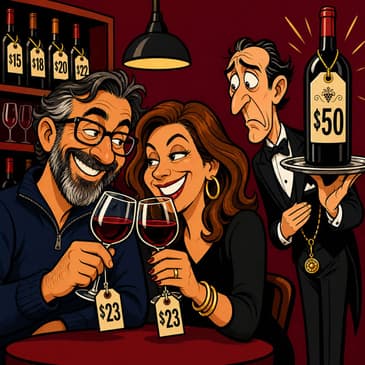
After more than 200 episodes, we are doing something we have never done before. We are doing a head-to-head comparison of two wines that are from the same grape, same year and the same region and have high ratings from reputable wine reviewers, but one is twice as expensive as the other. And we want to know - can we actually tell the difference between these two wines that have such different price points. Does a more expensive wine taste better or bring you more joy? We will let you know! We also talk about why wine reviews can be unreliable (but not ours, heavens no!), and why Oregon Pinot Noir can be pricey. Hint: when you make great wine carefully, and you choose to work with a grape as finicky as Pinot Noir, and when you only make a small amount of wine, that shizz is going to be expensive. Rather than saying expensive, we would maybe say a luxury item. That sounds better. Wines reviewed in this episode: 2023 Soter Vineyards Planet Oregon Pinot Noir, 2023 Chehalem Estate Vineyard Pinot Noir
Send us a Text Message and we'll respond in our next episode!
Contact The Wine Pair Podcast - we’d love to hear from you!
Visit our website, leave a review, and reach out to us: https://thewinepairpodcast.com/
Follow and DM us on Instagram: https://www.instagram.com/thewinepairpodcast/
Send us an email: joe@thewinepairpodcast.com
Show Notes
Episode #215: Experts Loved the $50 Oregon Pinot Noir. We Chose the $23 Bottle! 00:00
Carmela, Oregon Pinot Noir is all the rage. Especially for you. And so today we're doing something we have never ever done before.
Oh wow.
We're going to head-to-head taste a less expensive under $25 Pinot Noir with one that's more than twice as expensive. Both from the same vintage, both from Oregon's Willamette Valley, and we're going to see if we can actually taste the difference between the two.
It's going to be fun.
Spoiler alert, they are different.
Very.
But which one did we like better? You gotta listen to find out.
Key Questions We Answer
- Is the more expensive Oregon Pinot Noir actually worth it?
- Can you find a good Oregon Pinot Noir for under $25?
- Why does Oregon Pinot Noir cost more than most wines?
- What food pairs well with Oregon Pinot Noir?
Episode Overview and First Thoughts on Oregon Pinot Noir 00:40
Hello fellow Pinot Nuts or Pinot Nots! And welcome to The Wine Pair Podcast. I’m Joe, your sommelier of reasonably priced wine, and this is my wife and my wine pairing partner in crime, Carmela. And we are The Wine Pair!
If you're new to our podcast, here's what we do: Every week we buy wines under $25 with our own money, taste them, and give you our brutally honest opinion on whether they're worth buying. Nobody pays us to review specific wines, we don't accept free bottles from wineries, and we're not afraid to call out a bad wine when we taste one. Decanter Magazine calls us fun, irreverent, chatty, and entertaining - so if that sounds like your vibe, welcome to our tribe of wine lovers.
Alright, Carmela, today we are going to do something we have not done before, and that is do a head-to-head tasting and comparison of a less expensive wine versus a more expensive wine to see if we can really tell the difference. Today, we have an Oregon Pinot Noir that is under $25 and is highly rated, in fact, it is a wine that has received 90 ratings from Wine Spectator and Wine Enthusiast and an 89 from Vinous, so is is no slouch, and if it is good, would be a killer wine from value perspective, and we are comparing it to an Oregon Pinot Noir that retails for $50 and has a 93 from Wine Spectator, a 92 from Wine Enthusiast and an Editor’s Choice award, and a 94 from sucky James Suckling.
So, this is not a head to head of a crappy wine and a good wine of the same varietal and region. This is not a joke, people. This is a head to head of two wines that have good ratings and come from the same region and same varietal. So it should be a fair fight.
I should note that we are not doing a blind tasting, and as you would guess, blind tastings are seen as the gold standard of wine tasting or really any comparison because you are not letting any factors other than the wine itself impact you - not the label or the price or the region or anything like. And so because we are not doing that, there is some potential bias that could sneak in and so we need to just admit that. But, in all honesty, most of the time all of you out there, and us, are not blind tasting wines. So, we will try as hard as we can to be open-minded in our tasting today.
But, something you should know about most of the wine reviews and wine tastings you read is that often, they are not totally unbiased. It is not unusual that wine reviewers either receive free bottles or receive commissions or are in some way compensated. And, in fact, many people are surprised that we buy our own wines because most wine podcasts, etc. likely do not. For instance
- Major publications, including Wine Enthusiast and Decanter, explicitly state that they may earn commissions from affiliate partners when readers purchase wines through links on their sites.
- Professional tasting panels that evaluate thousands of bottles annually (sometimes upwards of 2,000 per reviewer) often are tasting wines that have been submitted for review by the producers themselves, something we won’t do
- While some organizations prioritize blind tasting, other reviewers evaluate wines while working with the winery or winemaker, which can introduce further social or professional bias
There is no clean number that I could find showing how often professional wine reviewers are outright paid to review or endorse wines, but there is plenty of smoke around the issue. In one of the biggest scandals, allegations around Robert Parker’s Spain operation claimed it was charging wineries for access to Wine Advocate critic Jay Miller, and while an investigation said it found no evidence Miller himself received anything of value, it still concluded the whole setup created an “appearance of impropriety.” James Suckling, who you who listen to us know we think is a hack, also faced accusations that he had been paid about CAN$24,000 by Quebec’s SAQ for tasting sessions, though Suckling said any money was for videos, not for tasting wines. And in New Zealand, the issue got even more concrete, with reporting that some reviewers or review businesses openly charged fees tied to reviews. So, it’s out there.
Another thing to take into consideration is that there has been a lot of research done into the consistency of experts, and the results are not great. So, even if reviewers are on the up and up, they may not be able to give great reviews.
- Statistical analysis of major wine competitions found that tasting results can be really inconsistent. A study at the California State Fair secretly presented judges with samples from the same bottle three times. The results showed that even trained professional palates frequently gave significantly different scores to identical wines.
- The study also concluded that the objective evaluation of large numbers of wines, and in some of these competitions they may taste 50 or more wines, is "beyond human ability" and that medals are often distributed "at random.” This is often called Testing Fatigue
- The tasting order (which wine came before or after another in a tasting) and bottle variation (slight differences between two bottles of the same wine) can cause an expert to rate the same vintage differently
- Even a person's mood and the temperature of the room can shape perception even if the taster is unaware of it. You may just be having a bad or good day!
- There is also just a clustering problem. Most professional wine ratings are currently clustered within a very narrow band, typically between 84 and 96 points, which brings the quality of the ratings into question.
- MRI scan experiments have shown that when tasters are told a wine is expensive, the "reward and motivation" centers of their brains activates, meaning the perception of price impacts the taste experience regardless of the wine's actual quality
So, here is our take on the issue, and how we approach it because having you all trust us is absolutely critical for us. We feel like all of our credibility is baked into the fact that you can trust our reviews and ratings, whether you agree with them or not.
- First, as we always let you know, we buy all of our own wine, and we will not review a wine that has been sent to us. We are very straightforward on that issue when winemakers reach out to us, and that is why we interview them rather than tasting and reviewing their wins.
- We also openly admit that we have a specific palate and set of taste preferences and that what we like may not be what you like, and so, rather than expecting you to agree with us or assuming we are always right, we just want you to use us as a reference point.
- We try to be very credible by tasting wines that we have not tasted before on the show and giving you our honest opinion about them, whether we like them or not. Most wine reviewers only tell you about the wines they like. We tell you both - wines we like, wines we don’t like, and also wines we are mid on.
- We have our own 10 point scale because we think 100 point scales appear more precise than they are, and we don’t think there is a meaningful difference between a 90 and a 91 score. We do think, though, that there is a big difference between a 6 and an 8 or even a 7 and a 9. Those are vastly different scores for us and so we try to keep it pretty simple and pretty clear what our ratings mean.
So, we know we are not perfect, but we want to be as objective, honest, and reliable in giving you our ratings and reviews as possible.
And on that note, we have these two Oregon Pinot Noirs we need to taste and review to let you know if we can tell the difference between one that is twice as expensive as the other, and again both of the wines have strong professional ratings, and we’ll talk a little bit more about Oregon Pinot Noir . . .
But first . . . we have to do our shameless plug.
Thank you for listening to us and for supporting our show, and know that we buy all of the wine we taste and review every week so that we can give you real and honest reviews. If you like what you’re hearing, please subscribe to our podcast and leave us a five star rating and review so we can grow listeners.
We also love to hear from you and we always respond so you can follow us on Instagram and Bluesky at thewinepairpodcast. You can contact us on our website thewinepairpodcast.com, and you can sign up for our email newsletter there and you can also send us a note at joe@thewinepairpodcast.com and let us know about wines your want us to review or just shoot the breeze, we love chatting it up.
And, as we do every week, we’ll tell you someone we think you should recommend The Wine Pair Podcast to - because the best way for us to grow listeners is when you tell your family and friends about us - and this week, we want you to recommend us to anyone who loves Pinot Noir but wants to know if they can actually find a Pinot Noir that is good that is not super expensive because this may be the episode for them.
Topic: WTF Makes Oregon Pinot Noir Special, and Can You Get It for a Reasonable Price? 12:07
Many of you know that we love Pinot Noir, and I am starting to get a real feel and affection for Oregon Pinot Noirs. The reason why it has taken some time for me to get into them is that I had to sort of work through different producers of their Pinot Noir to find ones that I really like, and because they are at a relatively high price point so it can be an investment to get into them, and so price I will get to in a minute. On a total side note, my favorite right now is Audeant, so you can put that in your brain box.
Back on the price point, we don’t do a lot of Oregon Pinot Noir on this podcast, though, because despite the fact that it is considered high QPR for its quality - QPR is a term we and other wine nerds use that means high quality to price ratio, and it sort of the purpose of our podcast but I digress. But, the truth is that despite this high QPR reputation, as we said most Oregon Pinot Noir price points are just too high for our podcast. And there are some reasons for that.
Overall, Oregon Pinot Noir is intentionally positioned within the higher-priced segments of the wine market. To start there, you can basically find more or less three tiers of Oregon Pinot Noir pricing:
- Entry-Level and "Best Buys" ($20–$35): Contrary to the perception that all Oregon Pinot is expensive, there are numerous well-rated options in this range like Ken Wright and ElkCove and we like a little winery called Compton. These are often blends from multiple vineyards across the Willamette Valley designed to offer consistent quality at a more accessible price - however, all of that is relative because for many people, $35 is a lot to spend on a bottle of wine anyway
- The next level are Estate and Sub-appellation Bottlings ($40–$80): This is where a large portion of the region’s specialized production sits. These wines often come from older, more established sub-AVAs like the Dundee Hills or Eola-Amity Hills, and examples include Cristom Mt. Jefferson, Domaine Drouhin, The Eyrie Vineyards
- Then there are the Luxury and Single-Vineyard Reserves ($100–$600+): At the top of the scale, prices escalate significantly for small-parcel productions, but are still below top tier Burgundy.
So, Oregon Pinot Noir does have some variation in price, and some may find it actually reasonable for the type and quality we are talking about. But, the question is, just why is it more expensive than the average wine. Well, growing and making any wine is not a low-cost endeavor regardless, but there are a few things that impact the price of an Oregon Pinot.
- The "Heartbreak Grape": Pinot Noir is notoriously difficult and fussy to grow. Its thin skins make it susceptible to sun damage, rot, and frost, requiring intensive management and they still may have a bum year, making it a high-risk, high-cost crop for farmers
- Small-Scale Production: Oregon is a region of "mom-and-pop" wineries rather than corporate giants. Approximately 70% of Oregon wineries produce fewer than 5,000 cases per year, meaning they cannot benefit from the economies of scale that allow regions like California’s Central Valley to produce $10 bottles
- High Land and Labor Costs: As the region's reputation has grown, land in the Willamette Valley has become increasingly expensive. Additionally, many premium producers use labor-intensive hand-sorting and pruning rather than machines to ensure quality, and so that care costs money
So, there are good reasons why Oregon Pinot Noir is not exactly cheap, but it kind of is considered one of the "value" entry points into the world of premium wine - an affordable luxury if you will, even if it remains more expensive than what most people will normally buy. Remember, a high quality wine from Burgundy will be many times more expensive than a wine of similar quality from the Willamette Valley, so it’s all relative
For a little more information on the Willamette Valley AVA, which stands American Viticultural Area, which is an official designation in the US, when you buy a bottle of Pinot Noir from Oregon, you may see it just says Willamette Valley, or you may see a specific sub-appellation like Eola-Amity Hills. If it just says Willamette Valley, that means it is going to come from some blend of grapes from the 11 different sub-appellations of Willamette Valley. If you do see the specific sub-appellation, these are the ones that are considered the top 5
- Dundee Hills is widely considered the most famous and established sub-appellation in Oregon and it is the birthplace of Oregon Pinot Noir dating back to 1965. It is known for an elegant style of Pinot Noir with bright red fruit flavors like cherries and raspberries, along with earthy mushroom notes
- Yamhill-Carlton is next, and it is known for its powerful or “muscular” wines with darker fruits and baking spices. The Soter wine we are drinking today is in the Yamhill-Carlton AVA, although the wine itself is a blend.
- Eola-Amity Hills is next and it has a growing reputation for high-scoring wines that are known for crisp acidity and a firm tannins, often with flavors of raspberry and black fruit with distinct spicy notes
- Ribbon Ridge is the smallest sub-appellation in the Valley and is considered prestigious. It produces wines that are said to have distinct aromas of dried rose petals, hibiscus, and citrus.
- Chehalem Mountains is the last and largest, and in fact Ribbon Ridge is actually a sub-appellation of Chehalem, the other being Laurelwood which will come up in a few minutes. Because it is so vast, the style is harder to pin down, but it is known for wines with sturdy tannins with bright acidity
But that’s enough information. I think it’s time to learn a little more about the specific wines we are drinking today. Whaddya say?
Highly Rated But Differently Priced Oregon Pinot Noir Wines We Chose for This Episode 20:13
Usually the wines we choose for our episodes are under $25 each, but in this case one is under $25, and the other sells for $50. Both of these wines should be relatively easy to find because I bought one on wine.com, and the other you can find online at the winery’s website. You will have no trouble finding Oregon Pinot Noir in the United States, but you are most likely to find more mass produced wines like Underwood, A to Z, and Erath. If you want the really good ones, you are going to have to hunt around. As always, go to your local wine merchant and they will be more than happy to find you a great Oregon Pinot Noir. And, by the way, this last week I was in Vegas and had two excellent Oregon Pinots, one from Lingua Franca and the other Beaux Freres.
The first wine we are going to drink today is the 2023 Soter Vineyards Planet Oregon Pinot Noir, and this is the less expensive wine. Again, this wine got 90 ratings from both Wine Spectator and Wine Enthusiast, and Vinous gave it an 89, so all good scores. There was a tech sheet for this wine, which is helpful.
The wine is just labeled as Willamette Valley, and they don’t say specifically where the grapes are from, so we can assume it is a blend of Willamette Valley Pinot Noir grapes. The tech sheet says the wine was fermented using traditional methods like small, open top vessels, that it was aged for 8 months in 100% used French oak barrels. Remember that French oak is a lighter oak than American, and the fact that they use used oak means that they are just trying to get some oxygen on the wine, not oak flavors because used oak is often called neutral oak because it does not impart oak flavor to the wine.
They also call out that 89% of the wine is LIVE certified, and the remaining 11% is organic. LIVE, if you do not know, stands for Low Input Viticulture and Enology and it is a is a rigorous, third-party sustainability standard for vineyards and wineries in the Pacific Northwest that verifies that winegrowers use environmentally friendly, socially responsible, and science-based practices to promote soil health, biodiversity, and ethical labor. We have a link in our show notes if you want to learn more: https://livecertified.org/ Soter also gives 1% of their sales to the Oregon Environmental Council. So, you can feel good about drinking these wines.
The next wine we are going to drink is the 2023 Chehalem Estate Vineyard Pinot Noir, and full disclosure, we have interviewed the winemaker Chehalem and we did visit their tasting room when it opened, but we bought this wine ourselves, and we will endeavor to give and honest and unbiased review in the podcast today. Have faith!
This wine got some strong ratings as well as we mentioned earlier including a 93 from Wine Spectator who I really trust. There was also a good tech sheet for this wine, so what I can tell you is that the wine is from the Chehalem Mountain AVA, specifically the Laurelwood District which is, if you remember, a sub-appellation of the appellation that was just established in 2020. Laurelwood is at a higher elevation which gives it good acidity, and the soil is said to give the wine a distinct mineral edge.
One thing I like is that they tell you the Pinot Noir clones they use, which in this case is 90% Pommard clone and 10% clone 777, and these were planted in 2008, so they are still relatively young vines. They also say after harvest, this wine was destemmed and fermented in open-top stainless steel tanks. It was aged in 31% new French oak barrels for ten months before blending and bottling. So, they have some new oak on the wine which will impart flavors.
If you are a real wine nerd, Pommard and 777 are two of the most popular Pinot Noir clones, with Pommard being famous for high tannins, intense earthiness and savory notes, and dark cherry. 777 is a Dijon clone, and is known for being very aromatic, with cola like qualities, and a velvety texture.
But, I think that is enough information - let’s get to drinking! We’ll take a quick break and be right back. And, if you have these wines or similar wines, drink along with us to get some participation points, which you can trade-in for free stickers. You just need to send me an email with your mailing address, and I will get those “I drink with The Wine Pair Podcast” stickers over to you!
LINKS TO SOURCES FOR THESE SPECIFIC WINES
- https://static1.squarespace.com/static/5e3a5536ac71fc660508f195/t/681160707100c605a9981fd2/1745969267020/23pop_sheet_print.pdf
- https://shop.stollerwinegroup.com/wp-content/uploads/2026/02/2023_CHE_SV_ChehalemEstatePN_TechSheet.pdf
2023 Soter Vineyards Planet Oregon Pinot Noir, 2023 Chehalem Estate Vineyard Pinot Noir Wine Tasting, Pairing, and Review 28:45
Wine: Soter Vineyards Planet Oregon Pinot Noir (Click here if you want to find this wine on wine.com. We may be compensated if you purchase)
Region: Oregon, Willamette Valley
Year: 2023
Price: $22.97
Retailer: wine.com
Alcohol: 13.5%
Grapes: Pinot Noir
Professional Rating: WS 90, WE 90, V 89 Vivino 3.9
What we tasted and smelled in this Soter Vineyards Planet Oregon Pinot Noir:
- Color: Burgundy red, ruby red
- On the nose: Strawberry, raspberry, red berries, cherry, cherry licorice, Twizzler, alcohol heat, cinnamon bear, pine forest, earth
- In the mouth: A little young - could probably use more air or age, tart cherry, Rainier cherry, cherry liqueur, cherry jelly as it warms up, tight tannins
Food to pair with this Soter Vineyards Planet Oregon Pinot Noir: Eggplant parmesan, bolognese sauce, pasta with red sauce, lasagna, rolled flank steak, braised meats, a fall wine, stew wine, steak, shish kebab, Mediterranean foods
As a reminder on our rating scale, we rate on a scale of 1-10, with no half points, where 7 and above means that we would buy it, and 4 and below means that we are likely to pour it down the sink, and a 5 or 6 means we are likely to drink it and finish it, but we are probably not going to buy it.
Soter Vineyards Planet Oregon Pinot Noir Wine Rating:
- Joe: 7/10
- Carmela: 7/10
Wine: Chehalem Estate Vineyard Pinot Noir (Click here if you want to find this wine on wine.com. We may be compensated if you purchase)
Region: Oregon, Willamette Valley
Year: 2023
Price: $50
Retailer: Winery
Alcohol: 14.1%
Grapes: Pinot Noir
Professional Rating: WS 93, WE 92 & Editor’s Choice, JS 94 Vivino 4.0
What we tasted and smelled in this Chehalem Estate Vineyard Pinot Noir:
- Color: Ruby red, bright, a bit of orange on the edges
- On the nose: Earthy, vegetable, umami, not a ton of fruit, grilled green pepper, flowers, stinky field flowers, a little bit of cherry, grandma’s perfume, potpourri, incense, Italian herbs like oregano
- In the mouth: Very earthy, blackberry jam, blackberry bramble, tart blueberry, spice, cinnamon, clove, Dr. Pepper, blue fruits, smoky, tight tannins, very different wines
Food to pair with this Chehalem Estate Vineyard Pinot Noir: A good steak wine, cheeseburger, sausages, fatty meats
Chehalem Estate Vineyard Pinot Noir Wine Rating:
- Joe: 7/10
- Carmela: 6/10
Which one of these are you finishing tonight?
- Carmela: Soter Vineyards Planet Oregon Pinot Noir
- Joe: Soter Vineyards Planet Oregon Pinot Noir
The Test: Did we nail the taste profiles expected from Willamette Valley Pinot Noir? 44:54
- General
- Willamette Valley Pinot Noir is celebrated for its elegance, balancing bright red fruit with earthy, savory undertones and high acidity. Common flavor profiles include red cherry, raspberry, cranberry, and strawberry, often accented by forest floor, black tea, cola, and baking spices. These wines are typically light- to medium-bodied, featuring silky tannins.
- Soter Vineyards Planet Oregon Pinot Noir
- Winery: A lively expression of Willamette Valley Pinot Noir, this wine bursts with juicy notes of ripe cherry, raspberry, and red plum. Delicate hints of rose petal and a whisper of soft spice add depth and intrigue; the finish is vibrant and fruity,
- WS: Snappy and fan-friendly, with lively flavors of cherry, pomegranate, and tarragon that end with zesty tannins.
- WE: Fresh aromas of mint, saline, fresh and dark raspberries form a perfume worthy of summer. Tingly acidity then joins forces with integrated tannins and the smoothest texture this side of cashmere. The wine's boysenberry, orange peel and dark chocolate flavors cement the deal.
- V: Lifts from the glass with vibrant black cherry and shavings of pine complemented by mentholated herbs. Juicy to the core, it splashes across the palate with ripe wild berry fruit. A flourish of inner florals punctuates the close. Fresh yet a bit short, it tapers off with a pleasantly bitter tinge and berry concentration.
- Chehalem Estate Vineyard Pinot Noir
- Winery: Aromatically, this wine is complex and constantly evolving, with a vibrant mix of dark red fruit leaping from the glass. Floral notes of violets and rose petals are complemented by hints of sweet and savory spices. On the palate, it is bold yet layered, with silky tannins that coat the mouth. The oak influence is integrated into a vibrant structure, leading seamlessly into a balanced, refined finish.
- WE: The wine's earthy nose mixes wet modeling clay with touches of saline, violets and a whole lot of blackberries. Velvety tannins and lively acidity bolster flavors like tart blackberry, elderflower and mint. The wine's texture is lithe and nimble.
What is the verdict on Oregon Pinot Noir? 47:13
We love them. It’s fun to try different versions and labels to really taste the differences between them. You have to try different styles to really understand what you like, because they are very different.
Listener Shoutouts 48:42
We have some fun listener shoutouts for this week, and we so appreciate when you reach out to use and tell us what you think, or what you are drinking, and so here are some shoutouts:
- Corinne - Alsace sylvaner, planting Syrah
- Ryan - Game Night - filmed in his neighborhood!
- Adrienne - drink an Austrian pinot this past weekend and a new world Riesling from Australian producer that you could mistake as an old world German Riesling, it was so good
- Shekar featured in a Forbes article: https://www.forbes.com/sites/lizthach/2026/04/22/mastering-the-art-of-pairing-wine-with-indian-cuisine/
- Brian from https://www.wendelinvines.com/
Wines coming up in future episodes in case you want to drink along with us 50:12
- Viurna / White Rioja
- 2 Buck Chuck
- 2023 Charles Shaw California Chardonnay
- 2023 Charles Shaw California Cabernet Sauvignon
- Lebanese wines
- Italian Sangiovese, but not Chianti
- 2022 Cantina Roccafiore Melograno
- 2021 Di Majo Norante Sangiovese
- Alsace Pinot Gris
- 2020 Pierre Sparr Pinot Gris
- 2020 Frey-Sohler Vielles Vignes Pinot Gris
- Frappato
Outro and how to find The Wine Pair Podcast 50:43
Thank you for listening to us and for supporting our show, and remember, we buy all of our own wine and we do all of the writing and recording and editing to bring you a show every week because we absolutely love doing it, and our small little ask for you is that you please follow or subscribe to our podcast and also please leave us a nice rating and review to help us grow our listeners - and a huge thank you to all of you who have done so already!
You can also follow us on Instagram and Bluesky at thewinepairpodcast. You can contact us on our website thewinepairpodcast.com, and you can sign up for our email newsletter there and you can also visit our “Shop Wine” section where you can find links to buy the wines that we rate as buys in each episode. I will also note that on our website, if you are curious about a wine we have covered in the past, we do have a pretty good search functionality, so you can use that find wines you want to know more about.
And we want to make content you care about and you like, so send us a note or DM us and give us some feedback or let us know if there are wines you want us to try or wine making areas of the world you are curious about - and we’ll take care of it! joe@thewinepairpodcast.com
Alright, with that, we are going to sign off, so thanks again, and we will see you next time. And, as we say, life is short, so stop drinking shitty wine.
RESEARCH ARTICLES AND LINKS FOR THIS EPISODE
- https://www.wineenthusiast.com/basics/the-essential-guide-to-pinot-noir/
- https://www.wineenthusiast.com/culture/what-makes-pinot-noir-pinot-noir/
- https://www.wine-searcher.com/grape-384-pinot-noir
- https://www.decanter.com/wine/grape-varieties/pinot-noir/
- https://www.masterclass.com/articles/wine-101-what-is-pinot-noir-how-to-serve-pinot-noir-and-how-to-pair-pinot-noir
- https://en.wikipedia.org/wiki/Pinot_Noir
- https://www.wine-searcher.com/select/oregon-pinot-noir
- https://www.wine-searcher.com/regions-oregon
- https://www.wine-searcher.com/regions-willamette+valley
- https://www.decanter.com/wine/wine-regions/oregon-region/
- https://www.wineenthusiast.com/region/willamette-valley/
- https://www.wineenthusiast.com/culture/willamette-valley-turns-40/
- https://en.wikipedia.org/wiki/Oregon_wine
- https://en.wikipedia.org/wiki/Willamette_Valley_AVA
- https://en.wikipedia.org/wiki/History_of_Oregon_wine
- https://en.wikipedia.org/wiki/The_Eyrie_Vineyards
- https://en.wikipedia.org/wiki/David_Lett
- https://en.wikipedia.org/wiki/Dundee_Hills_AVA
- https://en.wikipedia.org/wiki/Eola-Amity_Hills_AVA
- https://en.wikipedia.org/wiki/Yamhill-Carlton_AVA
- https://www.wine-searcher.com/m/2025/09/is-expensive-wine-a-scam
- https://www.decanter.com/wine-news/brain-makes-expensive-wine-taste-better-374464/
- https://www.decanter.com/wine-news/wine-price-taste-study-454675/
- https://www.wine-searcher.com/m/2022/11/weighing-wine-scores-against-price
- https://www.wine-searcher.com/m/2026/01/whats-the-point-of-points
- https://www.wineenthusiast.com/basics/what-does-price-say-about-your-wine/
- https://www.wineenthusiast.com/basics/drinks-terms-defined/what-is-qpr-in-wine/
- https://en.wikipedia.org/wiki/Blind_wine_tasting
- https://www.wineenthusiast.com/culture/wine/blind-wine-tasting-rate-fairly/
- https://www.youtube.com/watch?v=21dc0Q_rmr4
- https://www.youtube.com/watch?v=g04Jn78TwmE
- https://www.wineenthusiast.com/ratings/wine-ratings/how-oregon-became-a-pinot-noir-paradise/
- https://www.wine-searcher.com/m/2020/09/oregon-wine-industry-continues-to-grow
- https://www.wine-searcher.com/m/2021/06/heat-the-burning-issue-for-oregon-winemakers
Support The Wine Pair Podcast by heading to our website and shopping for the wines we give our highest ratings to in our Shop Wines section. Just click on this link - you pay the same price, and we may get a small amount of compensation.
You can also support us by clicking on this affiliate link to wine.com and find great wines under $20!
And, if you are looking for a great website builder for your podcast, click on this link to use the service we use and love: Beamly, formerly known as Podcastpage.io
KEY INSIGHTS & FREQUENTLY ASKED QUESTIONS
Q: Is expensive Oregon Pinot Noir actually worth it?
A: Not necessarily. Joe and Carmela tasted a $23 bottle against a $50 bottle, both with strong critic scores, and both chose the cheaper wine as the one they'd finish that night. More money does not guarantee a better bottle.
Q: Can you find a good Oregon Pinot Noir for under $25?
A: Yes. The 2023 Soter Vineyards Planet Oregon Pinot Noir costs around $23 and earned 90-point scores from Wine Spectator and Wine Enthusiast. Joe and Carmela both rated it 7 out of 10, which on their scale means buy it.
Q: Why is Oregon Pinot Noir more expensive than most wines?
A: Pinot Noir is notoriously hard to grow, most Oregon wineries are small family operations that produce very little wine, and land in the Willamette Valley has gotten expensive as the region's reputation has grown. It is still far cheaper than comparable Burgundy, which is where the "affordable luxury" reputation comes from.
Q: What food pairs well with Oregon Pinot Noir?
A: Oregon Pinot Noir is a solid food wine, but the style of the bottle matters. The Soter, with its cherry and red berry flavors, worked well with pasta, bolognese, and braised meats. The Chehalem had moreblackberry, spice, and savory herb character and wanted something fatty: steak, sausage, or a cheeseburger.
Q: Can you trust professional wine ratings?
A: Use them as a starting point, not gospel. Research shows that trained tasters frequently score the same wine differently when tasting blind, and many major publications earn affiliate commissions when you buy through their links. Joe and Carmela buy all their own wine and take no bottles from wineries, which is less common in wine media than most people realize.
Full Episode Transcript
Joe: 00:00
Carmela, Oregon Pinot Noir is all the rage.
Carmela: 00:04
Especially for you.
Joe: 00:05
And so today we're doing something we have never ever done before.
Carmela: 00:08
Oh wow.
Joe: 00:09
We're going to head-to-head taste a less expensive under $25 Pinot Noir with one that's more than twice as expensive. Both from the same vintage, both from Oregon's Willamette Valley, and we're going to see if we can actually taste the difference between the two.
Carmela: 00:24
It's going to be fun.
Joe: 00:25
Spoiler alert, they are different.
Carmela: 00:27
Very.
Joe: 00:28
But which one did we like better? You gotta listen to find out. All right. Hello, fellow Pinot Nuts or Pinot Nots, and welcome to the Wine Pear Podcast. I'm Joe, your simollier of reasonably priced wine, and this is my wife and my wine pairing partner in Crime Carmela. And we are the wine pear. Okay, if you're new to the podcast, here's what we do. Every week, we buy wines under $25. With our own money, we taste them and give you our brutally honest opinion on whether they're worth buying. Nobody pays us to review specific wines. We don't accept free bottles from wineries, and we're not afraid to call out a bad wine when we taste one. Decanter magazine calls us fun, irreverent, chatty, and entertaining. So if that sounds like your vibe, welcome to our tribe of wine lovers.
Carmela: 01:18
So you weren't crazy about that, uh I just I feel like you were trying too hard. No, but also it's like not hard enough, actually. Wow.
Joe: 01:27
Oh wow. Pinot nuts, you know, like you're nuts about Pinot. Okay, but it's part of the theme. It's part of the theme.
Carmela: 01:34
I know, and I do, I mean, it's a good college try. Always. Thank you. You're always very supportive. I shouldn't be critical, especially when I haven't come up with one.
Joe: 01:42
No, it's okay.
Carmela: 01:43
So I take that all back. Okay.
Joe: 01:44
No, it's no, but you don't have to. I don't want you to take it back. But Carmela, today we're going to do something we have never done before.
Speaker 3: 01:50
Uh-huh.
Joe: 01:51
And that is do a head-to-head tasting and comparison of a less expensive wine versus a more expensive wine to see if we can really tell the difference. Okay. So today we have an Oregon Pinot Noir that's under $25 and is highly rated. In fact, it's received 90 ratings from multiple sources, so it's no slouch. And if it's good, it'll be a killer value. And we're comparing it to another Oregon Pinot Noir that retails for 50 bucks. Wow. And has a 93 rating from a really reputable source and a 94 from Sucky James Suckling. So that doesn't count.
Carmela: 02:23
Wow, 94 though, James. Yeah.
Joe: 02:25
Yeah, I know. He never does that. Oh my gosh. So this is not a head-to-head of a crappy wine and a good wine of the same varietal and region. This is not a joke. This is dead serious today. This is serious.
Carmela: 02:38
You have your serious pants on?
Joe: 02:40
I've got my serious underwear on. And this is a head-to-head of two wines that have good ratings, come from the same region and same varietal, and we want a fair fight.
Carmela: 02:48
Wow. Nothing below the belt.
Joe: 02:50
Nothing below the belt. Now I should note, Carmelo, that we are not doing a blind tasting. And as you would guess, blind tastings are seen as sort of the gold standard of wine tasting, or really any comparison, because you're not letting any factors other than the wine itself impact you. Not the label or the price or the region or anything like that.
Carmela: 03:09
Or the vibe. We're not, I mean, we don't really, we're not very vibey down here anyway.
Joe: 03:13
We're in the basement, so it's not super vibey in the basement. And so because we're not doing that, there is some potential bias. We just have to be honest that could sneak in. And so we just, again, we want to admit that. But in all honesty, most of the time, you out there in listening land and us are not blind tasting wines anyway.
Carmela: 03:29
Right. I mean, blind being blindfolded, especially, is not fun.
Joe: 03:34
It's not fun. Right. So usually they don't blindfold you. No, I know. Okay. Um, so we'll, but we'll try as hard as we can to be open-minded and unbiased in our tasting today. But on that note, Carmela, because you're curious, I know I can tell from your face. Something you should know about most of the wine reviews and wine reviewers and wine tastings you read is that often they are not totally unbiased.
Carmela: 03:57
Right. They're not blindfolded.
Joe: 03:59
No, and it's not unusual that wine reviewers either receive free bottles or receive commissions or in some way compensated. In fact, many people are surprised when we tell them we buy our own wines because they assume that no, hey, you guys must get wine sent to you or something. We don't. We don't. We even if we do, we will not review them. And we're very honest about uh people who reach out to us about that. But here's some things to know like major publications, including Wine Enthusiast and Decanter, they do state that they may earn commissions from affiliate partners when readers purchase wines through their links on their websites.
Speaker 3: 04:32
Okay.
Joe: 04:33
Professional tasting panels that evaluate thousands of bottles annually often are tasting wines that have been submitted for review by the producers themselves. Again, something we don't do. And while some organizations prioritize blind tastings, other reviewers evaluate wines while working with the winery or the winemaker, like sitting right in front of them.
Carmela: 04:54
Oh my.
Joe: 04:55
So there's some that's right. So there's no clean number that I could come up with or find on the interwebs showing how often professional wine reviewers are outright paid or compensated to review or endorse wines, but there's some smoke around the issue, Carmela. Some smoke. So in one of the biggest scandals, allegations around Robert Parker's Spain operation claimed it was charging wineries for access to wine advocate critic Jay Miller. Oh. And while an investigation said it found no evidence Miller himself received anything of value, it still concluded the whole setup created an appearance of impropriety.
Carmela: 05:32
This is like wine in the news.
Joe: 05:34
It kind of is, but I, you know, this is so this is kind of a extended version of it, I guess.
Carmela: 05:38
Okay.
Joe: 05:38
Jimmy Suckling, and those of you who listen to us know that we think he's a hack. He also faced accusations that he had been paid about $24,000, Canadian dollars, by Quebec's SAQ for tasting sessions. Though Suckling said that the money was for videos, not for tasting wines. Yeah, right, Jim. All right. And in New Zealand, the issue even got more concrete with reporting that some reviewers and review businesses openly charged fees tied to reviews. So it's out there. It's out there.
Carmela: 06:11
I'm glad we're not one of them.
Joe: 06:12
We are not, you know what? That is something that we take very seriously, actually, that we are unbiased and we buy our own lines and all that stuff. You know, we say it all the time. It means something to us. Right. Now, another thing to take into consideration, Carmela, is that there has been a lot of research done into the consistency of experts. Because, you know, you trust these people and it's like they must know what they're talking about. Kind of like you probably think that maybe we know what we're talking about. And the results are not great. So even if the reviewers are on the up and up, you know, they're not taking any money, they may not be able to give great reviews. And here's some reasons why. Statistical analysis of major wine competitions found that tasting results can be really inconsistent. A study, this is a great one. A study at the California State Fair secretly presented judges with samples from the same bottle three times. And even trained professional palates frequently gave significantly different scores to the same wine. No.
Carmela: 07:08
Yes. You guys.
Joe: 07:10
Yes. The study also concluded that the objective evaluation of large numbers of wines, and in some of these competitions, they're tasting 50 wines, 100 wines, 200, they're tasting tons of wines is beyond human ability. And that medals are awarded basically at random.
Carmela: 07:27
Oh no. It's called That's kind of discouraging.
Joe: 07:30
It is. It's called testing fatigue. So if you if a reviewer is basing something off of a major like wine competition, probably not the best thing.
Carmela: 07:38
After a while, you're just like, I don't know. I don't know.
Joe: 07:40
It tastes like wine.
Carmela: 07:41
I just taste like the last one I drank.
Joe: 07:43
Yeah, I didn't taste the sh that one, so I guess it's better. The tasting order also matters.
Carmela: 07:48
I believe that.
Joe: 07:49
Yeah, the bottle you taste first matters like differently. It's good, you're gonna have a different impression than when you taste second. And then even a person's mood or the temperature of the room can shape perception. So if you're having a good day or a bad day, you may like rate your wine differently.
Carmela: 08:04
Of course.
Joe: 08:05
And then there's also the clustering problem. So most prof you probably noticed this, most professional wine ratings like Jimmy Suckling are clustered within a very narrow band, typically between 84 and 96 points. Which brings the quality of those ratings into question. Like, what's the difference between an 88 and a 90? I don't know. Do you know? It's a feeling. It's a it's a vibe.
Carmela: 08:27
I hate to say it. It could just be.
Joe: 08:29
Yeah. And then here's one more just thing just to bring it right to right home is that MRI scan experiments have shown that when tasters are told that a wine is expensive, the reward and motivation centers of their brains activate.
Carmela: 08:42
No. Yes. But how are they testing that?
Joe: 08:44
They're really they got an MRI, they got a they got them in the I don't know. Like when you spill the wine, I don't know. I don't know what. Maybe they just they're just you thought of that.
Carmela: 08:53
We're gonna actually we're gonna do an MRI on this guy's brain.
Joe: 08:56
This is where your tax dollars are going, my friends. Anyway, so here's our take on the issue, Carmella, because that's what really matters. What do we think, right? Right. Because we want you to trust us. It's critical that you trust us.
Carmela: 09:06
Is that what this is all about? That's it's about building trust. It's all about trust and mistrust with other people.
Joe: 09:11
That's right. Don't trust anybody else. Just trust us. Because we feel like all of our credibility, or at least a portion of it, is baked into the fact that you can trust our reviews and ratings, whether you agree with them or not, and that's actually part of it too. So, first, as we always let you know, we buy all of our own wine, and again, we don't review a wine that has been sent to us. We also openly admit, Carmela, that you and I have a specific palette, that we have kind of tasting preferences, that we may not like what you like. And so rather than expecting you all to agree with us or assuming that we're always right, we just want you to use us as a reference point.
Speaker 2: 09:47
Right.
Joe: 09:47
And then we try to be very credible by tasting wines that we have never tasted before on the show. So when we taste the wine, it's a new wine. It's very rare that we are tasting a wine on the show that we've already tasted before. And then we also tell you if we like the wine or we don't like the wine. Like most wine reviewers only tell you about wines that they like. They're only telling you the wines that they rate highly, but we're gonna tell you the ones we don't like too. And then the last thing is we kind of like this 10-point scale. We think it's pretty clear that if a wine's a five, it's very different than if it's an eight. It's just, it's it might, I think it's easier to deal with than like what is the difference between an 89 and a 91? I don't know. But the difference between a six and a 10 is huge.
Speaker 3: 10:28
Right.
Joe: 10:28
So we know we're not perfect, but we want to be objective and honest and reliable and giving you our ratings and reviews. And so that's that. And on that note, we have these two Oregon Pinot Noirs that we need to taste and review to let you know if we can tell the difference between the one that's twice as expensive as the other. And again, both of these wines have strong ratings, and so that's part of it.
Carmela: 10:49
And we'll talk a little bit more about Oregon Pinot Noir, but first you gotta do our shameless plug.
Joe: 10:55
That's right. So thank you for listening to us and for supporting our show. And we've said this now 47 times, but we buy all the wine we taste and review every week so that we can give you real and honest reviews. And so if you like what you're hearing, please subscribe to our podcast and leave us a nice five-star rating review so we can grow listeners. And thanks to everybody who's done that. We'd love to hear from you. We always respond. So follow us on Instagram and Blue Sky at the Wine Pair Podcast. You can contact us on our website, thewinepairpodcast.com. You can sign up for our email newsletter there, and you can always just send us a note at Joe at the winepairpodcast.com. Just let us know how things are going. Right. You know, and if you trust us, let us know. Do you trust us? Just say Joe.
Carmela: 11:33
I mean, maybe not.
Joe: 11:34
Just say Joe, we trust Carmella. We are not sure about you. No, I think you're very trustworthy.
Carmela: 11:38
Do you think so?
Joe: 11:39
Yeah.
Carmela: 11:39
After 30 years, I think you're very trustworthy. I can attest to that.
Joe: 11:43
30 years old. That's nice after being 30 years old. And as we do every week, we'll tell you someone we think you should recommend the wine pair podcast to because the best way for us to grow listeners is when you tell your family and friends about us. And this week, we want you to recommend us to anyone who loves Pinot Noir, but wants to know if they can actually find a Pinot Noir that's good and that's not super expensive, because this may be the episode for them.
Carmela: 12:06
Yes.
Joe: 12:06
So, Carmela, I think it's time to find out just what the f makes Oregon Pinot Noir special. What do you think?
Carmela: 12:13
I'm ready.
Joe: 12:13
Okay. Now many of you know that we do love Pinot Noir, and I'm starting to get a real feel and real affection for Oregon Pinot Noirs. And the reason why it's taken some time for me and Carmella to get into them is that I had to sort of work through different producers of Oregon Pinot Noir to find ones I really like, and because they are at a relatively high price point, most of them. So it can be an investment to get into them. And so price I will get into in a minute. And on a total side note, I don't even I don't even know why I'm bringing this up, Carmela. On a total side note, my favorite Oregon Pinot Noir right now is made by Audiont. So for those of you out there who are curious, put that in your $125. It is not. It is definitely $125. Oh wow. Okay, so back to price point. We don't do a lot of Oregon Pinot Noir on this podcast because despite the fact that it is often considered high QPR, QPR is the term that we and other wine nerds use that means high quality to price ratio, and it's sort of the purpose of our podcast. But the truth is that despite this high QPR reputation for Oregon Pinot Noir, as we said, most Oregon Pinot Noir price points are just too high for our podcast. Most of them are just over $25. And there's some good reasons for that. And overall, Oregon Pinot Noir is sort of intentionally positioned within the higher price segments of the wine market. So to start there, you can basically find about three tiers of Oregon Pinot Noir wine pricing. And this is what you're going to run into. There's entry level or best buys, those are between $20 and $35. These are usually blends from multiple vineyards across the Willamette Valley. They're consistent, they offer good quality. You know, even $35 for a lot of people is a lot of money to spend. So even at the low end, Oregon Pinot Noirs can be expensive for people. The next level are the estate and sub-appellation bottlings. Those range between $40 and $80. This is where most of the region's specialized production sits. And these often come from single AVAs like Dundee Hills or Iola Amity Hills. And there's a lot of good examples like Crystal and Domain Drowin and Audion is another one. And then there are luxury wines. And the luxury Oregon Pinot Noirs are $100 plus, sometimes $600 or more.
Carmela: 14:33
Oh boy.
Joe: 14:34
So Oregon Pinot Noir does have some variation in price. You can find them as low as $20. And some may find it actually reasonable for the type and quality of wine we're talking about. So me personally, I think for the price and for the quality, they're pretty darn good if you want a really good Pinot Noir. And then the question is just why is it more expensive than the average wine? Like, why is Oregon Pinot Noir just more expensive?
Carmela: 14:57
Good question. Do you know that answer? I do. Okay.
Joe: 14:59
So I mean, the very first thing just we should just say about winemakers in general is that especially smaller winemakers, they're doing God's work because it is hard work. You know, they have to buy the plots of land, they have to grow the grapes, they have to make the wine. It is not a low cost, it is a high cost, high involvement job. And so just from the get-go, you should know that wine has a higher price point. I'm not talking about the mass-produced wines. I'm talking about like artisan wines have a higher price point because these people are putting a lot of time and care into what they're doing. So that's just one. Another reason why is Pinot Noir is called the Heartbreak Grape for a reason. If you've ever seen the movie Sideways, you know this, but it's difficult to grow. It has thin skins, it's susceptible to sun damage and rot and frost.
Carmela: 15:47
They're kind of high maintenance.
Joe: 15:48
High maintenance. So that alone increases the price. The second is like I was saying, Oregon has a lot of small-scale producers. Oregon is a region of mom and pop wineries. Approximately 70% of Oregon wineries produce fewer than 5,000 cases a year.
Speaker 3: 16:06
Wow.
Joe: 16:07
So they they are small organizations. They don't benefit from economies of scale. And so that's why they can't sell their wines for 10 bucks. They have to price them at the point that they're that cost them to make, and so they can make a little bit of profit.
Carmela: 16:19
Well, right.
Joe: 16:20
And then there's high land and labor costs. So as the region's reputation has grown, land in the Willamette Valley where it's good to grow grapes is getting more expensive. And then premium producers, which a lot of these Oregon Pinot Noir makers are, they're very artisan, they care about it. They use labor-intensive practices like hand sorting and hand pruning rather than machines. And so that type of care costs money. And another thing that I'll bring up too is that a lot of them are organic, sustainable farms. So they're not using cheap shortcuts to with things like fertilizers and stuff. So they really, there's a lot of care in there. So there are a lot of good reasons why Oregon Pinot Noir is not exactly cheap. But I will say it is kind of considered one of the value entry points into the world of premium wine. And I might even call it an affordable luxury, even if it remains more expensive than what most people will normally buy. And I think one thing to remember is that a burgundy, again, burgundy is pinot noir, you know, red burgundy is pinot noir. You're gonna spend a lot more money for a similar quality wine when it comes from France. Right. So you should just know that. Now, a little bit more information on the Willamette Valley. So the Willamette Valley is a specific AVA, and AVA stands for American Viticultural Area. This is all of the wine-growing areas in the United States that are officially recognized are called AVAs. And so when you buy a bottle of Pinot Noir from Oregon, you may see that it says just Willamette Valley, or you may see a specific subappellation, like we said, Aeola Amity Hills. If it just says Willamette Valley, it's gonna come from a blend of grapes from one of the 11, one or more of the 11 different AVAs or subappellations within Willamette Valley. But if you do see a specific sub-appellation, here are the ones that most people consider the top five.
Speaker 2: 18:09
Okay.
Joe: 18:10
I would say all of them are very good. These are kind of critics consider the top five. Dundee Hills is considered the most famous, and it's the first. It's the birthplace of Oregon Pinot Noir. It's known for an elegant Pinot Noir. Yamhill Carlton is the next, and it's known for powerful or muscular wines with darker fruits and baking spices. And the the soda wine that we're drinking today is in the Yamhill Carleton AVA, but it's a blend.
Carmela: 18:38
Now, are you gonna tell me which one is the more expensive one?
Joe: 18:41
Yeah, we'll know because we always do that. We always talk about the price. So you will know. The next of the top five is Aeola Amity Hills. It has a reputation for high-scoring wines that are known for crisp acidity and firm tannins. Then there's ribbon ridge. Ribbon Ridge is the smallest sub-appellation in the valley, and it's considered very prestigious. And then there's Shahalam Mountains, and that's the last and largest. And in fact, Ribbon Ridge is actually kind of a sub-appellation of Shahalam Mountains. And the other one is Laurelwood. So remember that because that will come up. But because the Shehalem Mountains are kind of vast, it's a little bit hard to pin them down, but they are known for wines with sturdy tannins and bright acidity. So if you're looking for an Oregon Pinot, those are sort of the five that you should be looking for. Now, I'm not going to say that there aren't great ones you can find in the other ones, but as a shortcut, if you're starting out, those would be great places to look. And you can always go to our show notes. Did you know we have show notes? I knew that. Yeah, you can go to our show notes and in this look for this episode, and you can you don't have to memorize it. There's no test. Wow. You can just go to the show notes and guys, yeah.
Carmela: 19:45
No pressure. No pressure. Just the fact that you said that puts a little pressure on you.
Joe: 19:50
No, no, there's no. I'm saying there's no pressure. You just go on your phone right now. Go on your phone, look up the winepairpodcast.com, find this episode, look for the show notes, and you'll see those five appellations there.
Carmela: 20:01
Okay, okay. That's it. Participation points for that.
Joe: 20:04
Why not?
Carmela: 20:04
Stickers.
Joe: 20:05
Why not? But Carmela, I think that's enough information. I think it's time to learn a little bit more about the specific wines we're tasting today. What do you say? Let's do it. Okay, well, now usually the wines we choose for our episodes are under $25 each. But in this case, as we've been mentioning, one is under $25 and the other sells for $50. So a good, you know, one's twice as much as the other. And both of these wines should be relatively easy to find because I bought one on wine.com. And the other you can find on the winery's website. We'll give you more information about that. And you'll have no trouble finding Oregon Pinot Noir if you live in the United States. Outside the United States, maybe less less easy. But the ones you're most likely to find are the mass-produced ones like Underwood, A-Z, and Erath. If you want the really good ones, you're gonna have to hunt around. And as always, go to your local wine merchant and they will be more than happy to find you a great Oregon Pinot Noir. And by the way, I mentioned this, Carmela. I was I was out on a little trip to Vegas and I came home last night and I told Carmela that I had two excellent Pinot Noirs from Oregon there.
Carmela: 21:09
But they were not under $25.
Joe: 21:12
They were, I mean, a glass of one of them was about $22. But one was Lingua Franca and the other was Beaufrere. So those are really good ones that I like a lot, and the wines were delicious. Okay. The first wine we're gonna drink today is the 2023 Sodered Vineyards Planet, Oregon Pinot Noir. And this is the less expensive wine. So I am telling you, Carmilla.
Carmela: 21:33
Okay.
Joe: 21:34
This wine got a 90 rating from Wine Spectator, a 90 rating from wine enthusiasts, and Vinius gave it an 89. So these are really good scores, especially for uh, you know, an Oregon Pinot Noir. The wine is labeled, I found a text sheet. The wine is labeled as Willamette Valley. So they don't specifically say where the grapes are from, so we can assume it's a blend of Willamette Valley Pinot Noir grapes. The text sheet says the wine was fermented using traditional methods like small open top vessels. It was aged for eight months in 100% used French oak barrels. So remember that French oak is the lighter oak. It's a lighter oak than American. And the fact they use used oak means that they're really trying to just get some oxygen on the wine. They're not really trying to get a lot of oak flavor into the wine. A used oak, especially if it's been used more than like a couple of times, has almost no oak flavor. And a lot of times, if you're if you're curious and you want to impress your wine nerd friends, you might say it's neutral oak.
Carmela: 22:31
Oh. Neutral. Nice.
Joe: 22:33
They also call out that 89% of the wine is live or L I V E certified, and the remaining 11% is organic. So L I V E, if you didn't know, stands for Low Input Viticulture and Enology. And it's a really rigorous third-party sustainability standard for vineyards and wineries in the good old Pacific Northwest where we are. And it verifies that wine growers use environmentally friendly, socially responsible, and science-based practices to promote soil health, biodiversity, and ethical labor. So we have a link to that in our show notes if you want to uh know more. And soda also gives 1% of their sales to the Oregon Environmental Council. Oh, wow. So if that's important to you, this will make this will be a wine that makes you feel good when you drink it. Right. In more ways than one. The next wine we're going to drink is the 2023 Shahalem Estate Vineyard Pinot Noir. And full disclosure, we have interviewed the winemaker at Shahalem and we did visit their tasting room when it opened, but we bought this wine ourselves. So promise. We promise, but we have to be honest. We pinky swear. We have to be honest. We don't want anybody to go, hey, didn't you post pictures on your Instagram from there? Right. We did.
Carmela: 23:44
I mean, if we visited the paparazzi were there and they took pictures.
Joe: 23:47
That's right. That's fine. We're not gonna lie. We're not gonna get caught in a lie and said we're say we're a doctor or anything like that. Right. We're gonna be really honest.
Carmela: 23:55
I mean, you're almost a doctor, though.
Joe: 23:57
Of wine. I could be.
Carmela: 23:59
Well, I mean, your brother's a doctor. That's true.
Joe: 24:01
It's kind of like being a doctor. Yeah. Anyway, we will still endeavor to give a real and honest review of this wine. We promise, like Carmela said.
Carmela: 24:10
Pinky promise. That's right.
Joe: 24:12
The wine got some strong ratings, as we mentioned earlier, including.
Carmela: 24:16
I think I said pinky swear.
Joe: 24:17
Pinky swear. What is the difference between a swear and a prominent?
Carmela: 24:20
I don't remember. You're gonna you're gonna find out what I said. Did I say pinky promise or pull?
Joe: 24:23
I think you did say pinky swear, but are they different?
unknown: 24:25
I think maybe.
Joe: 24:26
What do you think the difference would be?
Carmela: 24:28
Well, I don't know. Pinky swear. Like I don't whoa, whoa. I think that it's pinky promise. I think I just made up Pinky Swear.
Joe: 24:37
I like Pinky Swear myself.
Carmela: 24:38
I don't even know what that means. Do you remember baby swear?
Joe: 24:41
Do you remember Pinky Tescadero?
Carmela: 24:42
No.
Joe: 24:43
From Happy Days?
Carmela: 24:44
Not really. Okay. I should. I should. Well, your your daughter had a dog named Pinky. Yeah. A stuffed dog.
Joe: 24:50
A stuffed dog, not a real dog.
Carmela: 24:51
Yeah, but I don't remember Pinky Tescadero.
Joe: 24:53
Well, look, look up uh old happy days and you'll see.
Carmela: 24:56
I probably will remember.
Joe: 24:57
Can we get back to the wine? Yes. Okay, so anyway, uh got a 93 from Wine Spectator. I really trust them. There was also a good text sheet for this wine, so I can tell you that the wine is from the Shahalam Mountain AVA and specifically from the Laurel Wood District. Remember, I said that would come up. There you go.
Speaker 3: 25:14
Remember that.
Joe: 25:14
There you go. The Laurel Wood District was only established in 2020. Oh. It's kind of interesting. It's at a higher elevation, so it gives good acidity. You should know that. Higher elevations tend to be cooler, and that's good for acidity in grapes. And they say the soil gives the wine a distinct mineral edge.
Carmela: 25:33
Wait, I think I understand Pinky Swear. I'm sorry to interrupt. I think Pinky Swear is like you're you are like not lying. Like I like, I think. And Pinky Promises, like you're keeping a promise.
Joe: 25:46
I like it.
Carmela: 25:46
I think if Pinky Swear is like, you know, like if you are swearing on a Bible.
Joe: 25:50
Yeah, I get it. I like, I like that. I like that you delineated those and that you spent the last few minutes of my talking, not listening to what I was saying at all.
Carmela: 25:59
I was thinking you know, just you was processing that in my brain. I like it. It's like But I can tell you what you're talking about too.
Joe: 26:06
I know. You're you can multitask me.
Carmela: 26:08
No, I don't know if omnitask. You should see the doodling I'm doing too.
Joe: 26:12
I know you're doing doodling. Trust me. People, you guys don't know this, but I'm like working hard. I'm like focused. I got my show notes. Carmela's doodling. She's talking about thinking about pinkies. I don't know.
Carmela: 26:24
No, you will never get a script. I don't have a script when it's not my turn to talk. Although I don't ever have a turn to talk. I just talk when I want to. Okay, back to the show.
Joe: 26:35
Do you feel better now that you've released this?
Carmela: 26:38
I don't know, but I wonder how many people are going to look up Pinky Promise Pinky Square. Because I that is going to be like one of the first things I do when we're done tonight.
Joe: 26:44
Another thing that you should just let us know about. Just email us. I am going to do that. And what do you prefer to use?
Carmela: 26:50
I'm now I'm I'm like I need to.
Joe: 26:52
I don't think you need to look it up. I think you I think you cracked the case.
Carmela: 26:56
Well, I don't know. I don't know for sh certain.
Joe: 26:59
Okay, can we get back to the wine? Yes. Okay, so one thing I like about this wine is that they tell you the Pinot Noir clones that they use, which in this case is 90% Pomard clone and 10% clone 777. That's not a Boeing jet. It is a specific clone. And these clones were planted in 2008, so they're still relatively young. And they also say that after harvest, this wine was destemmed and fermented in open-top stainless steel tanks. It was aged in 31% new French oak barrels. I think they mean that the there were 31% of the wine went into new French oak barrels for 10 months before blending and bottling. So they're blending the wines that were in the oak and the wine that was not in the oak from the same vintage, same grapes, everything. So it should have a little bit of new oak, which will impart some wine flavors, but not a ton. And if you're a real wine nerd and you want to put this in your brain box, Pomard and 777 are two of the most popular Pinot Noir clones, with Pomard being famous for high tannins, intense earthiness, and savory notes, and dark cherry. And 777 is a Dijon clone. It's known, yes.
Carmela: 28:07
I mean just give just like a number. Just given a number.
Joe: 28:11
And it's known for being very aromatic with cola-like qualities and a velvety texture.
Carmela: 28:17
Kind of sexy. Lucky number seven.
Joe: 28:21
That's right. Three times. You know what that means. I don't know. Okay, but I think that's enough information. I think we need to start drinking these wines and seeing if we can tell the difference. Are you ready?
Carmela: 28:30
I'm ready.
Joe: 28:31
Okay, if you have a wine, an Oregon Pinot Noir, if you have one of these Oregon Pinot Noirs, if you have any Pinot Noir, or just a red wine, drink along with us and see if you agree with our tasting notes, and we'll be right back. Okay, we're back, and we're ready to try. Our first wine is the Soder Vineyards Planet, Oregon Pinot Noir. It's from Willamette Valley, Oregon. It's a 2023. It was $22.97 at wine.com, 13.5% alcohol, 100% Pinot Noir. And as we mentioned, Wine Spectator gave it a 90, Wine Enthusiast gave it a 90, and Vinius gave it an 89, and Vivino only had a 3.9, but what do they know?
Speaker 2: 29:10
Right.
Joe: 29:10
The first thing that I'll say is it's kind of a subdued bottle. It's got a nice little picture of the state of Oregon, but it is a screw cap, which we are very positive on. We love a screw cap. What about the color, Carmilla?
Carmela: 29:23
Well, to me, it looks like a Pinot.
Joe: 29:25
It looks like a Pinot. Yeah. That burgundy red. Yeah. Yeah.
Carmela: 29:29
Not so inky.
Joe: 29:30
No.
Carmela: 29:31
You know, like it's definitely got some brightness to it.
Joe: 29:34
Kind of a ruby red.
Carmela: 29:36
Mm-hmm.
Joe: 29:37
Okay, well, let's smell it and see what we think.
Carmela: 29:40
Smells nice.
Joe: 29:41
Yeah, I think it's got a little. I want to, I mean, it does have a little cherry, but I almost want to say strawberry.
Carmela: 29:46
Oh, I would say so.
Joe: 29:47
Or raspberry, like a red berry.
Carmela: 29:49
Right. I would think so. Yeah. The first thing I thought of was cherry for sure. But even like some licorice, you know. Like a cherry licorice. Cherry licorice. Yeah, it's a little, it's kind of got this um real like candy taste or smell to it.
Joe: 30:02
I agree. A little twizzler.
Carmela: 30:04
I I'm smelling a little heat. Okay, like uh um alcohol. Okay, okay.
Joe: 30:10
But maybe a little cinnamon too.
Carmela: 30:12
I was gonna say, oh, so more of a baking spice. I was gonna say, like, is it a cayenne heat, like a hot heat, a spicy heat, or I think it's more like a cinnamon bear.
Joe: 30:20
Yeah.
Carmela: 30:21
Ooh, I could see that.
Joe: 30:23
But it does have a little alcohol-y hotness on it, too. Okay.
Carmela: 30:26
What was the alcohol percentage anyway? Only 13 and a half.
Joe: 30:29
13 and a half.
Carmela: 30:30
Okay.
Joe: 30:30
Were you doodling while I was talking about it?
Carmela: 30:32
I might have or thinking about, you know, you know what? Pinkies. Finkies and swearing.
Joe: 30:38
No, you said you know what. Like there was something else I should have known. No. And there's a little earth on it too. Like a little, almost like um, I'm gonna this is gonna sound really corny, but almost like pine forest.
Carmela: 30:49
Oh, the pine.
Joe: 30:50
No, do you get come on?
Carmela: 30:52
Like Yeah, like a fresh forest earth. Fresh earth forest. Okay, yep, yeah. I think so. I like that.
Joe: 30:60
All right, well, I'm curious. I think we should taste it. Okay, let's do it. It does have good complexity. So let's see what what it tastes. In the scent. It's it's nice. It I think it is a little hot.
Carmela: 31:12
I think it's a little hot or a little young.
Joe: 31:14
Young. We just opened it up. We just cracked the the screw cap. And so it does taste a little bit like I feel like maybe it needs some air.
Carmela: 31:23
Maybe that's it. Yeah. Because it is. It's like the cherry is uh instead of strawberry and raspberry, which I am still kind of getting, it's kind of like a tart cherry. Not like a deep red cherry, like a rainier cherry almost.
Joe: 31:36
Yeah, I mean I I'm expecting I was expecting this kind of like tartness and acidity. I think it's more of like a cherry liqueur than I was expecting.
Carmela: 31:44
Oh. So you're getting some sweetness on it.
Joe: 31:46
But more alcohol. More like a cherry liqueur.
Carmela: 31:49
You're definitely finding it hot, huh?
Joe: 31:50
Yeah, yeah, it is. I mean, it's only a 2023.
Carmela: 31:54
Yeah, it's not as smooth as you would expect for a Pinot.
Joe: 31:57
Yeah.
Carmela: 31:58
But it I bet it's a good food wine, which I'll just do.
Joe: 31:60
Well, let's do that. What food would you have with it?
Carmela: 32:02
Well, I think like for some reason I'm thinking of like, I don't know why this, but like an eggplant parmesan.
Joe: 32:09
Okay.
Carmela: 32:10
Um I'm with you. I mean, just as something like you could have a little bit of a another.
Joe: 32:14
I like that.
Carmela: 32:15
For some reason, it doesn't have to be a big meaty dinner with this wine. I think.
Joe: 32:20
But I was thinking when you said that, I went to Italian foods and I did think bolognese. Like I think it's a good idea. That'd be really nice, yeah.
Carmela: 32:25
That would be really nice too. Sometimes, yeah. Something about a pasta.
Joe: 32:29
Red sauce.
Carmela: 32:30
A red sauce.
Joe: 32:31
Yeah, something simmered in a red sauce or baked in a red sauce.
Carmela: 32:34
Like it's a lasagna.
Joe: 32:35
You had lasagna this weekend.
Carmela: 32:36
Mm-hmm. Something rich and what do you think? Would that work? Um, sure. I mean, ours is a vegetarian lasagna we normally make. But I think that would be nice. But this would also be good with like a brushole, like a stuffed meat, you know, with like you know, different veg like tomatoes, spinach, cheeses, like rolled into a flank steak would be so tasty, I feel like. And that cheese would go nicely too with it.
Joe: 33:02
Yeah, the way this wine is drinking right now, it feels like a fall wine, like a stew wine. Something there's something that you brought up, like something braised or simmered would be, you know, whether it's braised in wine or braised in it and you know, whatever, like a stew. Right. It would be really good.
Carmela: 33:19
Comfort food wine?
Joe: 33:20
Yeah, I think it'd be very good. I think steak, I do. I mean, you could have definitely have chicken with this wine, but I I I'm kind of thinking a meat, like a meaty kind of wine too.
Carmela: 33:28
Yeah, I mean, this would be fun. I mean, if I if we want to kind of like switch gears though, too. I mean, this would be nice with like shish kebabs.
Joe: 33:36
Yeah.
Carmela: 33:36
Too.
Joe: 33:37
Like if we were thinking about trying to do this in the summer, you could do Mediterranean foods, hummus and falafel.
Carmela: 33:46
Oh, that would be nice. Yeah, it's a pretty versatile wine in terms of what you can chow down with it.
Joe: 33:51
Yeah, and I think as it's getting a little air to it and warming up, I think I'm getting a little bit more a little bit more flavor on this wine. I think it's mellowing out a little bit, or maybe it's me that's mellowing out a little bit. But I'm thinking more of like almost a little bit of jam, like cherry jam on it. Almost like a fr a jelly or a jam, I'm getting a little bit.
unknown: 34:11
Okay.
Joe: 34:14
I don't know. You're just making stuff up.
Carmela: 34:16
No, I don't think so. I think that you're I think that I it is there's definitely cherry. Like we are getting cherry on this wine.
Joe: 34:23
For sure.
Carmela: 34:23
For sure.
Joe: 34:24
Okay, let's rate this wine. As a reminder on our rating scale, we rate it on a scale of one to ten. We don't give half points. Seven and above means we would buy it. Four and below means we're gonna pour it down the sink, and a five or a six means we're gonna drink it and finish it, but we're probably not gonna buy it. So, Carmela, what rating are you gonna give this wine?
Carmela: 34:42
Well, I would say I'm gonna give it, I'm gonna give it a seven.
Joe: 34:47
Okay.
Carmela: 34:47
I think I'm gonna give it a nice, just solid seven.
Joe: 34:50
Okay. I'm gonna start out with a six.
Carmela: 34:51
Okay.
Joe: 34:52
I like it. I would drink it. I'm not sure at this point I would buy it. But you know what? I'm gonna let it sit out for a little bit. Just let that glass kind of sit out and see if it gets a little bit more air, if it starts to do a little better. Because sometimes really these wines need 20 minutes, half an hour, an hour to really kind of open up.
Carmela: 35:10
And I'm I'm taking a better look at this label. And I know we shouldn't choose wines for labels. No, but I do really like this label. I'm just thinking that, you know, it does have the Oregon state on there, and it's got some trees, you know, like evergreens, and it kind of is it's kind of a PW wine.
Joe: 35:29
P and W is Pacific Northwest for those of you who don't know.
Carmela: 35:33
Yeah, and it's like it could be a fun gift wine for a Pinot lover from Oregon or that's going to Oregon, or I just think it's kind of a cool label.
Joe: 35:40
And look, this is a nice wine. Don't get me wrong. I gave it a six, maybe I'll give it a seven. I don't know, but it's a nice wine. It's not a bad wine at all. I just have a high bar for Pinot. You do. So okay, we're gonna take a break and we're gonna try our last wine. Okay, we're back and we're ready for our next wine. This is the Shahalem Estate Vineyard Pinot Noir from Willamette Valley, Oregon. Also a 2023, 50 bucks at the winery, 14.1% alcohol, 100% Pinot Noir. This one got a 93 from Wine Spectator, a 92 from Wine Enthusiast, and an editor's choice. James Sucky Suckling gave it a 94, and Vivino gave it a four. So before we taste, this was not a screw cap, this actually had a cork. Before we taste it, what do you think about the color?
Carmela: 36:28
I think it's very pretty, very similar to the last one. Yeah. And it's pretty and ruby and bright, and it looks like a Pinot.
Joe: 36:35
I would almost say on the edges, it almost has a little bit of orangey orange. Yeah. Don't you think? What kind of edges? Okay, let's smell it and see what we think.
Carmela: 36:43
Hmm.
Joe: 36:44
Earthy.
Carmela: 36:45
I was gonna say vegetable, earth, well, and a little bit of fire.
Joe: 36:51
Yep. Now remember, yep, yep. Remember, we did say the Pomard, it's it's 90% Pomard, and Pamard is famous for high tannins, intense earthiness, and savory notes. Remember I said that? I'm telling you, that's what's coming through. Very earthy, almost meaty in its savoriness, like umami-ish.
Carmela: 37:12
Yeah, it is. I know. When I first smelled it, I was a little bit turned off, but now I'm kind of getting into it. It is, it's kind of like like almost like a like you'd have like a grilled pepper. Totally. You know, something kind of with a little bit of burnt on it, a little bit of char.
Joe: 37:29
Like a a green pepper. A grilled green pepper, don't you think?
Carmela: 37:33
Yep, yep. And so, yeah, I'm kind of getting that. I'm not getting as much fruit on it.
Joe: 37:37
I'm not either. I'm getting a little bit of like flour, like not quite rose, like you know, sometimes there are those stinky flowers in the fields. It's a little bit like that.
Carmela: 37:46
Also, I was in the field smelling stinky flowers.
Joe: 37:48
I don't want to tell you, kind of.
Carmela: 37:50
Wow. Field time.
Joe: 37:51
Yeah, now I did open this wine up about 15 minutes ago, so I tried to give it a little bit of air. I I am getting a little bit of like cherry on it, but it's very earthy. Like it's got a ton of earthiness to it.
Carmela: 38:04
Yes, it feels very smells very all natural.
Joe: 38:07
Natural. Like the forest floor.
Carmela: 38:09
I mean, like the grapes were just picked and haven't been washed.
Joe: 38:13
I'm definitely getting now some more perfume, like rose perfume or like your grandma's perfume.
Carmela: 38:18
My grandma?
Joe: 38:19
Not your grandma per se, but a grandma's perfume. Like a potpourri kind of smell.
Carmela: 38:23
Yeah. But definitely more like dried flowers. Dried flowers, yeah.
Joe: 38:28
For sure. As it's like opening up, I am getting more and more different kinds of scents in it. Like part of me was getting a little bit of incense.
Carmela: 38:35
Wow, you're really getting a lot of from earth to meat to rose to incense.
Joe: 38:41
And now we're getting some herbs too.
Carmela: 38:43
Oh, look at chew go. I'm just gonna go. I know, it's very weird. Oh, it's very blind. She's blindfolded. I've got them blindfolded over there.
Joe: 38:52
No, but a little bit of like Italian herbs.
Carmela: 38:55
Oh, okay.
Joe: 38:56
Parsley, a little more like oregano. Basil. Maybe a little basil, yeah. Maybe a little. I think we should taste it before I start smelling like, you know, something crazy. Right.
Carmela: 39:07
Okay.
Joe: 39:08
Let's do it. It's a it's very earthy. It's got some actually in the taste, it's got some like jamminess. I feel like a little, it's not quite cherry, it's more like blackberry. That's what I'm getting more of.
Carmela: 39:21
I'm kind of I don't know. I'm trying to figure this one out. I mean, it's maybe like blackberry bramble, even. You know, like you know, when it's you're out picking blackberries, yeah, like on the side of the road.
Joe: 39:33
Totally. And that's what I'm saying. Yeah. And maybe they've been sprayed with something that you're not supposed to eat.
Carmela: 39:38
Oh, oh wow. But no, sometimes there's that little bit of brown, you know, bramble on it.
Joe: 39:42
Yep.
Carmela: 39:43
And you can taste it. That's what I'm kind of getting.
Joe: 39:45
I'm getting a little bit of blueberry, like tart blueberry on it. Like an under-ripe blueberry. Ooh. But there's earth on this thing. There is like spice and earth, like cinnamon and clove. Uh I'm not quite like I'm almost getting a Dr. Pepper. Almost like a little pepper on it. Like almost like a little bit of cola. Like they were saying cola, but I'm thinking more like a Dr. Pepper.
Carmela: 40:11
Oh, wow.
Joe: 40:12
Which is a little spicy. It is spice. That's what they call it, the pepper.
Carmela: 40:15
Oh, I know.
Joe: 40:16
Do you do you like better uh Dr. Pepper or Mr. Pib?
Carmela: 40:20
Um, I have not had either of them for probably 30 years. And do you remember so that must have been I was like one or two.
Joe: 40:26
Do you remember Shasta?
Carmela: 40:27
I do.
Joe: 40:28
I think they had the skipper. Wait, I don't get it. It was their version of Dr. Pepper, but they call it the Skipper. No. Yes, they did. There's always these weird names.
Carmela: 40:38
Okay, the worst. Mr. Pibb, though.
Joe: 40:40
Mr. Pip, Dr. Pepper and Mr. Pib. They couldn't try any harder than that. This is totally peanut nuts or peanut knots.
Carmela: 40:48
Right. This is going on a tangent, but the worst was tab.
Joe: 40:51
Tab was good and awful.
Carmela: 40:53
It was so awesome.
Joe: 40:54
It tasted like metal.
Carmela: 40:55
Yeah, it was like you could die from that.
Joe: 40:58
You probably, I probably should have. I drank a lot of that.
Carmela: 41:00
Really?
Joe: 41:01
Yeah. Because my aunt, you know, my aunt Agata, she had tab. Well, you know, because they were always trying to lose weight.
Carmela: 41:07
Oh.
Joe: 41:07
And tab was a diet soda.
Carmela: 41:09
Always diet.
Joe: 41:10
Always diet.
Carmela: 41:11
There's no regular version, right?
Joe: 41:12
And people drank it because it was diet, not because it tasted good.
Carmela: 41:15
It didn't taste good. So bad.
Joe: 41:17
But I loved it. I don't know why. You know, sometimes you you smell things that you smell bad or you taste the anyway.
Carmela: 41:22
It was just kind of like No, like I used to like it when my mom would fill up the car at the gasoline station. I liked the smell. I don't think that's unusual.
Joe: 41:31
I don't not a bit.
Carmela: 41:32
Okay, what are you thinking here? What else? You got a lot of cogs down here, but yeah, no, I'm cogs.
Joe: 41:37
I like it. I'm getting more and more fruit, like, but jammy kind of more blue fruits. More blue fruits.
Carmela: 41:43
Like plums? No, well, a little bit.
Joe: 41:46
Actually, a little bit more like blueberry and blackberry and that kind of stuff.
Carmela: 41:49
It's a blue fruit, huh?
Joe: 41:50
Well, maybe it's a black fruit, but I mean, come on.
Carmela: 41:52
Okay, I'm sorry. I'm getting too nitpicky on you.
Joe: 41:55
No, you're great. Okay. Let's talk about the food we want to pair with the Shahalem Estate Vineyard Pinot Noir.
Carmela: 42:00
Well, I do think this would be a good wine for like a nice steak. Like I do think you could do a cheeseburger, a steak, something juicy.
Joe: 42:08
Yeah.
Carmela: 42:08
What do you think?
Joe: 42:09
I'm with you. I think it's I I think this one is a little bit less, you know, for so for like we were talking about like stewed or braised or those kinds of things. I actually agree with you. I think this is more of like a steak, like a seared steak.
Carmela: 42:20
Right. Or you could even do some like sausages, like some different kinds of. I mean, I guess a lot of times it's pork sausage, but I think you could definitely do something with a little bit of fat on it.
Joe: 42:32
I fully agree. I think the acidity on this wine could totally cut through it. I will say both of these wines have nice acidity, and both of them have what I would call like kind of tight tannins, like firm tannins. There's they're dry, but they don't linger. Like they are tight. They are like you got it, and it's cleaning off your tongue right away. All right, I'm gonna do something here, Carmela. Okay. I'm gonna grab this other wine and do it like a little bit of like Taste tests.
Carmela: 42:58
Taste test a little comparisons.
Joe: 43:01
See if I can, you know. What what do I honestly think? Okay between the two.
Carmela: 43:05
Give it to me.
Joe: 43:06
I'm just gonna try it.
unknown: 43:07
Okay.
Joe: 43:08
Just don't pressure me.
Carmela: 43:09
Do you want me to like mix mix them up?
Joe: 43:11
Oh, but then you how would would you remember?
Carmela: 43:13
I'd have to do something in order to remember.
Joe: 43:15
Ooh, that could be kind of fun. Maybe we'll have to do that.
Carmela: 43:17
Yeah, we'd probably be able to pick it out now.
Joe: 43:19
Probably.
Carmela: 43:20
Okay. Was that the first one? Is that the soda?
Joe: 43:22
The soda. I'm actually now it's juicier. I'm kind of liking it. I think I might change my rating on it.
Carmela: 43:28
Okay. Funny how it really, when it's something sits a little bit, it does change.
Joe: 43:31
Totally. I'm gonna taste the chaalam. It's so much this wine is so much smokier, earthier.
Carmela: 43:37
Yeah, it's very different. Very different than the first one. Yeah. They're different, hard to even compare.
Joe: 43:42
Mm-hmm. How would you rate this wine, the second wine?
Carmela: 43:46
It's funny. I don't know if I like it quite as much. My taste wise, some people, I mean, I might just like blow them out of the water. They're gonna be like, what?
Joe: 43:54
Yeah.
Carmela: 43:55
But I for my taste, I I think I'm gonna give this one a six.
Joe: 43:59
Okay. You give it a six, I'm giving it a seven, and I'm going back to the first one and giving it a seven.
Carmela: 44:05
Okay.
Joe: 44:06
I think it's a really nice wine. I think they're both really nice wines. You are a cheap date. Thank you for that. I just think they're different. What's great about this is they are very different experiences.
Carmela: 44:16
Yes. Agree. Almost hard to even, you can't really compare them to each other.
Joe: 44:20
Yeah, and I think they both need more time, to be honest with you. I think they but one thing I will say, so we had a $25 one and a $50 one. Neither one, one of them we didn't go, oh my gosh, this is so much better. You know what I mean?
Carmela: 44:32
No, no. No, not at all.
Joe: 44:34
So I think if you choose wisely, you can choose wines that you like that are you don't have to spend a lot of them.
Carmela: 44:39
I actually think you would try even though they're both Pinot's, you choose one for different occasions.
Joe: 44:44
For sure.
Carmela: 44:45
Like in terms of what you're enjoying with them.
Joe: 44:47
For sure. I think you're right. Which one of these would you finish tonight?
Carmela: 44:50
I'm gonna go with the soda.
Joe: 44:51
I think you're soda. Soda. I want a soda. All right, let's talk about the taste profiles expected from Willamette Valley Pinot Noir. It's celebrated for its elegance, balancing bright red fruit with earthy, savory undertones and high acidity. Common flavor profiles include red cherry, raspberry, cranberry, and strawberry, often accented by forest floor, black tea, cola, and baking spices. Okay, it's soda. The winery says a lively expression of Willamette Valley Pinot Noir. This wine bursts with juicy notes of ripe cherry, raspberry, and red plum, hints of rose petal, a whisper of soft spice and add depth. Finish is vibrant and fruity. Wine Spectre says snappy and fan friendly with lively flavors of cherry, pomegranate, and tarragon.
Speaker 3: 45:35
Oh, oh, oh, okay.
Joe: 45:36
Interesting. Wine enthusiast, fresh aromas of mint, saline, fresh and dark raspberries, tingly acidity, wines, boysenberry, orange peel, and dark chocolate flavors cement the deal. That's kind of interesting.
Carmela: 45:50
Okay.
Joe: 45:50
Viney says lifts from the glass with vibrant black cherry and shavings of pine. Didn't I say that? You said pine floor. I did. Complemented with mentholated herbs.
Carmela: 46:02
Mentholated herbs.
Joe: 46:03
I like that. Ripe wildberry fruit. Flourish of inner florals punctuates the clothes. Okay. The winery for the Shahalam says, aromatically, this wine is complex and constantly evolving with a vibrant mix. Actually, I do think that's true. I feel like as I kept drinking it, it did keep changing. With a vibrant mix of dark red fruit. I said black blue fruits, but they said dark red fruit leaping from the glass.
Carmela: 46:28
Oh wow.
Joe: 46:29
Floral notes of violets and rose petals complemented by hints of sweet and savory spices. On the palate, it's bold yet layered, silky tannins, oak influence. Wine enthusiast says the wine's earthy nose.
Speaker 3: 46:42
So we were definitely getting it.
Joe: 46:43
Mixes wet modeling clay with touches of saline. That's interesting. Violets and a whole lot of blackberries.
Speaker 3: 46:51
Oh wow.
Joe: 46:52
Come on, baby. Velvety tannins and a lively acidity bolster flavors like tart blackberry, elder flower, and mint. So they they got some herbs, but not what I not oregano.
Carmela: 47:05
You were really grasping.
Joe: 47:07
I was just like, give me some herb. Give me something, I'll do it. But I got the earthiness. No, yeah, we both got the earthiness.
Carmela: 47:14
Yeah.
Joe: 47:14
What's the verdict on Oregon peanut noir?
Carmela: 47:17
Oh, we we really like them. Come on. We really warmed up to these guys.
Joe: 47:21
We do. We like them. She gave me a wink. So I'm kind of getting nutty about Oregon Pinot Noir. I will say that they they do vary a ton. The two that I had this week in Vegas were very cherry. Much more of what kind of I expect from a Pinot, but they're very different. And I think depending on the what's nice about Oregon Pinot, and that's this is why it takes a little bit of time. Like you gotta know your producers, is that you can get very different styles. Like the Shahalem style is is much more, it's more meaty and rich. Uh, and and those are these are just different from some of the other styles you're gonna get. So I say try your Oregon Pinot Noir, but be picky about which ones you're gonna taste. And just because you taste one and don't like it, doesn't mean that you're not gonna find one you like. All right. We're gonna skip our wine in the news this week segment because we got a little long one. It's Carmilla said I kind of did wine in the news this week.
Carmela: 48:13
You kinda did.
Joe: 48:14
I kind of did it with all the you know, studies said that you why you know why you really liked it? Because we could skip the wine in the news segment.
Carmela: 48:21
No, I thought I kind of was like, wait, did he're getting tired of doodling? No, my my page is full. I'm full.
Joe: 48:27
But wait, you're gonna say, wait, did he?
Carmela: 48:29
No, but I was like, did he screw up the sequence? Because this sounds like wine in the news.
Joe: 48:34
Me screw up.
Carmela: 48:35
All right. I mean, I wasn't look, I would never question.
Joe: 48:38
I don't have the script. I never screw up. Anyway, let's go. We're gonna go to some listener shout-outs. We have some fun listener shout-outs this week. So, Corinne, she reached out to us. She was talking about all sauce wine. She had an all sauce Sylvanor and was also talking about how they're starting to plant Syrah and All Sauce. So, Corinne, thanks for reaching out. And we love it when you reach out and tell us all about all the wines you're drinking. Ryan reached out to us, and this was the crazy one. I sent this to Carmelo right away. But you know we love the movie Game Night. Well, it just so happens our buddy Ryan, one of our listeners, his neighborhood was chosen as the spot where they filmed part of Game Night.
Carmela: 49:16
Insane.
Joe: 49:17
And they were using neighbors' houses as the houses like this is on.
Carmela: 49:21
And he sent pictures. I mean, this was one of the greatest pictures of the houses, and when they were taping.
Joe: 49:26
No, this was one of the greatest emails I've ever received in my life.
Carmela: 49:30
We were both just stunned, mouths wide open. Mouths wide open.
Joe: 49:33
Oh and then Adrian reached out, she said she drank an Austrian Pinot Noir this weekend and a new world Riesling from an Australian producer that she said you could mistake as an old world German Riesling. It was so good. Oh, and we also got a note from Shaker who said that Forbes published a feature yesterday, and he was one of the four experts interviewed. And so we'll put a link to that in our show notes. And thanks, Shaker, for always reaching out.
Carmela: 49:58
Well done.
Joe: 49:59
Yeah, we love it when you guys reach out and tell us what's going on. We we're we super dig it. And so we'll always shout you out. We always respond. And by the way, I got a little note from a winemaker named Brian, so we're gonna see if we can get Brian in an interview. But you know what? Let's also talk a little bit about wines coming up in future episodes in case you want to drink along with us, because I added a few more. And if you go to our show notes, you can find out the exact wines that we're drinking, the vintage links, and everything. So we're gonna do white Rioja, we're going to do two buck chuck, we're gonna do Lebanese wines. Yes, I said two buck chuck, Carmilla. We're gonna do two buck chuck, Lebanese wines, Italian Sangiovese that's not Chianti, all sauce Pinot Gris, and we're gonna do frappato, which is gonna be one of our Italian wine adventures. But with that, we are going to sign off. So thank you for listening to us and supporting our show. And remember, we buy all of our own wine and we do all of the writing and recording and editing to bring you a show every week because we love doing it. And our small, tiny, little teeny tiny ass for you is that you please follow or subscribe to our podcast, let your family and friends know about us, and please leave us a nice rating review to help us grow our listeners. And a huge thank you to all of you who do that. We so, so, so, so, so appreciate you. You can also follow us on Instagram and Blue Sky at the WinePair Podcast. You can contact us on our website, thewinepairpodcast.com. You can sign up for our email newsletter there, and you can visit our shop wine section, where you can find links to buy the wines that we rate as buys in each episode. We also want to make content that you care about to send us a note or DM us and give us some feedback and let us know if there's wines you want us to try or winemaking areas of the world, you're curious about it, and we will take care of it for you. Joe at thewinepairpodcast.com is the email address you should use. But with that, we're gonna sign off. So thank you once again. We'll see you next time. And if we'd like to stay live and short, so stop drinking shitty wine. Bye-bye.