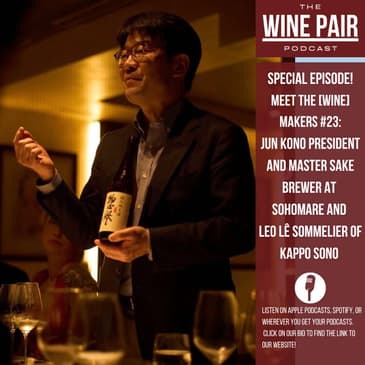
Sake is not a beverage we often cover on the podcast, but when we had the chance to talk to one of the great sake makers in the world, we jumped at the chance. In this episode we introduce you to Jun Kono of Sohomare, one of the world’s premier sake makers, and Leo Lê Sommelier of the great Kappo Sono in New York City and Momoya. What a treat to meet these two leaders in their respective businesses, and get to know them. As you know, sake is often called “rice wine,” but that is not the best description of it because the brewing process is so different and complex. And while many sake makers are trying to chase more accessible and fresher versions of sake, Sohomare is focused on making deep, complex, and elegant sake that is made to be eaten with food. We know you will learn a ton, like we did, in this conversation, and come away with a new appreciation for one of the most significant alcoholic beverages in human history.
Send us a Text Message and we'll respond in our next episode!
Contact The Wine Pair Podcast - we’d love to hear from you!
Visit our website, leave a review, and reach out to us: https://thewinepairpodcast.com/
Follow and DM us on Instagram: https://www.instagram.com/thewinepairpodcast/
Send us an email: joe@thewinepairpodcast.com
Show Notes
Special Episode! Meet the (Wine) Makers #23: Jun Kono President and Master Sake Brewer at Sohomare and Leo Lê Sommelier of Kappo Sono and Momoya
________________________
KEY QUESTIONS
- What is the kimoto method in sake brewing?
- What food pairs well with sake?
- What is Yamadanishiki rice and why does it matter for sake?
- What is the difference between old school and new school sake?
- How do sake breweries maintain consistency from year to year?
- What is Sohomare sake?
- What does a sake sommelier do?
________________________
Introduction to the Interview with Jun Kono President and Master Sake Brewer at Sohomare and Leo Lê Sommelier of Kappo Sono and Momoya 00:00
Hello, and welcome to this special episode of The Wine Pair Podcast! I’m Joe, your sommelier of reasonably priced wine, and for this special episode, I am on my own as my wine pairing partner in crime is busy making cakes for her Baby Cakes micro-bakery, which by the way you can learn more about if you head over to her website lovebabycakes.com.
Today, we are going to introduce you to Leo Lê beverage director and sommelier at renowned kaiseki restaurant of Kappo Sono and Jun Kono Master Sake Brewer at Sohomare, one of the great sakes in the world
First, as a quick orientation to what we usually do in our podcast podcast, in most episodes we learn about, taste, and review two to three wines that are reasonably priced, which means under $25, and should be easy to find. However, for this special set of episodes, we interview people who are involved in actually making wine. Because part of what we want to do with our podcast is to educate ourselves and you on different aspects of wine knowledge in a fun, entertaining, and unstuffy way, even fun and entertaining as Decanter magazine has called our podcast, and that is what we are doing today!
A small plug before we get to the interview with Leo and Jun - if you like what you are hearing or are interested in hearing our other “regular” episodes, please subscribe or follow our podcast so you can hear more - especially since you are only getting one half of The Wine Pair Podcast in this episode! You can also go to our website thewinepairpodcast.com to send us a note or subscribe to our newsletter, you can follow us on Instagram and Bluesky at The Wine Pair Podcast, and, if you like what you are hearing, you can even leave us a nice rating and review, we won’t mind!
Ok, let’s get to the interview with Leo and Jun
Interview with Leo Lê and Jun Kono 2:04
Hi Leo and Jun and welcome to The Wine Pair Podcast. We are so excited to have you and to share with our listeners something a little different, and that is a deep dive into artisanal, high quality sake. So, if you are ok, I think I will just jump into the questions.
Interview Questions:
- Tell us a little about yourself - your background, your family, etc., and if wine or sake or fine dining played any part in your growing up. Let’s start with you, Leo, and then will go to Jun
- Jun, tell us about how you got into sake brewing. Was this something you had planned for and pursued, or did it "find" you? I read that you are the 5th generation owner and president of Sohomari Sake. Was this pre-ordained?
- June, did you have a mentor, or someone who taught you the ropes?
- Leo, how did you get into and expert on sake and Japanese beverages? And how did you find Jun?
- Jun, what do you think defines you as a sake maker and makes you and your sake special?
- Jun, I imagine there is a goal to make your sake consistent every year, but do you find there are variations each year? And do you like to experiment with different types of sake? I also read that you blend your sake. What is your philosophy on that?
- Leo, how do you think about sake in terms of your diners? It sounds like you focus on rate and historically important sake (including unpasteurized and “freshly squeezed” types called shiboritate). Why is that important?
- If we were to invite you to Sunday Night Dinner (a tradition in our Italian American family), what of your sake would you bring and why?
- How can people find your sake and follow you (your website, social, etc.)
The restaurant Kappo Sono itself is helmed by Chikara Sono and seats only 12 guests per evening—this intimate context allows for a detailed, bespoke pairing program. When you sit at Kappo Sono, you can expect not just the chef’s multi-course kaiseki menu, but a highly curated beverage journey alongside each course, thanks to Leo’s program. The beverage experience at Kappo Sono is described in reviews as “a masterclass in pairing” under his leadership.
Jun Kono is the 5th-generation owner-president of Sohomare Sake Brewery in Tochigi Prefecture, Japan. Founded in 1872. Under Kono’s leadership, Sohomare made a strategic decision to revive and emphasize the “kimoto” method — a traditional, labor-intensive brewing starter technique that had been largely set aside in many breweries. The kimoto method at Sohomare is portrayed as yielding deeper flavour, fuller body, and better ageing potential. Under his watch, Sohomare has achieved many awards: top prizes at regional sake contests (e.g., Kanton-Shinetsu Regional Sake Judging) and gold medals in national sake appraisals consistently.
Outro and How to Find Jun Kono President and Master Sake Brewer at Sohomare and Leo Lê Sommelier of Kappo Sono and Momoya 28:56
Thank you very much for listening to our interview with Jun Kono and Leo. Sake is not something we know a ton about, so it was fascinating for me to hear more about the classical style of sake them make, how it is different from newer types of sake, and how it can go with so many different types of cuisines. And we really hope you will look for Sohomare sake and that you will look for the restaurants that Leo is responsible for.
Now, in case you are worried about how to get in touch with Leo and Jun, don’t worry, you can find out all of this information on our website thewinepairpodcast.com in our show notes for this episode. But so you have it, here again is the information about how to find out more about
Sohomare
- Website: https://sohomare.co.jp/en_fr/
- Instagram: https://www.instagram.com/sohomare/
Sohomare Distributor
- Website: https://worldsake.com/
- Instagram: https://www.instagram.com/worldsakeimports/
Leo Lê
- Instagram: https://www.instagram.com/leobaole/
And, we hope you will subscribe to our podcast The Wine Pair Podcast and follow us on Instagram, and visit our website at thewinepairpodcast.com where you can reach out to us and sign up for our newsletter, and you can also reach out to me at joe@thewinepairpodcast.com if you want more information, and we look forward to hearing from you!
But for now it’s time to go, and as we like to say, life is short, so stop drinking shitty wine.
________________________
FAQ Frequently Asked Questions
Q. What is the kimoto method in sake brewing?
A. It's the traditional method for developing the yeast starter, and Jun Kono describes it as relying on natural microorganisms rather than commercially produced acids. The catch is that natural processes require an extremely clean brewery. Jun says that discipline is exactly what gives Sohomare's sake its clean finish and real depth of flavor.
Q. What food pairs well with sake?
A. More than most people assume. Leo Le paired Sohomare with foie gras at Nougatin, a French restaurant next to Jean-Georges in New York, and says it went deliciously. He's also matched it with vongole pasta. His reasoning: sake is made from rice, which is naturally high in umami and acidity, so it pairs broadly across Japanese, French, and Italian cuisines.
Q. What is Yamadanishiki rice and why does it matter for sake?
A. Jun Kono calls it the best sake rice in Japan, out of over 100 varieties. Sohomare sources 100% of theirs from the top-graded Yokawa area in Hyogo Prefecture, about 400 miles from the brewery. Jun travels there every year to drink with the farmers, because maintaining those personal relationships is the only way to keep access to the best fields.
Q. What is the difference between old school and new school sake?
A. Leo Le put it clearly: new school sake is fresh, aromatic, and instantly gratifying, but often cloying. You get a glass and a half and you're done with it. Old school sake, like Sohomare, is restrained, elegant, and precise, hard to put down. Leo says the more experience he gains, the more he gravitates toward the old school, and toward Sohomare specifically.
Q. How do sake breweries maintain consistency from year to year?
A. At Sohomare, through blending. Their flagship Tuxedo sake combines 13 different batches across 3 vintages, using 3 different yeasts, bottled 7 or 8 times a year. Before each bottling, Jun Kono tastes all the batches and sets the ratios. He then orders Sohomare at restaurants, checks the bottling date on the back label, and compares what he's drinking to what he decided months ago.
Q. What is Sohomare sake?
A. Sohomare is a sake brewery in Tochigi Prefecture, Japan, founded in 1872. Jun Kono is the 5th generation leading it, already working with his son who will be the 6th. Their style is built on three things: Yamadanishiki rice from top-graded fields, the traditional kimoto method, and careful blending, all aimed at depth and complexity rather than easy freshness.
Q. What does a sake sommelier do?
A. Leo Le spent 23 years building his expertise in Japanese restaurants, starting at 18 when he took a job at a Japanese restaurant to earn money as a student and tried sake for the first time. He was later mentored by Timothy Sullivan, one of the first non-Western sake sommeliers. Now at Kappo Sono, a 12-seat kaiseki restaurant in New York, he builds the entire beverage program around sake pairing.
Support The Wine Pair Podcast by heading to our website and shopping for the wines we give our highest ratings to in our Shop Wines section. Just click on this link - you pay the same price, and we may get a small amount of compensation.
You can also support us by clicking on this affiliate link to wine.com and find great wines under $20!
And, if you are looking for a great website builder for your podcast, click on this link to use the service we use and love: Beamly, formerly known as Podcastpage.io
________________________
FULL TRANSCRIPT
Joe: 00:07
Hello and welcome to this special episode of the Wine Pair Podcast. I'm Joe, your Samolier of Reasonably Priced Wine. And for this special episode, I'm on my own. My wine pairing partner in crime Carmilla is busy making cakes for her baby cakes micro bakery, which by the way you can learn more about if you go over to her website at lovesbabycakes.com. But today we've got a special treat. We are going to introduce you to June Tono President and Master Stock of Tohomare and Leole Moye of Capital Tono and Momoya in the North. And Tohomare is one of the great stockes in the world. But first, it's a quick orientation to what we usually do in our podcast. In most episodes, we learn about taste and review two to three wines that are reasonably priced, which means under $25 and should be easy to find. However, for this special set of episodes, we interview people who are involved in actually making wine, or in this case, making sake, because part of what we want to do with our podcast is to educate ourselves and you out there in Listening Land on different aspects of wine knowledge in a fun, entertaining, and unstuffy way, and even fun and entertaining as Decanter magazine calls our podcast. And that's what we're doing today. And a small plug before we get to the interview with June and Leo. If you like what you're hearing or are interested in hearing our other regular episodes, please subscribe to or follow our podcast so you can hear more, especially since you're only getting one half of the Wine Pear podcast in this episode. And you can also go to our website, thewinepairpodcast.com, to send us a note or subscribe to our newsletter. And you can follow us on Instagram and Blue Sky at the WinePair Podcast. And if you like what you're hearing, you can even leave us a nice rating and review. We won't mind. But with that, let's head over to the interview with June Kono and Leo Lee. And you will love this interview and learning more about sake, something we don't cover too often in the podcast, but is often connected to wine. Get ready to learn a ton and have a great time. Hi, Leo and June, and welcome to the Wine Pair Podcast.
Speaker 2: 02:08
Hi. Hi.
Joe: 02:10
We are so excited to have you and to share with our listeners something a little different, and that is a deep dive into artisanal high-quality sake. So if you're ready, I think we'll just jump into the questions.
Speaker 3: 02:25
Yes, I'm ready.
Joe: 02:26
Great. That's great. Okay, we're gonna start first with you, Leo, and we're just gonna do tell us a little bit about yourself, a little bit about your background and your family, and if if wine or sake or even fine dining uh played any part in your growing up.
Speaker 2: 02:41
Yeah, uh, not really. Fine dining and wine and sake uh was pretty absent in my childhood. Um I was a lifelong New Yorker, uh born and raised in upstate New York, outside of a city called Rochester. But uh I did grow up in restaurants. Um, my mother uh and my father they ran Vietnamese restaurants of all types of cuisines, but uh it's Vietnamese restaurants in the all throughout the 80s in Rochester, when this population or this area doesn't really know a lot about uh Vietnamese cuisine. But uh this is really why I think I have a connection to restaurants. But uh yes, alcohol, much less sake, didn't really play a role in my upbringing at all, except for, I don't know, Genesee crema and these big jugs of Carlo Rossi California Chevlis that my father would drink and cook with. But uh other than that, not really. And uh I went downstate to go to college and eventually grad school, and I'm actually a grad school dropout, and I dropped out to dedicate myself full-time to the restaurant industry. And um, throughout university, I worked in all types of Japanese restaurants uh where I was exposed to sake, and and really I've been hooked since uh and now it's my 23rd year in the industry.
Joe: 04:04
Well, that's fantastic. In a little bit, we're gonna dig into how you got into sake. But June, if you don't mind, we'll uh turn to you. You have a long background or your family has a long background in sake making. So, yes, very clearly there was sake in your background, but tell us a little bit about your background, what role the sake business played, and and sort of your your family and the and the traditions around it.
Speaker 3: 04:32
Okay, hi. My name is Juan. The family name is Kono. The Kono family, maybe I can say the Kono clan, has its roots in Shikoku. It's in the western side of Japan. We were there until mid-16th century. The Kono clan is a samurai in Ehime Prefecture in Shikoku district. But at those times there was a civil war in Japan and our family was deflated. So we couldn't live there, and we ran away from Shikoku to Gifu Prefecture to hide ourselves for several generations. In Gifu Prefecture, we couldn't call ourselves Kono, and we called ourselves Takemura. That is the uh family name of the royalty, in order not to be killed. Then in the Edo period, we went to Shiga Prefecture, that is next to Gifu, and we first made measo and verdegar, then to the sake. And in the beginning of Meiji era, that is uh 1872, we came to the current place, Tochingi Prefecture, and we started sake making here. And from that point, I am the fifth generation of the family, and I'm working with my son, and he will be the sixth. And I have a grandchild children, and one of them will be the seventh. That that the family history. Thank you.
Joe: 06:23
That is amazing, amazing. Thank you for that explanation of the history. Now, when you were growing up, did you always expect that you would run the family business, or was there ever a time where you thought, I'm not sure if I want to do this?
Speaker 3: 06:40
Actually, I was I was raised at the sake brewery, so I always thought that I would take over the family business from a young age.
Joe: 06:50
And when you were young, you spent time in the brewery, but did you were you involved in the sake making process even as a child?
Speaker 3: 07:00
No, no, I was just raised, and uh I I was at the brewery until at the age of 18. Then I went I went to the university in Tokyo.
Joe: 07:11
Now you are a brewmaster of sake.
Speaker 3: 07:14
Well, I can say the brewmaster that is in Japanese toji. The brewmaster is the responsible for making sake. So I am the owner, and at the Sohamada we have we have the brewmaster. I'm not the brewmaster.
Joe: 07:30
I see. Were you ever involved in actually making the sake?
Speaker 3: 07:33
Yes, just after returning to the brewery.
Joe: 07:36
So tell us a little bit about what it was like to actually make the sake and how that may have helped you or impacted you as the owner and and the person running the the brewery.
Speaker 3: 07:50
My idea is the brewermaster is the carpenter to make the house, and the owner is the designer of the house. That is my opinion.
Joe: 08:02
Very good. Okay, Leo, let's go back to you. How did you get into sake? And how did you become an expert on sake and Japanese beverages?
Speaker 2: 08:14
Um, I think it's just pure desperation. Uh, my first job was at my university's library, and uh minimum wage wasn't gonna cut it at 18, especially if you wanted to take girls out on dates. And uh actually, this friend of mine took me to uh my first Japanese restaurant, actually, and gave me sushi for the first time. It was uh like a spicy salmon roll or something, and I was really hooked and sake for the very first time when I was 18 away from home. It was an extremely busy restaurant and a lucrative one at that. And so I was just amazed at that meal, and I asked for a serving position right after the right after the dinner, and the rest is history, and it was just restaurants after restaurants, working in different Japanese restaurants for the last two decades.
Joe: 09:03
And so, how did you meet or learn about June and his sake?
Speaker 2: 09:08
Uh well I tried Kono san's sake for the first time in maybe the early 2000s, maybe the mid-2000s. There's this really expansive sake bar, it's subterranean, uh, in midtown Manhattan called Sakagura. And uh during that time, the Japanese restaurants that I was working at uh were out in Long Island and they didn't really have an extensive sake list. And so I would always have to go into Manhattan to go to the sake bars to expand my knowledge. And so I was actually introduced to Konosan sake through uh my mentor and my very good friend now, it's a sake samurai by the name of Timothy Sullivan, and uh he was one of the first non-Western sake somalias, and uh we met each other very early in his career, and so yeah, everything just kind of snowballed after that. He introduced me to a lot of different types of sake, we went to a lot of sake tastings, but yeah, it was in the mid-2000s when I tried Sohomare's examples from Sohomare for the very first time.
Joe: 10:18
And then when did you get the chance to actually meet?
Speaker 2: 10:21
Much after that, I think. I didn't meet Kono-san until maybe in the mid-2018s, perhaps maybe 2017, 18.
Joe: 10:30
And I should just mention that before we started, I asked Kono-san how I should address him. He left it up to me, and so I'm calling him June, but Konos-an is the correct way to address somebody of his stature.
Speaker 2: 10:43
Yeah, I can't call him June. I have to call him.
Joe: 10:48
So June or Konosan, what do you think makes your sake special? What do you really focus on and the types of sake that your brewery makes?
Speaker 3: 10:60
I think what is very important is crafting sake through precise microbiome management. In Japan, some there is a some trend that uh to be natural is very good, but to make sake is to control the microorganism. I think that is the correct way to make sake. So that is our idea of making zohama. And we should have a certain goal. What is our ideal flavor for sake? We should seek for that. And in my opinion, the sake should have deep complexity, and sake should have depth finished, and maybe that should be overpowered and aromas. So to achieve that goal, we have three important things. One is the sake rice called Yamadanishki, and we can find over hundred varieties of sake rice in Japan, but I think that the Yamadanishki sake rice is the very best. The second is the kimoto method, it's a classical method of making Japanese sake, and the third is the blending of sake. So every three points can be very popular words for making Japanese sake, but we have so human characters for Yamadanishki, Kimoto, and blend. The first one, the sake rice Yamadanishki, we choose the Yamadanishki from over a hundred varieties of sake rice, and we buy it from the best region in Kyomwa Prefecture. Inside Hyongwa Prefecture, there are three groups of rice fields, A, B, C, and we buy it 100% from A region in Hyongwa Prefecture. And inside the A region, we think that the Yokawa region is the very best for our socket. And next to Yokawa, there is a region called Tojo, and we buy maybe more than 50% from Yokawa and 40% from Tojo, and a few percent from next to Tojo. So that's the rice field for Yamadanishki in So Masakeburi. And it's very difficult to buy a Yamadanishki from Yokawa region in Hyomwa Prefecture because Yamadanishki was born in 1936, and they have a strong relationship in the brewers in Nada in Hyongwa Prefecture. But we are in Japan, like how many kilometers? I can say 400 miles away from the rice field. So we have to go there every every year to drink with farmers, to drink with farmers' association. Human relationship is very, very important to get the very best Yamadanish from the very best rice field. And for kimoto, it's a very ancient way of making Japanese sake. It's the method of making east daughter. It's very natural, but because it's natural, we should have a very clean atmosphere in the brewery. And to make kimoto in the very clean atmosphere, that makes our sake in a very clean finish. And the third point is blending. Uh we have Kimoto Juma Daiginjo that is in the menu of uh the Osan's restaurant, that is tuxedo. And taxedo is the blending of 13 different batches and three different vintages, and we use three different yeast to make the complexity and to make the depth in the flavors. Nowadays, the Japanese sake tends to be very fresh, very aromatic, but the Soma Taxed is in the opposite side. So that are the three main points. What is different from others of the Soma sakeburi? Thank you.
Joe: 15:05
Thank you very much for that explanation. That's very helpful. A lot of our listeners don't know much about sake or how it's made. And so I think that's a wonderful way to explain to them how it's made and how much care you put into it. So, Leo, because Konosan is very humble, can you talk about what you really like about his sake?
Speaker 2: 15:28
Uh, definitely. Uh Konosan's right uh in that I mean I remember we had a conversation maybe a few years ago, and it was this influx of what what I call new school sake uh that were being uh imported to the United States uh into the New York market. And they're usually made by younger producers who are uh trying to react against kind of an old school style or Kono-san style of sake. And uh they are indeed fresher and more wine-like and um instantly gratifying. And oftentimes it's doesn't really have staying power. You know, you drink kind of this new school sake, it's it's sweet, uh, it's uh kind of layered and it's hyper-aromatic. But in the end, you you don't experience the finesse and the depth of flavor and really the quality that goes into konosan sake. I don't know if I'm getting older, that I tend to gravitate towards the older school styles of sake now. But yeah, I'm I'm in my fourth decade now, and I really, you know, if I see soho mare in a shushi restaurant, uh, or particularly a restaurant where it's in omakase and you're having a long dinner and you just want to focus on one sake, it would be sohoare, in my opinion. Again, there's a everything is really virtuistically in balance, you know, aromatically, it's not too much. Uh, it's kind of restrained and elegant. Uh, again, there's this finesse to it, it's really precise. The palette, uh, texturally, again, it's really sharp and clear. It's something that it's really hard to put down. Like all these examples from Suhomare, it's it's really hard to stop sipping. A lot of these new school sakes, you have maybe a glass and a half and you're kind of finished with it because they're often too cloying, or it's perhaps just to get bored of it. But now, yes, I think with age and with experience, I think I would prefer like older school sake, like Kono San sake.
Speaker 3: 17:47
Thank you very much for your appreciation. Yeah.
Joe: 17:51
And I think, Leo, the way that you explained it is I think often the way that people come to wine drinking as well, where very often the first types of wines are the maybe more simple wines or the more, you know, the easier to access. And then a lot of people gravitate towards more complexity, more richness, more something more contemplative. And it sounds very much similar to how Konosan makes their sake. Let me ask you one more question, Leo, if you don't mind. So, you know, you are a smolier, you think very much about pairing food and wine together. So, when you think about sake, konosan sake, what are you thinking about in terms of the right ways to pair it with food? What types of foods are you thinking about pairing it with?
Speaker 2: 18:42
I think konosan sake it's it's really versatile. It tends to go along with a lot of different types of ingredients and cuisines, sake in general, because it's made from rice, and rice has a lot of amino acids, and so it tends to inherently have a lot of umami already. So I think the sake does the work itself of pairing. But with Konosan's really elegant sake, I think it would, you know, I come from a lot of Japanese restaurants, so I pair with a lot of Japanese dishes and ingredients, but I was thinking about cuisines that are outside of Japan. And I think, you know, with pasta dishes, you're Italian, Joe. So I think pasta dishes are delicious paired with soho mare. Again, it's this finesse and this elegance. So I was thinking like a vongole pasta, some sort of linguini, uh, that's really kind of uncuous and has this touch of lemon and acidity to it. Tends to, I think, pair nicely with soho mare. Sohomare again has this uh umaminess to it, uh, has this high acidity to it that tends to, I think, pair nicely with pasta dishes like that. I in fact bought soho mare to a French restaurant one time. Uh I bought it to Nougatin, uh, which is this restaurant that's uh beside Jean-Georges' restaurant. And so I often uh go there for cocktails a lot, but this time I had sake uh in my bags. I just took it out, and the bartenders know me there, and so I just uh decided that we were gonna pair Sohomare with a whole bunch of appetizers from this bar. And it went deliciously with Jean-Georges does this foie gras dish where he caramelizes the top of the foie gras, and so you have kind of this texture, but you have the sweetness, but then you have this really umami bomb in this dish, and then you pair again with this really elegant sake that has this backbone of umami to it, and it went really well together. Not just Japanese cuisine, French, Italian.
Joe: 20:49
Well, you beat me to it because you are both invited to come to Seattle anytime and come to our family dinner, Sunday night dinners. We do a, you know, it's an Italian-American version of food, but you're very welcome to come. We would be honored if you would come and that you bring soho mare sake with you, and we will find the right ways to parawak it out ahead of time. I do have one more question before we get to how people can find sohoare and and konasan's sake. I imagine it's important to you that sohoare is always consistently excellent, and you mentioned a lot of blending, blending of different vintages as well as blending of different different batches. Yeah. How do you make sure that every year, because every year is different in terms of the weather and the all everything, how do you how do you ensure that your sake is consistently excellent?
Speaker 3: 21:53
So my taxi, it's uh kimoto jumai daikinjo. We make bottling, not Once a year. We bottled tuxedo maybe seven times, eight times a year. So every time we bottle it before bottling, we should make a decision what's the blending ratio of the of the botches. For example, we we make tasting over 15 different botches, that is from aged one year, two years, and three years. And one botch is fermented by one single yeast, but we use three different yeasts, yeast number 1401, yeast number seven, and yeast number six. So we make the blending and we make sure that the this botch is whether the same quality as the one before bottling, or that we should do maybe even better than the last one. So that makes the quality or consistency of the zone. And it it's very interesting that the tasting as I work and tasting after work with a dinner is completely different. Or sometimes different. So I do tasting as I work at the brewery, but sometimes when I go to New York and I ordered a glass of uh tuxedo as a dinner was sometimes different. And well, sometimes I I asked the sommelier to show me the bottle and the back label of the Sovomare, the bottling date is indicated. So I remember my work like six months ago tasting, and this time in New York to taste it as a dinner, and or sometimes I confirm what it is good, or sometimes I I should make maybe these bottles to add a few percent more than the other time. So that is uh how I how I make uh the this decision. And about 10 days ago I had a sohomai sake dinner in a four seasons resort in Maui, and I had uh five different glasses of sohomale after sohumai pairing dinner, and I was thinking about the taste with enjoying the dinner, and well sometimes it tends to be a work, but uh I was reflecting the decision what I made three months ago or four months ago. That's very interesting. Thank you.
Joe: 24:38
It's amazing that you know the batches, you know the different blending, the taste of specific bottlings. That's amazing. What a what an amazing palette you have, and just uh so much experience with sake.
Speaker 3: 24:54
Well, I I think my palette is good or not, but uh as the owner, I think I should make the decision. Well, sometimes it's wrong, but anyway, it's good.
Joe: 25:04
Yes, yeah, that's that's your responsibility. That's wonderful. Is there anything else that you would like to cover before we finish?
Speaker 3: 25:12
After enter the university, I I entered the university in 1980 and I studied uh the economics. And in 81 I traveled Europe for 30 days with a backpack with a friend of mine, and France fascinates me. And I went to France in 82 for nine-month drinking. And a friend of mine who traveled with me in 81, he also was fascinated by France. So he became, he's now a Japanese ambassador in France. Interesting story.
Joe: 25:51
Did you learn anything on that trip because you had grown up with the brewery, etc. Did you learn anything on that trip about French wines, etc., that influenced you at all in terms of when you came back?
Speaker 3: 26:05
I think my palate during stays in France drinking drinking wines. So after France, I went to uh to the States for a 30 days trip. And at the time I went to Nak Bali in 83. So those kind of foods um make some impacts to my palate, and also uh the family cooking at my house, my mother's cooking and my wife's cooking that makes my palate.
Joe: 26:33
Wonderful. Well, it's been so nice to talk to you both. I really appreciate it. I think that our listeners are going to just love hearing all this information about sake. I mean, again, we focus so much on wine, but this is one of the great beverages of the of the world. Um, before we go, I do want to give people a chance to know where to find you. So is there a website, uh, social media? Are there ways in which they can find Sohomare and you as well, Leo?
Speaker 2: 27:02
Uh well, I think I feel like I'm still living in the 90s, so I I'm not tech savvy at all. Uh I I do I do do a lot of scrolling, but uh I'm not really active on social media. Um, but you can find me on Instagram at Leo Baole. It's just L-E-O-B-A-O-L-E. Uh you can send me messages there. Uh, but most of the time I'm in the restaurants that uh we own in New York. So you can find me at Caposono, uh, you can find me at uh all the Mamoya restaurants, all of these restaurants that I have jurisdiction over uh the beverages, uh there will be examples of soho mare always. So you can definitely uh find a glass or a bottle at these restaurants.
Joe: 27:48
Excellent. And Konosan, is there a way that our listeners can find you?
Speaker 3: 27:54
The importer of Sohomare in the States is the World Sake Imports. When you when you see the website of the World Sake Imports, you can find the information about the Sohomare. They import 14 different sake breweries, and Sohomare is one of the 14. The website is wallsake.com. Thank you.
Joe: 28:15
Well, thank you very much for being on the show and looking forward to seeing you and and honestly, come to Seattle, we will have you for dinner.
Speaker 3: 28:24
My pleasure would like to go there. And they also maybe next time in New York. Oh, yes, most definitely. Not maybe, definitely. Next April we will have our job socket there.
Speaker 2: 28:38
Okay, good.
Speaker 3: 28:39
That'll be on the 30th.
Speaker 2: 28:42
Great. So yes, we'll see you in April then. Or before that.
Joe: 28:47
I might have to join you both. Oh, yeah.
Speaker 2: 28:50
Thank you so much.
Joe: 28:51
Bye-bye.
Speaker 2: 28:52
Bye-bye. Thank you very much.
Joe: 28:57
Thank you very much for listening to our interview with June Kono or Kono-san and Leo. And you know, sake is not something that we know a ton about, so it was super fascinating for me to hear more about the classical style of sake they make, how it's different from the newer types of sake, and how it can go with so many different types of cuisines. That's really something I didn't know. And we really hope you'll look for Sohomare sake, and that you will look out for the restaurants that Leo is responsible for as well. And in case you were worried about how to get in touch with Leo and June or how to find them, don't worry. You can find out all this information on our website, the winepairpodcast.com, in our show notes for this episode. Just find this episode, click down on the show notes, and you'll find it. But here it is again. So you have the information. Sohomare. The website is sohomare.co.jp, and then you have a backslash E-N underscore F R. That's for English and French. And you can find them there in English. And then Instagram is at Sohomare, S-O-H-O-M-A-R-E. That's how you spell Sohomari. The Sohomare distributor again is World Sake Imports. Their website is worldsake.com and Instagram is also World Sake Imports. And then for Leo Lee, his Instagram is Leo Bao Le. It is L-E-O-B-A-O-L-E. And that's how you find them. So please check them out. Check out the Sake. We think that you'll enjoy it and have a great time. And with that, we're gonna go. So we hope you'll visit us again. Come to our podcast, subscribe to our podcast, the Wine Pearl Podcast, and follow us on Instagram and visit our website at thewinepearpodcast.com. And you can always reach out to us. And you can sign up for our newsletter there. We always respond to you when you reach out to us. You can also reach out directly to me at Joe at thewineperpodcast.com. If you want more information, you have wines you're interested in, or stock A, or winemakers, or stock A makers that you'd like us to talk to. And we look forward to hearing from you. But with that, it's time to go and as we like to stay. Life is short.