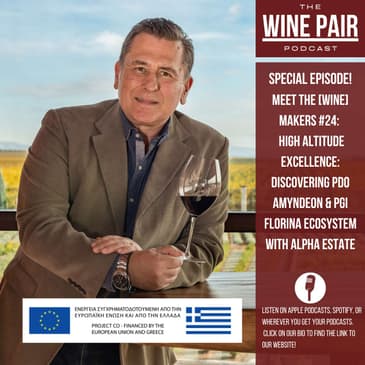
Angelos Iatridis has a philosophy that stuck with us: if you want to be a better man, you make better wine. That's the kind of thoughtful conversation we get into in this special episode, a deep dive into PDO Amyndeon and PGI Florina, two of Greece's protected wine designations, with Angelos from Alpha Estate. He talks about Xinomavro, the region's signature red grape, which is often described as sitting somewhere between Nebbiolo and Pinot Noir, but shaped entirely by Amyndeon's high altitude, its ring of three mountains, and two nearby lakes that keep the climate in balance. He explains why the sandy, limestone soil left behind by an ancient lake gives the wine its acidity, and how that same acidity lets Xinomavro age for decades, slowly turning from red fruit into notes of dried tomato and olive paste. Angelos also opens up about how climate change has actually helped ripening in Amyndeon over the last 30 years, why he believes the best winemaking technology should be invisible in the glass, and how his own daughter's research helped preserve the purest expression of the grape for the next generation. By the end, he's picked the exact bottle he'd bring to a big Sunday family dinner, one he says carries both place and memory. It's a warm, generous conversation with someone who clearly loves what he does, and you'll come away wanting to track down a bottle of his Xinomavro for yourself.
Send us a Text Message and we'll respond in our next episode!
Contact The Wine Pair Podcast - we’d love to hear from you!
Visit our website, leave a review, and reach out to us: https://thewinepairpodcast.com/
Follow and DM us on Instagram: https://www.instagram.com/thewinepairpodcast/
Send us an email: joe@thewinepairpodcast.com
Hello everyone and welcome to this special episode of the Wine Pear Podcast. I'm Joe, your sommelier of reasonably priced wine, and for this special episode, it's just me. Carmela is busy making cakes in her bakery and leaving all the fun stuff to me. Today we have a special treat because we're traveling to the breathtaking plateau of Amindian in northern Greece. We are exploring a region that's considered a true gem for wine lovers and home to some of the most elegant PDO, Amidian, and PGI florina wines in the world. Now, for a little education, in Greece, PDO stands for Protected Designation of Origin. And in Greek wine, it represents the highest classification for quality and authenticity. And PGI means protected geographical indication, and that means that it is a high-quality Greek wine produced in a specific region and with an established reputation and quality. Joining us and actually leading us through this journey is Angelos Iatridis from Alpha State, and he is going to talk about the magic of this ecosystem, the science and art of winemaking, and how this historic vineyard is evolving in the face of the global climate crisis. Now, before I chat with Angelos, I want to give you all a quick orientation to what we usually do in our podcast, because this is a special episode. In most episodes, we learn about taste and review two or three wines that are reasonably priced, which means under $25 and should be relatively easy to find. However, for this special set of episodes, we interview people who are involved in actually making wine because part of what we want to do in our podcast is educate ourselves and you are fabulous listeners on different aspects of wine knowledge in a fun, entertaining, and unstuffy way. Maybe we even call it entertaining, as Decanter magazine has called our podcast. And that's what we're doing today. But without further ado, let's get to the interview with Angelos. Hello, Angelos, and welcome to the Wine Pair Podcast.
SPEAKER_02Hi, Joe. Thank you for inviting me.
JoeOh, we are so happy to have you. We're really excited that you could join us, and we're really excited for our listeners to learn more about who you are, about your background, about Greek wine and alpha states. So if you're ready, let's get started. Yes, we can started. Great, great. So the first question is just there are some specific characteristics of Amidion that make it ideal for producing high-quality wines. Can you go into that a little bit? What are the things that are special about it?
SPEAKER_02The special, the unique thing about Amindon is uh uh located in northwestern Greece. So Amindon is a plateau area in a high altitude uh starting uh from uh 1800 feet above sea level to 900, 200 feet above sea level. So in a high altitude, and uh surrounding by mountains, three mountains, Mount Voras from the north, the mountain Vichy from the west, and the mountain vermian from the southeast. So the three Vs surrounding Amindion, Amindian Appellation. Into the appellation, there are two major lakes that compromise the climate. That means that uh during the summertime they release uh freshness and during winter time they release warm. So the climate condition into this appellation. And uh another important thing is uh in a high altitude we avoid the extremes of weather conditions. So it's really an excellent ecosystem, I can say, that protects the quality of the grapes we're producing, and our major grape varieties is Xinoma bro. Another important fact is the soil. The soil is mainly a sandy soil over limestone. So the whole area, the whole plateau used to be covered by a giant lake a thousand years ago. So the deposit of the lakes, all these microelements, they are located now in the uh limestone layer that gives specific character, a crispness, and acidity and minerality in uh Sonoma rule wines. So this is very unique. What is make different the amindon appellation from the other one?
JoeI'm gonna I'm gonna ask you a side question really quick. Angelus, you're originally from Greece, correct? Correct. And so did you grow up anywhere around Amindon?
SPEAKER_02I grew up in Thessaloniki. Thessaloniki is uh the co-capital of Greece, it's in northern Greece. So uh uh Amindon is about uh 100 miles from uh where I live. So it's not my birthplace, Amindon, but it's my my let's say my passion place. So it's where my passion or my wine making skills uh have uh engaged.
JoeOh, that's wonderful. That's great. So let's talk a little bit about uh some of our listeners may not be familiar with some of the designations that are used in Greece, like PDO and PGI. So can you talk a little bit about what PDO, amendon, and PGI Florina designations, what does that mean in terms of like quality and authenticity? And why should people be on the lookout for that?
SPEAKER_02Yeah, uh very good question. For the international consumer, PDO amindon and PGI Florida guarantee that the wine is not just from northern Greece in a loose marketing sense. There are legally protected uh European geographical indications, meaning the name can only be used when the wine follows an approved specification linked to origin, grape variety, and production rules and defined wine styles. The EU describes these schemes as helping consumer trust and distinguish quality products whose characteristics are linked to the place and know-how. PGA amindion is the stronger and more restrictive uh promise for the wine PDO. The EU rule is that the grapes must come exclusively from the defined geographical area where the wine is made. In the case of amindon, this means, like I told you, a high altitude, cool climate plateau in Florida, which is the prefecture, historically linked with 100% xinomagro, covering dry red, dry rose, and rosé sparking styles. So internationally, uh PDO amindom communicates authentic origin, tighter terror, identity, xinomavrotipicity, and stricter compliance. PGI Florina gives a broader but still protected guarantee. For EU wine PGI, at least 85% of the grapes must come from the named geographical area, and the wine must have quality, reputational or characteristics attributable to the origin. Florina PGI covers the whole Florida Prefecture, including the Amindio Plateau, and allows a wider palette of native and international varieties, such as Xinoma from Malagozia and Nasirtico, but as well as Sauvignon Blanc, Sardonnay and Chirab. PGI Florina communicates authentic regional origin, cool climate, Florida identity, but more freedom in varietals, brands, and styles. This is the description we have mainly uh based on the EU rules.
JoeGreat, makes sense. And for our listeners, we talk about this. It's very similar to DOCG in Italy. And so where like a Barolo or Barbaresco will have that designation, it has to come from a very specific area, specific rules, etc.
SPEAKER_02This is the exact same philosophy. Now the there is the compilance with the European rules. Now the DOC and DG DOCG is under the same skeptic of PDO amindon, for example, while you're talking about barbaresco and Nebbiolo.
JoeAnd I bring that up for a reason too. So let's talk a little bit about Xinomavro. We've actually covered it in episodes, and it's very often compared to Nebbiolo. And maybe you agree with that, maybe you don't, but we and we can talk about that. But it's a varietal that's known to be very responsive to the place where it's from. And so, how does the wine that you make and from the area stand out regarding like structure and profile, etc.?
SPEAKER_02My approach is a little bit different. I can say that Nebbiolo is close to Xinomavro. Okay. I like it.
JoeI like it.
SPEAKER_02Okay. So Xinomavro is very old, great variety uh from uh from the Alexander the Great era. So we have a huge tradition of growing Xinomavro in this area, Amindon. Xinomavro's style, yes, is for someone who loves this style of wine stylistically, but not from genetics. Uh the Xinomavro is uh, let's say it's uh could be a blend of uh Nebbiolo and Pinot Noir. The Xinomavro of Amindio has a different style from other regions producing Xinomavro. I can say that what characterize the Xinomavro of Amindon is the word finesse, finesse and balance. Finesse because have this very well-around balance of phenolics and the crispy acidity in the backpalate. This is typical of xynomavro and amindion. Amidon is a high attitude, so the greatest advantage we have starting from the from the ecosystem, starting from the terror, that means that because of the soil and the climate, you have higher acidity. And the acidity mainly based on the tartaric acid. Tartaric acid is the most prominent, the most stable acid into the grapes and to the wine as well. So it's the natural preservative to the wine, and that gives the potential, the huge potential of aging Xinomavro. So this is the descriptors of Xinomavro can say I can explain you the evolution palette of Xinomavro through time, starting from small red berries, forested fruits to dry fruits, prunes, and the end of each aging turn to dry tomato or olive pate. This is the evolution palette of Xinomavro. And the Xinomabro famindo takes uh a lot of time to achieve this complete aging profile.
JoeYeah, I am I love the descriptions that you give of the different flavor profiles that it has. And I think, and you're you're teaching me also how to say the word correctly, Xenom Mavreau. I think I'm saying it a little bit better. But uh, that it is it is one of the great red wines, great food wine that many people, not enough people know about. So I'm I'm really glad we're exposing our audience to that again. So let's talk about Florina and uh what are some of the challenges because of climate change, etc. What are some of the ch challenges that are being faced? And so, what are some of the things that you're doing in the vineyard to combat that?
SPEAKER_02You know, uh, this is why I choose to be in Amin Dun. Because as me uh and my partner Mike Mavrides, who's the Vine Grower, try to uh make our dreams come true here in Amin, it's because it's in a high attitude. So I think so far we have, let's say, uh generous experience of uh that climate changes help us a lot because the amindon 30 years back used to be uh mature in the end of October. And mature great variety in the end of October is a huge risk because we have starting the rainforest, the low temperatures, so we have a lack of ripening, a lack of maturity. So more aggressive phenolics, unbalanced acidity. With all this new situation, we achieve really a very high level of maturity. Of course, the trailing system, the higher canopy, uh using in our vine growing technique help us a lot in order to, uh let's say, uh, make true the real potential of Xinomatron amindon. This is why amino is knowing a huge reputation here in our appellation, and many, many uh vine growers come here to get the fruit from amindon appellation.
JoeIt's very interesting the way that you talk about it. And I imagine, because you've had a long career in wine, that this um you you really have noticed some of these changes and that you've had to change techniques, etc., or regions have had to change techniques as the the weather has or the climate has changed.
SPEAKER_02Of course, we have lower rainfalls, and mainly during summertime that produces stress conditions to the vines. So you have to, let's say, regulate it, regulate the stress to the vines. It's very important to give some water so we have an irrigation system, for example, subsoil irrigation system, in order to give to the plant, to the vines, precise quantity of water with no losses of transpiration or losses from for picking the grapes, the the birds, the pipes of water. So underground we are right to the rooting uh level and we uh give uh the exact quantity of water that keeps vine in stable stress condition, not very high, but in order to produce quality, not to produce quantity, but in order to produce the specific quantity, they can uh they can absorb uh the specific energy from the photosynthesis. So, how high is the canopy gives the energy to the plant in order to balance the yield, the grapes. So it's very important to see how much yield you can get in amino region in order to get the highest rapid in phenolics and in aromatics of synoma for variety.
JoeThat's a great explanation. We often talk about on the podcast how water stress, it sounds strange, but water stress is good for grapes. And so your explanation really helps to color in why that's important and what it means in terms of creating great wine. So let's move to another question. Modern technology is something that winemakers have to sort of always deal with. There's you want to be you want to use as many traditional techniques, but also modern techniques. So, how are you using modern wine technology to bring out the characteristics of the wine, to really bring out the the best of the ecosystem?
SPEAKER_02Uh modern winery technology helps most when it acts like a precision tool, not a stylistic filter. Its role is not to make the wine more modern, but to protect what the vinegar has already created. In a place like Amindion, where altitude, poor soils, cool nights, winds, old vines, and biodiversity all shape the grape, technology should help preserve freshness, aromatic purity, texture, and sight expression with us as little distortion as possible. The most important contribution is accuracy at the moment of decision. Optical sorting, gentle steaming, gravity movement, control temperature fermentation, inert gas protection, and precise oxygen management allow the winemaker to keep only the healthiest fruit, avoid curse extraction, protect delicate aromas, and prevent microbial or oxidative deviation. In other words, technology removes noise so the grape can speak more clearly. For varieties like Xinomavro, this is especially important. Xinomavro naturally has acidity, tannin, and red fruit complexity, tomatoes, spice, and earth retention. Modern tools allow us to extract with respect enough structure to express the variety, but not so much force that the wine becomes dry, aggressive, or overwork. The same logic applies to the white and rose, where temperature control and reductive handling can preserve florality, citrus, minerality, and natural vibrancy without turning the wine into a technical product. So the best modern winery is almost invisible in the glass. It gives skilliness, precision, stability, and longevity, but the drinkers should taste aminded, the grape, the vegan as a specific block, not the machinery. That is ideal balance, high technology in the cellar, deep humility towards the vineyard.
JoeThat's great. And I imagine, you know, as somebody who has a long career in winemaking, that you still do a lot of balancing between technology modern technology and techniques that you've just known for a long time. How do you balance those?
SPEAKER_02As a winemaker, I'm a scientist. So uh I have to inform every year for what happens in the in my field of expertise. So it's very important to watch all this evolution and to try with me and my team to uh make the implication to our vineyards of our winery. So this is what we are doing. This is everyday work. So for us, it's uh it's so important to be up to date of what happens to the wine style structure and give the good example to the people of the wine industry here in Greece. So it would be very helpful for us to be very close to what happens right now in uh our viticultural and winemaking fields.
JoeYeah, like all of us who um, you know, as we get older, we have to we have to adapt. That's how we make it. We have to adapt all the time.
SPEAKER_02We have to adapt, you know. The technology is not an enemy, you know. The technology is not it's it's a tool, it's how to use it, you know, it's very important. But the key words for me is balance. You know, the the goal is to have the balance, to find the balance, and define the balance for Xinomavro, it's the finesse. So that finesse can be approachable to the consumer, to the everyday consumer. Not the professional is another way of judging something, but the consumer has to feel the balance, has to feel the experience of tasting Xinoma. And this is our goal.
JoeYeah, I love that. Well, let's talk a little bit more about you as a winemaker. What is your personal philosophy and how does that show up in the wine? Do you have a signature that distinguishes Alpha State's label from others? And then, you know, we I like to ask this question a lot. And you said you're you're a scientist, but how do you balance or how do you think of the art versus the science of winemaking?
SPEAKER_02You know, uh I try I try to follow the nature. So, but you know, I have believed the experience, uh, and I have certain uh level of knowledge and expertise in order to give my my personal signature. You know, you imagine that the wine is like uh a painting. You know, you imagine that, you see the field, you and you imagine the vinegar, you imagine the the great variety, like you imagine the expression, it's how you use your different colors, you know, it's it's an expression of yourself. So, what I believe, I believe that every year our best vineyard is our next, you know, because every year we have more experience. And all this experience go to the to the wine, go to the vineyard. And the good wine is related with the man, related to the human. You know, if you like to be a better man, you do better wine, you know. It's what I believe. And this is a philosophical approach of making wine and especially making wine in Amindon. Amindon is a small place with less than 3,000 people living in the area, in a big area, so it's quite isolated for the big cities like Thessaloniki or Athens. So Amingon needs something that we try to have an intense fingerprint to the society here, to bring new generation here to work on the fields, to work uh in the vineyard, to to work in the wineries. And we are very happy that we see that people from other regions coming to Amindion and make rebirth this place again and see how important is uh the Amindion importance in the in the Greek wine sector.
JoeYeah, it's a great answer. And you know, you made me think a little bit that, you know, anybody who's involved in anything creative, there is an aspect of it that's technical. Uh that technical acuity, that knowledge is part of what informs the ability to be creative, to have that freedom to create. And I think that's very much coming out in the way that you talk about how you make wine. Is there anything that you would say like there's a specific type of style or taste profile or something that you try to get out of your wine?
SPEAKER_02You know, the personal style for me is balance, and balance is uh closely related with uh with the acidity, with uh the structure of the phenolics. So it's very important, you know. For example, for the xenomagro, it's very important to choose the right moment for the harvest by tasting the seeds of xynomagro. It's very important, it's not just check if they turn from green to brown. You have to taste and see the structure of the phenolics that cannot be extracted to the wine. So, and also to feel the skin of xynomagro. All this fruity, red fruity character, it's mainly located in this part. So it's very important to feel the right moment of making the choice of harvest. This is how how we like to introduce our personal involvement in the style of the wines we produce. It reflects the the personality of not just the winemaker, because the winemaker is a small percentage, it's the whole team, you know. We have the wine grower, we have the we have the the winemakers, but it's a it's a team, it's a team working unstoppable for this cause.
JoeIt's a great explanation. It's like I think about it, it's it's not following a recipe to everything. Every precise detail. It's knowing the form and structure and then having the feel as well around it to know when things are ready, they that they taste right. That I love that what you talked about, the skin, that you that it feels right. So that I that's a great explanation.
SPEAKER_02Thank you. Thank you, Joe.
JoeSo tell us a little bit about Alpha Estate and some of your recent releases. And are you doing experimentation in some of your latest vintages?
SPEAKER_02We never stop doing experimentation, meaning that we have installed in our winery and our RD department make every year some trials, uh, some trials mainly from uh vine-growing techniques, uh, working on the field. Uh, for example, of how when we have to topping, when we have to make green harvest, when we we have to go to the higher or high canopy in different varietals, but as well, we do a clonal selection a few years back. This is uh the thesis of my daughter Angeliki, who made a clonal selection here in Amindon. And so we have a sanitary condition, a high sanitary condition, uh, genetically speaking, uh, for the xynomavro amindon. So we produce with necessary vacassieta in uh Nea. We produce uh clonal selection, uh it's the clone 1937 from amindon that have the pure expression of what is Xynomavro amindon. But we have some new releases right now, which is uh the Xinomavro clones 1937 will be commercially released on coming September. And we have all as well uh dessert wine sweet wines uh of Xinomavro will be released at the end of the of this year, coming from 2017 Vindis. And uh part of this, we have some other wines uh like uh Malagusia, we produce a really a great uh complexity Malagousia from our vineyard, uh which is another very important grape variety, uh, indigenous grape variety.
JoeOne of the things that people may not agree, again, Xenomavro is one of the great red wines, and I think one of the great red wines that people don't know about. And like a lot of great red wines, it can age. Uh, some of that has to do with the acidity and the structure. So, how do you feel like the wine evolves over time? And what if somebody hangs on to uh one of your wines for a while, what should they expect 10 years down the road?
SPEAKER_02They can age without a bottle of wines because of the I I have to say it again, because of the acidity, our wines, our xinomavro wines can age for many decades. I believe that you can see different phases, different uh evolution of xinoma role through the decades, every decade. So we in a positive way, in order to achieve the excellence after 30 or 40 years. But this is a xynomavro, it's in every stage of each evolvement. You you see uh which evolution, you see a very unique character, you know, who always beloved. This is this is the greatness of Xinoma bro. And that's why it's one of the greatest varieties you you can taste, you know. This this is the message to to the wine community, and uh, and what we see, we see growing interest in every market we export that Xinoma Vro is uh very well uh accepted, demanding, and uh it's it's really it's really fantastic.
JoeWell, that that's great. I just have a couple more questions to ask you. One of them is a question that we ask quite often when we interview people, and that is we come from an Italian-American family, not Greek, but close, and we always do a Sunday night dinner, a big family Sunday night dinner, that's our tradition. So you're invited to our Sunday night dinner, and the only thing that we ask is you have to bring the wine. And let's just, you know, it's it's um kind of uh maybe, you know, the a couple of courses, a pasta dish with red sauce, a meat dish. What what wines would you bring to the dinner to share from Alpha State's to share with our family?
SPEAKER_02Great question. Thank you for asking me that. Uh I bring Alpha State ecosystem, Xinomavro Reserve, old vines, single block barbayanis. For a Santa Nani dinner, I want a wine that feels generous but not sowy, serious, but still emotional. This bottle does that because it carries both place and memory. 100% Xinomavro from the Barbaianis block in a Mindon, from the very old handgrafted bush vines planted in 1919, with the freshness and tension of attitude behind it. The official profiles give exactly the sandy table language. I'd want sun dry tomato, smoking black fruit, strawberry, dark cherry, liquorice, spice, firm but velvety tannins, and a long finish. In candle, roasted lamps, as well as other pairings, grilled meats, sausages, rabbit stew, peppers in olive oil, or full-body cheeses, but make it ideal for a family table where this is and are passed around and conversation last longer than the meal.
JoeI love it. So when are you coming over? That's the question. When are you coming? We want you there soon.
SPEAKER_02Yeah, I'll be in the states uh in the end of this month. So end of May.
JoeSo wonderful.
SPEAKER_02Yeah.
JoeOh, that's great. Where will you be? Uh, we'll be in New York.
SPEAKER_02Uh, we'll be in uh Nandaket and uh uh food and wine soon in Nandakit, and I will be in uh Washington, DC.
JoeGreat. Uh well, too far for us, but at least in the states.
SPEAKER_02Next time I'll fly over you.
JoeOh, very good. Yeah, we would love that. Okay, let's talk a little bit about how our audience can find your wines in either international markets, how they can learn more about you and find some of your wines.
SPEAKER_02Alpha State Export in uh more than 50 countries all over the world. Uh so it's a company that uh founding in uh 1996, the vineyard, in 1997 was the legal status of the legal entity of the Alpha State. Uh 2003 was our first commercial production released to the market in 2005. So we are two partners, two friends here in Alpha State. Max Mabridis is uh the vinegrower, and I'm the winemaker. We have uh the great achievement uh we have is the fact that our children is already follow us, are in the business, so it's very important for us because uh you know it's uh very important to see the future in front of us. I believe that uh the the Alpha State wines, you know, have a quite extended lineup of wines. Uh of course, Xinomavro in different versions. We have a great uh Rosé PDO Xinomavro called Rose Xinomavro uh Hedgecock. We have uh very important uh for the US market Xinomavro Hedgecock red wine from the same block. We have the Rose and the red version of uh this block. We have the Barbajanis Xinomavro from the oldest Xinomavro block. And uh we produce uh Malagusia. Malagusia is a very elegant, very fresh, uh quite uh white blossom character variety. It's very important in Greece. We it's one of the most important grape varieties growing mainly in northern Greece now. And uh we produce some other international grape varieties, we produce some Sauvignon blanc. My thesis on the Bordeaux University, where I study analogy, was descriptors of wine growing and winemaking of making a typical Sauvignon Blanc variety. So I have certain expertise working with Professor De Bourdieu. And uh of course, we have uh some uh dessert wines called Omega, from the Alpha to Omega. So uh we have our dessert wines from uh the Xinoma where I told you before. 100% in the Omega white, which is a blend of Malagusia and Gibustramina.
JoeWell, thank you very much, Angelus. We had a great time talking to you, and and we will put in our show notes and in the outro after we talk, I'll have links to the website and ways that people can can source your wines. But I know I I've had Alpha State wines, they are they're not hard to find, and and we really hope that our our listeners will will seek them out.
SPEAKER_02Thank you. Thank you for inviting me.
JoeYou bet. Thank you very much. Bye-bye. Thank you. Thank you so much. Okay. Take care. Bye-bye, ciao.
SPEAKER_02Bye-bye. Ciao, ciao.
JoeThank you so much for listening to our interview with Angelos. What a great person and a great story, and so fascinating to hear his approach to winemaking, his expansive experience that he brings to his craft, and the way that he thinks about the grapes and the juice and the skins and the land and everything that goes into winemaking. It's fabulous. Now, in case you're worried about how to find Angelos and Alpha Estates, don't worry. You can find out all of this information on our website, thewinepairpodcast.com, in our show notes for this episode. You just look for this episode, you click on it, you scroll down, and there you have it. But so you have it. Here's the information about how to find out more. The website is alpha-estate.com. On Instagram, it's alpha underscoreestate, and the email is visit at alphaestate.com. And with that, we also want to give a final plug for our podcast and our regular episodes. So we hope for those of you who are new to the podcast that you will subscribe to and follow our podcast and follow us on Instagram and Blue Sky at the WinePair Podcast, and visit our website at thewinepairpodcast.com where you can reach out to us and sign up for our newsletter. And you can also reach out to me at Joe at the WinePair Podcast.com if you want more information, or if you have wines or winemakers you want to know more about, or if you just want to shoot the breeze, don't worry about it. Just email us and and reach out, DM us, whatever. We love to talk to you and we always respond and we look forward to hearing from you. But now it's time to go, and as we like to say, life is short. So stop drinking shitty wine. Bye-bye. This episode was sponsored by the European Union and Greece.