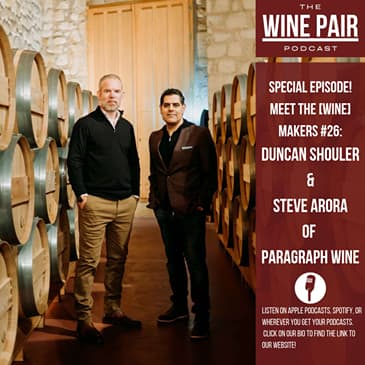
You may not have considered alcohol-free wine just yet, but this holiday season, it’s time to give it a good look. First of all, it is a great way to create a festive atmosphere that includes everyone, whether they drink alcohol or not. Second, it is not an “either-or” decision. Some people may want to drink alcohol for part of the evening, and then switch to non-alcohol options that give them that same taste and feel of wine. Third, for those of us watching our calories and carbs, dry dealcoholized wine like those made by PARAGRAPH are naturally very low in sugar and in calories. Fact: dry wines already have almost no carbs or sugar, but it is the alcohol that carries the calories, so dealcoholized wines are nearly zero calories per glass! We had a fantastic conversation with Duncan Shouler and Steve Arora of PARAGRAPH Wine who are the winemaker and founder of the winery respectively. In this interview, we talk about the groundbreaking aroma capture technology they use which differentiates their alcohol-free wines from others. We also chat about the challenges of making great dealcoholized red wines like Tempranillo and white wine like Chardonnay, and how zero-alcohol wines can fit into your lifestyle. This is the second time we had the chance to speak with Duncan, and we were so happy to welcome him back again!
Send us a Text Message and we'll respond in our next episode!
Contact The Wine Pair Podcast - we’d love to hear from you!
Visit our website, leave a review, and reach out to us: https://thewinepairpodcast.com/
Follow and DM us on Instagram: https://www.instagram.com/thewinepairpodcast/
Send us an email: joe@thewinepairpodcast.com
Show Notes
Special Episode! Meet the (Wine) Makers #26: Duncan Shouler and Steve Arora of PARAGRAPH Wine 00:00
________________________
KEY QUESTIONS
- How is non-alcoholic wine made?
- Does non-alcoholic wine taste like regular wine?
- Is non-alcoholic wine low in calories?
- Is non-alcoholic wine only for people who don't drink?
- How do you serve non-alcoholic wine at a holiday dinner?
- Why is non-alcoholic red wine so hard to make?
- What is PARAGRAPH wine, and who makes it?
________________________
Hello, and welcome to this special episode of The Wine Pair Podcast! I’m Joe, your sommelier of reasonably priced wine, and for this special episode, it’s just me! Carmela is busy making cakes in her bakery and leaving all the fun stuff to me.
Today you are going to hear a great conversation. There is a huge interest in non-alcoholic beverages for people looking to reduce their calories, or who are sensitive to or prefer to avoid alcohol, or even people who want to enjoy alcoholic beverages without making them feel out of control. And this is especially true as we think about the Holidays and the events and occasions we are going to be attending and throwing where we want everyone to feel included. And having non-alcoholic wine is a great place to start. One of the people who has been most involved in creating non-alcoholic wine and is considered a pioneer for his work in creating the world’s first zero alcohol Sauvignon Blanc is Duncan Shouler who has been a guest on the podcast before.
Back in 2023, Episode 104 to be exact, we talked to Duncan while he was working with Geisen Wines. Today, he is part of a new premium alcohol-removed wine company called PARAGRAPH Wine, and we are so lucky today to be joined not just by Duncan but the other co-founder Steve Arora. I will let them tell their story because they tell it best, but the simple way to explain it is that Steve is the business side of the equation, and Duncan is the winemaker. Together, they are partnered with the famous Spanish wine brand Familia Muga, and are bringing really exciting wines like Tempranillo, the famous grape in Rioja wine, into the non-alcoholic fold. This is going to be a great episode.
Before our chat with Duncan and Steve, I want to give you all a quick orientation to what we usually do in our podcast. In most episodes we learn about, taste, and review two to three wines that are reasonably priced, which means under $25, and should be easy to find. However, for this special set of episodes, we interview people who are involved in actually making wine. Because part of what we want to do with our podcast is to educate ourselves and you our listeners on different aspects of wine knowledge in a fun, entertaining, and unstuffy way, even entertaining as Decanter magazine has called our podcast, and that is what we are doing today!
Ok, let’s get to the interview with Duncan and Steve.
Interview with Duncan Shouler and Steve Arora of PARAGRAPH Wine 02:48
Hi Duncan and Steve, and welcome to The Wine Pair Podcast. We are super excited to be talking to you again, Duncan. It’s been a couple of years and we can’t wait to hear more about your new adventure with PARAGRAPH Wine, and we are thrilled that you brought Steve along with you. Our audience is going to love hearing about your story and the ways you are changing non-alcoholic wine, so without further ado, I think we just get to hearing from you! Are you ready?!?
Interview Questions:
- Duncan, for listeners who may not have heard our first conversation, tell us a little about yourself and your background in wine and winemaking.
- Steve, tell us a little about your background and how you and Duncan came together to create PARAGRAPH.
- Duncan, when we last spoke you were already deeply involved in alcohol-free wine. How has your thinking about the category changed since then?
- Why did you decide to build Paragraph, and what did you think was missing from the alcohol-free wine market?
- What new techniques or improvements have you made to the process of producing alcohol-free wine?
- What have you learned about making alcohol-free wine that surprised you?
- How are consumers responding to PARAGRAPH and to alcohol-free wine more broadly?
- What do you think defines PARAGRAPH and makes the wines different from others in the category?
- Tell us about a few of your latest releases and what makes you excited about them.
- Duncan, do you lean more toward the art or the science of winemaking, or both?
- If we were to invite you to Sunday Night Dinner, a tradition in our Italian American family, which of your wines would you bring and why?
- How can people find your wines and follow PARAGRAPH?
Outro and How to Find Duncan Shouler and Steve Arora of PARAGRAPH Wine 40:42
Thank you very much for listening to our interview with Duncan and Steve. I really loved the idea of bookending the Steve brought up in the podcast where you can start and end the evening with a non-alcoholic wine as a way to keep the festivities going in a responsible way. And, I also loved the idea of creating a more inclusive celebration or dinner or event by including de-alcoholized wine.
Now, in case you are worried about how to find Duncan or Steve or PARAGRAPH Wine, don’t worry, you can find out all of this information on our website thewinepairpodcast.com in our show notes for this episode. But so you have it, here is the information about how to find out more
- Website: https://us.paragraph.wine/
- Instagram: https://www.instagram.com/paragraph.wine
- Email: contact@paragraph.wine
And with that, we also want to give a final plug for our podcast and our regular episodes, so we hope for those of you who are new to the podcast that you will subscribe to or follow our podcast The Wine Pair Podcast and follow us on Instagram and Bluesky and TikTok at thewinepairpodcast, and visit our website at thewinepairpodcast.com where you can reach out to us and sign up for our newsletter, and you can also reach out to me at joe@thewinepairpodcast.com if you want more information, or if you have wines or winemakers you want to know more about, and we look forward to hearing from you!
But for now it’s time to go, and as we like to say, life is short, so stop drinking shitty wine.
________________________
FREQUENTLY ASKED QUESTIONS
Q. How is non-alcoholic wine made?
A. Dealcoholized wine starts as finished, full-alcohol wine, and the alcohol is removed at the end, so the quality of that starting wine is decisive. Vacuum distillation removes the alcohol at low temperatures, around 30°C (86°F) in newer systems, which avoids cooked flavors. The aromas that leave with the alcohol can then be captured and added back.
Q. Does non-alcoholic wine taste like regular wine?
A. Not exactly. Alcohol adds body and warmth, so even a well-made dealcoholized wine feels lighter, and anyone expecting an identical glass may be disappointed at first. A good dry version can still deliver real wine aroma, acidity and structure. Sweeter styles can taste great on the first sip but seem grape-juicy by the bottom of the glass.
Q. Is non-alcoholic wine low in calories?
A. Yes, when it's dry. Most dry wines have little or no sugar left, and the alcohol is what carries the calories. Take the alcohol out of a dry wine and most of the calories go with it, leaving a very low-calorie drink.
Q. Is non-alcoholic wine only for people who don't drink?
A. No. NielsenIQ's 2025 research found that 92% of buyers of non-alcoholic beer, wine and spirits also buy alcoholic products. So for many buyers it's an addition rather than a replacement: a glass on a night off or a switch partway through an evening. It also lets guests who don't drink at all still hold a glass of wine.
Q. How do you serve non-alcoholic wine at a holiday dinner?
A. Try bookending. Open the evening with a non-alcoholic wine or sparkling option, serve full-alcohol wine with the main course alongside a dealcoholized red for anyone not drinking, then close with another non-alcoholic option, such as a red with chocolate or cheese. Guests who skip alcohol are included from the first pour, and nobody has to explain their glass.
Q. Why is non-alcoholic red wine so hard to make?
A. Alcohol softens how tannin and acidity feel, so removing it can leave a red tasting edgy and sharp, almost as if it came from a cooler climate. A red still needs tannin for structure, though. Winemaker Duncan Shouler's answer is ripe, round tannin, like that of warm-climate Spanish Tempranillo, which holds its structure without turning harsh.
Q. What is PARAGRAPH wine, and who makes it?
A. PARAGRAPH is a dealcoholized wine brand founded by Steve Arora and winemaker Duncan Shouler, with Rioja's Familia Muga as a partner. Shouler previously ran winemaking at New Zealand's Giesen and created its non-alcoholic range. PARAGRAPH started with a Spanish Tempranillo, followed by a Chardonnay from southern France, both made with low-temperature vacuum distillation and aroma capture.
________________________
Support The Wine Pair Podcast by heading to our website and shopping for the wines we give our highest ratings to in our Shop Wines section. Just click on this link - you pay the same price, and we may get a small amount of compensation.
You can also support us by clicking on this affiliate link to wine.com and find great wines under $20!
And, if you are looking for a great website builder for your podcast, click on this link to use the service we use and love: Beamly, formerly known as Podcastpage.io
________________________
FULL TRANSCRIPT
Joe: 00:07
Hello and welcome to this special episode of the Wine Pear Podcast. I'm Joe, your smollier of reasonably priced wine, and for this special episode, as usual, it's just me because Carmilla is busy making cakes in her bakery called baby cakes and leaving all the fun stuff to me. Today you're gonna hear a great conversation. There's a huge interest in non-alcoholic beverages for people who are looking to do things like reduce their calories or who are maybe sensitive to alcohol or prefer just to avoid alcohol, or even people who want to enjoy alcoholic beverages without making them feel out of control. And this is especially true as we think about the holidays and the events and occasions we're going to be attending and the parties we're gonna be throwing, where we want everybody to feel included. And having non-alcoholic wine is a great place to start. One of the people who's been most involved in creating non-alcoholic wine and is considered a pioneer for his work in creating the world's first zero alcohol Sauvignon Blanc is Duncan Schuller. And he's been a guest on the podcast before, so we're really excited to have him back. Back in 2023, episode 104 to be exact, we talked to Duncan while he was working with Geese and Wines. Today he's part of a new premium alcohol-removed wine company called Paragraph Wine. And we are so lucky today to be joined not just by Duncan, but the other co-founder Steve Aurora. And I'll let them tell their story because they tell it way better than I do. But the simple way to explain it is that Steve is the business side of the equation and Duncan is the winemaker. And together they are partnered with the famous Spanish wine brand Familia Muga, and they are bringing really exciting wines like Tempranio, the famous grape and Rioja wine, into the non-alcoholic fold. So again, this is going to be a great episode, really fun, great conversation, and actually a lot of things to think about around, especially around the holiday. Now, before our chat with Duncan and Steve, I want to give you all a quick orientation to what we usually do in our podcast. In most episodes, what we do is we learn about and taste and review two wines that are reasonably priced, which means under $25 and they should be easy to find. But for this special set of episodes, what we do, obviously, is we interview people who are involved in actually making wine. And there's a reason for that, because part of what we want to do with our podcast is to educate ourselves and you, our faithful listeners, on different aspects of wine knowledge in a fun, entertaining, and unstuffy way, and maybe even entertaining, as Decanter has called our podcast. And that's what we're doing today. But without further ado, let's get on to the interview with Duncan and Steve and Paragraph Wine. Hi, Duncan and Steve, and welcome to the Wine Pair Podcast.
Speaker 1: 02:52
Hi, Joe. It's uh great to be back and good to see you again.
Speaker 2: 02:56
Joe, thanks so much for the invitation. And uh it's really nice to meet you.
Joe: 03:00
Well, we are super excited to be talking to you both and actually really excited to talk to you again, Duncan. It's been a it's been a couple of years since uh since we talked, and I can't wait to hear more about your new adventure with paragraph wine. And we're thrilled that you brought Steve along with you as a as a partner. So that's great. And our audience is really gonna love hearing about your story and the ways that you're changing non-alcoholic wine. So I think we just get to it without further ado. I think we just need to hear from you guys. So are you ready?
Speaker 1: 03:29
Absolutely.
Joe: 03:29
Okay, Duncan the first question is for you. For listeners who may have not heard our first conversation, tell us a little about yourself and your background in wine and winemaking.
Speaker 1: 03:39
Yeah, well, look, I actually grew up in the UK, which I suppose is uh, although a very important country as a wine consumer, not really a country many winemakers come from. Uh, I originally studied marine biology, uh, so I had a science background. Um, but about 26 years ago, I moved to New Zealand with my family. And I'd been a wine lover for several years before that. At the time, the wine industry in New Zealand was really just getting going, and I found it fascinating. It felt like a potential way to combine my love of science and love of wine. So I did that. I studied to become a winemaker, and then from there tried to figure out how to make wine and hopefully do it well. Uh so I spent a bit of time traveling the world. I was very lucky. I got to work at some great places like Chateau-on-Jalouse and Santa Milon, beautiful estate. I too in Corneros, a little bit closer to you, uh Amersfield in Central Otago, and sort of tried to craft my winemaking style. Then, after years of traveling, I settled down in Mulberry, New Zealand, and joined Geeton Wines. And then in 2020, I became their chief winemaker, and that's where I took the interesting step to design a range of non-alcoholic wines. We put those together, and they've been a huge success. They were massively successful, still are, which is great to see. And um that was that was a fantastic thing to be part of. Then in the last 18 months, I've been very lucky to be working with Steve and my first experience as part of a team creating a totally new brand with Paragraph, and it's been an amazing journey so far, very exciting.
Joe: 05:13
That's awesome. We can't wait to hear more about this new wine, Paragraph Wine, your new company. But before we get there, Steve, let's find out a little bit about your background and how you and Duncan came together to create Paragraph.
Speaker 2: 05:25
Well, I've been a lifelong wine lover and still very much a drinker of traditional wine. I spent over 25 years building and leading international businesses, particularly in a niche specialty sector of the financial services industry called reinsurance. But wine has always been a personal passion in parallel. And I spotted an opportunity in the premium alcohol-removed wine space for people who genuinely love wine. And I went straight to some good friends to jointly explore the idea. Those friends happened to be the iconic wine family in Spain, the Muga family from Rioja. And uh, we wanted to find the very best winemaker we possibly could with the skills and track record to bring the vision alive. So, you know, we went to the top of the list, we approached Duncan, he agreed to meet, and the rest is history.
Joe: 06:16
Well, it sounds like it was serendipity and also interested in how, you know, you moved from such a different space into wine, but we'll we can talk about that later. Duncan, back to you. When we last spoke, you were already really involved in alcohol-free wine. And, you know, there's a lot of different techniques and different ways of doing it, etc. How has your thinking about the category changed since that time?
Speaker 1: 06:43
Yeah, look, I think what probably what hasn't changed, if I if I to continue to start there, is that the category continues to grow. It's still growing, which is great to see. Obviously, it got off to a fast start, but it continues to grow very, very well. And it still presents a massive challenge to winemakers. Making non-alcoholic wine is tough. And the more you do it, the more you understand it's tough. But you also understand more and more about how to do it and hopefully do it well. What has changed, I think, is that the consumer acceptance and expectation of the wines has changed. Uh, I think people are more accepting of how it fits into their lifestyle, what occasions they drink those wines with, that it's not exclusive. It can be part of a lifestyle that still includes alcohol, of course. And that you know, a lot of people that drink these wines still consume regular full alcohol wine. But then, of course, one of the most exciting things in recent times is the evolution of technology. And that's become very, very important to what we're doing. The technology's evolved quite significantly, and there are now ways to help us make wines that have real true venous character, strong aroma, and we can create dry, savory styles without loss of sugar. And to me, that's really exciting because that's that's what it's always been about, trying to create something dry and serious and that appeals to regular wine drinkers.
Joe: 08:01
Yeah, we'll talk uh in a minute more about the techniques themselves, but you brought up something that I think is spot on, which is, you know, I find this for myself. I drink full alcohol wine, I drink full alcohol beer, but there's times where I don't want to drink full alcohol wine or beer. And I do think that the, you know, it's no surprise to anybody that there's a for a variety of reasons, whether it's health reasons or just because they just want to take a night off, they still want that wonderful experience of drinking wine, but maybe want to do it with less alcohol. There are many names for it. Do you prefer non-alcohol, zero alcohol, alcohol-free? What do you what's your preference or is there any preference for for what you call it?
Speaker 1: 08:43
It's a really good question. Um, I think that if you look specifically at paragraph, and obviously we'll get into this a bit more in more detail, but we're we are a de-alcoholized wine. And I say that because what's very important for us is that we we start with regular wine. We start with really high quality, full alcohol wine, and then we use that technology I mentioned to remove the alcohol. So we de-alkalize it. But look, I mean, non-alcoholic works as well. I think the most important thing is that the consumer understands that it is wine. It is made using wine grapes and fermentation and that it is a wine. And of course, the second most important thing is that they understand it doesn't have alcohol, and because that's obviously what they're looking for on that occasion. So I think if you if you capture both of those things in the name, then uh that's the most important thing.
Joe: 09:29
Great, perfect. Okay, for the next question, Steve, I'm gonna start with you and then Duncan, you can jump in too. Why did you decide to build Paragraph? And what did you think was missing from the alcohol-free wine market that you wanted to fill?
Speaker 2: 09:43
Well, the first thing is I had gained really strong conviction on the growing moderation trend and also the long-term category opportunity. And within that, we saw a gap for a premium wine-led, food-friendly product, not just another uh sweet grape juice. So, how could we build a product that was built for fine wine drinkers who wanted to moderate and at the same time having this great ritual of having a glass of wine every night and a nice bottle on the table with food? The second part is as a wine drinker, I had opened a bottle of traditional wine almost every night for 25 years, shared it with my wife, really enjoyed it, but I just reached a point in my life where I couldn't sustain that anymore. You know, my body wasn't processing the alcohol, and I just felt it's something that used to serve me quite well, but wasn't something that I could sustain uh going forward. But I still wanted a glass of wine in my hand every night and a really nice drink. And I became a little bit curious, but then frustrated that there wasn't a nice option out there for the Monday night, for the Tuesday night, or for the evening where you decided you wanted to do something that didn't have alcohol in it. So that's what really sparked the curiosity as well, alongside the business case. And so this is for us about the extending the story of wine, not entirely replacing it. And, you know, there's an interesting data point from the IWSR that shows how this category has grown in the US, 23% from 2019 to 2024. In the UK, over that same period, it's 15%. And this is backward-looking historical data. It's not a forecast of the future, and we think there's actually going to be more momentum in this category going forward.
Joe: 11:39
Yeah, and Duncan, uh curious to hear your thoughts as well. But but one of the things that to note as well about what you were saying, Steve, is that the growth of non-alcoholic wine has also come at the same time that the overall wine industry has sort of shrunk. So it's even a bigger, you know, the this growth and this interest in non-alcoholic wine is real and people are really turning to it and excited by it. But Duncan, why did you want to start Paragraph Wine?
Speaker 1: 12:05
Well, first and foremost, I I love wine. And you know, I love making wine, I love growing wine, and I love drinking wine. And so I I find myself in that position where as a winemaker, you often say, make wine not for yourself. It's very important. You've always got to be consumer focused, consumer first. And I strongly, strongly believe in that. But I find myself in the situation with Paragraph that I am probably to the to a certain degree part of the consumer set. Uh I'm someone who loves wine, who still wants to have wine in their lifestyle, but is increasingly conscious that I can't always have a glass of alcoholic wine every night, or two or three glasses every night. So it's been a very interesting way to make a wine, and I look at it in a way where I say, what would I look for? And therefore, what would our target consumer look for? We're looking for something that is not a direct replacement. It can't be something that imitates regular wine because it can never look exactly the same. But back to the point mentioned earlier, it's about bringing in the ritual, it's about having the ability to have a glass in front of you while you're cooking dinner, while you sit down with the family with your meal or at the local restaurant that gives you that wine experience. And that's what we're trying to achieve. Uh, it's it's not easy to do all of the time, but for me, it's been really fantastic using this project to show that actually you can create something that generates that experience.
Joe: 13:29
And can you tell our listeners a little bit more about the Familia Muga, how they have been involved and where that came from as well?
Speaker 2: 13:38
Yeah, sure. So I've had a relationship with the Muga family for over 25 years, specifically with Eduardo Muga. And it's just a wonderful friendship with the family based on several years of friendship and trust, big lovers of their wines. And, you know, when I was thinking about making the shift from financial services to uh the wine industry, I mean, it's really natural for me to engage them, ask for their advice, their guidance, their perspectives. And as we jointly explored the market opportunity, I think they also saw that consumer trends are shifting. This is an interesting team, particularly with Duncan's track record. Um, the timing looks good. And it was an interesting way for them to get involved and get exposure to the category while still maintaining, you know, the wonderful wines that they produce. So it just worked out really well. It's been natural, and they're wonderful partners that help us, you know, with several aspects of our business. But that's just a genesis was a relationship that dates back 25 years.
Joe: 14:44
And yeah, and I should note for our listeners, you know, this is a famous winemaking family. They've been doing it for a very long time. Duncan has a pedigree of winemaking that is very impressive. And so the paragraph is a very exciting and I think well-positioned wine brand to really kind of take off in this category. So let's talk a little bit about. We alluded to this a little bit, but what new techniques or improvements have you made to the process of producing alcohol-free wine, Duncan?
Speaker 1: 15:17
Yeah, I'd I'd start off with something I think we discussed last time, actually, Joe, which is that without question, the most important thing is the quality of the wine you start with. You really do have to put a huge amount of attention to detail in the base wine. It has to be high quality and it has to be of a certain style. The more and more I work in this category, uh, the more I understand what wines respond well to the process and what wines don't. And even then, you can't be 100% sure. So it takes a lot of trial and error. One thing is an absolute certain you have to start with good wine if you want to make a good non-alcoholic wine. So that's the first and foremost. But the technology, what we're using now is I think when I previously discussed spinning cone. Spinning cone is great technology for making non-alcoholic wine, does a wonderful job of low temperature alcohol removal about 40 degrees. We're now using some fantastic new uh low temperature vacuum distillation technology that allows us to distill the alcohol at 30 degrees Celsius. So, in in wine terms, it's like in terms of non-alcohol production is super low, really, really low. So that's fantastic. So that preserves the natural characteristics, the flavours, the tannin profile. You don't get those cooked characteristics. That's very important. But the next part is really interesting, and we're using something called aroma capture technology. When we remove the alcohol, pretty much all of the aroma leaves the wine with the alcohol. We're then able to extract the aroma back out of the alcohol using a very natural process and reintroduce 100% of the aroma back into the wine. Now, with spinning cone, you can do that to a degree, and it's very effective. But this new technology allows us to add 100% of the aroma back. And that means we can create a non-alcoholic wine that's truly venison aroma. It's complex, it has the oak characters, the fruit characters, the spice, you know, hopefully all those things that remind you of good quality temper or Chardonnay. And it also means that the palate has natural fruit sweetness. So we can create something that's dry and venous without loss of sugar. So that to me has been an absolute game changer.
Joe: 17:31
You said something that I'm curious about. Are there certain wines or certain grapes that lend themselves better to non-alcoholic processes than others?
Speaker 1: 17:40
Absolutely. There absolutely are. Now, look, you can make you know decent examples of non-alcoholic wine from most grape varieties, but it's definitely true that some grape varieties are better suited than others. Um, if I talk about red wine, uh, the first thing you have to think about is tannin profile, because when you remove alcohol from wine, the tannin can look really edgy and aggressive. But at the same time, you want your non-alcoholic red wine to have tannin. You want it to have structure and texture so that the wine drinker feels like they're drinking your red wine. Temperillo, which we've used, is a really great balance because obviously, coming from Spain, you've got this lovely ripe, uh, round-edged, fine, cocoa-y tannin that coats the outside of the mouth and it's not aggressive. So when you lose the alcohol, you still have that structure, but it's not edgy on the palate. With white wine, probably the biggest thing to think about is aromatics and acidity. Now, you want to start off ideally with something quite aromatic, uh, and the acidity can be overly pronounced once you've removed alcohol. So you don't want something that's too acidic. Now, we actually produce our white wine using Chardonnay, which is relatively high acid and not especially aromatic. So that almost contradicts what I'm saying. But what's important for us is this new technology is allowing us to capture the Chardonnay aroma and get it back into the glass. So you're getting, you know, the white peaches and the apples and the citrus and the oak profile. Whereas if you did it with other technologies, it'd be very, very hard to do. But yeah, absolutely, some varieties are certainly better than others.
Joe: 19:16
Yeah, super fascinating. And is there anything that you've learned about making alcohol-free wine that that surprised you?
Speaker 2: 19:23
Yeah, I mean, as a newcomer to the category, one thing that I've learned is that the quality of the base wine is strongly correlated with the quality of the end product. That doesn't mean you can spot a wine that's full strength and say, oh, I love this wine, and therefore let's use this. It takes a lot of product development and working backwards from the finished product to find the underlying base wine. But there's no doubt you have to start with quality if you want to end with quality. The second thing for me has been around the first sip. It can be misleading. So sweetness is great on the first sip, but by the time you get to the end of the glass, you're not super motivated to pour another one and to continue through the evening. But a savory product or one with low, low sugar, I think gets better and better as the experience moves on. And it's one of the reasons why we called our brand Paragraph, because the first sit may not tell the entire story. And maybe third is the unexpected calorie benefit. We didn't set out to optimize for calories, but when you remove alcohol and you have very low sugar, ultimately most of the calories are gone. And in our products, the Chardonnay is approximately eight calories per glass, and the Temperanillo has approximately 12 calories per glass. And that really surprised me. And it's not something we talk about too much and is not probably particularly known to our customer base, but it's a great added benefit, you know, alongside our central proposition. So you got to start with great wine and you got to know what you're doing. And we're, you know, we feel great about the team that we have led by Duncan that has tremendous winemaking experience. And we're able to come up with like a really thoughtful end product.
Joe: 21:17
Yeah, you bring up a really important point, especially for any of our listeners or people who drink wine who are trying to be careful about health or calories, that there is this sort of like sugar-free wine movement, but most dry wines are low or no sugar anyway. The alcohol is what carries the calories. And so by removing both by having a dry wine and then removing the alcohol, like you mentioned, Steve, you have a very low calorie product. And what makes that great is then you can uh enjoy it without guilt. Uh and the and the dryness and the way that you were describing it too, Duncan, is that you, you know, this should, these should be wines that are great with food, I would imagine.
Speaker 1: 21:58
Yeah, that's that's been one of our most Important philosophies as well is that we want something, of course, that is venous and complex, but it has to go well with food, right? I mean, if you're drinking premium wine, uh, sometimes you're going to drink it without any food, no doubt about it. But often it's at its absolute best when you're pairing it with food. And people, you want it to be fun, you want it to elevate your evening with friends and with food, and that's what we're trying to achieve here.
Joe: 22:25
Yeah, we'll talk about that a little bit more uh towards the end when we when we talk about our the dinner that we're inviting you to. But back to back to paragraph, how have consumers been responding to paragraph? I imagine very positively, but tell us what people think about it and what they appreciate about it.
Speaker 1: 22:42
Yeah, we're getting some really great responses. It's uh it's been a fantastic six months to sort of see how people respond in the market because you never really know, right? You think you've created something wonderful, but you never really know until you see it. We're getting a lot of great responses about the dryness. People are saying they love the fact that this is a non-alcoholic wine that's dry. And uh, you know, often those sweeter examples can look great on the first sip, but as you get to the bottom of the glass, they start getting a little bit great juicy, and and that can be become a bit off critics. So people are loving the dryness, they're loving the aroma because it's complex and it's venous. The temperanio, they're loving the structure because it has tannin, it has you know complex, drying tannin. Uh, the meat is great with food and makes you feel like you're drinking a good glass of red. And look, we've had we've had a lot of people say this is the best non-alcoholic wine that they've tried. So that's really, really satisfying. Of course, the reality is it it can still be a challenge. The non-alcoholic category is a challenge, uh, especially for a dryer style. Not everybody's gonna like it. And for people who try it for the first time, if they still have an expectation that it's gonna taste exactly like a full alcohol wine, then they they'll likely be disappointed at first because it can't taste exactly the same. It will always be a little bit lighter in texture, it won't have the uh the warmth of alcohol. But once you sort of get your head around that and you discover that it can have the aroma and the acidity and the structure and all those things together create a really wonderful Venice experience, then people really love it. So it's it's been a fascinating process seeing how people uh respond to the wine.
Speaker 2: 24:22
And we've received some wonderful independent recognition. I mean, Rolling Stone Spirit Awards, you know, elected us the best non-alcoholic wine. Their quote is that paragraph is heritage over hype. That was really rewarding to receive and to read, particularly so early in our evolution as a brand. And we've had great listings in restaurants, interactions with sommelier's, in luxury retail, which really supports our underlying proposition. And, you know, I think all of those cohorts have said to us that this is a very gastronomical product, which is something that we agreed with. You know, one thing just to share is a very powerful data point, which comes from Nielsen IQ, that 92% of buyers of non-alcoholic products also buy alcoholic products. So for us, again, this is about fine wine drinkers, it's about moderation, it's about, you know, always having a glass in your hand, but elevating the category to a standard where fine wine drinkers, you know, really feel proud about what they're drinking on the nights when they're not drinking.
Joe: 25:34
You know, I love about your answer, Steve, is uh, and you can see this in the partnership. Steve is the business guy, he's got the data and the stats, and Duncan is the winemaker because he knows about the techniques. I love it. It's a great pairing. So, kind of on that note, it was great that you got the accolades from Rolling Stone and that the customers are liking it. What do you think makes Paragraph different? What do you think defines Paragraph? What do people really appreciate about it that, you know, maybe is different from some other non-alcoholic wines?
Speaker 1: 26:06
Well, Joe, for me, I would straight away say our wine philosophy. I think our absolutely meticulous approach to the base wine, we spent a huge amount of time getting our white base wine right. It's uh, I think Steve probably enjoyed this part in the process. We had to taste dozens and dozens and dozens of wines and do extensive blending uh tastings before we got it right. So it was a pretty full-on few months, but a lot of fun. So we take that part so seriously, and of course, having familiar family Amoog there as well with their guidance on varieties like Tempaneo is so valuable. And then combining that with technology, uh, it has to be done in this category, and we were very conscious that we wanted to find the best technology available, which we've done. And then you put all those things together, and look, I don't want to sound like a broken record, but what we want out of our wine is for it to be dry and serious and complex in dinners. And uh we want it to be something that elevates an occasion at the dinner table. So it's got to go well with food, can't be great juicy, it's got to be, you know, serious and complex.
Speaker 2: 27:17
You know, adding on to those points, I mean, I have to mention the pedigree. There are serious wine people involved in this venture. I mean, Duncan's track record speaks for itself in some of the products he's developed, both full strength alcohol and in the non-alcoholic category, matched with the great team that we have, and also the generations of experience at the Muga family. So when you take that all together, I think the pedigree is a differentiator for us. And Duncan mentioned as a part of that, the product development and the substantial time and care that was devoted to the end product, I think is something that will ultimately benefit our customers. The other thing to add is the luxury presentation. I mean, we really tried to invest into sophisticated packaging and something that gave our customers, you know, a really nice wine experience and something that would make you very proud to put on your dinner table. So if you take all of these factors and our ambition, uh we believe we can lead the premium category in the space.
Joe: 28:27
Duncan, we've been you've been talking about the the wine and how you make the wine. And obviously, in non-alcoholic wine, there's a lot of technique, there's science in it, but you're a full winemaker. So what do you lean more on? The the the science or the art of winemaking? Is it a balance? How do you think about that?
Speaker 1: 28:45
I think about it a lot, and I think I think any winemaker does. And the answer is always going to be different for each winemaker. The the reality is with a product like Paragraph, it has to be both. I mean, the the art of wine is what makes wine what it is. Uh the beauty of growing something in a field that creates amazing flavor, and then using these amazing yeast to convert those flavours into even more exotic aromas and textures and colours. That's art and it's just amazing. And that's that's the beauty of wine. But if you want to capture all of that and get it into a bottle that then can be served reliably at a table, you need to use some science. If you don't, then unfortunately, you can lose that art. You can lose it through oxidation or microbial spoilage. Now, in the case of non-alcoholic, we do all the first part. So we want to capture the art, we want to grow fantastic fruit that goes through a great fermentation process and creates all the magic of wine. But then, of course, we've got to use science to remove the alcohol for that last step. That's critical. And uh so for us, it's very much a pairing of both. And look, I would say, even outside of Paragraph, my general winemaking philosophy would always be one of both. You let art express itself as much as you can, but sometimes you 100% need science to help you do that. If you cut corners, then the art can be lost very quickly if you haven't used the right science.
Joe: 30:13
Yeah, makes sense. It has to be the right balance to make it really work. Well, as we record this, we're going headfirst into the holidays. And to me, the holidays is a great opportunity to either serve non-alcoholic wine along with full alcohol wine or introduce people to it because for a variety of reasons, people maybe want those different options for the holiday table. And so let's talk about some of the new releases that you have and what what you're excited about with them and then why they may be great during the holiday season.
Speaker 1: 30:46
Well, we uh we don't always like to do things easily, a paragraph. And we started our brand by releasing a red wine. Now, red wine is unquestionably the hardest non-alcoholic wine to make well. Uh, we love a challenge, but I'm actually I'm gonna step into Steve's shoes here for a minute and I'll give you some stats. Uh, around about 47% of wine consumed globally is red wine, but only about 5% of non-alcoholic wine consumed globally is red. So we saw that as an opportunity. And we see that and we say people they want it, they they want a good example of a non-act red in their lives. So that's where we're gonna start. So we started with a temperillo, and we spent a load of time, as I've said before, finding the right style. Uh, obviously, the fact that we are partnered with Familia Muga meant that Spain was a really obvious place to start, and of course, it is the home of Temperino. Now, I mentioned earlier tannin profile in red wine, and Spanish Temperino has just the right tannin profile because it's a hot climate, warm climate, so it's lovely ripe tannin. When you remove alcohol from wine, it's almost like taking it from a warm climate to a cooler climate because the tannin and the acidity become more pronounced, and even the flavor and aroma profile seems to head more towards a cooler climate expression. So, starting with a warm climate tempaneillo is fantastic. So, what that means for us is that we've got this lovely dry aromatic tempanillo, it's got beautiful colour, the aroma is dark fruit and spice, and some of that sandalwood character you get in in Spanish Tempanillo. Holiday season, I mean, look, tempanillo, especially our style, it is a really fantastic thing to have with roast turkey. I know that probably sounds a bit cliche, but it really is because you know the uh the the richness of roast turkey and things like the saltiness pair really well with a fresh, bright style of Tempanillo. Um, so we followed up the Temponillo with a Chardonnay. Uh Chardonnay, I said before, isn't necessarily the easiest white variety to make because it's a neutral white variety. But as we all know, when Chardonnay's done well, it's complex and dry and venous and savory, and it's absolutely delicious. We wanted to capture that experience in a non-alcoholic form. And we knew we could do it with this new technology we're using. So we found some lovely Chardonnay in the south of France that has classic peachy, citrusy characteristics and beautiful oak profile, and then got to work on that. And uh that wine is a very recent release. It's doing really well. It's just beautiful and fresh and bright. It's it's so enjoyable. Uh at the start of an evening, we're really proud of it.
Joe: 33:27
Okay, now we're getting to the most important part, kind of on this whole like holiday, the table. We always say we invite you to a Sunday night dinner, but we're going, we're gonna step it up for you guys because around Christmas, we're an Italian-American family, both Carmela and I. And so we do the Feast of the Seven Fishes. Okay, so you are both invited. This is a big deal. You're both invited, I'm not kidding, to our Christmas Eve Feast of the Seven Fishes. And the interesting thing is, so I want you to pair the wines. I'll lay out the the dinner. The way the dinner starts is is seven fishes. There's cracked crab, there's grilled shrimp, there's octopus salad, there's clams, there's uh uh mussels, there's all the all the seafood. And that's the first part. And that's just like around a table and everybody's eating. And then there's the second part of the meal, which is still no meat, but it's more of a maybe more of a classic Italian lasagna, those kinds of things with the with a red sauce. No meat, but a red sauce. So tell me about what wines you're gonna bring and how they're gonna pair perfectly and make you guys the heroes of the Feast of the Seven Fishes for our family.
Speaker 2: 34:39
Well, as a wine lover, um, I have to start with my picks from Italy in terms of full strength wine. So I would start with a Franca Corta, probably move towards a Chardonnay from Alto Adige, and then maybe for the main course, Brunello or a good super Tuscan. So those are my favorites from the region, and that sounds like a great dinner lineup that you have planned. And I'll actually consider uh joining. So, Duncan, let's uh let's plan our trip. But there would be a role for paragraph, the Chardonnay and the Temperanio 2, and they can serve as complementary options across the meal. And if you think about what wine is, it's about the food, the company, the ritual, the choice. It's not always a binary decision to say, is it alcohol or is it not alcohol? And two things that I've learned and introduced into my life: one is the concept of bookending. Every time I entertain now, I always start off with something non-alcoholic, whether it's the paragraph Chardonnay or it's a sparkling tea or something else, just to start off the evening, to reduce the amount of alcohol that goes through the entire night and to give options. You'd be surprised how many people decide to stick with that option and not move to alcohol, but there's plenty of people that say, okay, now I'm ready for something else. And at the end of the night, the other end of the bookend, I generally introduce something, either a non-alcoholic spirit or the tempranio to go with chocolate or cheese or something. So this bookending concept, I think, is really interesting, has worked really, really well. And our friends uh have responded really well to that concept. The other thing I would say is just the theme of inclusion. So we get the feedback all the time that people love putting paragraph on the table. No longer do they have to say that the wine drinkers sit on one side and the water drinkers sit on the other side, the wine drinkers that get loud, the non-wine drinkers aren't getting annoyed anymore, and everybody is just taking whatever they like to drink. No one knows, and it's not a topic of discussion, and everyone feels included. So I would say for the dinner that you outlined, which sounds amazing, uh, I would probably mix in our paragraph wines, some of my other favorites, sprinkle that them in, maybe start with the paragraph, end with the paragraph. Um, and it sounds like a really amazing.
Joe: 37:12
Yeah, I'd love that answer because it's it doesn't have to be an either or. In fact, the and is the better approach, which is how do you both I think the inclusive, like you have family members or friends who want to drink and some don't want to drink. And maybe you throughout the course of the evening or your guests want to change it up. Some they may want to start with alcohol and end with non-alcohol. So I love that answer because it isn't binary. It's let's think about this as part of a full experience. And I I really, I really appreciate that. Anything to add, Duncan?
Speaker 1: 37:47
Uh, first of all, Joe, I'd say that when you when you described the dinner, you absolutely had me uh with Crab and Octopus. I'm there. Like it's uh it sounds a wonderful, wonderful occasion. Um, I would just add that Steve actually introduced me to the concept of of bookend drinking, and I love it. And I've started doing it, it's a lovely way to host people because you know, handing someone a glass of non-alcoholic wise or sparkling at the start of an evening is it's it's number one, it's fresh and it can be delicious and it goes really well with canopes, but it's a conversation starter. Um, it's a really interesting way to start an evening, and it also means that for those people who are going to continue the evening without drinking, they've been included right from the very beginning. Then, of course, you can have that wonderful bottle of Brunello or Borollo or Burgundy or whatever it is in the center of the table to match the wonderful main. But again, for those people who aren't drinking, they've got the option of something like a paragraph tampanillo. So it's both inclusive and it does elevate the evening. It means that you can extend your evening and have a lot of fun and uh try something different, uh, try different food pairings, and that's what it's all about, isn't it? It's all about having fun and enjoying some drinks with friends and food and uh and inclusion.
Joe: 39:03
Yeah, I mean, how fun that everybody can have a glass of wine in their hand, whether that wine has alcohol or not. I love it. Well, on that note, how do people find paragraph wine? Where can they buy it? Now that they're going to be really excited to bring it into their parties or their dinners or just on a Tuesday night, how can they find paragraph wine?
Speaker 2: 39:21
Our website is uh www.paragraph.wine. You can find all the details about our story and the wines, and you can purchase the wines there. We're available in the US. We're building our presence internationally, including some flagship markets of Switzerland and Spain and many other European markets. If you follow us on social media, you'll find all the updates for our various launches, upcoming SKUs, events, et cetera, and just following along the journey. And uh ultimately, this is about more ways to wine. That's our overall premise. And we're really excited about bringing paragraphs to as many of your listeners as possible, Joe.
Joe: 40:04
Love it. And we'll have all this information in our show notes. You have an Instagram and Facebook, and there's a website, and so we'll have all that information, but we do encourage everybody to check it out and find the wonderful wine that's being made by Paragraph. Well, thank you both so much. This is great. Uh, I was super excited, Duncan, when you reached out because we hadn't spoken for a few years. And I was thrilled and honored that you were interested in having another conversation. So thank you both very much. And again, thanks for being on the podcast.
Speaker 1: 40:35
Been an absolute pleasure, Joe. Thanks for uh thanks for chatting with us.
Speaker 2: 40:39
Thank you so much.
Joe: 40:43
Thank you very much for listening to our interview with Duncan and Steve. I really love the idea of bookending that Steve brought up in the podcast, where you can start and end the evening with a non-alcoholic wine as a way to keep the festivities going, but in a responsible way. And I also love the idea of creating a more inclusive celebration or dinner or event by including dealcoholized wine for those who, again, may not be interested in drinking that evening or just don't drink at all. It's it's a great way to make everybody feel like they're part of the party. Now, in case you're worried about how to find Duncan or Steve or Paragraph Wine, don't fret. You can find out all this information on our website, thewinepairpodcast.com, in our show notes. Just go to this episode, scroll down, you'll find all this information. But so you have it, here it is, and how to find out more. The website for paragraph wine is us.paragraph.wine. Instagram is paragraph.wine, and their email is contact at paragraph.wine. And with that, we also want to give a final plug for our very own winepair podcast and for our regular episodes. And so we hope for those of you who are new to the podcast, that you'll listen in on those. And then you'll want to subscribe and follow our podcast and follow us on Instagram and Blue Sky and TikTok at the Winepair Podcast. And then you'll want to visit our website, thewinepairpodcast.com, where you can reach out to us and sign up for our newsletter. And then you'll also want to email me at Joe at the Winepairpodcast.com. You can always do that. We'd love to hear from you if you want more information, or if you have wines you want us to taste and try, or if you just have a winemaker you really are interested in us talking to then give us a little jingle via the email machine and let's take care of it. So with that, it's time to go. And as we like to say, the life is short. so stop drinking shitty wine. Bye-bye.