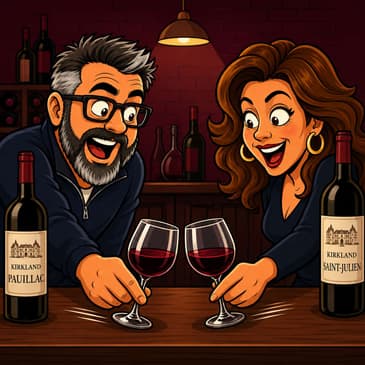
We all know that Costco wine moment when you see a Kirkland Signature wine and you wonder, should I get it? Well, we are here to tell you that you should snatch up these two beauties if you see them. The Costco Kirkland Signature 2023 Pauillac and 2023 Saint-Julien are great Bordeaux wines that you will not be able to find at this quality at this price anywhere else. But wait, are you confused by French wine and don’t know what kinds of grapes go into Pauillac and Saint-Julien? You are not alone, and we will help decode these Left Bank red Bordeaux wines from Haut-Médoc. Did we lose you already? Don’t worry. Just know that these are going to be Cabernet Sauvignon heavy blends, and the rest we’ll tell you about in this episode. Also know that we do not usually love Cabernet Sauvignon, so we were really pleasantly surprised by how much we liked these wines. Join us for a fun learning adventure! Wines reviewed in this episode: 2023 Costco Kirkland Signature Saint-Julien, 2023 Costco Kirkland Signature Pauillac.
Send us a Text Message and we'll respond in our next episode!
Contact The Wine Pair Podcast - we’d love to hear from you!
Visit our website, leave a review, and reach out to us: https://thewinepairpodcast.com/
Follow and DM us on Instagram: https://www.instagram.com/thewinepairpodcast/
Send us an email: joe@thewinepairpodcast.com
Show Notes
Episode #225: Costco Kirkland Signature Wine Challenge: Saint-Julien vs. Paulliac! 00:00
________________________
KEY QUESTIONS
- Are the 2023 Kirkland Signature Pauillac and Saint-Julien Bordeaux worth buying at Costco?
- Which is better, the Kirkland Pauillac or the Kirkland Saint-Julien?
- What does the Kirkland Signature Pauillac taste like?
- What does the Kirkland Signature Saint-Julien Bordeaux taste like?
- Should you drink the Kirkland Pauillac and Saint-Julien now or let them age?
- Who bottles the Kirkland Signature Saint-Julien Bordeaux?
- What food pairs with Kirkland Signature Pauillac and Saint-Julien Bordeaux?
________________________
Episode Overview and First Thoughts on Red Bordeaux 00:33
Hello fellow Terroiriors (Terroir Warriors)! And welcome to The Wine Pair Podcast. I’m Joe, your sommelier of reasonably priced wine, and this is my wife and my wine pairing partner in crime, Carmela. And we are The Wine Pair!
If you're new to our podcast, here's what we do: Every week we buy wines under $25 with our own money, taste them, and give you our brutally honest opinion on whether they're worth buying. Nobody pays us to review specific wines, we don't accept free bottles from wineries, and we're not afraid to call out a bad wine when we taste one. Decanter Magazine calls us fun, irreverent, chatty, and entertaining - so if that sounds like your vibe, welcome to our tribe of wine lovers.
The name for the tribe this week comes from listener Timmy’s wife Gina, and so we are very thankful to Gina, and just remember if you have some names for our tribe that you want to share, send them our way and if you have not been on the podcast, we’ll ask you if you want to join us. Don’t be shy!
Carmela, today we are back doing another Costco Kirkland Wine Challenge after basically doing one last week with Moscato d’Asti. And, by the way, the pronunciation police got on me about that one.
As you know, or I hope you know, when we usually do these challenges, we pit a Kirkland wine against the exact same wine that is not a Kirkland wine, and usually a well reviewed wine, to see how the Kirkland Signature wine fares. And that’s what we did last week, although we did not title the episode that. But not today. Oh no. Today, we are doing something different. Today, we are going to review and taste two Costco Kirkland Signature red Bordeaux wines, both from 2023, and one is from Saint-Julien (sah-Julia), and the other is from Pauillac (Poe Yac). And, pronunciation police, come at me.
Now, why are we doing this different version of the episode, you might ask? Well, first of all, because when I was at Costco, I was thinking about doing a regular Kirkland wine challenge, and I found both of these Bordeaux wines, and I thought doing two episodes on the same subject would maybe feel like a lot, and I couldn’t choose just one, so, on the spot, I decided that I would just buy them both compare them in an episode. Because I am a decider.
The second reason is because French wine is still pretty challenging for me and a lot of other people because it is so particular based on the specific appellation, that I thought it would be valuable to dig in a bit more, and educate myself on so I could educate all of you. As best as I can.
So, if you don’t know this already, while we often think of Burgundy as the land of Pinot Noir, and Bordeaux as the land primarily of Cabernet Sauvignon and Merlot, it is much more complicated than that. Bordeaux has, get this, 65 different appellations and depending on who you believe on the interwebs, somewhere between 4600 and 5600 chateaux making wine, so, you know, that’s a lot to try and learn. And why I find French wine very challenging, and also why you can’t just say you like red Bordeaux because that could mean a lot of different things. Which we will dig into.
The simplest way to understand the complexity of Bordeaux is to break it up into two: Right Bank versus Left Bank. Right Bank wines come from the area north and east of the Dordogne River, and they tend to be Merlot-heavy. Left Bank wines come from the area west of the Gironde and south of the Garonne river, and they tend to be Cabernet Sauvignon-heavy. That is the easiest place to start, and why just saying you like Bordeaux is . . . complicated.
Getting into a little more detail, the Left Bank is where you find some of the most famous names in Bordeaux: Pauillac, Margaux, Saint-Julien, Saint-Estèphe, Graves, and Pessac-Léognan. These wines are usually very structured, tannic, and built for aging. We’ll talk more about Pauillac and Saint-Julien in the next section of the podcast because that’s where the wines are from today once again, but Margaux is known for elegance and perfume, Saint-Estèphe tends to be rugged and muscular. Graves and Pessac-Léognan are also important because they make both red wines and some of Bordeaux’s best dry white wines.
On the Right Bank, the big names are Saint-Émilion and Pomerol, along with Fronsac and Canon-Fronsac. Because these wines usually lean more heavily on Merlot and Cabernet Franc, they are often a little rounder, softer, and more plush than Left Bank Bordeaux. Saint-Émilion is probably the most famous Right Bank appellation, and Pomerol is tiny, prestigious, Merlot dominant, and often very expensive.
But Bordeaux is not only red wine. Sauternes and Barsac are famous for sweet wines made from grapes affected by noble rot, where a fungus basically removes a lot of the water in the grapes so they are almost like raisins, and this gives the wines rich flavors like honey and apricot. And Entre-Deux-Mers, which literally means “between two seas,” sits between the Garonne and Dordogne rivers and is best known for crisp, refreshing dry white wines.
So, as a quick review before we give you the quiz (there is no quiz, don’t worry): Left Bank usually means Cabernet Sauvignon, structure, tannin, and power. Right Bank usually means Merlot, Cabernet Franc, and a rounder, softer, more velvety style. And then Bordeaux also gives you dry whites, sweet wines, and more affordable everyday bottles under broader labels like Bordeaux and Bordeaux Supérieur. It’s a potpourri, and confusing, but worth learning about because it is also one of the seminal wine areas in the world.
And so today we have two Costco Kirkland Signature red Bordeaux wines to drink, both from the Left Bank, which means they will be Cabernet Sauvignon heavy, so if you like California cabs this will help you understand where they came from, and we’ll taste and review these wines, one from Pauillac and one from Saint-Julien to let you know if either or both of them you should buy the next time you are at Costco . . .
But first . . . we have to do our shameless plug.
Thank you for listening to us and for supporting our show, and know that we buy all of the wine we taste and review every week so that we can give you real and honest reviews. If you like what you’re hearing, please subscribe to our podcast and leave us a five star rating and review so we can grow listeners.
We also love to hear from you and we always respond so you can follow us on Instagram and Bluesky at thewinepairpodcast. You can contact us on our website thewinepairpodcast.com, and you can sign up for our email newsletter there and you can also send us a note at joe@thewinepairpodcast.com and let us know about wines your want us to review or just shoot the breeze, we love chatting it up.
And, as we do every week, we’ll tell you someone we think you should recommend The Wine Pair Podcast to - because the best way for us to grow listeners is when you tell your family and friends about us - and this week, we want you to recommend us to anyone who loves California Cab but doesn’t know the French wines they came from, or who thinks that Bordeaux wines are like California wines because they are not, and they can learn a lot by listening to this episode.
Topic: WTF Are Pauillac and Saint-Julien Red Bordeaux Wines? 11:03
Carmela, let’s find out just what the eff Pauillac and Saint-Julien Red Bordeaux wines are, shall we?
First of all, wine has been made in the Bordeaux region since Roman times, so we are talking thousands of years. However, it wasn’t always so hoity-toity like it is today. In fact, the land was very marshy, and was used mostly for animal grazing. It wasn't until the marriage of Henry Plantagenet and Eleanor of Aquitaine in 1152 that Bordeaux wines gained popularity in England. In the areas we care about, Pauillac and Saint-Julien which are technically in the broader area known as Médoc, but for wine nerds specifically in the Haut-Médoc, the first vineyards in Pauillac were planted in the second half of the 13th century, though the area was still mostly growing grains.
The wine industry really took off in the 1600s, when Dutch engineers drained the Médoc’s salt marshes, and people were like, hey, this soil is real good for growing wine grapes. In Saint-Julien, local aristocrats and the Bordeaux bourgeoisie started buying large plots of vines and building their fancy châteaux, many of which still dominate the landscape today. Pauillac also had a big advantage because it was close to the docks on the Gironde Estuary, which made it a great center for commerce. By the early 1800s, it had become the largest city in the Médoc because merchants and brokers moved there to grow the wine trade.
The reputation of these regions was really locked in by the Bordeaux Wine Official Classification of 1855, requested by Emperor Napoleon III, and yes, that was a big deal even to today. Pauillac became home to three of the five First Growths, and maybe you have heard of some of these: Lafite, Latour, and, eventually, Mouton. Saint-Julien does not have a First Growth, but it became famous for having a ridiculous concentration of elite estates, with 11 classified growths in a pretty small appellation.
If this whole thing about growths and classed growths is a little confusing, just know this: in Bordeaux, when wine people talk about First Growths, Second Growths, and so on, they are usually talking about the famous 1855 Classification. In this context, the word “Cru” is usually translated as “growth,” so Premier Cru means First Growth, and it goes all the way down to Fifth Growth. A classed growth just means a château made it into that historic ranking. So, the fact that these Costco wines come from Pauillac and Saint-Julien does not mean they are First Growths or classed growths, but it does mean they come from two of the most famous and important appellations in Bordeaux.
So let’s dig into Pauillac and Saint-Julien a little more. Remember, these are both Left Bank wines, so Cabernet Sauvignon is usually the star. Pauillac and Saint-Julien only make red wines under their appellation names, and the classic blend is Cabernet Sauvignon with some Merlot, Cabernet Franc, and sometimes Petit Verdot. Cabernet Sauvignon brings structure and power, Merlot brings roundness and softness, Cabernet Franc can bring freshness and aromatics, and Petit Verdot is usually used in smaller amounts for color, structure, and spice. And yes, Malbec and Carménère are historically part of Bordeaux too, although today they are used in tiny amounts, if at all.
Typically, top-quality châteaux produce blends consisting of roughly 70% Cabernet Sauvignon, with the remainder being a mix of Merlot and Cabernet Franc. Pauillac tends to be heavy in Cabernet Sauvignon, with some estates using as much as 80% in the blend. In Saint-Julien, Cabernet Sauvignon is typically closer to about 60% of the blend.
Pauillac is often called the "jewel in the crown" of the Médoc and considered by many to be the epitome of Bordeaux. Its fame is built on several key factors:
- Home to the Elites: Pauillac is, as we have said, the only appellation to house three of the five "First Growth" châteaux
- Called the "Iron Fist in a Velvet Glove": The region is famous for a specific style of wine: rich, full-bodied, and powerful with a "stern" tannic structure that develops incredible elegance as it ages. Key tasting notes often include cassis, lead pencil, cedarwood, and cigar box. Those are amazing wine nerd terms that are in use today, and so put them in your brain box if you want to look snobby
- Exceptional Longevity: Pauillac produces some of the longest-lived wines in the world; top vintages can age for 100 years or more
Saint-Julien is the smallest of the major Médoc appellations, and it is revered for its consistency and balance. Here are some key factors for Saint-Julien
- Densely Classified Terroir: Nearly the entire appellation is of elite quality. In Saint-Julien, close to 90% of the land is classified under the 1855 system, the highest ratio of any Bordeaux region
- "Super Seconds": Although it lacks a First Growth, Saint-Julien is famous for its "Super Second" growths: estates that produce wine of a quality often considered equal to the First Growths
- Balance: Geographically sandwiched between Pauillac and Margaux, Saint-Julien's wines are famous for combining the power of Pauillac with the elegance of Margaux
- Homogeneous Terroir: The region features a uniform soil of large gravel, which act as natural radiators to help the Cabernet Sauvignon grapes ripen
- Sometimes, these appellations are described with Pauillac having the superstars and Saint-Julien having the deep bench. And that is why I think this tasting is going to be really interesting because we’ll see if we can tell the difference
But that’s enough information. I think it’s time to learn a little more about the specific wines we are drinking today. Whaddya say?
Costco Kirkland Signature Pauillac and Saint-Julien Red Bordeaux Wines We Chose for This Episode 18:15
As usual, the wines we have chosen for this episode are under $25, and they should be relatively easy to find because I bought them at Costco. Now, Bordeaux wines are not terribly hard to find, but you do need to go to a place with a decent wine selection of French wines to get good ones, and especially to find wines that are from Saint-Julien or Pauillac. Check your local Costco to see if they have these wines as well, because it can be a little bit of a crap-shoot, and I think I bought these over a month ago. As usual, go to your local wine shop and ask them to help, and they will be happy to.
The first wine we are going to drink is the 2023 Costco Kirkland Signature Saint-Julien. This wine was a little easier to find out information about. First, it is a blend of 62% Cabernet Sauvignon and 38% Merlot. The wine is bottled by Maison Ginestet, and they are not a château but rather a négociant which is a firm that works with châteaux and either buys grapes from them, or bottles wines for them. They are a merchant dating all the way back to 1897, and they have more than 350 partner châteaux that they work with.
The Costco Wine Blog gave this wine 93 points and the Reverse Wine Snob gave it 89-90 points, both buys. In fact, the Costco Wine Blog called it the best vintage ever for this wine. They also note that the last vintage, which was from 2021, was actually 76% Merlot which is strange, and that is quite a change.
There is not a lot more to tell you about this wine, so we’ll move on to the next one.
Which is the 2023 Costco Kirkland Signature Pauillac. This wine was more mysterious. For instance, they do not list the blend, although we can be pretty certain it is Cabernet Sauvignon heavy. The back label does say it was aged nine months in French oak barrels, which is completely expected. The label identifies the bottler as “M.L. à F33460,” and MISA Imports is the importer.
The Costco Wine Blog gave this wine a 92, and the Reverse Wine Snob gave it a 91. The Costco Wine Blog also said this wine is a baby and could use more time in the bottle, something I agree with in general for good wines. It probably needs ten years, but we’ll see.The Reverse Wine Snob said this wine has not been at Costco for 7 years. So that’s kind of a big deal. And, that you are very, very unlikely to find a wine from Pauillac at this price. Ever. So, after our tasting, you may want to immediately go to Costco to see if you can find it.
But that’s really it.
But, I think that is enough information - let’s get to drinking! We’ll take a quick break and be right back. And, if you have these wines or similar wines, drink along with us to get some participation points, which you can trade-in for free stickers. You just need to send me an email with your mailing address, and I will get those “I drink with The Wine Pair Podcast” stickers over to you!
LINKS TO SOURCES FOR THESE SPECIFIC WINES
- https://costcowineblog.com/2023-kirkland-signature-saint-julien-bordeaux/
- https://www.reversewinesnob.com/kirkland-signature-saint-julien-bordeaux-review/
- https://www.reversewinesnob.com/kirkland-signature-pauillac
2023 Costco Kirkland Signature Saint-Julien, 2023 Costco Kirkland Signature Pauillac Wine Tasting, Pairing, and Review 23:09
Wine: Costco Kirkland Signature Saint-Julien
Region: France, Bordeaux
Year: 2023
Price: $18.49
Retailer: Costco
Alcohol: 13.5%
Grapes: 62% Cabernet Sauvignon, 38% Merlot
Professional Rating: CWB: 93, RWS 89-90 Vivino
What we tasted and smelled in this Costco Kirkland Signature Saint-Julien:
Color: Dark purple with a ruby rim
On the nose: Very aromatic, intense, plum, blackberry, spice, wood, black cherry, black pepper, clove, clay on the swirl, a little hot, needs time to open up
In the mouth: Nice acidity, good grippy tannin, nice roundness, pencil shavings, dark fruit, black cherry, black currant, prune, date, Merlot softens the edges of the wine, good balance, great for people who like big red wines like Cabernet Sauvignon, still young
Food to pair with this Costco Kirkland Signature Saint-Julien: cheeseburger, steak frites, stew, a bit of a fall wine, a food wine, rich fatty meats, sausages,
As a reminder on our rating scale, we rate on a scale of 1-10, with no half points, where 7 and above means that we would buy it, and 4 and below means that we are likely to pour it down the sink, and a 5 or 6 means we are likely to drink it and finish it, but we are probably not going to buy it.
Costco Kirkland Signature Saint-Julien Wine Rating:
- Joe: 8/10
- Carmela: 7/10
Wine: Costco Kirkland Signature Pauillac
Region: France,Bordeaux
Year: 2023
Price: $19.99
Retailer: Costco
Alcohol: 13.5%
Grapes: Cabernet Sauvignon-based blend
Professional Rating: CWB: 92, RWS 91 Vivino
What we tasted and smelled in this Costco Kirkland Signature Pauillac:
- Color: Very dark purple, seems serious
- On the nose: Flowery, roses, black strap molasses, molasses, smells thick, ripe dark red cherry, plum, spice, cedar, cayenne, cinnamon stick, fresh shaved nutmeg, blackberry jam, fruity and juicy, some sweetness
- In the mouth: Juicy, fruity, jammy, needs to age - it is very young, molasses, brown sugar, dark cherry, plum, some acid that will mellow out over time
Food to pair with this Costco Kirkland Signature Pauillac: Steak, red meat, steak frites, cheeseburger, blue cheese, filet mignon with blue cheese on top, lasagna, spaghetti and meatballs, pork tenderloin, beef stroganoff, cheese enchiladas
Costco Kirkland Signature Pauillac Wine Rating:
- Joe: 8/10
- Carmela: 8/10
Which one of these are you finishing tonight?
- Carmela: Costco Kirkland Signature Pauillac
- Joe: Costco Kirkland Signature Pauillac
The Test: Did we nail the taste profiles expected from Red Bordeaux from Saint-Julien and Pauillac? 38:08
- General
- Saint-Julien: smooth, juicy, silky, blueberry, blackcurrant, prune, floral, spicy, licorice, mint, baking spices, chocolate mocha, pencil shavings, truffle, leather
- Pauillac: full bodied, rich, firm, blackcurrant, blackberry, dark cherry, pencil lead, cedar, cigar box, tobacco, wet forest, stones after a rain storm. Spice, mocha, smoke
- Costco Kirkland Signature Saint-Julien
- Winery: Bursting with luscious black fruit aromas, this wine radiates a generous fruity character that captivates the senses. Layers of cocoa intertwine with vibrant fruit and spicy notes, creating an aromatic symphony.
- RWS: opens with a much different aroma than the 2021. It’s a bit shy at first but keep swirling and sniffing and it reveals pleasing dark fruit plus lots of other touches like baking spice, pencil shavings, mint, chocolate and licorice. Some firm tannins and nice aging potential. It ends dry, juicy and surprisingly long and lasting on the grippy finish. It was similar on day 2.
- CWB: In the glass this is a medium to deep ruby; spice and floral nose, with black fruit flavor, blackberry, black cherry; grippy tannins; lingering cedar, mocha; good acidity, super dry finish. Classic Saint-Julien Bordeaux, well balanced and just delicious.
- Costco Kirkland Signature Pauillac
- Winery: Intense aromas with notes of black cherry, vanilla, and brown baking spices are complex with full body. Tannins are fine and integrated with a long, refined finish.
- CWB: The wine is a medium to dark ruby in the glass; vibrant nose of pencil shavings, tobacco, cedar; medium plus in body; nice red and dark fruit flavor of cherry, blackberry; tight tannins which are keeping the wine a bit closed right now. There's high potential here, but it might take time to unlock. The finish is on point, nice acidity, dry and lasting.
- RWS: begins with a very enticing aroma that gets even better as it has more air. Blackberry, dusty spice, cedar, vanilla and more all the fill the glass. It features a smooth mouthfeel, nice depth and similar flavors to the nose and it definitely gets better with air so don’t be shy about letting it breathe. It ends dry, grippy and quite long and was slightly better on day 2 where some added tobacco notes come out on the finish.
What is the verdict on Red Bordeaux from Saint-Julien and Pauillac? 41:28
Liked it a lot more than we expected. Pleasantly surprised. Very good wines. Great wines for those who love Cabernet. Proves why it is important to taste French Bordeaux so you know what the wine is really supposed to taste like when well blended. Great with food.
And now it is time to head over to our news desk so that we can cover our wine in the news this week segment.
Wine in the news this week: This Wine Was the Toast of the World. Now Even the Locals Don't Drink It. 42:37
Our wine in the news this week comes from the New York Times, written by Eric Asimov, who is the chief wine critic. Links are in the show notes as always, and his article is entitled "This Wine Was the Toast of the World. Now Even the Locals Don't Drink It." And the headline is not a tease. It is literally about how nobody in Bordeaux is drinking Bordeaux anymore. Feels like a good connection to today, right?!?
So here’s what’s up. Asimov spent some time in Bordeaux this spring, walking the streets, eating at the casual restaurants and the wine bars, and doing the thing you would expect a wine critic to do in a world-famous wine capital, which is to look at what people are actually drinking. And what he found was kind of stunning. The bottles on tables all over the city were from everywhere except Bordeaux. People were drinking Loire Valley whites. They were drinking Beaujolais. They were drinking natural wines from other regions. They were drinking Burgundy. They were drinking, as Asimov put it, basically anything other than the wine that made their city famous.
And to be clear, this is not normal. In every other wine region in France, and most European countries, the local wine dominates the local wine lists and is expected to be the perfect pairing with local foods. You go to Burgundy, you drink Burgundy. You go to the Rhône, you drink Rhône. It is a basic rule of French wine culture. But it seems Bordeaux is the one place where that rule has fallen apart.
But why is that? Asimov says the answer turns out to be a couple of things. The first is pricing. The great Bordeaux wines have become so expensive that nobody actually living in Bordeaux can afford them. One Bordeaux wine professional told Asimov that only an extremely wealthy elite can now afford bottles of this kind. The second part is the other end of the shelf. The cheap Bordeaux you find in the French supermarkets, the three euro and five euro bottles, are, said to be so dreadful to drink that they too have been ignored. So you have got the top of the market priced out for locals, and the bottom of the market not worth drinking. The middle, the part that should be the everyday wine of a wine-loving city, has been hollowed out.
The other piece of this is generational. The younger drinkers in Bordeaux, the people in their 20s and 30s, see Bordeaux wine the way a lot of young drinkers everywhere see it. As stuffy. As something their grandparents drank. As a wine wrapped in old-fashioned ceremony and high prices and rules nobody wants to learn. So they are reaching for the natural wines, the lighter reds, the easier whites, the stuff that feels alive and current. Similar to the article in the our newsletter this week.
Now to be fair, Asimov is careful to say it is not literally every restaurant. But he saw it frequently enough to call it out. And it’s strange because not only is Bordeaux so famous for wine, but it is one of the premier wine destinations in the world. People go there to drink Bordeaux.
I guess for me, some of the underlying issues Asimov found are why we do this podcast: how do we find interesting, delicious, different, and inexpensive wines that are worth drinking. And how do we make them accessible to normal people like us.
Carmela, what do you think?
Listener Shoutouts 46:51
We have some fun listener shoutouts for this week, and we so appreciate when you reach out to use and tell us what you think, or what you are drinking, and so here are some shoutouts:
- Adrienne- shared a Lebanese white wine she had that she really like, a blend of Sauvignon Blanc, Chardonnay, and Semillon
- Ashley asked about our new puppy, and was wondering if we have done Eastern European wines. We have done some like Croatia and Albania, but there are others like Georgia we need to take a look at!
- Timmy asked where he can hear our music (that is why you need to sign up for the newsletter because you get all sorts of fun stuff from us)
- Chef Paul got back to us and said he liked the episode on Michigan wine and suggested we look to cold hybrid grapes. I truly believe with global warming they will be more and more essential to the future of wine. Added to the list!
Wines coming up in future episodes in case you want to drink along with us 48:02
- Verdejo: 2024 Marques de Riscal Rueda Verdejo, 2024 Bodegas Vatan Nisia Old Vines Verdejo
- Gigondas: 2023 Crous St Martin Gigondas Les Espaliers, 2023 Notre Dame des Pallieres Gigondas Les Mourres
- Vermentino: 2022 Tommasi Poggio al Tufo Vermentino, 2024 ColleMassari Melacce Vermentino
- Chateauneuf-du-Pape: 2024 Costco Kirkland Chateauneuf-du-Pape, 2023 Domaine du Vieux Lazaret Chateauneuf-du-Pape
Outro and how to find The Wine Pair Podcast 48:23
Thank you for listening to us and for supporting our show, and remember, we buy all of our own wine and we do all of the writing and recording and editing to bring you a show every week because we absolutely love doing it, and our small little ask for you is that you please follow or subscribe to our podcast and also please leave us a nice rating and review to help us grow our listeners - and a huge thank you to all of you who have done so already!
You can also follow us on Instagram and Bluesky at thewinepairpodcast. You can contact us on our website thewinepairpodcast.com, and you can sign up for our email newsletter there and you can also visit our “Shop Wine” section where you can find links to buy the wines that we rate as buys in each episode. I will also note that on our website, if you are curious about a wine we have covered in the past, we do have a pretty good search functionality, so you can use that find wines you want to know more about.
And we want to make content you care about and you like, so send us a note or DM us and give us some feedback or let us know if there are wines you want us to try or wine making areas of the world you are curious about - and we’ll take care of it! joe@thewinepairpodcast.com
Alright, with that, we are going to sign off, so thanks again, and we will see you next time. And, as we say, life is short, so stop drinking shitty wine.
________________________
KEY INSIGHTS & FREQUENTLY ASKED QUESTIONS
Q. Are the 2023 Kirkland Signature Pauillac and Saint-Julien Bordeaux worth buying at Costco?
A. Yes to both. The Pauillac earned 8/10 from both hosts; the Saint-Julien earned 7/10. Both are recommended buys. Pauillac at this price is unusual; almost no wines from this appellation exist below $20, and this wine hadn't been at Costco in 7 years. The Saint-Julien at $18.49 is also a great price for a wine from this prestigious appellation.
Q. Which is better, the Kirkland Pauillac or the Kirkland Saint-Julien?
A. The Pauillac. Both hosts rated it 8/10 and chose it to finish the night over the Saint-Julien (7/10 & 8/10). It's more structured and complex, with dark cherry, cedar, tobacco, and spice. The Saint-Julien is smoother, fruitier, and more approachable right away. Both are worth buying, but the Pauillac delivers more depth.
Q. What does the Kirkland Signature Pauillac taste like?
A. Juicy and jammy with dark cherry, plum, blackcurrant, cedar, tobacco, pencil lead, and spice. Very aromatic, it needs air to open up fully. It's young right now but has good depth and structure. Both hosts rated it 8/10.
Q. What does the Kirkland Signature Saint-Julien Bordeaux taste like?
A. Smooth and juicy, with blueberry, blackcurrant, prune, floral notes, spice, and pencil shavings. The nose is very aromatic with strong dark fruit and baking spice. It's a 62% Cabernet Sauvignon, 38% Merlot blend from Saint-Julien. Approachable right away with nice balance and some aging potential. Rated 7/10.
Q. Should you drink the Kirkland Pauillac and Saint-Julien now or let them age?
A. The Pauillac is best in 3-5 years but can be enjoyed now with a good decant. The Saint-Julien is more approachable right away and can be drunk now without much fuss, though it also has some aging potential.
Q. Who bottles the Kirkland Signature Saint-Julien Bordeaux?
A. The Saint-Julien is bottled by Maison Ginestet, a Bordeaux wine merchant founded in 1897 that works with over 350 partner estates in the region. Maison Ginestet also bottles wines for other major retailers. The Pauillac's bottler is not identified on the label.
Q. What food pairs with Kirkland Signature Pauillac and Saint-Julien Bordeaux?
A. Both wines pair well with red meat, steak, steak frites, cheeseburgers, and filet mignon. The Pauillac also handles richer dishes: beef stroganoff, pork tenderloin, and blue cheese sauce. The Saint-Julien works well with lasagna, spaghetti and meatballs, and pasta with red sauce. Both want food with weight and fat.
________________________
RESEARCH ARTICLES AND LINKS FOR THIS EPISODE
- https://en.wikipedia.org/wiki/Saint-Julien_AOC
- https://www.wine-searcher.com/regions-saint-julien
- https://www.bordeaux.com/en/designations/medoc/saint-julien/
- https://www.thewinecellarinsider.com/bordeaux-wine-producer-profiles/bordeaux/st-julien/
- https://vintagebyugcb.com/en/2020/03/12/saint-julien/
- https://en.wikipedia.org/wiki/Pauillac_AOC
- https://www.wine-searcher.com/regions-pauillac
- https://www.thewinecellarinsider.com/bordeaux-wine-producer-profiles/bordeaux/pauillac/
- https://www.cellartours.com/destinations/bordeaux/wine-regions/pauillac
- https://www.thewinedoctor.com/regionalguides/bordeaux8pauillac.shtml
- https://en.wikipedia.org/wiki/Bordeaux_Wine_Official_Classification_of_1855
- https://www.thewinecellarinsider.com/bordeaux-wine-producer-profiles/bordeaux/1855-bordeaux-classification/
- https://en.wikipedia.org/wiki/Bordeaux_wine
- https://www.thewinecellarinsider.com/wine-topics/negociants-courtiers-en-primeur-bordeaux-wine-system/
- https://vinepair.com/articles/bordeaux-en-primeur-explained/
- https://www.thedrinksbusiness.com/2024/04/bordeaux-2023-en-primeur-system-at-breaking-point/
- https://mitchellrabinowitz.substack.com/p/en-primeur-in-bordeaux-why-wine-futures
- https://wineeconomist.com/2024/09/24/bordeaux-bloodbath-grubbing-up-flashback/
- https://www.decanter.com/wine-news/bordeaux-vineyard-grubbing-up-scheme-hampered-by-weather-535310/
- https://www.thedrinksbusiness.com/2024/07/bordeaux-vine-pull-falls-short-of-target/
- https://wine-intelligence.com/blogs/wine-news-insights-wine-intelligence-trends-data-reports/bordeaux-s-wine-crisis-shrinking-vineyards-falling-production-and-the-fight-for-stability-vinovistara-wine-intelligence
- https://www.wsetglobal.com/knowledge-centre/blog/2025/bordeaux-20-adapting-to-climate-change-consumer-trends-and-modern-tastes
- https://winecap.com/editorial/news/climate-change-in-bordeaux-are-new-varieties-the-answer
- https://time.com/5777459/france-wine-climate-change/
- https://costcowineblog.com/2023-kirkland-signature-saint-julien-bordeaux/
- https://www.reversewinesnob.com/kirkland-signature-saint-julien-bordeaux-review/
- https://costcowineblog.com/2023-kirkland-signature-pauillac-bordeaux/
- https://www.reversewinesnob.com/kirkland-signature-pauillac
- https://www.tastings.com/Wine-Review/Kirkland-Signature-2023-Pauillac-France-09-18-2025.aspx
- https://vineyardsbordeaux.com/the-bordeaux-wine-region-in-crisis-structural-challenges-deep-transformation-and-new-opportunities/
________________________
Support The Wine Pair Podcast by heading to our website and shopping for the wines we give our highest ratings to in our Shop Wines section. Just click on this link - you pay the same price, and we may get a small amount of compensation.
You can also support us by clicking on this affiliate link to wine.com and find great wines under $20!
And, if you are looking for a great website builder for your podcast, click on this link to use the service we use and love: Beamly, formerly known as Podcastpage.io
________________________
FULL TRANSCRIPT
Joe: 00:00
Carmela, wines from Pollock and Saint Julien from Bordeaux are world renowned. You know that, right? So true. But the question you really want answered is this Are the versions from Costco's Kirkland brand worth buying or not?
Carmela: 00:13
And you want to know that. You want to know if you can get these wines at Costco and they're good.
Joe: 00:18
Should you buy them?
Carmela: 00:19
Right. Spoiler alert, you should buy them. You should.
Joe: 00:23
Find out more to learn more about these wines from Bordeaux and what we think about them and our tasting. Hello, fellow Te Warriors, and welcome to the Wine Pair Podcast. I'm Joe, your Samoyer of a reasonably priced wine, and this is my wife and my wine pairing partner in Crime Carmelo.
Carmela: 00:46
Hi there.
Joe: 00:46
And we are the Wine Pair. Hooray! If you're new to our podcast, here's what we do. Every week we buy wines under $25 with our own money. We taste them and give you our brutally honest opinion on whether they're worth buying. Nobody pays us to review specific wines. We don't accept free bottles from wineries, and we're not afraid to call out bad wine when we taste one. And Decanter magazine calls us fun, irreverent, and entertaining. So if that sounds like your vibe, welcome to our tribe of wine lovers or terror warriors. It's a hard one to say. Who came up with that? Well, that was Timmy's wife, Gina. Oh my.
Carmela: 01:20
It's kind of awesome.
Joe: 01:21
Yeah, listener Timmy. He's given us a bunch of names, and then I guess he hooked his wife into it, which sounds familiar, right? You get your wife involved.
Carmela: 01:29
I love that. But like, you know, she was like, I'm not letting him get the spotlight all the time.
Joe: 01:33
No, it's time to move on in on him. Skip, grab the hook and come on in.
Carmela: 01:38
Love it. Love it.
Joe: 01:39
So um, if you have though, if you have tribe names that you want to share, send them away. And if and if you have not been on the podcast, we'll ask you if you want to join us, but don't be shy. Okay, Carmela, today we are back to doing another Costco Kirkland wine challenge after basically doing one last week with Moscato Dosti. And by the way, the pronunciation police got on me about that one. Oh. Because I was saying Moscato D Osti, and they were like, no, it's Moscato Dosti.
Carmela: 02:03
Can I guess who the police was?
Joe: 02:05
No, it wasn't. It was somebody, it was some rando.
Carmela: 02:08
Oh, really?
Joe: 02:08
But Timmy did also give me some pronunciation stuff too.
Carmela: 02:11
Oh.
Joe: 02:12
Anyway, as you know, Carmela.
Carmela: 02:14
For you to be getting like, you know, grammar police, especially for Italian words. Pronunciation police is like good for you guys.
Joe: 02:21
Yeah, but the French put him in his place. Yeah, thanks. I mean, today, too, the French stuff, oh boy, this could be a real mess. But as you know, Carmela, or as I hope you know, and all you people out there in listening land, when we usually do these challenges, we pit a Kirkland wine against the exact same wine that's not a Kirkland wine, and a usually well-reviewed wine to see how the Kirkland signature wine fares. And that's what we did last week, although we did not title the episode as a Kirkland signature challenge, but not today, Carmilla. No, no, today we are doing something completely different. Today, we're gonna review and taste two Costco Kirkland signature red Bordeaux wines, both from 2023, and one is from Saint Julian, and the other is from Polyac.
Carmela: 03:05
Wow.
Joe: 03:06
I've worked on the channel.
Carmela: 03:07
I can tell you are practicing.
Joe: 03:08
And so, pronunciation, please, come at me. Come at me, bro. That's right. Now, why are we doing this different version of the episode, you might ask? This is tough.
Carmela: 03:18
Kind of Costco versus Costco.
Joe: 03:20
Well, one reason is very practical. When we were at Costco, I was thinking about doing a regular Kirkland wine challenge, and I found these two Bordeaux wines. And I thought about doing two episodes of the same subject. That that might feel like a lot.
Carmela: 03:34
Yeah.
Joe: 03:35
And I couldn't choose just one. So on the spot, I decided that I would buy them both and compare them in an episode because I'm a decider.
Carmela: 03:42
I mean, good call. I'm a decider.
Joe: 03:44
I just want you to know that.
Carmela: 03:46
Way better than I am.
Joe: 03:47
Yeah, that's that is true, actually. The second reason is because French wine is still pretty challenging for me and a lot of other people because it's so particular based on the specific appellation that I thought it would be valuable to dig into that a little bit more and educate myself so that I could educate all of you. Lifelong learner. That's right. At least educate you as best as I can. Because I always get something wrong. No, even pronunciation.
Carmela: 04:12
I don't think so.
Joe: 04:13
You know, I can admit it. I can admit it. I can almost say it too. Okay, so if you don't know this already, while we often think of Burgundy as the land of Pinot Noir and Bordeaux as the land primarily of Cabernet, Sauvignon, and Merlot, it is much more complicated than that. Bordeaux has, get this, Carmella, 65 different appellations. And depending on who you believe on the interwebs, somewhere between 4,600 and 5,600 chateaus making wine. So, you know, there's a lot to learn in just Bordeaux. Right. And it's part of why I find French wine so challenging, and also why you can't just say you like red Bordeaux, because that could mean a lot of different things. Right.
Carmela: 04:55
You don't sound very cool when you say that.
Joe: 04:57
No, you sound you sound.
Carmela: 04:58
I mean, not cool, but like it's it's not about being cool. You don't need to be cool.
Joe: 05:03
Yeah.
Carmela: 05:04
I don't know.
Joe: 05:04
I think I'm cool.
Carmela: 05:05
You're very cool. But it doesn't matter. I don't, I mean, I don't judge anybody by their coolness.
Joe: 05:11
Or by their cover.
Carmela: 05:12
No.
Joe: 05:12
Exactly. Okay, so here's something. We're gonna dig into this a little bit. The simplest way to understand the complexity of Bordeaux is to break it up into two. Two is not very hard. Break it up into two. There's right bank versus left bank. Right bank wines come from the area north and east of the Dodonia River. I'm gonna get all these wrong, and they tend to be Merlot heavy. Left bank wine comes from the area west of the Gironde and south of the Garonne River, and they tend to be Cabernet Sauvignon heavy. And that is the easiest place to start. And why just saying you like Bordeaux is complicated. Right. Because the banks are different. I mean you can't just one bank, right?
Carmela: 05:51
No. Do you guys know what the bank means? It's not like going to the bank, though. No, it's a riverbank. A riverbank.
Joe: 05:57
Right. No, getting into a little more detail. I'm glad you clarified that. I had to clarify because myself.
Carmela: 06:02
That's why I said I was like, oh, wait, he's not talking about it.
Joe: 06:04
And I think some people were like, I never go to the bank anymore. Right.
Carmela: 06:07
Who goes to the bank? And so they're very probably not. Probably nobody was thinking about the bank. No.
Joe: 06:12
But nobody was. But I'm glad your mind went there because it really helps to clarify.
Carmela: 06:16
I'm just sort of, you know, like I said last time we have a new view and I'm kind of daydreaming. Oh god. So I gotta keep myself into check.
Joe: 06:23
This is no different than usual. Okay, getting into a little more detail, the left bank is where you find some of the most famous names in Bordeaux, like Pollac, Margot, Saint Julien, Saint Estef, Grav, and Pessalignon. I don't know if I'm saying these right. These wines are usually very structured, very tannic, and built for aging. And we'll talk more about Polac and Saint Julien in the next section of the podcast, because that's where the wines we are drinking are from today. But Margot is known for elegance and perfume. Saint Estef tends to be rugged and muscular, and Grove and Pesal Lyon are also important because they make both red wines and some of Bordeaux's best dry white wines.
Carmela: 07:04
Nice.
Joe: 07:05
And now on the right bank, the big names are Saint Emilion and Pomeron, along with Français and Canon Français. And because they you know what the key to French is just don't say the last syllable or the last letter. Right.
Carmela: 07:19
It kind of comes through your nose.
Joe: 07:20
Exactly. Even if I'm wrong, I'm at least getting closer. Okay.
Carmela: 07:24
Just get the nose thing going. That's right. Right?
Joe: 07:26
Yeah, that's right. Because these wines usually lean more heavily on Merleau and Cabernet Franc. They are often a little rounder and softer and more plush, kind of like me, than left bank Bordeaux. Saint Mignon is probably the most famous right bank appelléchon. And Pomerol is tiny, prestigious, Merlot dominant, and often very expensive.
Carmela: 07:47
I like that you crack yourself up.
Joe: 07:48
Thank you. Now, Bordeaux is not only red wine. I hope you know this. No. They have white wines.
Carmela: 07:53
We've had it, we've had it before.
Joe: 07:55
That's right. But also Saturn and Balsa are famous for sweet wines made from grapes affected by noble rot, which sounds gross and kind of is. And it's a fungus that basically removes a lot of the water in the grapes. So they're almost like raisins. But it's noble. It's noble. And it gives these wines really rich flavors like honey and apricot. And then there's other stuff too, but you know, here we go. As a quick review before we give you the quiz, because there's a quiz. No, there's no quiz. Left bank usually means Cabernet Sauvignon, structure, tannin, and power. Right bank usually means Merlot, Cabernet Franc, and a rounder, softer, and more velvety style. And then Bordeaux also gives you dry whites, sweet wines, and more affordable everyday bottles under broader labels like Bordeaux and Bordeaux Superior. But it's a potpourri, Carmilla. It's a potpourri, which is a French word. And it's confusing, but worth learning about because it's also one of the most seminal wine areas in the world. Wow.
Carmela: 08:55
You know, it really is. Amazing.
Joe: 08:57
And so today, Carmilla, we have two Costco Kirkland signature red Bordeaux wines to drink, both from the left bank, which means they will be Cabernet Sauvignon heavy. So if you like California cabs, this will help you understand where they came from. And then we'll taste and review these wines, one from Poyoc and one from Saint Julien, to let you know if either or both of them you should buy the next time you're at Costco. But first, you gotta do our shameless palette. That's right. So thank you for listening to us and supporting our show. And know that we buy all the wine we taste and review every week so that we can give you real and honest reviews. And if you like what you're hearing, please subscribe to our podcast and leave us a five-star rating or review. We won't we don't mind that at all.
Carmela: 09:37
No, we won't say no to that.
Joe: 09:38
No, so we can grow listeners. We also love to hear from you and we always respond. So you can follow us on Instagram and Blue Sky and TikTok at the WinePair Podcast. You can contact us on our website, thewinepairpodcast.com, and you can sign up for our email newsletter there. And you can all and you just missed it. So if you just missed our because it's always out the first day of the month, this this month was a banger. So if you missed it, just send me a note at Joe at the winepairpodcast.com and I will personally hand deliver it to your email inbox. But you can also just email us at joe at the winepairpodcast.com and let us know about wines you want us to review, or just you know what, just talk. Just talk to us. Right. We're lonely.
Carmela: 10:17
Sometimes we just like to listen. That's right. We do enough talking.
Joe: 10:19
We did to each other and on the podcast. Totally. And sometimes we want to hear somebody else talk every once in a while. Okay. And as we do every week, we'll tell you someone we think you should recommend the wine pair podcast to. I by the way, it is very bouncy. I mean, the sound is very much bouncier in this room. I'm really noticing it, but it's totally fine. Because the best way for us to grow listeners is when you because we moved up from the basement.
Carmela: 10:40
Oh, right, but when we don't have a lot of furniture right now.
Joe: 10:42
No, it'll when we get the sofa, it'll help.
Carmela: 10:45
Yeah.
Joe: 10:45
Anyway, because the best way for us to grow listeners is when you tell your family and friends about us. And this week we want you to recommend us to anyone who loves California cab, but doesn't know the French wines that they come from, or who thinks that Bordeaux wines are like California wines because they're not. And they can learn a lot by listening to this episode. So true. So true. Okay, Carmella, let's find out just what the follow and Saint Julien red Bordeaux wines are, shall we? Let's do it. First of all, wine has been made in Bordeaux since Roman times. So we're talking thousands of years. However, it wasn't always so hoity-toity like it is today. Right. The land was very marshy. It was used for mostly animal grazing.
Carmela: 11:25
Oh my goodness. Those animals, they were eating wow.
Joe: 11:28
Well, they weren't eating wine. I don't know.
Carmela: 11:30
You just never know.
Joe: 11:31
You don't know, actually, right? Right. It wasn't until the marriage of Henry Plantagenet and Eleanor of Aquitaine in 1152 that Bordeaux wines gained popularity in England, which was important. In the areas we care about, Poyot and Saint Julien, which are technically in the broader area known as Medaux, but for wine nerds specifically in the Ho Medaux, the first vineyards in Poyot were planted in the second half of the 13th century, though the area was still mostly growing grains, like cereal. The wine industry really took off in the 1600s when Dutch engineers drained the Medaux salt marshes, and people were like, hey, this soil is real good for growing wine grapes. That's what they said. But they said it from they were like, ha ha, this uh soil is good for grapes. Anyway, in Saint Julien, both aristocrats and the Bordeaux bourgeois, which is also a French word, started buying large plots of vines and building their fancy chateaus, many of which still dominate the landscape today. And I'd kind of like to see them personally.
Carmela: 12:32
I'll go with you.
Joe: 12:33
Okay, let's do it. Polyoc also had a big advantage because it was close to the docks on the Giron estuary, which made it a great center for commerce. And by the early 1800s, it had become the largest city in the Midaux because merchants and brokers moved there because of the wine trade. So wine made people move in there. Yeah. Now the reputation of these regions was really locked in by the Bordeaux wine official classification of 1855, which was requested by Emperor Napoleon III. And yes, that was a big deal, and it's a big deal even today. Polliac became home to three of the five first growths. And maybe you've heard of some of these wines.
Carmela: 13:16
Okay, give them to me.
Joe: 13:17
Lafitte, La Tour, and Mouton.
Carmela: 13:20
Okay.
Joe: 13:21
Okay. Saint Julien does not have a first growth, but it became pretty famous for having a ridiculous concentration of elite estates with eleven classified growths and a pretty small appellation. Okay, now I've said a bunch of things you're probably like, I don't know what they're talking about. It sounds like fancy wine nerd talk, and it is, but we're gonna break it down a little bit because I think it's something to know. The whole thing about growths and class growths, again, can be a little confusing, but just know this. In Bordeaux, when wine people talk about first growth, second growth, and so on, they're usually talking about this famous 1855 classification that Napoleon III asked for. And in this context, the word crew, so you've heard the word crew, C-R-U, yes, is usually translated as growth. So premier crew means first growth, and so on, all the way down to fifth growth. A classed growth just means a chateau made it into the historic ranking. It made it. It made it, Carmela. Woo! So the fact that these Costco wines come from Pollac and Saint Julien does not mean they are first growths or class growths, but it does mean they come from two of the most famous and important appellations in Bordeaux.
Speaker 3: 14:34
Wow.
Joe: 14:35
So that's what you need to know. So let's dig into Polliac and Saint Julien a little bit more. Remember, these are both left bank wines, so Cabernet Sauvignon is usually the star of the show. Polliac and Saint Julien only make red wines. They only make red wines in the Appalachian, no white wines. And the classic blend is Cabernet Sauvignon with some Merlot, Cabernet Franc, and sometimes Petit Verdeaux. Cabernet Sauvignon brings structure and power. Merlot brings roundness and softness. Cabernet Franc can bring some freshness and aromatics, and Petit Verdeaux is usually used in small amounts for color and structure and spice. And yes, malbac and camanier are historically part of Bordeaux too, but they are used in either tiny amounts or not at all. Now, typically, top quality chateaus produce blends consisting of about 70% Cabernet Sauvignon, and the remainder is Merlot and Cabernet Franc, etc. Poyat tends to be heavy in Cabernet Sauignon, with some estates using as much as 80% in the blend. And then in Saint Julian, Cabernet Sauvignon is typically closer to about 60% of the blend. So just more stuff for your brain box. Right.
Carmela: 15:44
In case you want to know. So much.
Joe: 15:46
But if you really like Cabernet Sauignon, you might like Poyot a little bit better than Saint Julien, but you know, we'll find out today. Poyot is often called the jewel in the crown of the Mado and is considered by many to be the epitome of Bordeaux.
Speaker 3: 15:59
Wow.
Joe: 16:00
And its fame is built on several factors. One is the home of the elites. As we said, three of the five first growths are in Polloc. It's called the iron fist in a velvet glove, Carmelo.
Carmela: 16:11
Wait, that seems kind of intense.
Joe: 16:13
It is aggressive. No, it is. It's a specific style of wine. It's rich, it's full-bodied, it's got heavy structure, but it gains some elegance as it ages. And key tasting notes are often these wine nerd terms like cassis, lead pencil, cedar wood.
Carmela: 16:30
Sophisticated. And cigar. It's just like a lead pencil.
Joe: 16:33
But if you want to be snobby, if you want to like show lead pencil? Say lead or pencil shavings. Absolutely.
Carmela: 16:39
Oh boy.
Joe: 16:39
And exceptional longevity is another thing that makes them stand out. Polyoc produces some of the longest-lived wines in the world that and top vintages can age for a hundred years. A hundred years. That's older than me. Yeah, by a little. A little bit. Saint-Julien is the smallest of the major Medaux appellations, and it's revered for its consistency and balance. And here's some key factors for Saint-Julien. It's a densely classified Taois. In other words, as we said, the entire appellation is of elite quality. So although there are no first growths, it's got a lot of what they call super seconds. So Saint Julien is famous for its supersecond growths estates that produce wine of quality, often considered equal to the first growths. And as I said, balance. The wines are famous for combining the power of Polioc with the elegance of Margot. And it also has considered homogeneous in Tiwa. The region features a uniform soil of large gravel, which acts as natural radiators to help the Cabernet Savillon grapes ripen. So sometimes the this is what people say, Carla, sometimes that Polioc is like the superstars. They're like, you know, the the big names and Saint Julien has the deep bench. Okay. Right? So, you know, starters and the bench.
Carmela: 17:56
But still, the bench can be really good. Look, you need a strong bench.
Joe: 18:01
Exactly. And that's why I think this tasting could be really interesting because we're going to see if we can tell a difference between the two. Well, we will see. Well, and on that, I think that's enough information. So I think it's time to learn a little bit more about these wines. What do you say? Let's do it. Okay, so as usual, the wines we have chosen for this episode are under $25 each, duh, because they're from Costco. And that should also make them relatively easy to find because we bought them at Costco because they're Kirkland wines. Now, Bordeaux wines are not terribly hard to find, but you do need to go to a place with a decent wine selection of French wines to get good ones, especially to find wines that are from Saint Julien and Poyac in particular. So check your local Costco to see if these have these wines, because it can be a little bit of a crapshoot when you go to Costco, you don't know which ones you're going to get. And I think I bought these a little bit over a month ago. And as usual, you can always go to your local wine shop and ask them to help, and they'll be happy to do that. The first wine we're going to drink is the 2023 Costco Kirkland Signature Saint Julien. And it's this wine was a little easier to find out information about. So first, it's a blend of 62% Cabernet Sauvignon and 38% Merlot. So it's close to balanced. It's close to balanced. The wine is bottled by Messon Gin Este. And they are not a chateau, but they're a Negotion. And Negotion is a fancy name for a firm that works with chateaus and either buys grapes from them or bottles the wine or makes the wine, etc. So they're not growing the grapes, they're buying the grapes, and then they're either bottling or making the wine. And but they are a merchant dating all the way back to 1897, and they have more than 350 partner chateaus that they work with. The Costco wine blog gave this wine 93 points, and the reverse wine snob gave it an reverse wine snob gave it an 89 to 90. They couldn't decide. What? It's like 6'7, 6'7.
Carmela: 19:52
89 to 90.
Joe: 19:53
Dash 90. Yeah, I don't know. But that means they're both buys. And in fact, the Costco wine blog called it the best vintage ever for this wine. Wow. This Kirkland wine. They also note that the last vintage, which was from 2021, was actually 76% Merlot. Oh. So that's kind of strange. So this is a big switch. But there's not a lot more to tell you about this wine. So we're going to go to the next one. The second one is the 2023 Costco Kirkland signature Boyoc. This wine was a little bit more mysterious, harder to find out stuff about. So for instance, they do not list the blend. They don't tell, they don't say that. Yeah, but we can be pretty certain it's Cabernet Sauvignon Heavy. The back label does say it was aged nine months in French oak barrels, which is completely expected. And the label identifies the bottler as, get this, M-L-A-F-33460. Wow. You know, very precise.
Carmela: 20:46
That's hard to remember. If you're like, hey, can you get that bottle? Let's see. What is it?
Joe: 20:50
M-L-A-F-33460.
Carmela: 20:53
I'm so glad they don't label wines like that normally.
Joe: 20:55
I am too. I would hate that to be the name of my company. Right.
Carmela: 20:58
Or like of me. Oh. If that was my name.
Joe: 21:01
That would be odd. It'd be weird. It'd be very odd. And then Misa Imports, M ISA imports as the importer. The Costco wine blog gave this wine a 92. The reverse wine snob gave it a 91. The Costco wine blog said that this wine is a baby. Wow. And could use more time in the bottle. So it may be a little early. So that's something to consider. I agree with that in general for really good wines. It probably needs seven to ten years before it's ready, uh, but we'll see. Uh and the reverse wine snob said that this wine has not been at Costco for seven years. Oh no. Yeah. So this is the first Polioc that they've had on the Kirkland signature label in seven years. So if you find it, people, grab it and we'll tell you if it's worth drinking. Right. And you are very unlikely to ever find a wine from Polioc at this price, ever.
Carmela: 21:49
So we lucked out.
Joe: 21:50
Yeah. So maybe. We did. And so what I would say is after this episode, if we really like it, then you should run out and get it.
Carmela: 21:56
Actually, will you be running out to get more?
Joe: 21:58
No, probably not. Okay. But uh no, actually. Actually, just know that our our wine taste is our wine taste. We may we don't we're not Cabernet Sauvignon lovers, so we may not like it so much, but we'll tell you if we think a Cabernet Sauvignon lover will like it.
Carmela: 22:10
Well, right, right. And if it's something that we would like like that we normally wouldn't either.
Joe: 22:16
We'll let you know. Right. Okay, Carmela, that's it. I think that's enough information. So if you have one of these wines and you taste along with us, let us know what you think. But if you have any Bordeaux wine, just open it up. Even a uh, you know, a thousand dollar Bordeaux wine, just drink along with us.
Carmela: 22:31
It's worth it with us.
Joe: 22:32
What are you gonna what are you saving it for? Right. This is the special occasion you've been waiting for.
Carmela: 22:36
This Thursday or Monday or Wednesday night that you can do it. You don't know what night it is. Yeah, just whenever you're listening to it is special. That's right. That's right. It's a special night.
Joe: 22:46
And you're with us, and you don't get to be with us all the time, just on these special nights. Right.
Carmela: 22:50
So open up just once a week, unless you listen to us the same episode every day. Which we're gonna do. Like if you're a re-listener.
Joe: 22:57
Wow, that would be a lot. And if you do, please let us know.
Carmela: 23:01
We can only we can only wish.
Joe: 23:02
Yeah, we'll get you a therapist. Okay, anyway, we'll be right back. Okay, we're back and we're ready to try our first wine. And the the sound in this room is so bouncy. I have to stay really close to the mic, and I don't think it's helping that much. Okay, the first wine is the Costco Kirkland Signature Saint Julian. It's from Bordeaux France. This is the 2023. It was $18.49 at Costco, 13.5% alcohol, 62% Cabernet Sauvignon, 38% Merlot. The Costco wine blog gave it a 93%. Reverse wine snob gave it an 89 to 90. And uh Carmela's coughing because it is uh these. I said the same. I mean, you coughed, but they're very aromatic.
Carmela: 23:45
They really are. Really, I mean they tickle your nose and it gets it in your throat, and I don't know.
Joe: 23:50
It's totally true. These are what you call lifted wines. Now we're gonna talk about the color, but then we'll get to the smell. It's pretty. Dark.
Carmela: 23:57
Yeah, it's very dark. It's dark purple.
Joe: 24:00
It's kind of got this ruby on the rim, too, of the wine, like the edges. I think it's really pretty.
Carmela: 24:05
Very pretty.
Joe: 24:06
But it's dark. It's a dark wine. Okay. Now let's see what made you cough. Smells strong.
Carmela: 24:11
Yeah, it's very strong. Yeah. I mean, it's like it's very plummy and maybe blackberry. I've I'm getting spice too.
Joe: 24:19
Smoke, wood. I really wish I had opened these up a little earlier. I opened them up just like a couple minutes ago. And so the other one, the pulyak, I I opened up at the same time so it could get a little air. I just think this needs air and time.
Carmela: 24:32
Ooh, yeah, it is strong.
Joe: 24:34
Yeah, I'm with you, those same flavors. Black cherry. I'm getting black cherry as well. And uh, yeah, spice.
Carmela: 24:41
I'm trying to put my finger on the spice. I mean, it's kind of peppery.
Joe: 24:44
Yeah, black. For sure.
Carmela: 24:45
Yeah, black, but I'm almost thinking there are some baking spices, like maybe even like clove. They're kind of intense.
Joe: 24:51
I could do that. I could do clove. Ooh, on the swirl, it gets a little clay, little clay on the swirl. Oh boy, this is gonna be this is a wine, like it just feels big. Carmela's not excited about it.
Carmela: 25:03
I'm just not. I mean, I just yeah. No, it's just big.
Joe: 25:06
So just remember juicy. Yeah, we're we don't usually drink these kinds of wine, so if we don't love it, that may mean that you love it. It's okay.
Carmela: 25:13
Yeah, no, and I actually I like I do like the smell. It is very aromatic. I can just tell it's going to be it's gonna be intense, probably.
Joe: 25:22
It smells it smells young to me, it smells hot to me. Like I really should have opened it up. It probably needs a little bit more time in the air, but you know what? Let's try it. Let's just let's put it to the test. Let's see what we think. You know, it's not as overpowering, it's not as punchy in the face as I thought it was gonna be.
Carmela: 25:39
It's not. It's it's funny, there's a little bit of acidity, acidity in it that I didn't expect.
Joe: 25:44
For sure. Yeah, not as it's not as oaky. No, and it's got nice tannins, it's got kind of like you know, they they talk about firms, firm tannins. I think it's actually well, this is the Saint Julien, so it's a little softer and rounder. I agree.
Carmela: 25:58
Yeah, it's not, it's and it's got nice fruit on the beginning, but not too, you know, sometimes they're they're so juicy and jammy, and they're almost like like a dried fruit, something very intense and concentrated. I don't not find that. I'm not finding it coming through as very really in, you know, intense.
Joe: 26:17
Yeah, I I agree. It's I mean, it's it's a firm, grippy wine for sure. I am getting a little bit of that pencil shavings or pencil lead on it. And on the front, it's very like it's dark fruits. I want to say cherry again, like black, dark black cherry, but maybe it is more of that like black currant.
Carmela: 26:36
Okay, yeah, I would say something like that. But I am getting kind of like a prune or like a date, yeah, even, but not anything, you know. I mean, those can both be pretty rich. Yeah. And it, but so it's almost like a tamped down. I'm getting the I'm getting the flavors. I'm just not finding it quite as intense as I thought I would from the smell.
Joe: 26:56
Yeah, this is where I think the Merlot really kind of cuts the, you know, like sh softens the edges, kind of rounds it out. Like I just, if it was just Cabernet, I think it would be super strong, but the Merlot just kind of like rounds it out. Uh, you know, it's uh it's a pretty nice wine. I I think this is something that if you have a Cabernet lover or you have somebody who loves a big bold red wine, I think they'd really like this. And again, I think it's I think it's pretty young. Yeah. Uh Carmela, what would you eat with this Crossco Kirkland signature Saint Julian?
Carmela: 27:27
Oh, I you know what? It's so funny. I don't, I'm kind of thinking like, I mean, you could do a lot, but I think like a cheeseburger would be really good with this. Something meaty, cheesy.
Joe: 27:35
Steak? Do you would you do steak?
Carmela: 27:37
For sure. Steak and potatoes, even.
Joe: 27:39
I mean stew.
Carmela: 27:41
For sure. It's kind of fall. It's kind of a fall wine. What about you?
Joe: 27:44
It's a food wine. Like, this is a great example of a wine that you can drink on its own, and it's also going to be really good with food. I think it needs rich, fatty meats. Sausages would be good. But I think I think that would be really nice with it. That's where cheeseburger.
Carmela: 28:00
Like something juicy. It doesn't really fit with this, you know, French Bordeaux.
Joe: 28:04
No, it does. I mean, steak free. How about steak free? Exactly. That would be perfect.
Carmela: 28:08
So much fancier. But I, for some reason, that just crossed my mind.
Joe: 28:11
Yeah. Well, um, I think we rate it. Okay. So let's do it. Okay, as a reminder, on our rating scale, we rate on a scale of one to ten. We don't give half points. Seven and above means we're gonna buy it. Four below means we're gonna pour it down the sink. A five or six means we're gonna drink it. We're gonna finish it, but we're probably not gonna buy it. So, Carmela, this is a tough one for you, I know.
Carmela: 28:30
Well, no, I think actually that um I wasn't giving it a fair shot when I was smelling it. I just felt like it was gonna be too rich for it.
Joe: 28:37
I thought so too. I was expecting not to like it.
Carmela: 28:40
Yeah, so I'm gonna give it a seven. Okay, I I I like it.
Joe: 28:43
I'm gonna give it an eight. And I think if this was a few years older and I'd opened it up a bit longer, I think that I would give it a higher rating.
Carmela: 28:53
It's wow, that's a good rating to begin with.
Joe: 28:55
Yeah, this is a really good wine. This is a wine your dad would love. Oh I think you're don't you think your dad would love it?
Carmela: 29:01
Yeah, I think so. I think so.
Joe: 29:02
I mean, it's a nice wine, it's it's kind of balanced. It's got some like, you know, it's got nice fruit. It's also got good tannin. It's great with food. Like, this is a really nice wine. We just had a raccoon run by. We just were like, see our new view. This is why when we get the Yorkie, we have to be careful because that raccoon probably eat it.
Carmela: 29:22
Yeah, that raccoon was like three times the size of our little Yorkie.
Joe: 29:26
Yeah, totally. Okay, we're gonna take a break and we're gonna try our second wine. All right. Okay, we're back and we're ready to try our next wine. This is the Costco Kirkland signature Pollock. It's from Bordeaux France. It's a 2023 vintage. It was $19.99 at Costco. Wow. Still a bargain. 13.5% alcohol. So both of these are only 13.5% alcohol. So I think if you're waiting for one of those big like alcohol bombs, that's not what you're gonna get. I think it's a little bit more balanced. We don't know the blend. We know it's Cabernet Sauvignon based, it probably has some Merlot in it, but we'll find out. Costco wine blog gave it a 92, reverse wine snob gave it a 91. So these are close ratings. But Carmelo, let's talk about the color first.
Carmela: 30:13
It's similar and it's very pretty, dark too.
Joe: 30:17
Yeah, I would say it's lacking that ruby kind of rhythm.
Carmela: 30:21
Yeah, on the edges. And it's a little more purple.
Joe: 30:24
It's it's dark. Like it's almost black purple. Right. Like it's very dark. So I think it's a darker color. It's not quite as translucent on the edges. It's not quite to me, it's not quite as pretty. It's it's more, it seems like a serious wine.
Carmela: 30:38
Oh, seems very serious, not so approachable.
Joe: 30:41
Yeah, like like you.
Carmela: 30:42
It's a little intimidating. Like you. Like me?
Joe: 30:44
Yeah, like you. You're intimidating.
Carmela: 30:45
Ooh.
Joe: 30:46
I'm not.
Carmela: 30:47
I've never been told that before.
Joe: 30:48
Oh, right. Anyway, let's smell it and see what we think. It's flowery.
Carmela: 30:53
I was gonna say the same thing. There's something roses. There's something molasses y on it too. It's kind of it's kind of like thick and syrupy.
Joe: 31:03
It does kind of have a thick kind of smell. I'm getting a little cherry on it. Not just a little, a lot of cherry on it.
Carmela: 31:10
Me too. Dark cherry.
Joe: 31:11
But like a one of those ripe red cherries, like those dark red cherries, like ripe. Really ripe.
Carmela: 31:17
Yep. I totally agree.
Joe: 31:19
I think it's got plum, it's got spice. I'm getting like cedar on it, you know, wood. It's definitely got a lot of.
Carmela: 31:26
I kind of feel like it's a you're not getting baking?
Joe: 31:29
No, I'm thinking more cayenne. I'm almost getting like a cayenne, but maybe a little cinnamon I'm gonna say a little bit of cinnamon stick almost.
Carmela: 31:36
Even the stick, not just the stuff that you just pre- No, like when you kind of shave uh, you know, cinnamon or you steep cinnamon sticks. Whoa, is it making you cough now? Um I'm with you. Yeah, something like that, like, you know, with or even nutmeg, kind of a freshly shaved spice.
Joe: 31:56
Yeah, I like it's got it's a little jammy, like I feel like I'm getting a little like blackberry jam or blueberry jam on it. It's kind of nice. It's got like this nice kind of jammy kind of smell, which I don't typically love a lot, but it's it's fruity. It smells fruity and juicy to me.
Carmela: 32:12
It's a little, I'm getting molasses. I don't know, like black strap molasses. And it's almost a little bit of like it's not a little bit like pork. It's got some sweetness on it, yeah, for sure.
Joe: 32:23
That's what I was getting too with that like those berries. I think it's like jammy, I think it's fruity. I mean, I mean, sugary, like sweet. I'm totally with you. Okay, okay. Well, let's taste it. That's a real test. That's right. That that's a good wine. You're you're not so crazy about it.
Carmela: 32:40
No, no, I like it.
Joe: 32:41
Juicy and fruity and why do you think I'm not forward wine? You kind of rolled your eyes.
Carmela: 32:46
You spit, and then you know, I rolled my eyes because I was spitting.
Joe: 32:49
Oh, she spits, ladies and gentlemen.
Carmela: 32:51
Sometimes I spit.
Joe: 32:52
No, she spits. She doesn't like to drink a lot of wine anymore, and so she spits a lot. She's like a real taster.
Carmela: 32:58
Right, right.
Joe: 32:59
No, not like me who's getting like half crocked.
Carmela: 33:01
Whoa! He gets drunk, and I don't. No, no, he doesn't. I do not. Wow. And he gets angry. No, I know. No, no, no. I do like, but I don't, you know, I just like to sometimes spit, you know?
Joe: 33:16
There's so much there that we could go into that's really kind of dirty, but we're not gonna talk about it. No, I wasn't trying to be dirty at all. I know, I know. I mean, like spitting is dirty. She's a spitter.
Carmela: 33:25
Spitting, like I think we can all agree, is pretty dirty.
Joe: 33:28
Yeah, she's trying to avoid the joke, but uh it's fine. Okay. Uh, this is a really it's a really juicy, it's very juicy.
Carmela: 33:36
Very dirty wine. It's a very dirty wine. No, it's very juicy and jammy.
Joe: 33:41
This is a wine that needs age. It is a baby. Like, this is really young. You can see where it's gonna go. It's gonna have a long life, this wine, I think. It's it's nice, like it's it's a nice wine, but I think it is young and it needs air. Kind of like me. I need some air.
Carmela: 33:57
Do you need some room to breathe? Kind of. Wow. Are you feeling a little suffocated? Did I put a cork in you one day?
Joe: 34:05
Maybe. Okay. Uh, what else are you tasting, Carmela?
Carmela: 34:08
Well, I mean, a lot of what I was smelling. I'm still I'm getting that little bit of sweetness, that little molasses or brown sugar almost. Um, but I it's definitely got fruit on it. Dark cherry again, plum, probably too.
Joe: 34:21
It's got a lot of acid right now. I feel like it's kind of acid-y, uh it, which is gonna be great with food, but I think over the long haul, it might mellow out a little bit. I feel like it has maybe some Cabernet Franc in it, maybe a little bit more Cabernet Franc than Merlot, because it's not as round. It's not as round as the other one, but it's got that fresh kind of freshness.
Carmela: 34:42
Don't you wish you could guess what it was in and somebody would tell, like what percentage of just what was in this wine?
Joe: 34:49
Which grapes? This is gonna be something that tortures me for the rest of my life.
Carmela: 34:53
Oh my god, I'm so sorry. Do you think maybe you could like reach out to them? Reach out and touch some money and polyoc oh my anyway.
Joe: 35:04
Um, all right. Well, let's see what food would you pair with this Costco Kirkman signature polyac?
Carmela: 35:09
I think a lot of the same steak. It's a steak free. It's a red meat wine. It's a steak free wine. Yeah, it's a few. I feel like I want to have steak free. Steak free would be would be awesome. Cheeseburger, uh blue cheeseburger, blue cheese would be good. Wow. Don't you think blue cheese? Yes, yes. Kind of a blue cheese like sauce or something with that steak.
Joe: 35:28
Like a filet mignon, which is also French. A filet mignon.
Carmela: 35:31
I was supposed to know that you say it.
Joe: 35:32
Um with that little, like sometimes they put a little on top and it kind of melts a little bit.
Carmela: 35:37
Yeah.
Joe: 35:38
Yeah, you know that. That's what I would like on with this. Of it there.
Carmela: 35:40
Whatever the is, I don't know. Yeah. I'm tired of your. You don't spit in half.
Joe: 35:50
Okay, this is going to be a little bit more.
Carmela: 35:51
I mean, unless it's going into a that thing.
Joe: 35:53
All right, that thing, that thing. Anyway, uh, what uh anything else you'd I I think this is a steak wine.
Carmela: 35:59
I do too.
Joe: 35:59
It's really nice. But you know what? Actually, I think this could hold up to lasagna, don't you think? Spaghetti and meatballs. I saw totally, totally. This is a great sure. Yeah. I mean, actually, you know what I'm thinking.
Carmela: 36:12
If you can do like a tenderloin, actually, like a pork tenderloin. I'm sorry. I think you could, like a crusted one.
Joe: 36:17
Be nice, be happy with it.
Carmela: 36:19
I'm sorry. No, no, bizarre. No, but like a crusted one would be really good.
Joe: 36:22
Crusty the clown.
Carmela: 36:23
No, no.
Joe: 36:24
And you know what I'm thinking? Beef stroganoff. You know, something creamy and beefy. You're like, oh god. Mexican food actually might be okay with this. Like a cheese. Enchilada.
Carmela: 36:35
Enchilada or nachos. I had I had my son knows how to treat me. He took me to Mexican food two nights in a row.
Joe: 36:45
Oh my god. I know. That doesn't sound like I loved it. That where it's so many stories here that we could tell. Carmelo, what are you gonna rate this wine?
Carmela: 36:53
Um, I'm gonna it's you know what? It's giving me eight vibes.
Joe: 36:57
Yeah.
Carmela: 36:57
I mean, I might give it an eight because it's really not one I would typically even buy. But if I'm gonna buy a wine like this, I if I gave the one the other one a seven and I like this one better, I'm gonna give it an eight.
Joe: 37:09
Yeah. This is an eight for me, but I think if it was older, I think I'd give it a nine. I think it needs a little bit of time. It is a baby. It is a baby. So I think it need, but these are both really good wines. Yeah, I think so too. I I'm actually super pleased and surprised because again, we don't really love Cabernet Sauvignon, but this is why to me, okay, I'm just gonna geek out and be rude or whatever, yuck somebody's yum, but I don't mean to do that. I will say that up like California cabs are just mostly Cabernet Sauvignon, and I think they're too much. Like, I think you need a little bit of blend to mellow them out a little bit and make them more drinkable and more approachable. Otherwise, they are just kind of punch you in the face wines. Like, this is a big, bold, complex wine. They both are, but the blend makes them so much more drinkable, don't you think?
Carmela: 37:55
Yeah, agreed.
Joe: 37:56
Yeah. Okay, which one of these are you finishing tonight?
Carmela: 37:59
I'll go with this polliac.
Joe: 38:00
Okay, pollac. I I think uh I like them both. I don't know, I'm having trouble. I'll I'm gonna go with the pollac as well, but they're both really nice. Yeah. Okay, Carmela, let's see if we nailed the taste profiles that are expected from Red Bordeaux, from Saint Julien and Pollac. Saint Julien, smooth, juicy, silky, blueberry, blackcurrant, prune, floral, spicy, licorice, mint, baking spices, chocolate mocha, pencil shavings, truffle, leather. How'd we do?
Carmela: 38:26
Pretty darn well.
Joe: 38:27
Pretty good. We didn't get a lot of leather. I didn't get truffle.
Carmela: 38:29
Yeah, I mean we had a few, you know, pretty solid ones.
Joe: 38:32
What do you think about mocha?
Carmela: 38:34
I don't know what I I like that cog. I think it's good. Um cog?
Joe: 38:38
Did you say cog? I don't know what you mean by cog.
Carmela: 38:41
No, but no, cost of goods.
Joe: 38:43
No, I I like it, but I don't understand it.
Carmela: 38:45
Yeah, I don't either.
Joe: 38:45
But it's kind of like I don't understand you very often, but that's okay. I think it's a thing, I'll have to look it up. I like it. Okay, and polyak. Full-bodied, rich, firm, blackcurrant, blackberry, dark cherry, pencil lead, cigar, cedar, tobacco, wet forest, stones after a rainstorm, spice, mocha, smoke.
unknown: 39:04
Wow.
Joe: 39:04
What do you think? Did we get it?
Carmela: 39:05
Not bad.
Joe: 39:06
What are you doing?
Carmela: 39:07
I'm looking at what a cog is.
Joe: 39:09
She's looking up a cog, ladies and gentlemen. So with that, we're gonna just look at okay, the Costco Kirkland signature. The winery says bursting with luscious black fruit aromas. Agree agree with that. This wine radiates a generous fruity character that captivates the senses. Layers of cocoa. That's interesting. You you like that cog. Intertwined with vibrant fruit and spicy notes, creating an aromatic symphony. I like it. Oh reverse wine snob says opens with a much different aroma than a 2021, bit shy at first, keep swirling. Pleasing dark fruits, plus a lot of other touches like baking spice, pencil shavings, mint, chocolate, and licorice. I didn't get licorice, but we didn't definitely got pencil shavings.
Carmela: 39:45
Yeah, no, I didn't really either.
Joe: 39:46
Yeah, firm tannins, nice aging potential. I agree. Grippy on the finish, I agree. Costco wine blog in the glass, medium to deep ruby, spice and floral nose, black fruit, blackberry, black cherry, grippy tannins, lingering cedar, mocha, good acidity. I agree, good acidity. Mocha, they keep getting chocolate and cocoa and mocha.
Carmela: 40:05
I do think that I can get behind that, but I didn't, I wouldn't have pulled that out.
Joe: 40:09
It didn't like overpower me with that kind of flavor.
Carmela: 40:12
Yeah, because sometimes you do get a little bit of chocolate, dark flavor. For sure, for sure. But yeah, I don't know. I couldn't, I don't think that that was something that I was coming would come up with with these wines.
Joe: 40:21
What are the cogs? What the cog.
Carmela: 40:23
I don't really know.
Joe: 40:24
It's not okay. We're gonna move on.
Carmela: 40:25
Yeah.
Joe: 40:25
Costco signature boyac intense aromas with notes of black cherry, vanilla, brown baking spices. Complex with full body. Tannins are fine. I agree, I agree with that. Integrated with a long, refined finish. I agree with that. Costco wine blog. The wine is medium to dark ruby in the glass, nose of pencil shavings, tobacco, cedar, medium plus and body, red and dark fruit flavor, cherry, blackberry, tight tannins. Keeping the wine a bit closed right now. I agree. There's high potential here, but it might take time to unlock. I totally agree. I think it's young, it's it's nice tasting, but I think in five or ten years it'll be fantastic. Reverse wine snob begins with an enticing aroma that gets even better as it has more air. I think it needs air. Blackberry, dusty spice, cedar, vanilla. Did you get any vanilla? I don't think so.
Carmela: 41:13
Not really, no.
Joe: 41:14
Smooth mouthfeel, nice depth, similar flavors to the nose, definitely gets better with air. So don't be shy about letting it breathe. I agree. Dry, grippy, quite long, slightly better on day two with added tobacco notes. So I think it does, it's young. Carmelo, what's the verdict on red bordeaux from Saint Julien and Poyat?
Carmela: 41:34
I like it. I'm actually pleasantly surprised. I wasn't going at it thinking that I think I was thinking I'm gonna have to really think about this as if I was a lover of these wines. Yeah. But I actually am enjoying it and I would drink it and I would I would buy it for especially for people like certain people that would be a coming like coming over. So I'm down. What about you?
Joe: 41:55
I I agree, you know, again, we don't tend to love California cabs. And I think this is the reason why it's so important to know French Bordeaux, because it's what the wine, you know, it's where the wine came from. But I think it's also this, this blending and this roundness and this more depth and complexity that I really like a lot better than some of those really aggressive California cabs. I just think this is a to me, this is a much nicer wine drinking experience. And I think a lot nicer with food. I I find sometimes that those wines are so sharp and aggressive that they're just hard to like love. Yeah. For me.
Carmela: 42:32
Yeah, I can see that.
Joe: 42:33
Okay, and now it's time to head over to our news desk so that we can cover our wine in the news this week segment. Wine in the news this week. Our wine in the news this week comes from the New York Times Carmela, written by Eric Asimov, who's the chief wine critic of the New York Times. There's links in the show notes as always, and the article is entitled This Wine Was the Toast of the World. Now even the locals don't drink it. And the headline is not a tease. It is literally about how nobody in Bordeaux is drinking Bordeaux anymore. What? Fits with the episode. Am I right or am I right?
Carmela: 43:15
So right.
Joe: 43:15
Okay, so here's what's up. As Mob, I literally wrote that. Here's what's up. As Mob spent some time in Bordeaux this spring. He was walking the streets, he was eating at restaurants, he was going to wine bars and doing the things you would expect a wine critic to do at the world-famous wine capital of Bordeaux.
Carmela: 43:32
Right.
Joe: 43:32
Look at what people are drinking, right? Find out what they're drinking.
Carmela: 43:35
It would be weird if if this person wasn't.
Joe: 43:37
Right. If he was just drinking coffee and sodas, that would be odd. Right. So the what he found was the bottles on the tables all over the city were from everywhere except Bordeaux. Oh my God. People were drinking Loire Valley whites. They were drinking Beaujoulais. They were drinking natural wines from other regions. They were drinking Burgundy. They were drinking, as Asimov put it, basically anything other than the wine that made their city or their region famous. Where? This is not normal. In every other wine region in France and most European countries, the local wine dominates the local wine lists. And part of the reason is that they make it there, but it's also expected to be perfect to pair with local foods. You go to Burgundy, Carmela, you drink Burgundy.
Carmela: 44:16
You would think.
Joe: 44:17
You go to Rhone, you drink Rhone. That's like French wine rule. It's rules. Right. It's radically written in stone. When in France, do what the French do. Exactly. Exactly. But it seems that Bordeaux is the one place where this truth has fallen apart. Oh my. But why is that? So Asimov says the answer turns out to be a couple of things. The first is it's expensive. So Bordeaux wine is expensive. And they say that the Bordeaux wines have become so expensive that nobody actually living in Bordeaux can afford them. One Bordeaux wine professional told Asimov that only an extremely wealthy elite can now afford bottles of this wine.
Carmela: 44:53
Well, do they have a Costco nearby?
Joe: 44:55
That's a great question. I mean or a Walmart. Maybe go to the Walmart. The second part is the other end of the shelf. The cheap Bordeaux that you find in French supermarkets, you know, the three euro, five euro bottles are said to be so bad, so dreadful, that's what he said, to drink that they have become ignored. So you've got the top of the market that's priced out for locals and the bottom of the market not worth drinking. And so the middle, the part that should really be drinking it on an everyday basis is like there's nothing here for me. The other piece of this is generational. So if you got our newsletter, I wrote a little bit about this, but younger drinkers in Bordeaux, people in their 20s and 30s, they see Bordeaux wine and the way a lot of young drinkers everywhere see it. It's stuffy, it's something their grandparents drink, it's old-fashioned, it's it's high prices, it's rules, it's all that kind of stuff. So they're looking for natural wines, lighter reds, easier whites, stuff that feels more current. And so again, this is part of what's happening as well. So to be fair, Asimov is careful to say that it's not literally every restaurant where this is happening, but he saw it frequently enough to call it out. And it's strange because not only is Bordeaux so famous for wine, but it's one of the premier wine destinations in the world. It's where people go to drink Bordeaux. That's why you go there. So for people not to be drinking it there is kind of strange. Carmelo, what do you think about this whole thing?
Carmela: 46:16
Well, no, I'm kind of surprised, but I in one way, one sense and not in another. People want to bring they want to branch out more, they want to try different things, and they don't really want to spend the money. I agree. It's expensive out there. So I'm not a bit surprised. I mean, sometimes I'm like, I mean, when you first said it, I was like, what?
Joe: 46:32
That's crazy.
Carmela: 46:32
But right, right.
Joe: 46:33
Because you would never in Italy or other places we travel, you're always drinking local beverages, eating local foods.
Carmela: 46:39
It's kind of too bad that it's still so expensive in the local area.
Joe: 46:43
I fully agree.
Carmela: 46:44
So if it's not accessible where it's you know made, then it's bad news.
Joe: 46:49
Yeah, it's too bad. I agree. All right, we have some fun listener shout-outs this week. We love it when you reach out, so please keep reaching out and we always respond. But Adrian, she shared a Lebanese white wine that she had that she really liked. It was a blend of, yeah, a blend of Savillon Blanc, Chardonnay, and Savon. She said it was better than your average, you know, Sauvignon Blanc. So that's really cool. Nice. Ashley asked about our new puppy. And she was wondering if we have also done Eastern European wine. So we have done some like Croatia and Albania, but there's others like Georgia. And so, Ashley, we're on it, and we'll tell you more about the Yorkie when we get her. Right. We're still in Yorkie limbo right now. Timmy asked where he can hear our music. That's why you need to sign up for like your new music? Yeah, well, no, because yeah, this is why you have to sign up for the newsletter because there's pictures in there of me singing in a band with Carmela's uncle.
Carmela: 47:40
Yeah, kind of amazing. And Joe is so good.
Joe: 47:42
Oh boy, he's so good.
Carmela: 47:44
He's a great lead singer.
Joe: 47:45
Oh boy, that's really nice. She's getting paid. And then Chef Paul got back to us and he said he liked the episode on Michigan wine and suggested we look into cold hybrid grapes. And he believes that with global warming, they're gonna be more essential. And Paul, Chef Paul, we agree with you.
Carmela: 48:00
You're so good, Chef Paul.
Joe: 48:02
So we got it on the list. Okay, wine's coming up in future episodes in case you want to drink along with us. We're gonna do Verdejo. And again, if you go to the show notes, we'll give you the exact vintages and even the links to the specific wines. Verdejo, Gigondas, Vermentino, and Chateauneuf de Pop, the Costco Kirkland version, and then another version. Those will be worth it as well. But Carmelo, it's time for us to go. So thank you for listening to us and supporting our show. And remember, we buy all of our own wine and we do all of the writing and recording and editing to bring you a show every week because we love doing it. And our small little ask is that you please follow or subscribe to our podcast and leave us a nice five-star rating review to help us grow our listeners. And thank you so much to everyone who's already done that. Follow us on Instagram at Blue Sky and TikTok at the WinePar Podcast. Contact us on our website, thewinepairpodcast.com. Sign up for our email newsletter. Shop in our shop wine section where you can find links to buy the wines that we rate as buys in every episode. We want to make content you care about, so send us a note or DM us, give us some feedback, reach out to us at Joe at thewinepearpodcast.com. But with that, we're gonna sign off. So thank you once again. We'll see you next time. And as we like to say, life is short, so stop drinking.
Carmela: 49:11
Ado, you can't do it.