
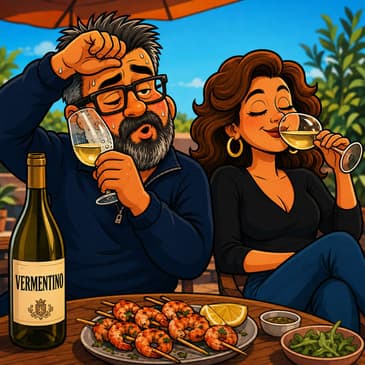
Nothing says summer like a nice, crisp white wine, and in this episode, we cover one of the greats that you may never have heard of called Vermentino. Vermentino is a fabulous wine most famously from the island of Sardinia that is a perfect summer sipper. Vermentino is also likely to be a wine that you start seeing more often because it comes from a grape that creates these crisp, high acidic wines, but can take the heat in warmer climates and keep its acidity. In addition to digging into Vermentino and tasting and reviewing a couple of great wines you should be on the lookout for, we also talk about the criteria that make a great summer sipper and we give you a short list of some other wines to look out for. Summer isn’t over yet! Enjoy it while it’s here! Wines reviewed in this episode: 2024 ColleMassari Melacce Vermentino, 2022 Tommasi Poggio al Tufo Vermentino
Send us a Text Message and we'll respond in our next episode!
Contact The Wine Pair Podcast - we’d love to hear from you!
Visit our website, leave a review, and reach out to us: https://thewinepairpodcast.com/
Follow and DM us on Instagram: https://www.instagram.com/thewinepairpodcast/
Send us an email: joe@thewinepairpodcast.com
Show Notes
Episode #229: Italian Wine Adventure #25: Vermentino! 00:00
________________________
KEY QUESTIONS
- What does Vermentino taste like?
- What food pairs well with Vermentino?
- What makes a wine a good summer sipper?
- How much should you expect to pay for a good bottle of Vermentino?
- Is Vermentino the same grape as Pigato and Favorita?
- Is Vermentino similar to Pinot Grigio or Sauvignon Blanc?
- Are these Tuscan Vermentinos worth buying, and which one should you pick?
________________________
Episode Overview and First Thoughts on Vermentino 00:33
Hello fellow wine lovers! And welcome to The Wine Pair Podcast. I’m Joe, your sommelier of reasonably priced wine, and this is my wife and my wine pairing partner in crime, Carmela. And we are The Wine Pair!
If you're new to our podcast, here's what we do: Every week we buy wines under $25 with our own money, taste them, and give you our brutally honest opinion on whether they're worth buying. Nobody pays us to review specific wines, we don't accept free bottles from wineries, and we're not afraid to call out a bad wine when we taste one. Decanter Magazine calls us fun, irreverent, chatty, and entertaining - so if that sounds like your vibe, welcome to our tribe of wine lovers.
Carmela, this week marks a bit over the halfway mark through summer. So, it may feel like we are getting to the tail end of it because we are in August, but the reality is that we have until the 21st of September to enjoy summer. Have you had a good summer?
So, today, we are going on another Italian wine adventure to talk about one of the great summer sippers anywhere on the planet, known as Vermentino. Now, we are going to spend some time talking about Vermentino in a little bit, but I thought we could spend a little time talking about just what makes a wine a great summer sipper, and what white wines other than Vermentino are great summer sippers. Since we still have lots of time to enjoy some summer sippers.
So, what makes a great summer-sipper white? Any thoughts, Carmela?
- A great summer-sipper white needs to feel refreshing. The most important characteristic is zippy acidity, because acidity makes your mouth water and gives the wine a crisp, thirst-quenching quality. It is what makes the wine work when it is super cold!
- Body matters, too, and so you want light- to medium-bodied wines which tend to feel lighter in the mouth and more refreshing than rich, full-bodied whites. A summer sipper should have enough texture and flavor to stay interesting, but not so much richness that it feels heavy.
- Oak can also affect how refreshing a wine feels. New oak usually makes a wine feel warmer and heavier. That is why many of the best summer whites are made with little or no obvious new oak. That oaky Chard? Not a great summer sipper. Sorry.
- The flavors typically associated with summer sippers tend to be fruity and bright - think orchard fruits and citrus. A little sweetness can be ok, but you want to avoid syrupy or cloying.
- A dry finish is usually ideal because it leaves the mouth feeling clean. Moderate alcohol helps as well, because higher-alcohol wines can create a warming sensation and lower- or moderate-alcohol wines are generally easier to sip over a longer period of time.
In terms of what some great summer sipper wines are that have these characteristics, here are a few for you
- Vinho Verde may be the quintessential summer sipper. It is light-bodied, relatively low in alcohol, has bright acidity, and often a subtle spritz that makes it feel extra fun.
- Albariño offers more fruit and body than Vinho Verde while still delivering that acidity and freshness a summer wine needs. Albariño goes great with summer meals because its acidity and salinity work really well with seafood, ceviche, grilled foods, and other lighter outdoor fare.
- Grüner Veltliner is another, it is quite flavorful but still crisp. Lighter examples commonly combine citrus and green-apple flavors with fresh herbs and the grape’s classic white-pepper note.
- Picpoul de Pinet is almost purpose-built for hot weather, and can be as lip-smackingly tart as lemonade. It is super acidic and even a little salty and is not well-enough known.
- Txakoli is similar. It is a too little known Spanish known for being extremely light, tart and zippy. Most examples have high acidity, relatively low alcohol and a bit of a spritz especially when it is poured from a height.
- Verdejo, which we did a few weeks ago, is another great summer sipper for people who want something a little bolder and with more body than the lightest, leanest whites. It can have a slightly bitter finish, often compared to grapefruit peel or fresh herbs, which is actually great for summer.
- Pinot Grigio is kind of a classic
- Finally, we of course have Sauvignon Blanc. It is a classic summer white wine. And we love it.
There are tons of others that are great choices, so we are just scratching the surface. If you go through our back catalog, you will find lots of other wines that we recommend as well like Gavi, Assyrtiko, Muscadet, and dry Riesling. Remember, it is still summer, don’t waste it. You never know how many summers you have left!
But we have to get to Vermentino, and we have two Vermentino wines to drink today to let you know if you should do a final stock up on either or both of them before the summer is over or you have a big Labor Day party planned if you live in the US . . .
But first . . . we have to do our shameless plug.
Thank you for listening to us and for supporting our show, and know that we buy all of the wine we taste and review every week so that we can give you real and honest reviews. If you like what you’re hearing, please subscribe to our podcast and leave us a five star rating and review so we can grow listeners.
We also love to hear from you and we always respond so you can follow us on Instagram and Bluesky and TikTok at thewinepairpodcast. You can contact us on our website thewinepairpodcast.com, and you can sign up for our email newsletter there and you can also send us a note at joe@thewinepairpodcast.com and let us know about wines your want us to review or just shoot the breeze, we love chatting it up.
And, as we do every week, we’ll tell you someone we think you should recommend The Wine Pair Podcast to - because the best way for us to grow listeners is when you tell your family and friends about us - and this week, we want you to recommend us to anyone who is looking to find a new summer sipper, and who you think will want to hold onto summer as long as possible. I guess, too, there are lots of people who live in warm climates, so they get to enjoy summer year around! Not us!
Topic: WTF IS Vermentino? 11:39
Carmela, let’s find out just what the eff Vermentino is, shall we?
Well, Carmela, let me tell you that the history of Vermentino is what professionals call “uncertain” The geographical roots of Vermentino are evidently the subject of intense debate among historians and ampelographers. Ampelographers was a new word, so I looked it up on the interwebs, and here is some more cool shit to put in your brain box. An ampelographer is someone who practices the science of ampelography which is the botanical science of identifying, describing, and classifying grapevines. Ampelographers traditionally used visual techniques like looking at leafs and grapes and stuff like that to do their identifying, but now they use DNA. I did not know there was such a thing, but it makes sense.
Ok. but back to the controversy of the history of Vermentino, there are three primary theories:
- The Spanish Theory: Many traditional sources suggest the variety is an indigenous grape of Spain, specifically from Aragon or Catalonia, which spread through Corsica and Liguria before arriving in Sardinia. However some dismiss this because Vermentino has never been found in Spain and there is no DNA connection
- The Greek/Middle Eastern Theory is another hypothesis that believes that Venetian merchants transported the grape from Greece or the Middle East to Italy during the hey-day of the kingdom of Venice.
- The Italian/Corsican Theory: Modern research increasingly points to a native Mediterranean origin, specifically within the Ligurian-Provençal basin. The thing the Corsican theory has going for it is that DNA studies have connected Vermentino to Rossola Bianca, a grape from Corsica.
Vermentino has been around in the Mediterranean for centuries. Historical records mention the variety under the name Arratelau in Sardinia and Liguria as early as the 14th century. During the Middle Ages, the church strictly controlled its cultivation, and it became common across Western Europe. During the Renaissance, the grape experienced a boom, flourishing across southern France and the Mediterranean islands.
While Vermentino is now known as the "jewel of Sardinia,” its path there was not straightforward. Cultivation in the northern Sardinian region called Gallura began in the 19th century and eventually spread across the island. However, for much of the 20th century, Sardinia was known for high-yielding red varieties used for bulk blending.
The transition to quality production occurred in the 1970s and 80s. In the 1980s, the local government incentivized growers to rip out high-yield vines and replace them with high-quality varieties like Vermentino. This culminated in Vermentino di Gallura being awarded DOCG status in 1996, the first and only DOCG in Sardinia.
Modern DNA typing has clarified Vermentino’s identity, establishing that it is genetically identical to several other prominent regional grapes:
- Pigato in Liguria, Italy
- Favorita in Piedmont, Italy
- Rolle in Provence and Languedoc-Roussillon in France
While they share the same DNA, they do express themselves differently in different regions. For example Pigato is often more aromatic. We ran into this same thing with Pinot Gris from Alsace vs. Pinot Grigio in Italy, if you want to check out that episode.
Today, Vermentino covers approximately 11,500 hectares (a hectare is about 2.5 acres) worldwide, but Italy remains the top producer with around 5,000 hectares dedicated to the grape, followed by France with 3,500 hectares. Beyond the Mediterranean, it has expanded to New World regions including the US, Australia, and South Africa. It tends to do well in warmer areas and it is drought resistant, and is able to maintain its acidity in these warmer areas. So, as the climate keeps warming, it may find itself more and more in these areas.
Vermentino is not considered one of the classic “aromatic white wines,” so it is not as highly perfumed as say a Gewürztraminer or Muscat, but it is considered a “semi-aromatic” white wine. Semi-aromatic means that it sits between neutral white wine grapes like Pinot Grigio or Chardonnay and aromatic grapes like Riesling. So, the aromas will be pronounced, but they will not jump out of the glass. For the nerds, it is compounds called terpenes which create those strong scents.
In Italy, and we are going to focus on Vermentino in Italy, winemakers focus on creating wines from Vermentino that are fresh, aromatic, and very acidic and crisp. To do that, a very common practice is cool fermentation, meaning under 65 degrees, in stainless steel tanks. The grapes are often treated with sulfur immediately after pressing to protect the juice from oxidation and help preserve aromas. They also avoid Malolactic Fermentation which, as we have mentioned many times, is a technique used to tamp down on acidity. With Vermentino, we want acidity!
Most Italian Vermentinos are intended to be consumed young and are bottled and released within six months of harvest, although the Gallura DOCG requires waiting until at least January 15.
Lees aging and battonage are commonly used to create more texture. Again, the lees are the leftover yeast and stuff from the fermentation process, and battonage means that the lees are stirred periodically. They also use brief skin contact, usually for just a few hours, to intensify aromas and structure or body. This is particularly used in Liguria where, again, the grape is known as Pigato. In Tuscany, they may also use oak aging, but it is more commonly not oaked to keep its crispness.
There are also different types of regional styles of the wine that are interesting. We are drinking the most popular crisp, dry style today, but if you travel around Italy, you may also run into
- A passito or sweet dessert wine in Cinque Terre (yes, the Cinque Terre that Rick Steve’s destroyed)
- In Sardinia, they have a sparkling or Spumante version
- In Tuscany, they sometimes use later harvest grapes to create a wine with a richer flavor profile and more sweetness which is said to give it tropical fruit flavors like guava and pineapple
- And, while it is usually bottled on its own, it is sometimes blended with Trebbiano, Malvasia, or other aromatic wines to create a bolder finished wine.
And, while it is growing in popularity, you can be one of the cool kids if you bring some to your next dinner party or order it at a fancy restaurant. People will think you are very bougie.
But that’s enough information. I think it’s time to learn a little more about the specific wines we are drinking today. Whaddya say?
Vermentino Wines We Chose for This Episode 21:44
As usual, the wines we have chosen for this episode are under $25, and they should be relatively easy to find because I bought them at wine.com. As we just mentioned, Vermentino is getting easier and easier to find, but look for it in Italian restaurants, in stores with good Italian wine sections, and, of course, go to your local wine shop and ask them to help, and they will be happy to.
The first wine we are going to drink is the 2024 ColleMassari Melacce Vermentino and it comes from Tuscany, as does our second wine, incidentally. This wine got some good reviews including 93 from James Suckling, and a 90 from Wine Enthusiast.
The tech sheet for this wine says that it is grown in sandstone soil and the vines are trained in the Cordon Spur style, which is where the vine looks a bit like a T and they leave some partial branches or spurs on each year from which shoots grow. The vineyards are about 1,000 feet up in the Montecucco region of central Tuscany which is near Montalcino. The grapes were picked in late August, and were fermented in stainless steel for 20 days at a cool 59 degrees. They use a vegan fining agent, no malolactic fermentation, they do use cold maceration, leaving the juice on the skins for 12 hours, so that will give it more aromatics, and age the wine for 4 months in stainless steel tanks and 2 months in the bottle.
This is a DOC wine, and the name Melacce on the label comes from the river that runs through the property. The winemaker is Luca Marrone, and from what I can tell from the Winebow website, who is the importer, the winery uses organic and socially responsible practices, and is woman-led. The winery says “They apply Italian passion and Swiss precision in crafting wines that represent top quality, history and identity of the region.”
The second wine we are going to drink is the 2022 Tommasi Poggio al Tufo Vermentino, and this wine is also from Tuscany, and received an 89 rating from Wine Enthusiast. Interestingly enough, this wine has an IGT designation, which means that it is an officially recognized and legally protected wine region for this wine, but does not have the restrictions or classification required for a DOC or DOCG. Remember, though, some of the best wines in Italy have IGT designations, so don’t let that fool you.
The winery says this is a single-vineyard Vermentino, which is generally considered a sign of quality, but the tech sheet doesn’t give a ton of information. They do say that they ferment the wine for 7 days, so quite a bit shorter than the first wine, and then they mature it for 5 months, and both of those processes are in stainless steel tanks. So, I expect a pretty crisp wine.
As I would have expected, the word Tufo on the label means that it is grown in volcanic soil, which it is. Interestingly enough, the winery is owned by the Tommasi Family Estates which is a big winemaking company in Valpolicella, and this was the first of their estates outside of Valpolicella. The area is quite different from the first wine, as the vineyards for this wine are near the coast, only 15 miles away, in the Maremma region. Remember the first wine is from central Tuscany.
Tommasi is a big wine company in Italy. They are probably most famous for their Tommasi Amarone, but in addition to Poggio al Tufo, they own 6 other wine labels from all over Italy. The label for Poggio al Tufo says they are eco-friendly, use sustainable technologies, and aim to be energy self-sufficient.
But, I think that is enough information - let’s get to drinking! We’ll take a quick break and be right back. And, if you have these wines or similar wines, drink along with us to get some participation points, which you can trade-in for free stickers. You just need to send me an email with your mailing address, and I will get those “I drink with The Wine Pair Podcast” stickers over to you!
LINKS TO SOURCES FOR THESE SPECIFIC WINES
- https://winebow-files.s3.amazonaws.com/public/vintage/techsheets/613028_Castello-ColleMassari_ColleMassari-Melacce_2024.pdf?VersionId=rUuXP5CJFKWOrY8TteeFnt2qEATSypFK
- https://vintus.com/wines/poggio-al-tufo-vermentino/poggio-al-tufo-vermentino-2022-2/
- https://vintus.com/wp-content/uploads/2023/07/Poggio-Al-Tufo-Vermentino-2022.pdf
2024 ColleMassari Melacce Vermentino, 2022 Tommasi Poggio al Tufo Vermentino Wine Tasting, Pairing, and Review 26:40
Wine: ColleMassari Melacce Vermentino (Click here to find this wine on wine.com. We may be compensated if you purchase)
Region: Italy, Tuscany
Vintage: 2024
Price: $17.97
Retailer: wine.com
Alcohol: 12.8%
Grapes: Vermentino
Professional Rating: JS 93, WE 90 Vivino 3.9
What we tasted and smelled in this ColleMassari Melacce Vermentino:
- Color: Straw yellow, light with some green hues
- On the nose: Apple, minerality, saltiness, lime citrus, sea shell, sea water, peach
- In the mouth: Summer sipper with some depth, salty and bitter at the end, sea stone, pithy, has some tannin, muted lemon, honeydew melon, some creaminess
Food to pair with this ColleMassari Melacce Vermentino: Great fish wine, light white fish, tuna, sushi, snapper, halibut, salmon, shellfish, versatile with lots of foods, chicken, grilled foods, spicy foods, pesto, white pizza
As a reminder on our rating scale, we rate on a scale of 1-10, with no half points, where 7 and above means that we would buy it, and 4 and below means that we are likely to pour it down the sink, and a 5 or 6 means we are likely to drink it and finish it, but we are probably not going to buy it.
ColleMassari Melacce Vermentino Wine Rating:
- Joe: 8/10
- Carmela: 8/10
Wine: Tommasi Poggio al Tufo Vermentino (Click here to find this wine on wine.com. We may be compensated if you purchase)
Region: Italy, Tuscany
Vintage: 2022
Price: $18.97
Retailer: wine.com
Alcohol: 12.5%
Grapes: Vermentino
Professional Rating: WE 89 Vivino 3.6
What we tasted and smelled in this Tommasi Poggio al Tufo Vermentino:
- Color: Lemon yellow
- On the nose: Gasoline or kerosene, some orange pith, some peach on the swirl
- In the mouth: Very different in the mouth, very lemony, lemon sorbet, some lemon pith, steely or metallic on the end, Aperol
Food to pair with this Tommasi Poggio al Tufo Vermentino: Fish wine, great with fish and chips and fried foods, spicy foods, sushi
Tommasi Poggio al Tufo Vermentino Wine Rating:
- Joe: 7/10
- Carmela: 8/10
Which one of these are you finishing tonight?
- Carmela: ColleMassari Melacce Vermentino
- Joe: ColleMassari Melacce Vermentino
The Test: Did we nail the taste profiles expected from Vermentino? 38:18
- General
- Fruit Notes: Tart lime, pink grapefruit, green apple, white peach, and ripe pear. Secondary Notes: White floral aromas (daffodil, acacia), crushed herbs like sage, and subtle iodine or saline sea spray.The Finish: A characteristic hint of bitter almond or grapefruit pith on the backend.
- ColleMassari Melacce Vermentino
- Winery: On the nose it is intense, with marked citrus and aromatic herbs. On the palate it is fresh, sapid, persistent and with a pleasant fruity aftertaste
- JS: A leafy and citrusy wine with aromas of sage, mint and grapefruit. Light-bodied, it shows zesty acidity balanced by flavors of fruit and leaves and a tight, polished texture. From organically grown grapes.
- Tommasi Poggio al Tufo Vermentino
- Winery: Intense, fruity aromas with typical characteristics of this grape variety. On the palate it is full and balanced and has a long finish.
- WE: Intensely floral on the nose, with daffodils, lilacs, orange blossom and tulips, with the slightly plasticky element of the flowers emphasized by a No. 2 pencil aroma underneath. More flowers, plus candied citrus and pear come out on the palate before a nutty, saline finish.
What is the verdict on Vermentino? 40:25
Love it. Great summer sipper, and all year sipper. A great alternative to your go-to wines, and a great wine to have in the summer.
And now it is time to head over to our news desk so that we can cover our wine in the news this week segment.
Wine in the news this week: Michelin’s First Winery Ratings Spark Backlash in Burgundy 41:26
- https://vino-joy.com/2026/07/15/michelins-first-winery-ratings-spark-backlash-in-burgundy/
- https://www.telegraph.co.uk/news/2026/07/09/michelin-about-to-ruin-wine/
Our wine in the news this week comes from Vino Joy News, written by Morris Cai. Links are in the show notes as always, and his article is entitled "Michelin's First Winery Ratings Spark Backlash in Burgundy." Ooh. Sounds like there is some good intrigue in this story!
Everyone knows Michelin ratings for restaurants. Most people who start a restaurant dream of getting a Michelin star (The Bear, anyone), and Michelin is the most feared and revered restaurant rating system in the world. It turns out now that they are expanding beyond restaurants into wine. What could go wrong?
The system works basically the same way as the restaurant one, except instead of stars, wine producers get grapes, which is cute. It operates on the same system as stars where there are three levels from one grape to three grapes.
They started with Burgundy, as they should. Only 9 producers got Three Grapes. 20 got Two Grapes. 33 got One Grape. Everyone else got a category called "Selected," which sounds like when your kid gets picked last for kickball but they still give you a Capri Sun.
The top Nine include all the wines you would expect. Domaine de la Romanée-Conti. Domaine Leroy. Roumier. All the names most of us will never drink. Nothing shocking there. But, the wineries in Burgundy were not having it.
Within days of the announcement, one of the Burgundy producers that got only One Grape, an estate called Domaine Arnoux-Lachaux in Vosne-Romanée, went public and told Michelin to take them off the list, and they did so for reasons that feel very principled. In their statement, they said: "Since 2020, we have deliberately chosen not to submit our wines for press reviews or ratings. We have therefore asked Michelin to remove the Domaine from the selection, in keeping with this long-standing position."
A few days earlier, Victoria Moore who is the wine columnist for The Telegraph of London, wrote an article that pointed out that Michelin already owns The Wine Advocate, which was Robert Parker's old 100-point scoring system, so now they own two competing wine rating systems. Which would be like if they bought a competing restaurant scoring system. Dumb.
Victoria Moores’ point in her article, which is right in the title, is that Michelin is going to ruin wine. That may be a little extreme, but do we really need another wine rating system, especially when the most honest and reliable system is ours since none of the other systems tell you when a wine is bad? But I digress.
We’ll see if any other Burgundy wineries tell Michelin to go fly a kite, but my question to you Carmela is, what do you think? Do you think Michelin overstepped into wine, and should just stick to their schtick, especially when they already have Wine Advocate?
Listener Shoutouts 45:23
We have some fun listener shoutouts for this week, and we so appreciate when you reach out to use and tell us what you think, or what you are drinking, and so here are some shoutouts:
- Bud: two week trip to Portugal and Spain on Viking. Shots of GINJINHA. The best were at the Sandeman and Ferreira port cellars. Had not had white port before. Barcelona was our favorite. Sagrada Familia
Wines coming up in future episodes in case you want to drink along with us 47:00
- Chateauneuf-du-Pape: 2024 Costco Kirkland Chateauneuf-du-Pape, 2023 Domaine du Vieux Lazaret Chateauneuf-du-Pape
- Gamay - Beaujolais: 2023 Domaine Gaget Cote du Py Morgon, 2024 Domaine Yohan Lardy Moulin-a-Vent Cru Beaujolais Les Michelons
- Decoy wines: 2023 Decoy California Cabernet Sauvignon, 2025 Decoy Sauvignon Blanc
- Algianico Rosé: 2024 Feudi di San Gregorio San Greg Rosato, 2024 San Salvatore Vetere Rosato
- Schiava: 2024 Alois Lageder Schiava, 2022 Elena Walch Schiava
- Loire Crémant: Gratien Meyer Cremant de Loire Brut, Langlois Cremant de Loire Brut Rose
- British bubbly: 2018 Henners Brut Vintage
Outro and how to find The Wine Pair Podcast 47:27
Thank you for listening to us and for supporting our show, and remember, we buy all of our own wine and we do all of the writing and recording and editing to bring you a show every week because we absolutely love doing it, and our small little ask for you is that you please follow or subscribe to our podcast and also please leave us a nice rating and review to help us grow our listeners - and a huge thank you to all of you who have done so already!
You can also follow us on Instagram and Bluesky and TikTok at thewinepairpodcast. You can contact us on our website thewinepairpodcast.com, and you can sign up for our email newsletter there and you can also visit our “Shop Wine” section where you can find links to buy the wines that we rate as buys in each episode. I will also note that on our website, if you are curious about a wine we have covered in the past, we do have a pretty good search functionality, so you can use that find wines you want to know more about.
And we want to make content you care about and you like, so send us a note or DM us and give us some feedback or let us know if there are wines you want us to try or wine making areas of the world you are curious about - and we’ll take care of it! joe@thewinepairpodcast.com
Alright, with that, we are going to sign off, so thanks again, and we will see you next time. And, as we say, life is short, so stop drinking shitty wine.
________________________
KEY INSIGHTS & FREQUENTLY ASKED QUESTIONS
Q. What does Vermentino taste like?
A. Vermentino is a dry, crisp white with citrus, green apple, and stone fruit flavors, wrapped in a salty, mineral edge that can taste like sea spray or a smooth beach stone. Expect notes of lime, peach, and melon, a light body, and a clean finish that sometimes carries a pleasant, faint bitterness.
Q. What food pairs well with Vermentino?
A. Vermentino is a natural match for fish and shellfish, think tuna, salmon, halibut, snapper, or sushi, thanks to its bright acidity and salty finish. It also holds up well to grilled dishes, spicy food, pesto, and white pizza.
Q. What makes a wine a good summer sipper?
A. A good summer sipper needs bright acidity, a lighter body, little to no oak, refreshing fruit flavor, a dry finish, and moderate alcohol. Vermentino checks every one of those boxes, crisp, unoaked, and easy to drink.
Q. How much should you expect to pay for a good bottle of Vermentino?
A. A solid bottle of Vermentino usually runs about $15 to $25. Two well-rated Tuscan bottles came in at $17.97 and $18.97, both earning strong professional scores.
Q. Is Vermentino the same grape as Pigato and Favorita?
A. Yes, genetically they're identical. Vermentino, Pigato (Liguria), and Favorita (Piedmont) are the same grape under different regional names, though soil and climate shape noticeably different results.
Q. Is Vermentino similar to Pinot Grigio or Sauvignon Blanc?
A. Vermentino sits in the same lane: light-bodied, dry, easy to drink. What sets it apart is extra salinity and mineral character alongside its citrus fruit.
Q. Are these Tuscan Vermentinos worth buying, and which one should you pick?
A. Both are worth trying, but the 2024 ColleMassari Melacce is the stronger pick: salty, mineral finish, creamy texture, 8/10 average. The 2022 Tommasi Poggio al Tufo is solid too, steely and lemon-forward, rated slightly lower.
________________________
RESEARCH ARTICLES AND LINKS FOR THIS EPISODE
- https://www.youtube.com/watch?v=DSry_catw5g
- https://www.youtube.com/watch?v=woGtlUSMahU
- https://www.youtube.com/watch?v=bBGvwP_SX5g
- https://www.cagliarimag.com/history/vermentino-of-sardegna-history/?lang=en
- https://lacave-eclairee.fr/en/blogs/info/all-about-the-grape-variety-rolle-or-vermentino
- https://www.mamablip.com/en/blog/vermentino-grapes
- https://en.wikipedia.org/wiki/Vermentino
- https://www.cellartours.com/blog/italy/jewel-of-sardinia-vermentino
- https://www.wine-searcher.com/grape-525-vermentino-rolle
- https://www.winewithseth.com/winewiki/vermentino-rolle/
- https://www.wineenthusiast.com/varietals/vermentino/
- https://swirlwine.co.jp/en/blogs/grape-varietals/vermentino-guide
- https://intovino.com/grape-variety-guides/vermentino-wine-essentials-guide/
- https://www.thegrapegrind.com/grapes/vermentino-wine-guide/
- https://www.vinorandum.com/grape/vermentino
- https://www.decanter.com/wine-news/opinion/jefford-on-monday/jefford-on-monday-secret-lessons-361/
- https://www.italianwinepodcast.com/italian-wine-blog/genetics-vs-terroir-why-vermentino-tastes-different-as-pigato-rolle-or-favorita/
- https://punchdrink.com/articles/vermentino-v-pigato-ligurias-two-white-wines-battle-it-out/
- https://www.jaywhiteley.com/all-the-rest/2wc3u4gxvowau5d7m7vw0h0olkybl4
- https://www.vinerra.com/education/grapes/discover-the-vermentino-grape-varietal-everything-you-need-to-know
- https://www.gamberorossointernational.com/news/11-vermentinos-not-to-miss-between-sardinia-liguria-and-tuscany/
- https://www.forbes.com/sites/paulcaputo/2024/02/21/vermentino-is-a-fresh-white-wine-for-a-hotter-world/
- https://www.goodpairdays.com/guides/wine-grapes/article/vermentino/
- https://whosewineisitanyway.substack.com/p/choose-your-own-wine-adventure-vermintino
- https://www.masterclass.com/articles/vermentino-wine-pairing-guide
- https://perfectpairings.wine/white-wines-pairing/vermentino-food-the-mediterranean-white-wine-and-its-best-food-pairings/
- https://www.matchingfoodandwine.com/news/pairings/the-best-food-pairings-for-vermentino/
- https://www.matchingfoodandwine.com/news/match_of_the_week/vermentino-and-seafood/
- https://www.suggestwine.com/en-us/articles/vermentino-wine-pairing
- https://drinkandpair.com/blog/vermentino-food-pairing/
- https://www.mdpi.com/2306-5710/11/4/118
- https://30secondwineadvisor.substack.com/p/getting-to-know-vermentino
- https://en.wikipedia.org/wiki/Vermentino_nero
________________________
Support The Wine Pair Podcast by heading to our website and shopping for the wines we give our highest ratings to in our Shop Wines section. Just click on this link - you pay the same price, and we may get a small amount of compensation.
You can also support us by clicking on this affiliate link to wine.com and find great wines under $20!
And, if you are looking for a great website builder for your podcast, click on this link to use the service we use and love: Beamly, formerly known as Podcastpage.io
________________________
FULL TRANSCRIPT
Joe: 00:00
Carmela, you know there's still some summer left.
Carmela: 00:03
Yay!
Joe: 00:04
And so there's still time to find the perfect summer sipper.
Carmela: 00:07
Oh my gosh, I'm there all day.
Joe: 00:08
And answering the call, Carmella, to bring you joy in your last weeks of summer is the fabulous Italian white wine called Vermentino. Woo! And we don't want to spoil too much, but we had a couple of Vermentinos that we're gonna taste in this episode, and let's just say they're pretty damn good.
Carmela: 00:25
Yeah, we are psyched about them.
Joe: 00:34
Hello, fellow wine lovers, and welcome to the Wine Pair Podcast. I'm Joe, your Simolier of Reasonably Priced Wine, and this is my wife and my wine pairing partner in Crime Carmela.
Carmela: 00:44
Hi there!
Joe: 00:44
And we are the Wine Pair. Yay! If you're new to our podcast, here's what we do. Every week we buy wines under $25 with our own money. We taste them and give you our brutally honest opinion on whether they're worth buying. Nobody pays us to review specific wines. We don't accept free bottles from wineries, and we're not afraid to call out a bad wine when we taste one. And Decanter magazine calls us fun, irreverent, and entertaining. So if that sounds like your vibe, welcome to our tribe of wine lovers.
Carmela: 01:12
Hello.
Joe: 01:12
Yeah, I didn't have a a name for the tribe. We're just going to wine lovers. We're just going to.
Carmela: 01:18
We are wine lovers. We all are, right?
Joe: 01:20
That's why you're here.
Carmela: 01:21
I mean, if you're listening, you're not. That would be interesting. That would be. We'd love.
Joe: 01:25
We want to know if you if you're not a wine lover.
Carmela: 01:28
Maybe you just like to hear us talk.
Joe: 01:30
Maybe. We might be the only ones. Okay. Carmela, this week marks a bit over the halfway mark through summer. So it may feel like we're getting to the tail end of it because we're in August, but we're in reality, we have until the 21st of September to enjoy summer.
Carmela: 01:48
I know, but then there's also the meteorological summer.
Joe: 01:53
Okay.
Carmela: 01:53
And that is ju begins June 1st.
Joe: 01:56
Okay, but when does it end?
Carmela: 01:58
August 31st.
Joe: 01:59
Well, that's lame. I want more summer. You know, well, that's what I mean.
Carmela: 02:02
Like, what are you a meteorological summer?
Joe: 02:05
Whatever makes summer last longer. That's what I want.
Carmela: 02:07
Yeah, I'm both.
Joe: 02:08
Okay. There we go. I'm both. Start sooner and later. I like it. I love it. Okay, Carmela, we're also going on another Italian wine adventure today. Yeah. And we're going to talk about one of the great summer sippers, because it's still summer, you know. It's and that summer sipper is known as Vermentino. And we're going to spend some time talking about Vermentino in a little bit. But I thought we could spend a little time talking about just what makes a wine a great summer sipper. Okay. And what white wines other than Vermentino are great summer sippers, since we have, again, lots of time to enjoy summer still. It's not over yet.
Carmela: 02:40
Right. And I mean that means lots of days to enjoy a nice summer sipper.
Joe: 02:44
That's right. And Carmelo, what do you think makes a great summer sipper?
Carmela: 02:48
Well, I like sparkling any time of year, but like a sparkling, wait, what?
Joe: 02:52
We're not doing sparkling, so I know, but what's wrong with that? You asked me what I like to sip on in the summer. No, I I just I like that you're not going with the theme. Keep going. I like it.
Speaker: 03:02
I'm laughing because I don't have the script remember. And I just, that was the first thing I came to mind.
Joe: 03:08
All right, keep going. I love it. This is going really well so far.
Carmela: 03:10
So I like kava.
Joe: 03:12
Okay.
Carmela: 03:13
But no, I like a clean, fresh glass of wine. So to me, like a Pinot Grigio is a fantastic white wine summer sipper. It's perfect. It's like clean, fresh. It's not too heavy. It's not oaky. I do like a Sauvignon Blanc too. That's another favorite.
Joe: 03:32
What about you? Well, I actually I'm just going to go through this list, but you kind of nailed the list. So we're going to go through the list really quick of what makes a great summer sipper, and you kind of knocked them out. So it needs to be refreshing. You know, you said crisp, but you want it to be zippy and acidity. Acidity makes your mouth water. It makes a wine crisp and thirst quenching. And it works when it's super cold. Like really acid y wines are great, super cold. Yes. Body matters. You want like light to medium body. Agree. Feels a little bit lighter in the mouth. It's more refreshing.
Carmela: 04:02
I mean, that's what we like.
Joe: 04:04
Exactly. But a summer sipper, I think that would be kind of typical.
Carmela: 04:08
Some people, though, they're very married to their like go-to white wine. And it may not be any of those.
Joe: 04:14
No, I totally agree. But another thing that you said that I think goes along with this is oaky wines don't make great summer sippers. So some people really love their oaky wines, but they actually don't make awesome summer sippers. No, agree. Because when they're super cold, really oaky wines don't do as well. They're kind of more mouthfeel. There's a little, they're a little heavier, you know, they're more cocktailing kind of wines.
Carmela: 04:35
But there are people who will, that's what they just is their go-to.
Joe: 04:39
You're right. You are absolutely right. But I think when we talk about a summer sipper, we're talking about some slightly different things. Another thing that you didn't mention, but I just, by the way, the fact that she doesn't have a script totally f this whole thing.
Speaker: 04:55
No, funny enough, though, for whatever reason, this one didn't work as well.
Joe: 04:59
No, it's great. It's great, it's working great. Okay. And then some other things that you didn't mention, but I think are worth talking about. What?
Speaker: 05:06
But did I not mention?
Joe: 05:07
One is flavors. Like you want sort of orchard fruits, you want citrusy, you know, things that are kind of acidic and light and bright. You know, a little sweetness can be okay, but you don't want super sweet during first summer sipper because it, you know, it feels a little bit too heavy in the mouth.
Carmela: 05:23
Well, it's funny though. Uh, what about like tropical fruits?
Joe: 05:26
Yes, totally tropical fruits for sure.
Carmela: 05:28
That's what I would think because that's that's hot weather uh fruits anyway.
Joe: 05:32
Yeah. And then a dry finish. You want moderate alcohol, a nice dry finish. That's where, like, not sweet, you want a nice dry finish because it's clean, it's crisp. When you were talking about a clean wine, that's kind of what I think about as a clean wine. It's something that ends really dry and kind of cleans out the mouth. So, you know what? You did a great job.
Carmela: 05:51
I don't think so.
Joe: 05:52
Except for starting with this.
Carmela: 05:54
I might be getting like my my a little slap on the hand later.
Joe: 05:58
No, there will be no no fisticuffs at all. You you whatever you speak.
Carmela: 06:03
But I do like a sparkling. I just I guess I was not paying attention.
Joe: 06:07
No, it's it's fine. You know what? Surprise. This is about honesty. We are about honesty.
Carmela: 06:13
Is the best policy.
Joe: 06:14
Yeah. In terms of what some great summer sipper wines are, you mentioned one of the great ones, which is Pinot Grigio. Yes. But for those of you who are wondering about other than Vermentino, what are some other summer sippers that maybe I should think about drinking? Here's a few. One is Vino Verde. Oh, true. Vino verde may be like the quintessential summer sipper. It's light, it's low in alcohol, it's super acid y and it's got a little bit of spritz. So there goes your sparkle. Yeah, there goes your sparkle.
Carmela: 06:42
See now.
Joe: 06:43
Another one is Albarino. It's a little bit fruitier, it's a little bit more body than Vino Verde, but it's got that acidity and freshness. It goes great with like summer meals, grilled foods, and seafood. Another one that I think people sleep on is Gruner Feldliner, which is it's really flavorful, but it's also really crisp. And it has those citrusy flavors and green apple kind of flavors, and maybe a little bit of herb, too, to get the little bit of that kind of bitterness on it that that's good in hot weather. Another one that people sleep sleep on is Pique Pole di Pinnae.
Carmela: 07:17
Oh, we like that.
Joe: 07:18
Yeah, we did an episode on it. It's great. It is like zippy. You talk about a zippy wine. That wine will is so zippy, it makes your lips smack. It's like lip smacking. Wow. It's so zippy. It's so good. And a little salty too, which is kind of nice in summer, a little saltiness.
Carmela: 07:34
Shacoli. See, it's good for you, it keeps you hydrated. Totally. Oh, look at that.
Joe: 07:39
Yeah. Shacoli, which is a Spanish wine. It's a little known wine, another one, but it's really light. It's really tart. It's really zippy. And remember, we talked about this when we did an episode on it. Sometimes they pour it from a height, like the and that gives it a little effervescence. So again, with your sparkling. Well, it's all about making connections. I'm doing the weave. I'm doing the.
Carmela: 08:05
I know, I know. Because I just, guys, again, no script.
Joe: 08:10
No.
Carmela: 08:10
If I go off script, it's because I don't have one.
Joe: 08:12
She just how can she be on the script if she doesn't have one? It's like being sorry, Joe. How can you say you're on the road if you don't have a road? True. Right? Another great one is Verdejo, which we did a few weeks ago. It's another great summer sipper. It's a little bolder. It's it's got a little bit more body than some of these super lean whites, but it's bright. It's a little got a little bitterness, which is nice. And then of course, Savignon Blanc. I mean, you know, it's just like a total yeah, it's a total summer one. Now there are tons of other wines that are great choices. We're just scratching the surface. We have a lot actually in our back catalog, like wines like Gavi and a Sirtico and Muscade and Dry Riesling. But here's the thing: it's summer still. Don't waste it. No, get your summer sipper on.
Carmela: 08:55
Why not?
Joe: 08:56
Why not? Don't wait. Because really the point is you never know how many summers you have left.
Carmela: 09:02
Oh my gosh.
Joe: 09:03
I like to mention this to Carmela to remind her that she has to continue to love me because you never know. This might be my last summer.
Carmela: 09:10
Well, and it could be you, yeah, sure. For me too. Like we both could be gone, so right. Who knows? We know. Oh my god, that's so dark.
Joe: 09:17
It is dark. But we're happy about it. Anyway. We're not. No, it's fine. It's totally fine. It's just a circle of life. Anyway, we have to get to Vermentino, Carmela. We have two Vermentino wines to drink today to let all of you out there in listening land know if you should do a final stock up on either of them or both of them before summer is over. If you have a big Labor Day party, maybe this will be it. If you're in the US and you do that Labor Day thing, maybe that'll be a good, it'll be a good wine to have. But first, you gotta do our shameless plunge. That's right. So thank you for listening to us and for supporting our show. And we buy all the wine we taste and review every week so that we can give you real and honest reviews. And so if you like what you're hearing, please subscribe to our podcast and leave us a five-star rating and review so we can grow listeners. We love to hear from you. We always respond. Follow us on Instagram and Blue Sky and TikTok and YouTube, evidently at the WinePair Podcast. You can contact us on our website, thewinepairpodcast.com. Sign up for our email newsletter there, which is coming out in about a week. So you get, you know, if you gotta get on and it's important that you're on the mailing list. Right. Lots of coupons. Yeah, no, it's coupons. No, no, there's no coupons. Oh, but I thought maybe if I said that, you just lure some people in.
Carmela: 10:26
You would disappoint some people there too.
Joe: 10:28
You're right, you're right. And you can always reach out to us at Joe at the winepairpodcast.com. Let us know about wines you're drinking. Or you know what? Just what's going on? Are you getting a dog? Oh. Because we'll by this, by the next time we record an episode, we will have a dog.
Carmela: 10:44
In this room with us.
Joe: 10:45
In this room, probably barking and all that.
Carmela: 10:47
We're gonna see how that goes.
Joe: 10:49
Could be a mess. But you know, if we give her a little wine, maybe she'll be okay. Doggy wine.
Carmela: 10:54
Oh gosh.
Joe: 10:55
Can you imagine? And as we do every week, we'll tell you someone we think you should recommend the wine pair podcast to because the best way for us to grow listeners is when you tell your family and friends about us. And this week we want you to recommend us to anyone who's looking to find a new summer sipper and who you think will want to hold on to summer as long as possible. And I guess there are also people who just live in warm climates and it's kind of summer all the time. No, no, that isn't nice. But they need like an all-the-time sipper.
Carmela: 11:21
Right. I mean, there's nothing wrong with that. I look, I take that back. It's not boring. We just we get seasons where we live.
Joe: 11:28
We get seasons.
Carmela: 11:28
And I I we enjoy the seasons. Right.
Joe: 11:31
Except for the the heart of winter in Seattle when it's you get four hours of sunlight and it's gray all the time. Yeah. You know what? Other than that, it's awesome. We love it. Okay, Carmela, let's find out just what the f Vermentino is, shall we? Let's. Well, Carmela, let me tell you that the history of Vermentino is what professionals call uncertain. Oh, that's an interesting word. The geographical roots of Vermentino are evidently the subject of intense debate among historians and ampologers. You ever heard of that term? I remember.
Carmela: 12:00
What's an ampologi?
Joe: 12:03
Ampologographer.
Carmela: 12:04
Ampolog.
Joe: 12:05
Ampologher.
Carmela: 12:07
Okay. Just tell me what it is.
Joe: 12:09
Okay. That was a new word for me as well. So I had to look it up on the internet.
Carmela: 12:13
Amazing.
Joe: 12:14
So here's what it is. Here's what they are. This is something to put in your brain box. If you can remember how to say the word. I don't or even how to spell it. An ampologies is someone who practices the science of ampology.
Carmela: 12:25
No, I understand those definitions.
Joe: 12:27
But that's not the definition. Okay, good. It's a botanical science of identifying, describing, and classifying grape vines. Oh wow. I never knew that. And you'd think doing a podcast for as long as we have, we should know ampologies.
Carmela: 12:39
You have to go to school for that.
Joe: 12:40
Probably. But problem you know, I mean, early on, no. But I think now there are probably degrees that you know.
Carmela: 12:48
More of a certification. Maybe. I've never heard it as a major or a degree.
Joe: 12:52
Ampology, no. But I want to go to a school that offers it.
Carmela: 12:56
I wonder if if something like Cal Poly has that.
Joe: 12:59
You know what? We're gonna find I'm gonna send you down there.
Carmela: 13:01
I mean, only because our daughter went to school there, and that's the only reason I'm wondering.
Joe: 13:06
I like the I like the curiosity. Curiosity is good, a growth mindset. I like it. Okay. Ampylographers traditionally used visual techniques like looking at leaves and looking at grapes and stuff like that to do their identifying, but now they do a lot of DNA stuff. They gotta be scientists, you know? Of course. So back to the controversy about the history of Vermentino. There are three primary theories. There's the Spanish theory, Carmela, which many traditional sources suggest the variety is indigenous to Spain, specifically from the area of Catalonia or Aragon, and it spread throughout Corsica and Liguria before arriving in Sardinia from Spain. However, some dismiss this because Vermentino has never been found in Spain and there is no DNA evidence. But that's kind of the traditional view. Okay. Another one is called the Greek or Middle Eastern theory. It's a hypothesis that believes that Venetian merchants transported the grape from Greece or the Middle East to Italy during the heyday of the kingdom of Venice. You know, they were kind of a big deal for a while. And then there's the Italian slash Corsican theory, which is modern research increasingly points to. It's a n that it's a native Mediterranean grape, specifically within the Ligurian Provençal basin. Because you know, Liguria is that part of Italy that kind of hits around the southern part of France and Nice and that's that part. So the thing the Corsican theory has going for it is that DNA studies have connected Vermentino to Rossolo Bianca, which is a grape from Corsica. So that one makes the most sense. Now, Vermentino has been around the Mediterranean for centuries. Historical records mention the variety under the name Aretalau in Sardinia and Liguria as early as the 14th century. And during the Middle Ages, the church strictly controlled its cultivation and it became common across Western Europe. Remember, if you want to know about European alcohol, just follow the church and the monks. They're all over it.
Carmela: 15:01
I love that.
Joe: 15:02
I love it too. During the Renaissance, the grape experienced a boom, flourishing across southern France and the Mediterranean Islands. Now, Vermentino is known today as the jewel of Sardinia, but its path there was not straightforward. Cultivation in the northern Sardinian region called Gallura began in the 19th century and eventually spread across the island. However, for much of the 20th century, Sardinia was known for high-yielding red varieties, which were used for bulk blending of wines. So the tradition to quality production occurred in the 1970s and the 1980s. And in the 1980s, the local Sardinian government incentivized growers to rip out those high-yield vines and replace them with high-quality varieties like Vermentino. And so this culminated in Vermentino di Gallura being awarded DOCG status. That's the highest status in 1996. And it is the only Sardinian wine that is classified as DOCG.
Carmela: 16:03
Wow. So that's a big deal. It is a big deal. Nice job.
Joe: 16:06
Good job, Sardinia. Modern DNA typing has clarified Vermentino's identity, establishing that it is genetically identical to several other regional grapes. There's a grape called Pigato in Liguria, Italy, and that's the same grape. There's one called Favorita in Piedmont, and that's the same grape. And there's a grape called Role in Provence and Lenguado Roussolon in France, and that's the same grape as Vermentino. Goodness. But like we've learned many times, even though they share the same DNA, they express themselves differently in different regions. So for example, Pigato is often more aromatic. And we ran into the same thing with one of your favorite summer sipper, Pinot Grigio in Italy is very light, very crisp. But when we tried Pinot Gris, same exact grape from Alsace, different wine. That was interesting. Even though it's the same grape. Right. Very interesting. Totally. Now today Vermentino covers approximately 11,500 hectares. A hectare is about two and a half acres. And that's across the world, but Italy is the top producer with around 5,000 hectares dedicated to the grape. France is second. And then beyond the Mediterranean, it has expanded into new world regions like the US, Australia, and South Africa. And we're probably going to see more of this because it tends to do well in warmer areas. It's drought resistant. And even in the heat, it's able to keep a lot of its acidity. So that's not common for grapes. Heat creates a lot of sugar and reduces acidity. So this could be a grape we see more and more of as the climate changes. Now Veromantino is not considered one of the classic aromatic white wines. So it's not as highly perfumed. We use that word perfumed. It just means, you know, the scent is coming out of the glass as wines like Gewürz Deminer or Murskat. But it is considered a semi-aromatic wine.
Carmela: 17:56
Okay. So it's like half. Right. Half points. They give half.
Joe: 17:59
We don't give half points.
Carmela: 18:00
That's right. That's that's interesting.
Joe: 18:01
But the aromatic wines do.
Carmela: 18:03
Right. Semi-aromatic.
Joe: 18:04
Semi-aromatic means that it sits between neutral white wines like Pinot Grigio, which you love, or Chardonnay and other really aromatic grapes like Riesling. So the aromas will be more pronounced, but they won't jump out of the glass like they do in an aromatic white wine. Now in Italy, and we're going to focus on Vermentino in Italy, winemakers focus on creating wines from Vermentino that are fresh and aromatic and very acidic and very crisp, just the way that we like them, Carmella. And to do that, a very common practice is cool fermentation. So they ferment it in 65 degrees or less, and they do it in stainless steel tanks. So no oak, right? So they're going to keep it crisp. Just what we like. Now, this is an interesting thing. The grapes are often treated with sulfur immediately after pressing. And what that does is it protects the juice from oxidation and helps preserve aromas. They also don't do malolactic fermentation, which we've mentioned many times in the past. Some wines will use malolactic fermentation to tamp down on acidity, but they want the acidity for Vermentinos, so they don't use it. Most Italian Vermentinos are intended to be consumed young and are bottled and released within six months of harvest. Wow. Now the only thing that's different is the Gallura D O C G requires waiting until at least January 15th. I don't know why January 15th. Wow. It's close to my birthday. It is. But maybe that's it. Maybe they're like, hey, it's close to Joe's birthday. Let's release it.
Carmela: 19:31
It's time.
Joe: 19:32
You know, it's time. Happy birthday. There you go. Now we're going to release some wine. Okay. Lees, aging, and batonage are commonly used to create more texture in Vermentino. And again, remember, leaves are the leftover yeast and stuff from the fermentation process, and batonage just means the leaves are stirred periodically. They also do use brief skin contact, usually for just a few hours, to intensify aromas and structure or body. Now we've we've talked about this before. If you leave the grapes on the skins for a little bit, they can get some more aroma. If you leave it too long, they start to become an orange wine.
Speaker 3: 20:04
So you don't want to do that.
Joe: 20:06
There are also different types of regional styles of the wine that are kind of interesting. So we're drinking the most common and popular style, the crisp, dry style. But if you travel around Italy, you might find these styles. Oh, nice. Yes, the city that Rick Steves ruined. Or cities, I should say. Right. In Sardinia, they have a sparkling or spumante version. That would be awesome. We gotta try that. In Tuscany, they sometimes use later harvest grapes to create a rich wine that has sweetness and also tropical fruit flavors like guava and pineapple. And then while it's usually bottled on its own, it's sometimes blended with trebiano, malvese, or other aromatic wines to create kind of a bolder finished wine. So while it's growing in popularity, you know what, Carmela, and you out there in listening land, you can be one of the cool kids. If you find Vermentino and you bring it to a dinner party or you're at a restaurant with some friends and you're like, oh, let's order the Vermentino, and they're like, oh my god, OMG, what do you mean? You'll be like the coolest kid on the block.
Carmela: 21:09
Oh my gosh. Or maybe not. Oh. They I mean you may just get lots of questions. Like, why? Why?
Joe: 21:14
Well, actually, it's true. There are times where I'm trying to order wine and people are like, just order the fing Chardonnay.
Carmela: 21:20
Oh, I mean, I've been down that road before with you, but like with other people, you know, where it's like, that's what they're gonna order.
Joe: 21:28
Yeah, there's no way around it. Stop fighting it. I try to fight it. You try to hold me back. Like, Joe, just they're gonna order Chardonnay. They're gonna order Let them. That's right. But I think that's enough information about Vermentino. I think we should learn about the wines that we're gonna drink today. What do you say?
Carmela: 21:43
I'm ready.
Joe: 21:43
All right. So, as usual, the wines we have chosen for this episode are under $25, and they should be relatively easy to find because I bought them both at wine.com. And as we just mentioned, Vermentino is getting easier and easier to find. But look for Italian restaurants or stores with good Italian wine sections, and of course, go Go to your local wine shop and ask them to help you, and they will be happy to. Of course. Of course. So the first wine we're gonna drink is the 2024 Cole Masare Melace Vermentino, and it comes from Tuscany, as does our second wine. So we don't have a Sardinian Vermentino, we're doing Tuscan Vermentinos. This wine got some very good reviews, including 93 from James Suckling. Woo!
Carmela: 22:23
Wow, he he must really like this wine.
Joe: 22:25
I know, that's crazy. Not a 90, but wine enthusiasts did give it a 90.
Carmela: 22:29
Okay.
Joe: 22:29
Now the tech sheet for this wine says that it's grown in sandstone, soil, and the vines are trained in the cordon spur style, which is where the vine kind of looks like a tea, and then they leave some like partial branches or spurs on uh each year, and then shoots grow from that. Okay. Uh vineyards are about a thousand feet up in the Montecucco. Amazing. Montecuco. You know, we know a person whose last name is Montecuco. Right. Yeah. So that's the Montecucco region of central Tuscany. Very often Italian people got their last names from the place they were from. Crazy. Anyway, and this area of central Tuscany is near Montalcino. The grapes were picked in late August. They were fermented in stainless steel for 20 days at 59 degrees. So that's a long time, but low temperature. They use a vegan fining agent. So if vegan wine is important to you, know that. They use they don't use malolactic fermentation. They do use cold maceration, which is sounds sad but isn't, and it leaves the they leave the juice on the skins for 12 hours. So it'll be pretty aromatic. And then they age the wine for four months in stainless steel tanks and two months in the bottle. Nice. And this is a DOC wine, so remember that. Uh and the name Malache on the label comes from the river that runs through the property. And the winemaker is Luca Marone. And what I can what I can tell from the Winebow website, Winebow is the importer. The winery uses organic and socially responsible practices and is woman-led.
Carmela: 23:57
Oh, nice.
Joe: 23:57
That's kind of cool.
Carmela: 23:58
We love a strong woman.
Joe: 24:00
I do. The winery says they apply Italian passion and Swiss precision in crafting wines that represent top quality history and identity of the region. Kind of feel like you might be a little bit like Italian and Swiss.
Carmela: 24:14
Me?
Joe: 24:14
Because you're so clean and ordered, but you're also like.
Carmela: 24:17
You don't think the Italians are clean?
Joe: 24:19
I don't I don't know. I don't want to type type.
Carmela: 24:22
You know my mother, and you know your mother.
Joe: 24:23
That's true. That's probably a dumb thing to say. Okay. The second wine we're gonna drink is the 2022 Tomasi Poggio Altufo Vermentino. And this wine is also from Tuscany, as I mentioned, and it received an 89 from wine enthusiasts. Okay. Now this wine is an IGT. Remember, I said remember DOC? Right. The DOC is a higher designation from than IGT. It's officially recognized and it's legally protected, but it doesn't have the same restrictions of DOC or DOCG, but it doesn't mean it's a great wine. Remember, some of the greatest.
Carmela: 24:54
I mean it isn't a great wine.
Joe: 24:55
Doesn't mean it isn't a great sorry, thank you for correcting me. Doesn't mean it isn't a great wine because some of the greatest Italian wines are IGT wines. Right. The winery says this is a single vineyard vermentino, which is generally considered a sign of quality. Uh the text sheet, though, doesn't give a ton of information. They say that they ferment the wine for seven days, so shorter than the first wine, and they mature it for five months, and both of those processes are in stainless steel. So again, we should be getting some crisp wines. Uh as I would have expected, the word tufo, tu-f o on the label means that it's grown in volcanic soil. The winery is owned by the Tomasi family estates, which is a big winemaking company, and Valpolicella, which is a very different area of Italy. And this was the first of their estates outside of Valpolicella. And the area is quite different from the first wine. The vineyards for this wine are near the coast in the Marema region, and the but because the first one is from central Tuscany. It's from inside Tuscany. This one's closer to the coast. And then Tomasi is a really big wine company in Italy. You've probably seen some of their wines. They're probably most famous for their Tomasi Amarone. But in it, in addition to Poggio Al Tufo, they own six other wine labels from all over Italy. And then the Poggio Al Tufo label says that they are eco-friendly, use sustainable technologies, and aim to be energy self-sufficient.
Carmela: 26:16
Oh, wow.
Joe: 26:17
So got some good choices here. I think that's enough information. I think it's time to taste and review the wines that we bought for this episode. So if you have a Vermentino or a crisp white wine or any white wine or any wine at all, any summer zipper. Just drink along with us and tell us if you agree with our tasting notes, and we'll be right back. All right. Okay, we're back. And Carmela did mention that maybe I was going a little fast in the last section. So I'll slow down. I'll slow down. I'm just hyped up. Woo!
Carmela: 26:49
I'm so excited for the summer zipper on summer day.
Joe: 26:52
That's right. The first wine we're gonna drink is the Cole Masari Malace Vermentino. It's from Tuscany, Italy. It is the 2024 vintage. $17.97 at wine.com. 12.8% alcohol. So to me, that's a little high for a crispy white wine. 100% Vermentino. James Sucky Suckling gave it a 93, and Wine Enthusiasts gave it a 90, and Vivino had a 3.9. But let's talk about the color. It's pretty light. It's pretty light.
Carmela: 27:19
Maybe like straw?
Joe: 27:21
A little bit, you know, it's almost got a little green in it, I feel like. Like almost a little greenish hue.
Carmela: 27:27
Perhaps it does. It's it's quite light though, wouldn't you say?
Joe: 27:30
Yeah.
Carmela: 27:31
Um, I can't I can't put my finger on it, but I'm thinking, I was thinking straw, but there is a touch of green or lime or something.
Joe: 27:39
Yeah, I was thinking maybe even it looks a little bit like a apple juice, like uh but like a green apple juice. Not that it makes any difference, but like a green.
Carmela: 27:47
It's like a granny smith apple juice.
Joe: 27:48
Granny Smith apple juice. Yeah. Okay, let's talk about what we're smelling.
Carmela: 27:53
You can tell it's pretty light. I'm getting some apple. It's also some miner some minerality on it. Something salty.
Joe: 28:02
I agree. I 100% agree. I'm also getting citrus, like apple and also citrus. Okay. But there's something a little bit like you said minerality. I think that's right. Steely or stone, like seashell or something on it. That that kind of that kind of mineral. Is that the kind of minerality you were thinking of?
Carmela: 28:20
I'm thinking of yes, and maybe like seawater or it kind of smells like you're by the sea without all the funkiness.
Joe: 28:28
I agree with you. I think that's right. No, I think that's a good call.
Carmela: 28:31
And maybe just a hint of peach, a little peach. Okay. And your citrus, what kind of what are you thinking about for citrus? Like lime, lemon, orange, great.
Joe: 28:41
It's uh maybe more lime. It's you know, lime sometimes smells a little warmer. That sounds stupid, but kind of does.
Carmela: 28:47
I agree.
Joe: 28:48
Okay, well, we're gonna taste it and see what we think.
Carmela: 28:50
Okay.
Joe: 28:53
It's nice. It is summer sipper, but it's got some depth to it.
Carmela: 28:58
Right, and it's got this bitter ending too. It almost goes from very light to uh a little bit salty and then bitter.
Joe: 29:09
Yeah, like licking a stone. Yes, like a stone by the sea.
Carmela: 29:13
Yeah, I mean it's kind of interesting.
Joe: 29:15
I like it.
Carmela: 29:16
I do too. But that initial, it actually does stay in your mouth a little bit longer than expected. That's not super, it's not as refreshing, I would say.
Joe: 29:26
No, it's crisp and it's zesty.
Carmela: 29:28
Yes. I think this would be like it's a little like pithy too.
Joe: 29:32
Mm-hmm. It does though, too. Remember they said that they sometimes they use the leaves and batonage. This does, and this one was kept on the skin for a while. It does have that like kind of it has tannin.
Carmela: 29:43
It does.
Joe: 29:43
It seems like it has tannin, it's got some stickiness in the mouth.
Carmela: 29:46
Yeah, a little bit of tea or something. Yeah. That's like a green tea.
Joe: 29:51
Yep. I agree with you. And the fruit is very, it's like nice, but it's a little muted. It's kind of lemony.
Carmela: 29:58
The citrus is coming through for me for sure.
Joe: 30:01
You know what I'm getting a little bit too is almost a little like honeydew or something.
Carmela: 30:04
Oh, okay. Are you getting a little melon? Maybe.
Joe: 30:07
Are you?
Carmela: 30:07
Yeah, honeydew. No, I can I can see that. I can taste that. Yeah. Yeah, but no, I'm definitely I'm getting that lemony, lime. Yeah, but there's a touch of like creaminess from sort of melon.
Joe: 30:21
Maybe that's the maybe that's why I'm thinking melon. It's kind of creamy, and it's probably from the leaves and the being on the skins. It's just got more mouthfeel. So I think if people are not crazy about Pinot Grigio being too light, I think they might like this.
Carmela: 30:33
I agree. I agree. This has got a little more personality.
Joe: 30:37
It's got personality. Walk. Personality, talk.
Carmela: 30:42
Nice job, Joe. But food would you eat? Our life is just you know one song after the next.
Joe: 30:49
You guys don't understand. I sometimes I come home from work and Carmela's just singing at the top of her lungs, she's got her airpods in, just singing at the top of her lungs.
Carmela: 30:56
But we're not we're really not that those kind of people who just sing all day long, are we?
Joe: 31:00
No.
Carmela: 31:01
No. But like, yeah, we catch each other singing sometimes. It's kind of weird. I don't know. Anyway, food. Okay, this to me would be a great fish wine.
Speaker 2: 31:10
Agree.
Carmela: 31:11
A really nice. I mean, I I'm just envisioning like a nice white fish.
Joe: 31:16
So you think it would go well with like a lighter?
Carmela: 31:18
I think you could do a light, like a traditional, like beautiful, like tuna. Um sushi would be awesome. Sushi would be so good. Or just even like um halibut would be so good, like a flaky halibut um, with some, I mean, veggies. I just can see a beautiful dish with lots of colorful veggies. But white white fish is just, yeah, really jumping out of me. I mean, salmon would be great too.
Joe: 31:48
I think you got fish on the brain.
Carmela: 31:49
Maybe.
Joe: 31:50
Because I know I I I totally agree with you. I think great shellfish, shrimp, that kind of stuff. But I think it's pretty versatile. I think it could go with like chicken, grilled foods. I think it'd be good with spicy foods like Thai food or something. I think it'd be quite good with it. Quite good with it.
Carmela: 32:06
Right. No, I mean you could even do like a pesto with really good. 100%. Pesto on chicken. A white page. Or pesto with a white pizza would be good. Yeah, no, I do agree. Maybe I do have fish on the mind.
Joe: 32:17
Yeah, I think you got fish on the brain. Yeah. But it's versatile. I think the creaminess or the mouthfeel gives it a little bit more versatility, I feel like.
Carmela: 32:24
It's not gonna be overpowered by anything.
Joe: 32:26
I agree. Okay, let's rate this wine. It's a reminder on a rating scale. We rate it on a scale of one to ten. We don't give half points. Seven and above means we'd buy it for below, means we're gonna pour it down the sink. And a five or six means we'll drink it. Thank you for serving it to us, but we're not gonna buy it. So, what rating are you gonna give this wine?
Carmela: 32:41
You know, I'm gonna give it an eight. I think I'm in the same boat as you, sister.
Joe: 32:46
She's not my sister. Oh, but um, yeah, I'm with you. I think it's it's like a notch above, you know, a typical white wine that we like. And it's like we like it. Uh and these are white wines we like, but I mean, this to me is a it's got a little bit more oomph on it. So we're both an eight. I like it. I like it too. We've got a mind milled. Ooh, look at us. Okay, we're gonna take a break and we're gonna try our next wine. Okay, we're back and we're ready to try our second wine. And this is the Tomasi Poggio Altufo Vermentino. It's from Tuscany, Italy. It's a 2022 vintage, $18.97 at wine.com, 12.5% alcohol, and wine enthusiasts gave it at 89. Vivina only gave it a 3.6. But Carmela, you said this uh as you poured it, it's a little darker.
Carmela: 33:31
Yeah, yeah, it is. To me, it's darker, it looks like more like lemon.
Joe: 33:35
Lemony. I'm it's almost on the verge of being like amber.
Carmela: 33:39
Oh, wow.
Joe: 33:40
I think it's maybe it's your lighting though. Maybe my lighting is on screwy. No, you're right. It's lemony yellow.
Carmela: 33:45
I don't know.
Joe: 33:46
You're right. Lemony yellow.
Carmela: 33:48
Yeah.
Joe: 33:48
I'm with you.
Carmela: 33:49
Actually, you do almost have to put it against like a white wall.
Joe: 33:51
Yeah, you're right. I'm just I'm failing.
Carmela: 33:54
You're not. I'm totally failing. Never as long as you keep trying.
Joe: 33:58
Thank you. Just dust yourself off and keep trying. Right. Okay, let's smell it.
Carmela: 34:04
Oh, different.
Joe: 34:05
This thing's got a little like gasoline or something on it.
Carmela: 34:08
It's got some it's different. Um, hmm. I don't know.
Joe: 34:12
It's got gasoline, man. It's got that gleam. I think it does gasoline y.
Carmela: 34:16
I'm not getting a ton, I can't pick out the fruit as easily on this one.
Joe: 34:20
I'm getting overwhelmed by the gasoline smell.
Carmela: 34:22
It's a little bitter, a little pithy even on the smell, like orange pith, maybe.
Joe: 34:27
It smells like a Riesling to me.
Carmela: 34:29
Okay, okay.
Joe: 34:30
Yeah, if I spin it, if I sp spin it or swirl it, maybe I'm getting a little bit of like peach or something. Yeah, but it's like super kerosene. Like it's real, it's kind of intense, the gasoline smell. Well, let's taste it. I'm super curious because I'm not getting a lot else on it. Let's taste it, see what we think. Okay. Ooh, it's totally different in the mouth. Very lemony.
Carmela: 34:54
Very lemony.
Joe: 34:55
Super lemon, like lemonade, like lemonade lemon.
Carmela: 34:58
Like lemon, um, almost like lemon sorbet.
Joe: 35:01
Yes, that's a good, yes.
Carmela: 35:03
Very lemony, yes. Lemon sorbet, lemon, what did you say? Lemonade.
Joe: 35:07
I think lemon sorbet is great. It's it's kind of got that pith of a lemon.
Carmela: 35:12
But a little bit of sugar, like a little bit of caramelized lemon. That's where you're getting that sorbet. Caramelized uh sugar or crystal. You know what I mean?
Joe: 35:20
I'm trying to think what and then on the end, I'm it's steely on the end. Steely, like steel. Like I am tasting like the you know, sometimes you get those aluminum Oh, a water bottle? Yeah, like a you know, you get those aluminum water bottles, or sometimes at the airport you get those aluminum you know, like water. Oh, yeah. I don't know what it tastes like. A little bit of aluminum.
Carmela: 35:40
A little bit for sure. But it's I mean, it's always surprising to me that you taste a wine that you first think smelled like gasoline, but there's none of that on the taste. I mean, of course not. I mean, it would be a terrible wine. But um, and I've never tasted gasoline.
Joe: 35:55
No, which it might be delicious.
Carmela: 35:57
But I do like I used to be one of those kids who liked the smell of gasoline.
Joe: 36:01
She was a huffer.
Carmela: 36:02
Ooh, called?
Joe: 36:04
No, no, that's a whole different thing. Huffing. Okay, okay. Didn't you get the warning about huffing when you were in junior high? Don't huff.
Carmela: 36:10
No.
Joe: 36:11
Like you're playing glue or yeah, or like I wasn't a huffer. No.
Carmela: 36:15
Were you a huffer?
Joe: 36:15
Well, I kind of think you were. If you were I like the smell of gasoline.
Carmela: 36:19
I know, but I was I just would stick my head out the window and my mom was pumping gas.
Joe: 36:25
Okay, huffer. She was a closet huffer.
Speaker: 36:28
No, I was right out there.
Joe: 36:30
No, you were there. I knew. Uh no, but do you any other flavors in there?
Speaker: 36:34
It's so lemony. I can't really get past it.
Joe: 36:37
I know. Well, let's go to almost a little, like the only twist I might put thus put on it is a little bit of orange sometimes. Like almost, you know what it reminded me just a touch of? Aperol.
Carmela: 36:48
Just a scoche. Uh, I think I would or I agree with that for sure. Just a skosh. Yeah, because there is a little bit of bitterness and a little bit of that orange.
Joe: 36:57
Yep, a little bit.
Carmela: 36:58
Just a bit.
Joe: 36:59
Just a touch. Okay. What food would you pair with the swine?
Carmela: 37:02
Well, I think a lot of the same foods, but I think this one actually would do really good with like fried fish, too. Like you could do fish and chips with this. A summer fish and chip platter. Come on.
Joe: 37:13
The waterfront.
Carmela: 37:14
Oh, be so nice. So, yeah, I could, I mean, and then again, you know, spicy foods would be great.
Joe: 37:20
Sushi again, like really good.
Carmela: 37:21
This has enough, like a good amount of acidity. So you're gonna be able to do a lot with the saltiness, fried. Ooh, it'd be so good. Be really good.
Joe: 37:30
Be really good. Okay, well, let's uh let's rate this wine. Okay.
Carmela: 37:34
Um I don't know. I'm I'm tempted to give this one an eight as well. Okay.
Joe: 37:40
Is that what you're gonna do? Is that what you're gonna do?
Carmela: 37:44
Yeah, I think I will.
Joe: 37:45
Okay. I'm gonna give this one a seven. Okay. I like it. I'd buy it. I would serve it.
Carmela: 37:49
I don't like it as much as the other one.
Joe: 37:50
That's why I'm giving it a seven.
Carmela: 37:52
That's why I'm torn. But I'm gonna I'm gonna keep because I think I like them equally. I just like them differently.
Joe: 37:57
So you don't want to give the other one a higher score. You want to keep them both at eight.
Carmela: 38:00
I'm gonna keep them both at eight.
Joe: 38:02
Good enough. Good enough. Here's the real question. Which one are you finishing tonight?
Carmela: 38:05
Well, I'm definitely going with the first one.
Joe: 38:07
Okay. So by you. Yeah, we are both on the cole masare malache vermentino. I I agree.
Carmela: 38:13
I think I mean they're both very good.
Joe: 38:15
They're kind of pretty different. I agree. Totally agree. Okay, well, let's talk about the taste profiles. Expected from Vermentino to see if we nailed it. Okay, in general, it's the fruit notes are tart lime, pink grapefruit, green apple, white peach, ripe pear. We got a lot of those. Secondary notes of floral aromas like daffodil and acacia, crushed herbs, like sage, subtle iodine, or saline sea sea spray. We're definitely getting that. And then on the finish, bitter almond or grapefruit pith. We were getting pith for sure. We never get almond, like that comes up a lot.
Carmela: 38:48
But you know, sometimes I think I just kind of miss it. Because I do think there's something about like raw almonds, especially that have kind of that creaminess that I just don't think about. It doesn't come to mind.
Joe: 38:59
Yeah.
Carmela: 38:59
But I can, once people say it, I'm like, oh yeah.
Joe: 39:02
I'm I'm totally, totally with you. It's not my first, it's not my go-to.
Carmela: 39:06
No.
Joe: 39:06
Okay, on the colemasari, the winery says on the nose it is intense, marked citrus and aromatic herbs. On the palate, it's fresh, sapid, persistent, pleasant, fruity aftertaste. Okay, and then James Suckling said, a leafy and citrusy wine with aromas of sage, mint, and grapefruit. Oh, mint. Light bodied shows zesty acidity balanced by flavors of fruit and leaves and a tight polished finish.
Carmela: 39:30
Lots of leaves going on. I'll get a lot of leaves.
Joe: 39:33
Okay, Tomasi, the winery says intense fruity aromas with typical characteristics of this grape variety. There is no fruit on the aroma at all. On the palate, it is full and balanced, long finish. And wine enthusiasts, intensely floral on the nose. I don't know what kind of flowers they smell. Like those like the dirt? Exactly. I don't know. Daffodils, lilacs, orange blossoms, tulips. On the nose? We got a very different wine then. Slightly plasticky element of the flowers emphasized by a number two pencil aroma. Now plasticky, yes, but we were getting more like gas. More flowers plus candied citrus and pear come out on the palate.
Carmela: 40:15
Definitely. Before a nutty sales not on the palette, I mean on the palate. On the palette.
Joe: 40:18
Okay. Before a nutty saline finish. Okay. Saline. We got like on the first one, it was more like salty, I think.
Carmela: 40:24
Yeah, I agree.
Joe: 40:25
All right, Carmela, what's your verdict on Vermentino?
Carmela: 40:28
Summer Sipper? So down with this. Yes. Great summer sipper. Yep.
Joe: 40:32
But even like all year sipper.
Carmela: 40:34
I agree. We're not I mean, you know what? We don't usually just distinguish between seasons and wines. We like what we like whenever whenever we want to have them.
Joe: 40:43
We do, but you know, here's the thing. I feel like a lot of people, you know, you just kind of have your go-to's, your safety wine, Sauvignon Blanc, blah, blah, blah. Like this is a great wine.
Carmela: 40:53
Well, you know, and it's also a great opportunity. I mean, speaking of seasons, because we don't always do this, but because I just said that, but it is a great opportunity to try different kinds of wines. 100%. That would be great for the particular season. And this is one that we need to start bringing on board.
Joe: 41:11
And you know what else we need to do? We need to go to Sardinia and Tuscany, maybe not so much in the summer, maybe at the tail end of summer, early fall, and drink some of this wine. I'm down. All right, we're gonna do it. And now it's time to head over to our news desk so that we can cover our wine in the news this week segment. Wine in the news this week. Our wine in the news this week comes from Vino Joy News, which is that's nice. It's written by Morris Kai, and links are in the show notes as always. And the article is entitled Michelin's First Winery Ratings Spark Backlash in Burgundy. Sound like good intrigue already, right? Yeah. So everyone knows Michelin, right? Michelin stars the ratings for restaurants. Most people who start a restaurant dream of getting a Michelin star. The bear, right? The bear. That's what he wants. He wants a star. And Michelin is the most feared and revered restaurant rating system in the world. And it turns out now that they're expanding beyond restaurants into wine, and what could go wrong?
Carmela: 42:10
Oh, probably lots.
Joe: 42:12
So the system works basically the same way as the restaurant one, except instead of getting stars, one through three stars, they get grapes.
Carmela: 42:19
Oh.
Joe: 42:20
So you get one grape, two grapes. It's kind of stupid. It's kind of stupid. They could have worked a little bit harder on that one.
Carmela: 42:25
Right. That was just the easy way out. We will give them grapes.
Joe: 42:28
Well, they probably look like zeros too, you know. Like what are they doing? Dummies. Okay.
Carmela: 42:32
Or like when you're doing a slot machine and the grape, the fruit comes up.
Joe: 42:36
That would be funny. That would be funny. Now they started with burgundy, as they should. Only nine producers got three grapes, 20 got two grapes, and 33 got one grape, and then everyone else got a category called selected, which is kind of like everybody getting a trophy. Oh wow.
Carmela: 42:52
So that's just the participation award, right? Kind of lame.
Joe: 42:56
The top nine include all the wines you'd expect Domain Romanicanti, Domaine Le Roy, Roumier, all the names most of us will never drink.
Carmela: 43:03
No.
Joe: 43:04
Right? Uh, nothing shocking there. But the wineries in Burgundy, a lot of them weren't loving it. So within days of the announcement, one of the Burgundy producers that got only one grape, a single grape, an estate called Domaine Arnaud Lachau and Vonet Romani, went public and told Michelin to take them off the list.
Speaker 2: 43:22
Oh, wow. That's right.
Joe: 43:23
And they did so for reasons that feel kind of principled. In their statement, they said since 2020, we have deliberately chosen not to submit our wines for press reviews or ratings. We have therefore asked Michelin to remove the domain from the selection in keeping with this long-standing position. Oh, okay. So you know, stick to your gun. I like that they have principles. Well, sure.
Carmela: 43:44
You gotta.
Joe: 43:45
They're not gonna like, oh, Michelin came along and all of a sudden we're we're now we're gonna change our tune. Yeah. Now, a few days earlier, Victoria Moore, who's the wine columnist for the Telegraph of London, wrote an article that pointed out that Michelin already owns the wine advocate. So Robert Parker's wine advocate, the They already own it and they have a their hundred-point scoring system. So now they have two competing wine rating systems. Weird. Like that's kind of a lot.
Carmela: 44:09
Can you do that?
Joe: 44:10
Well, of course they can do it, but it's like, can you imagine if you had like two rating systems for other things? Like if we owned another rating system, people.
Carmela: 44:17
And if you rate different, like you know, differently on each one, it would be confusing.
Joe: 44:22
It's it's just kind of silly. Victoria also pointed out in her article, it's right in the title, that Michelin is gonna ruin wine. Now that may be a little extreme, but do we really need another rating system? Do we really I don't think so? Do you need anything more than our rating system? Right. One through ten, very simple, no grapes. No half grapes.
Carmela: 44:41
No half grapes.
Joe: 44:42
There's no seeds in our grapes. Nope. Anyway.
Carmela: 44:44
Well, maybe. No, I don't think so.
Joe: 44:46
And by the way, none of these systems, unlike us, ever tell you a bad wine. We will tell you if a wine is bad. Right. They only tell you if a wine is good. Anyway. We'll see if any of the Burgundy wineries tell Michelin to go fly a kite. But my question to you, Carmela, is what do you think? Do you think Michelin overstepped? I think we just talked about this, and I do. Don't you think? Do you like sparkling wine as a summer sipper? I do. Don't you? I don't.
Carmela: 45:10
You'd be a liar if you said you didn't.
Joe: 45:12
I love it all the time, though. Summer, winter, spring, summer, winter, all fall. Okay. All you got to do is call. Okay, anyway, we have some listener shout out. Actually, okay, we're doing this on a kind of a weird day in an off week because we're going to be traveling and there'll be some interviews. So by the time you hear this, it'll be like more than a week since we record. It's very strange. So we don't have a ton of shout-outs. I got one shout-out, but by I bet by the time we come back, we'll have a lot of shout-outs.
Carmela: 45:41
Come on, people. Also, people are on vacation.
Joe: 45:44
Well, people are on vacation. They've got other things to do. But Bud, he told us about a two-week trip to Portugal and Spain on Viking cruises. Oh.
Speaker 2: 45:52
And he went on?
Joe: 45:53
Yes. And so, but I was like, but we had a back and forth. Like, I'm like, Bud, what'd you think of Viking? And he's like, well, it's very good. And so we had, I'm like, hmm, this is this sounds up my alley.
Carmela: 46:01
New best friend.
Joe: 46:02
But you know what they had in Portugal? What? Shots of ginja. Of course. Yes. Even in the bigger. What they think. I don't think he loved it, but he did have one in the little chocolate cup.
Speaker 3: 46:11
Oh, cute.
Joe: 46:12
And then they went to Porto and they had wines from Sandaman, which we saw, and Ferreira, where we went.
Carmela: 46:18
Oh, so cool. And they liked white port. Okay, see. So we have we are pals.
Joe: 46:24
But you know what he really loved? What? Bartholona.
Carmela: 46:26
We like Bartholona too.
Joe: 46:28
And you know what he loved in Barcelona?
Carmela: 46:30
Hamone.
Joe: 46:31
Hamone. What is it? Ham.
Carmela: 46:34
It's not Hamone.
Joe: 46:36
No, Hamon.
Carmela: 46:36
Hamon. Hamone.
Joe: 46:38
He loved, they loved Sagrada Familia.
Carmela: 46:41
Of course. Come on. Wouldn't it be? That thing is cool. It doesn't amazing. It's so beautiful.
Joe: 46:45
It's amazing.
Carmela: 46:46
Oh.
Joe: 46:46
Well, thanks, bud, for letting us know.
Carmela: 46:48
What about the Hamon?
Joe: 46:49
He didn't mention any Hamon. And all I'm going to tell you is we had so much Hamon. I felt like it was coming out of our ears.
Carmela: 46:56
It was a lot.
Joe: 46:57
It was a lot. But we did love Barcelona.
Carmela: 47:00
We did.
Joe: 47:00
Okay, Carmela, wines coming up in future episodes in case you want to drink along with us. We're going to do Chateau Neuf-de-Pop, including the 2024 Costco Kirkland Chateau Neuf de Pop. So pick that one up. And by the way, if you go to our show notes, you can see the exact wines, links to them, the years, all that kind of stuff. We're going to do Gamay from Beaujoulais, Morgan specifically, Decoy Wines, Alianico Rose, Schiava, Cremont from Loire, and British Bubbly. Oh, nice. So that's all coming up. But thank you for listening to us and supporting our show. And remember, we buy all our own wine and we do all the writing and recording and editing to bring you a show every week because we absolutely love doing it. And our small little ask for you is that you please follow or subscribe to our podcast. And also please leave us a nice rating and review to help us grow listeners. And thank you so, so, so much to everybody who's done that already. You can follow us on Instagram and Blue Sky and TikTok and YouTube at the Wine Pair Podcast. Yeah, it's all all over the place. You can contact us on our website, thewinepairpodcast.com, sign up for our email newsletter there. You can also visit our shop wine section where we where you can find links to buy the wines that we rate as buys in each episode. We want you to make content that you care about and you like, so send us a DM and give us some feedback. Let us know if there's wines you want us to try, or wine making in the areas of the world you're curious about, or great cruise lines that you really like, right? That you think we should go on, and we'll take care of it. Joe at thewinepairpodcast.com. But with that, we're gonna sign off. So thank you once again. We'll see you next time. And as we like to say, life is short, so stop drinking shitty wine. Chao chao. Bye-bye.