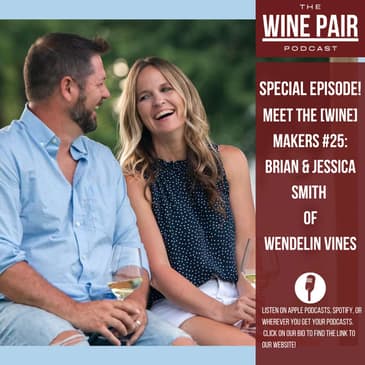
Meet Brian and Jessica, a husband and wife winemaking team from Kansas. Yes, you heard that right - Kansas! It’s not as crazy as it sounds. In fact, did you know that in the 1800’s, Kansas was one of the top wine producing states in the country? Brian and Jessica are one of a group of winemakers bringing back winemaking in Kansas through their new winery Wendelin Vines. And, you won’t believe the story of how they got here, but you have to listen in to get the full story. All we’ll say is that their adventure started on a beach in Maui drinking Mimosas at 10 AM in the morning, and today, they are in Kansas making wine. Enough said. We had a wonderful time getting to know Brian and Jessica, and you will, too. They are what happens when curiosity, passion, and DNA combine into something pretty wonderful.
Send us a Text Message and we'll respond in our next episode!
Contact The Wine Pair Podcast - we’d love to hear from you!
Visit our website, leave a review, and reach out to us: https://thewinepairpodcast.com/
Follow and DM us on Instagram: https://www.instagram.com/thewinepairpodcast/
Send us an email: joe@thewinepairpodcast.com
Show Notes
Special Episode! Meet the (Wine) Makers #25: Brian and Jessica Smith from Wendelin Vines
________________________
KEY QUESTIONS
- Is Kansas wine actually good, or just a novelty?
- Is Kansas actually a wine-growing region?
- What was Kansas's wine industry like before Prohibition?
- Why do Kansas winemakers grow French hybrid grapes instead of classic vinifera like Cabernet or Chardonnay?
- What do wines made from grapes like Seyval Blanc, Frontenac Gris, Frontenac Noir, and Chambourcin actually taste like?
- What food pairs well with a dry, crisp white wine like Frontenac Gris?
- Who are Brian and Jessica Smith of Wendelin Vines, and why did they leave corporate careers to start a winery in Kansas?
________________________
Full Transcript
Joe: 00:07
Hello and welcome to this special episode of the Wine Pair Podcast. I'm Joe, your samoyer of reasonably priced wine, and for these special episodes, I give Carmela a break so that she can take care of the work she has to do at her bakery, Baby Cakes. And I get the chance to talk to real winemakers to understand their history and their craft and all that other fun stuff. Today we get to talk to a winemaking couple, Brian and Jessica Smith. We're just starting out in the winemaking business in a place you may not expect people to make wine, and that's in the great state of Kansas. Yeah, I said Kansas. It may be surprising to hear that Brian and Jessica are making wine in Kansas, but there's a great story behind it, and they are not the only ones. And what is great about this episode is that we get to talk to people who are passionate about what they're doing and learning every day. And to be clear, they do have some history and DNA that help them to start this quest, but I'll let you hear that from Brian and Jessica yourselves in just a minute. First, as a quick orientation to what we usually do in the Wine Pair podcast, in most episodes, we learn about taste and review two wines that are reasonably priced, which means under $25 and should be easy to find. However, for this special set of episodes, we interview people who are involved in actually making wine because part of what we want to do with our podcast is to educate ourselves and you on different aspects of wine knowledge in a fun, entertaining, and unstuffy way. Even fun and entertaining is Decanter Magazine is called our podcast. And that is what we're doing today. A small plug before we get to the interview with Brian and Jessica, if you like what you're hearing or are interested in hearing our other regular episodes, please subscribe to or follow our podcast so you can hear more, especially since you're only getting one half of the Wine Pair Podcast in this episode. You can also go to our website, thewinepairpodcast.com, to send us a note or subscribe to our newsletter. And you can follow us on Instagram and Blue Sky and TikTok at the WinePair Podcast. And if you like what you're hearing, you can even leave us a nice rating and review. We won't mind one little bit. But with that, let's get on to the interview with Brian and Jessica. Hi, Brian and Jessica, and welcome to the Wine Pair Podcast. Hello. Thank you for having us. Oh, we're so excited to have you and share with our listeners the story of how you guys started your own winery, what you've learned, the wines you're starting to make, and all sorts of other fun things. So I think we should just jump in.
Speaker 4: 02:32
Yeah, let's do it.
Joe: 02:33
We're excited to share everything. Okay, so let's just start with a little bit about the both of you, your background, your families, and if wine played any part in your history or growing up.
Speaker 4: 02:44
Yeah, I'll I'll start. So we've been married 20-something years now. We met in college. Uh, I'm originally from New Orleans. Jessica is originally from an area called Salt Creek Valley, Kansas, which is about 30 minutes outside of Kansas City, northeast part of the state, a beautiful area, not flat like you would imagine most of Kansas is. And like I said, we met at college uh and were kind of in the corporate world for most of our adult life. For me anyway, wine wasn't really something, a growing up thing. I didn't grow up in the industry, didn't even grow up in agriculture. I grew up, you know, like I said, New Orleans and then Kansas City. So kind of a suburb guy. And uh, how we both sort of got into wine, I think about like a trip that we did to Maui. And neither of us were real big, heavy wine drinkers. And like I said, wasn't part of growing up. And we had just got kind of sick of everything else. And one morning we woke up, you know, it's a four-hour, five-hour time difference from where we're at. We woke up and said, Oh, let's have mimosas on the beach. Like that sounds amazing, right? Mimosas on the beach in Hawaii. And we went out, and as we started drinking mimosas on the beach, it for both of us, it was okay, a little bit less orange juice this time, a little bit less orange juice this time. And before you knew it, it was just like, wow, this is this prosecco is really good. One thing led to another. And I think, you know, by 10 a.m. on a Sunday, we're dancing on the beach, you know, and there's families there, and it's like, wow, this is this got away from us. Uh, and we sort of came to the realization, like, hey, we kind of like wine, like maybe this is something we should uh kind of explore with. And so that sort of led to, well, let's book a trip out to California and do wine tasting. And one thing led to another. And now we've tried all sorts of different, you know, places around the country and even a few internationally. And that's for me, anyway, sort of what led us into like the whole world of wine and wine tasting and exploring and the different adventures you can go on with wine.
Joe: 04:45
Well, I think what I've just learned is I want to go on trips with you guys. If you're by 10 o'clock in the morning, you're you're, you know, just all the way uh just the plain champagne or proseco.
Speaker 4: 04:57
We've grown a little since then, but there have been a few wine trips that have gotten out of hand, uh, for sure. But yeah, we've we've definitely grown since then. They would uh it's probably more food than wine now, but we definitely uh enjoy our vacations and our trips to wine countries.
Joe: 05:13
I guess, like I said, I'm we're coming with you. Okay, well, you found this love for wine, and now you've turned it into wine making. So how did that happen? Clearly, it wasn't something you had sort of started out interested in. So, how did you how did you get there?
Speaker 4: 05:26
Yeah, it definitely wasn't something that we started out doing. And I I tell Jessica quite a bit, like she does a good job of tempering my crazy dreams and my uh uh, you know, the odd things I try and dig into. So this is certainly one of them where part of me thought, eh, maybe she'll talk me off this ledge, but she sort of jumped in too, you know, both parents can't be crazy all the time, but this is one where I think we did, you know, like I said, for for years, 20-something years, I was in the corporate world. And towards the end of that, it was a lot of international travel. And I can remember in it was in February of 2020, I was in a hotel in Bangalore, like live streaming my son's senior year wrestling tournament. And I just kind of thought to myself, like, what am I doing? Like, what, like, what all the things I'm missing out on? So we came back from that, and that was right when COVID hit and the world just sort of shut down. And so I was fortunate enough to be forced to work from home all summer and in the rest of the year. And that's sort of what led to we've got to find, I've got to find something else to do. Like this corporate ladder climbing just isn't isn't it. I didn't feel it any, you know, I wasn't passionate about it anymore. And so, and we, you know, we live on we live on a bunch of acreage, her parents farm, and they have a uh huge, huge farm. And so we have a portion of that, and I thought, well, gosh, I wonder if I wonder if we could grow grapes out here. And that started with researching the history of wine in Kansas. And is this even possible? And we knew absolutely nothing about the grape growing side, and so that started this obsession of like, do we even have the soil for it? And what we sort of discovered is in the 1800s, Kansas was a major wine growing state, and so that was like a total like, oh wow. And then when my son went to college, most of the colleges in the country were going with remote online classes, and so I sort of thought, I wonder if I could like get a degree in this just going to class online. So, you know, at the age of 41, I re-enrolled in college and started piecing together classes from universities that were offering online courses all over the country. And so one thing led to another, and it was like, okay, this is something we could probably do, and I'm going to school to learn it. And so in 2021, we planted our first two acres, and then we just kept doing classes and checking off the certificates. And by 2025, you know, we were now four years into it. We have four four acres planted. We just bottled our first vintage, and before we knew it, uh, we had gone over a you know a relatively short period into being in this corporate America world to this crazy story of having a vineyard and winery in the state of Kansas. So that was sort of like how we jumped into the vineyard and winemaking side of things.
Joe: 08:27
So it's kind of amazing. Yeah, and I in a minute we'll go into some of your wines, but I think the whole Kansas piece is really interesting. Like, I think that's something that most people don't know that you can even make wine or grow wine grapes in Kansas. So I always like to find out you obviously were taking online classes and those kinds of things, but was there a mentor or somebody who like kind of helped you along or showed you the ropes? And is there a community in Kansas or around you of other people who are growing grapes or making wines that you can lean on?
Speaker 4: 09:02
There is. And actually, I would kind of maybe tell it in two ways. There's a community in Kansas, it's relatively small. There are about 30 to 40 wineries in Kansas, and the state of Kansas does a pretty good job of trying to support what they call specialty crop agriculture or ag tourism. And a lot of it falls under ag tourism. And so there's a community in Kansas, and they've been great. Everybody that we've reached out to here has been great. But I would actually, you know, maybe talk more about two of the mentors that I would say have kind of mentored us. One of the things that we sort of set out to do is one of the regions that we fell in love with was the Willamette Valley in Oregon. And so on one of our trips, we went and we stayed in McMinnville and a little place in McMinnville. The reason we chose that is because when I was doing research about the types of grapes, so they're very different. And some of your previous guests have talked about that. With the the French hybrids that we grow here, there's a variety in particular called Save all. And that variety stuck out to me. And I thought, well, you know, based on the descriptions, it sounds like this would be a good one. And I wonder if there are people who have done anything with this. There's a winery in, I think it's Newburgh that's called Bells Up. And this guy had won some awards with his Save all. And so I reached out to him and said, Hey, would you be interested in like, could we come up there and just kind of see how you do things? And this is very, very early on. And the guy's name's Dave, and he invited us out there, and we went and spent a little bit of time with him. And he loved the idea, like, hey, you're gonna try and do this, like recreate this in Kansas. And I he said, Yeah, you know, I found online that you've won some awards with your save all. And so he's been really, really great about answering just like off-the-wall questions, like, hey, on your save all, what do you know, when you harvest, what what do you harvest in, you know, what your p what's your pH at? What's your acidity at, or what bricks are you picking at? And so I and I've told him, like, hey, if I could just recreate what you did, and he jokingly, like, hey, we'll never compete, you know, like, but Dave from Bells Up has been really, he probably doesn't even know. He would probably tell you, oh, you know, I only answer a few emails from the guy. But his story of leaving corporate America and starting a winery out in Oregon and the way they do it, only do tastings with the winemaker, so that you know the experience is super high-end. And so Dave has been one that's been really, really, I would consider kind of a mentor in this space. And the other one is Kim Coleman, who you may or may not have heard of Coleman Winery. It's also out there, it's 10, 15 minutes, I think, from from McMinnville. That's another one that we've gone out there and spent some time with. And their winemaker are like, How do you do this? How do you do that? So it's sort of a combination of taking what we can do in the varieties that we have in Kansas and getting feedback from from the winemakers here, and then like overlaying the lens of what's going on in Oregon and are there viticultural practices we can apply or winemaking practices we could apply. So, between those two, it's really been sort of helpful in guiding us to figure out how to kind of navigate the world of winemaking in Kansas.
Joe: 12:17
So super interesting. And you you had no background in winemaking, and I'm assuming you didn't have any or much of a background in farming, because for most winemakers, they have to also be farmers. Now, Jessica, you your family has farmland in Kansas. So did you have any background? Was there a way that you you were able to sort of like drop into the planting crops, et cetera, that made it a little bit maybe easier than it could have been if you had no background?
Speaker: 12:48
I I would say for sure, yes. I mean, I was not directly involved in planting crops or harvesting crops, but I grew up on a farm. My dad, my dad was a farmer, and he still is a farmer. Farmers, I don't know that they ever retire, but he's still a farmer. He grows corn and soybeans. We had pigs growing up. So yeah, full-on farm life. So I would say most of what I could apply is I I just know how hard working people are. And you know, it's it's a lot of work. It's whether you're growing grapes or corn or soybeans or whatever it is. I knew going into this that it was going to be a lot of work.
Speaker 4: 13:25
She does a really good job of like, no, it's planting season, or you've got a spray, or so like I don't, I never have to convince her the agricultural side, or or like Joe, it'll be, hey, you know, I need to go get this tool. And she'll say, Well, don't buy the cheap one. My dad would say, Don't buy the cheap one. You have to buy the right tool. And so it's not like I have to sell her on some of the farming agricultural stuff. Like she grew up with that and kind of gets that part of it. Right.
Speaker: 13:54
But definitely not grapes. I never thought I would be involved in grape growing.
Joe: 13:59
A grape farmer. Did you did your father think you guys were nuts?
Speaker: 14:02
Yeah, I think so.
Speaker 4: 14:04
You know, it's interesting with because he we use a lot of his equipment to move stuff around. And when we first told him about it, he was like, What? Like, you know, you could you could grow grapes around here. And later on, I'll tell you why we chose the name that we did and the relevance there. But after seeing our first harvest, he had he has said, you know, there's some stuff over here by the pond. There's some land over here that I use as pasture land that if you need to, if you need to grow a little bit, like I'm not using that land for anything. So, and I've noticed he'll come over and harvest, you know, and he'll come over and check the crops and we'll talk more about different pests and things like that than we used to, for sure.
Joe: 14:40
That I mean, that's a secret weapon, uh, for sure, somebody with that kind of experience. And I I do, I think people who are wine drinkers often forget because wine has the connotation of being sort of fancy, and it's fundamentally a crop that you know is made into a drink. And there's a lot of hard work and dirt and muck and all that kind of stuff that's involved in it.
Speaker 4: 15:04
It's one of the things that I think sort of, I don't know that I would say separates, but maybe defines us a little bit in terms of the winemaking, which is every time we would go out and talk to one of the winemakers out in Oregon, I'll just use Oregon's example, there is this obsession with the fruit itself and the quality. And the ones that really stick out are ones that they could tell you everything about the variety that they've grown, the rainfall that they've gotten and why it would impact the taste palette, you know, and all that type of stuff. There's this obsession about it. And I think that kind of comes a little bit inherent in what we do. It's like, I don't want to have 15 varieties and do all these different things and this. We want to have a few varieties and get as good as we can with the varieties that we plant. And so that that's a little bit different, I think, maybe in our approaches. We want to just be obsessed with the varieties that we have and see if we can make them as good as we can.
Joe: 16:05
Yeah, let's keep going down this path because I I think this is an area that's going to be really interesting. You know, when you were seeking to make your wines, did you have like a style or an approach or something that you wanted to create in terms of defining what kinds of wine you wanted to make?
Speaker 4: 16:25
It might be different for both of us. I'll maybe I'll answer a little bit and then you can weigh in. I sort of went down the path of trying to recreate what I think Jessica would like. And so I go back to that story in Hawaii where we first started drinking Prosecco. And I thought selfishly, like, man, if my if my wife likes this, if I could figure out a way to like to make that, like I'd be a rock star. And so with the first variety that we chose, the save all, it was, is that something that I could recreate to kind of impress my wife? Right. And that was sort of like my approach of trying to think of creating the wines that I think she would like.
Speaker: 17:09
Yeah. And I think, well, we both kind of like similar style of wine, like a drier wine. We definitely are not sweet wine drinkers, so you're not going to find that. And we want to kind of let the, I mean, really let the wine speak for itself. Like we're we're not trying to add a bunch, we're not trying to change the taste of it. We want it really to come through and you're tasting the wine that was grown here, the grapes that were grown to. The terroir.
Joe: 17:36
Well, let's talk a little bit about that. I like terroir is a it's a great term. Um, but let's talk about what kinds of grapes, because I I this is one of the things that motivated me a little bit in why I wanted to start the podcast with Carmela, and that was like everything was Cabernet Sauvignon and Chardonnay. And that's because California is really it's quite good at growing Cabernet, Sauvignon, and Chardonnay and some other grapes. But you know, when you go to other wine regions like Virginia or New York or, you know, even in Oregon, parts of Washington State or Michigan, like you can't force the grape into the land. You have to go with what grows there and really does well. So, how do you think about that? The types of grapes and you talked about save all, but like, are there other grapes that you grow or want to grow?
Speaker 4: 18:29
Yeah, so so we have four different varieties planted, two white and two red. And, you know, one of the challenges I think that you have in Kansas is, and I get asked this quite a bit when we started this is well, like, are you gonna make good wine? Like, I get that question a lot, you know, like, like, no, I'm gonna intentionally not make good wine. But I'll ask, well, like, what does good wine mean to you? And they'll say, Oh, I love I love California cabs. I say, Well, you know, you can't make that here. That's not the type of grapes, that's not the varieties that will work here. If you want a California cab, the best place to get that is California. And so if you can think about a little bit, the French hybrids are what grow best around here. And there are some that plant vinephera and and make it work, but the French hybrids are the ones that are the most successful here. And so if you start with that, and there's tons of them, if you start with that as like the top of the funnel of what you can choose from, what I believe, and I think there's probably some science to back this up, is Kansas as a growing region, you get some pretty decent wet springs, but then you get heat, and you get heat the whole growing season, and you get a lot of sun the whole growing season. And what that sets you up for is you know, your fruit ripens a little bit earlier, you have a little bit higher acids and stuff because you have a shorter but hot growing season. So, like this part of the country could be amazing at doing a sparkling, at doing uh a good white wine. And so when we started, that was the first thing that we wanted to do is well, and it's a little bit easier, you know, it's a little bit more forgiving to start with a white wine if you're a new winemaker. So we picked out two varieties, our save all that I've talked about, and then a variety called frontnet gris, which I believe came out of Minnesota, if I'm not mistaken. And I had tried a frontnet gris, it's very versatile. You can do a lot of different things with it, but it has more depth, probably, than you would imagine. And so those are the first two varieties that we planted. When we harvested, we did our frontnet gris as a still gris style wine. And I think it probably surprised us both post-fermentation, like that first taste out of the tank post-fermentation. We kind of looked at each other and like, did we make this? Like, is this like for your first time? It's not bad. And so I think we were both a little bit surprised at how good the gris turned out. And then on the red side, we went with a similar same but but variety called the front neck noir. And then the state here grows a lot of Schomberson. And I believe the the gentleman you had on from Virginia also has a Schomberson. Uh, and so those are the two that we went with on the red sides. And so Schomberson is sort of like the the all-star of the state. I would say there's a lot of folks in the state that grow Schomberson. And I think if done, if done well, if you kind of implement the same practices that you have there in the Pacific Northwest, you can get a really good, I would say, probably medium-bodied Pinot style red out of those varieties. And so we planted those a little bit later, uh later in the year. So those will come online. Next, next leaf will be our first harvest. But you're you're sort of so it's sort of if if you think about it from an artist, you're a little bit like these are the paints that you start with. It's not just an unlimited supply. And then what you can do with those, like those ingredients to create.
Joe: 21:59
And so now. You're starting to release your first wines. So, what about them are you excited about? You're talking about some wines that are going to come out later. Tell us a little bit about the wines that you're creating.
Speaker 4: 22:11
So we only have one wine in the bottle right now. So we are the most excited about that one. And I think that for the folks, it it's hard as the it's hard for me to say, oh, it's amazing, or it's because I'm like obviously I think it's great because, you know, there's a part of me in it. The folks that we've given it to that I would say, you know, not my parents, my parents think anything we do are amazing, right? But some of the folks that we've that we've had come over to do tastings and it has a lot more depth for a white than I think I originally thought it would. I think we set out to create a light crisp, you know, something you could just chill and have on a Sunday on the on the porch kind of a wine. But it I think it has a little bit more complexity than we had thought it would, than we expected it to. And I think some of the folks who have tried it really enjoy it as like a like a dinner wine more than I think we thought it would. And so it's still, it's still a light white wine, but it has a depth and complexity that I don't think like we didn't expect. It was kind of a happy surprise. Uh, and I think some of that comes from a lot of folks in the state, and a lot of the feedback that we got was using commercial, like just starting with commercial yeast, because you know, like you've got to, that's just the next step in the process. And by accident, I would say, by accident, would you say after we, you know, after we pressed and had it in tanks, it started to ferment just with native yeast. So instead of like panicking, it was just like, well, let's let's let it go on native yeast for a little bit before we introduce some commercial yeast. And I think next year, and I think that probably gave it a little bit of the complexity. And certainly then when we introduced the commercial, it gave it a little bit of the aromas. It's got a real kind of uh tropical fruit aroma to it. Uh, and so that was surprising. I think next year what we'll probably try is we'll probably in this part of the state anyway, uh, with with kind of the all the growth and vegetation around here, I think we'll probably let it go on native yeast and see, and maybe maybe split some off and do it in two lots and see. But I think we'll probably let it go on native native yeast and see what kind of flavors that that gives us.
Joe: 24:18
This is a kind of an interesting segue because one of the questions I always like to ask of winemakers is do you lean more on the art or the science? And I know it's both, like it's both. You have you have to be able to do both, but it sounds like even early on in in the winemaking, you're kind of playing with both of these, with the native yeast. It's a little bit like art, but you also have to know a lot of the science behind it.
Speaker 4: 24:40
It was definitely let's start with the science approach. And hey, here's what all the textbooks say, and here's what I learned. And then I think once you get your hands dirty, and maybe it's just because the lack of experience, it very quickly turns into art. And I think a little bit with like I said, I come from New Orleans where food and music and art all sort of intertwine, and that's very big in my family. And so I think I've I just more naturally leaned into the art side of things. And, you know, we still do things that you kind of testing your sulfur number, your or testing your your SO2 numbers and things like that. But it's been a little bit more of the art behind things. We took some stuff and said, hey, let's let's try a French oak barrel. And so we ordered this little mini French oak barrel just to kind of like play and see what that would create and how that would how that would work. And so I I sort of describe it as, you know, it's kind of tries to be science based, but maybe art by accident, as you as like, you know, you don't have the you don't have the science skills with all the experience. So you art your way through things and it and it turns out what you've created at the end is a painting that you're pretty happy with.
Joe: 25:53
Yeah, love it. You are on very much a learning journey. So, what do you think the both of you have been learning along the way as you've gone into this very brave adventure?
Speaker: 26:04
One of the big things we learned is, well, we sort of knew, but and you haven't talked about the name yet, but going into this, we knew that there was some history in my family of winemaking in Kansas, but we've found out so much more. We found out much more information about my fifth great grandfather Wendelin, who actually had the one of the biggest vineyards in Kansas back before Prohibition. But we went even further from there and we traveled to Germany last year to find sort of his roots in Germany and found that actually they're still growing grapes in that area. Our ancestors that didn't move, that stayed in Germany, are still growing grapes there and got to meet them and see the vineyards and things like that. It was it's been very amazing that part of the journey.
Speaker 4: 26:49
You find you become a history buff as you get older, like you used to become super history nerds. My learnings, it's a totally different. I I have learned that this is like the perfect career choice for somebody with ADD, like myself. You have three different businesses. You have an agricultural vineyard business, you have a wine-making business, and you have a whole retail tasting room, you know, the consumer side of things business. And so I I for somebody like me who just like struggles at time to focus and concentrate, I will be in the morning out looking at trying to, you know, diagnose fungus on a leaf or mildew on berries, and then two hours later trying to figure out how you're putting tanks together and how you're like the right fittings for different tanks and why this pump isn't working and why you're getting air injected here. And then later on in the afternoon, you're you're solving e-commerce problems and why you can't ship to the state of Ohio because the tax rate you don't have set up correctly. And so for somebody like me to be able to just like move around free different businesses all in the same day. And when you get frustrated with something, then you're like, I'm done with this for the day. Well, there's something else you can kind of dig your mind into, and then and then like, oh, yeah, oh, now I figured out in my head how to go fix that other thing. And so that's been a big learning for me.
Joe: 28:15
Jessica, you started talking a little bit about the name. So tell us a little bit more about where the name came from.
Speaker 4: 28:22
Not to not to steal your thunder, Jessica. She mentioned it a little bit. I don't know that she does enough justice to her and her family on what we had here. So when we started the winery, we had we obviously, when we started the vineyard, we obviously had to come up with a name. And we knew that the history of her family, her great-great-grandfather, you know, four generations, five generations back, uh, was an entrepreneur in in Kansas in the 1870s. And as we did more research, we discovered that at one point he had the largest vineyard in the state of Kansas back in the 1870s before Prohibition. And they were producing over 6,000 cases a year of wine. And most of it, maybe not even most of it, but a large portion of it was sold as Sacramental wine across the state. And so when we came up with that, uh, we were like, oh my gosh, this would be great. Like, let's name it after him. And his name was Wendell and Hunt. And so that was our initial like that. We thought that would be a cool marketing idea. And it ties back to her family. And we did a bunch of research about how, you know, they started in in Kansas and all this. And that led to, well, I wonder like what part of Germany they came from. And so she started doing some research and found cousins that still live in the region that Wendelin and his family migrated from in Germany. So last November we made a trip over there. And as we were walking through this town and her her cousin Marcus, Marcus, Marcus, Marcus Hunt, and as Marcus was going through the village, you know, and he would point out this is where their family left from, and this is the church they were baptized. At one point, he said, Would you like to see, you know, the Hun Vineyard? And we both sort of looked at each other like, You the Huns still own a vineyard? And he said, Oh yeah, we still we still own vines and we still make wine today. And the Hun family in Baden, Germany, in uh Waldem still makes wine today, and it blew us away that and you know, and now we say, like, well, Jessica's a a fifth generation winemaker with kind of a four-generation back. And so, because of that, and and our labels are all embossed with the portrait of Wendell and Hun on the label, and that's that's become kind of a a rallying point for us as we as we've learned more and more about their family history and their history of winemakers here in Kansas in the 1800s, but even going back to the 1500s in Germany.
Joe: 30:55
That's such a great story. I mean, you had it in your blood, you just didn't know it. That's what it was. You just you discovered it, it came out. You you it it was it had to happen. Well, that that's an awesome story. We have uh, but I have a very important question. Now, uh, Brian, it sounds like you well, it sounds like the both of you have come out to the Pacific Northwest, but I'm not sure how much you've been to Seattle, you've been around Seattle, but next time you come out, you gotta let us know, and we will invite you over to Sunday Night Dinner, and that's a big deal. I just want you to know it's a big deal. Italian American family, we take that very seriously. So when you come to Sunday Night Dinner, yeah, the only thing that we ask, I mean, you're welcome, like you don't have to do anything special except bring us your wine. So, what wine are you going to bring us?
Speaker 4: 31:41
Ooh, why don't you why don't you what would you suggest, Jessica?
Speaker: 31:44
Um, well, hopefully, maybe the sparkling.
Speaker 4: 31:47
That's what I was gonna say. I was hoping you would say that. I think that what we tried to do with our sparkling is we tried to make it like a prosecco style sparkling. And so I think that would go perfect uh as the starting point to uh to a large Italian family dinner.
Joe: 32:05
And we always think about like when Carmel and I think about wine, and and usually when we talk about wine, we talk a lot about how it pairs with food. Do you think about that a lot in terms of how you're thinking about making wines too?
Speaker 4: 32:18
I don't know that we would set out to say, let's make a wine that would pair good with pork, or let's make a wine that would pair good with this. I think after the fact, what I've found is we're more along the lines of, ooh, this would taste really good with this. And as silly as it sounds, one of the things that's become like a staple for us is drinking a sparkling with the kettle, salt and vinegar kettle chips. It I like it has become we try and dress it up as a fancy, like, oh, you've got to try this. And so if we're responsible for the appetizer, you would expect a sparkling and some real high-end salt and vinegar kettle chips.
Joe: 32:58
We're totally with you. We we used to have that approach of sparkling wines being for just special occasions, and now we're like, yeah, the special occasion is Tuesday. So, you know, you can have you can have sparkling wine anytime. It's great, it's great with food, it's great with all sorts of things.
Speaker 4: 33:14
It pairs perfectly with food you would find at the county fair, surprisingly.
Joe: 33:18
Actually, that's true. Fried foods, like I've never tried it with a corn dog, but I have a feeling it might be awesome.
Speaker 4: 33:25
A little, a little Kansas twist to your sparkling wine.
Joe: 33:29
For sure. Okay, before we let you go, we want to let our listeners know how they can find you, how they get your wines, if they want to visit, what does that look like? So tell us that.
Speaker 4: 33:41
Yeah, so we're we're located in northeast Kansas. We're about 30, 35 minutes from downtown Kansas City. We're about 20 minutes from the airports, it's a pretty quick drive from the airport. So our our website is wendellandvines.com, and our Facebook page is Wendell and Vines. Uh, we just launched last week the shipping side of our site. So we can ship to 40-something states in the country now, probably like like most places. And so if you're in and around Kansas City, you can ping us on our website. Uh, most of what we do is private tastings. We have a barn here that was built in the late 1800s. It's our tasting room, and we talk a little bit about Wendelin and the history of wine in Kansas, a little bit of a drunk history of Kansas kind of approach. So it's fun. It's not, but those are probably the best ways to either try the wine or when you come out and do a tasting here with us.
Joe: 34:32
Well, that sounds perfect. And we'll have this information in our show notes and we'll repeat it again before we sign off. And I'll just say one last thing. What I'm hoping too is that we we have a chance to connect again when the Chiefs play the Seahawks in the Super Bowl this year. How about that?
Speaker 4: 34:49
I look forward to the day when we're back in the Super Bowl, but I'm also grateful for the four or five that we've been in recently.
Joe: 34:57
I think it could happen fast. He's back. Patrick's back.
Speaker 4: 35:00
So we're holding out for uh Taylor and Travis to come to a taste. That's that's when we know Wolf made it. When Wendelin vines in the Chiefs, you know, we have Taylor and Travis. That's right.
Joe: 35:11
That's right. Thank you so much for being on the podcast. We have had such a good time talking to you.
Speaker 4: 35:16
All right, Joe, thank you so much, man. It's Greg meeting you face to face.
Speaker: 35:20
Good luck with graduation.
Speaker 4: 35:22
Yeah, good luck with graduation.
Joe: 35:23
Thank you. Thank you. Appreciate that. Okay, take care, you guys. Bye-bye. See ya. Well, thank you very much to listening to our interview with Brian and Jessica and hearing their amazing story. It's so fascinating to hear about the discovery they made, of the history of winemaking and their family, and how they're bringing winemaking back to life in Kansas. We're really excited to see how this adventure plays out over the next few years, and we will definitely be paying attention and giving you all updates. Now, in case you're worried about how to get in touch with Brian and Jessica or finding Wendelin Vines, don't worry. You can find out all of this information on our website, the winepairpodcast.com, in our show notes for this episode. But so you have it. Here again is the information about how to find out more. The website is wendelinvines.com, W-E-N-D-E-L I-N-V-I-N-E-S.com. Facebook is wendelinvines, and email is Brian at wendelinvines.com. And we hope you'll subscribe to our podcast, the Wine Pair Podcast, and follow us on Instagram and TikTok and Blue Sky and visit our website, the winepairpodcast.com, where you can reach out to us and sign up for our newsletter. And you can also always reach out to me at Joe at the WinePair Podcast.com. If you want more information, you have other winemakers you want to introduce us to or you want to share what you've been drinking. We look forward to hearing from you. But for now, it's time to go. And as we like to say, life is short, so stop drinking shitty wine. Bye bye.
Joe: 36:53
Contact information for Wendelin Vines
- Website: https://www.wendelinvines.com/
- Facebook: https://www.facebook.com/WendelinVines
- Email: brian@wendelinvines.com
________________________
FREQUENTLY ASKED QUESTIONS
Q. Is Kansas wine actually good, or just a novelty?
A. It can genuinely surprise you. Kansas mostly grows cold-hardy French hybrid grapes bred to handle its wet springs and hot summers, not classic wine-region vinifera. One small Kansas producer found their dry white turned out more complex than planned, closer to a dinner wine than a simple sipper. It's a small but serious wine scene worth a chance.
Q. Is Kansas actually a wine-growing region?
A. Yes, more than most people realize. Kansas isn't known for wine today, but it currently has roughly 30 to 40 working wineries, mostly small, family-run operations growing cold-hardy grapes suited to its wet springs and hot summers. It's not Napa or Willamette Valley, but it's a real, growing wine region with its own distinct style.
Q. What was Kansas's wine industry like before Prohibition?
A. Kansas was once one of the biggest wine-producing states in the country. German immigrant winemakers built large vineyards in the late 1800s, some producing thousands of cases a year, much of it sold as sacramental wine. Kansas passed its own statewide prohibition in 1881, decades before the rest of the US, and the industry never fully recovered until recent decades.
Q. Why do Kansas winemakers grow French hybrid grapes instead of classic vinifera like Cabernet or Chardonnay?
A. Classic wine grapes like Cabernet or Chardonnay struggle with Kansas's wet springs, hot sunny summers, shorter growing season, and naturally higher acidity. French hybrid grapes were bred to handle exactly those conditions while still making quality wine. That's why Kansas growers lean on hardier varieties like Seyval Blanc, Frontenac Gris, Frontenac Noir, and Chambourcin instead of traditional vinifera vines.
Q. What do wines made from grapes like Seyval Blanc, Frontenac Gris, Frontenac Noir, and Chambourcin actually taste like?
A. Seyval Blanc leans crisp and citrusy with a light, mineral edge. Frontenac Gris can range from a light porch wine to a surprisingly complex, tropical-fruited white. Frontenac Noir brings juicy cherry and plum with soft tannins, while Chambourcin makes a deeper, medium-bodied red with dark fruit and a little spice, closer to Pinot than you'd expect.
Q. What food pairs well with a dry, crisp white wine like Frontenac Gris?
A. A dry, crisp white like Frontenac Gris works well as a food wine, not just a sipper. Its tropical fruit notes and refreshing acidity pair naturally with lighter dinner dishes, seafood, or roast chicken. If the wine leans sparkling and prosecco-style instead, it's equally at home with salty snacks like kettle chips or classic fried county fair food.
Q. Who are Brian and Jessica Smith of Wendelin Vines, and why did they leave corporate careers to start a winery in Kansas?
A. Brian and Jessica Smith left corporate careers during the COVID years to start a vineyard on Jessica's family farmland in Kansas. Neither had a wine background. They later discovered Jessica's own great-great-great-grandfather ran one of Kansas's largest vineyards in the 1870s, before Prohibition shut it down, making their new winery a real family legacy rediscovered generations later.
________________________
Support The Wine Pair Podcast by heading to our website and shopping for the wines we give our highest ratings to in our Shop Wines section. Just click on this link - you pay the same price, and we may get a small amount of compensation.
You can also support us by clicking on this affiliate link to wine.com and find great wines under $20!
And, if you are looking for a great website builder for your podcast, click on this link to use the service we use and love: Beamly, formerly known as Podcastpage.io
________________________