
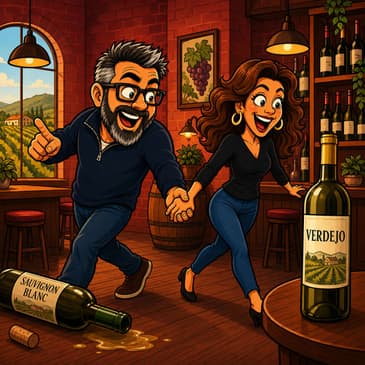
If you are stuck in a Sauvignon Blanc rut, then Verdejo is here to come to your rescue. This great white wine from Rueda Spain is very similar to Sauvignon Blanc, in fact it is sometimes called the “love child” between Sauvignon Blanc and Pinot Grigio, and it combines many of the wonderful tropical fruit and citrus smells and flavors of Sauv Blanc with just a bit more mouthfeel. This is a lovely wine from Spain’s most important white wine region. Verdejo is a fantastic summer wine, great for sipping outdoors, and awesome with fish and shellfish, fried and salty foods, as well as chicken and charcuterie. It still flies a little under the radar, which is why now is the perfect time to be the one to introduce Verdejo to your family and friends and be considered the cool kid dropping wine knowledge! Wines reviewed in this episode: 2024 Marques de Riscal Rueda Verdejo, 2024 Bodegas Vatan Nisia Old Vines Verdejo
Send us a Text Message and we'll respond in our next episode!
Contact The Wine Pair Podcast - we’d love to hear from you!
Visit our website, leave a review, and reach out to us: https://thewinepairpodcast.com/
Follow and DM us on Instagram: https://www.instagram.com/thewinepairpodcast/
Send us an email: joe@thewinepairpodcast.com
Show Notes
Episode #226: WTF is Verdejo? 00:00
________________________
KEY QUESTIONS
- Is Verdejo wine worth buying?
- What does Verdejo taste like?
- What food pairs well with Verdejo?
- What is Verdejo and where does it come from?
- How is Verdejo different from Sauvignon Blanc?
- Why did Verdejo almost disappear?
- Which Verdejo wine should you pick, Marqués de Riscal or Bodegas Vatán Nisia?
________________________
Episode Overview and First Thoughts on Wine Verdejo 00:35
Hello fellow Brix Layers! And welcome to The Wine Pair Podcast. I’m Joe, your sommelier of reasonably priced wine, and this is my wife and my wine pairing partner in crime, Carmela. And we are The Wine Pair!
If you're new to our podcast, here's what we do: Every week we buy wines under $25 with our own money, taste them, and give you our brutally honest opinion on whether they're worth buying. Nobody pays us to review specific wines, we don't accept free bottles from wineries, and we're not afraid to call out a bad wine when we taste one. Decanter Magazine calls us fun, irreverent, chatty, and entertaining - so if that sounds like your vibe, welcome to our tribe of wine lovers.
Yes, once again, the tribe name this week comes from Gina, and for those of you who may be wondering what we are talking about, BRIX in wine is a measurement of the sugar content in grape juice, which matters when winemakers are deciding when to pick their grapes because it predicts alcohol content. Anyway, thanks again to Gina for the names, and remember if you have a tribe name you want to send over to us, please do, and if you have not been on the podcast, we’ll ask you if you want to be a guest! Which we haven’t done for a while, but we really want to do again.
Today, Carmela, we are going to finally do a full episode on one of the most loved white wines in the world, and that wine is Verdejo from Rueda, Spain. Now, we actually have tasted a Verdejo as one of the wines we did way back in episode 20, and some of you won’t believe it but we actually used to review three wines in each episode which was both a lot of wine and a waste of money and wine because we can’t drink three bottles of wine in a day or two. Heck, we can’t hardly drink one. So today, we are going to do an episode on Verdejo, but you’ll be happy to know, Carmela, that we are only going to taste and review two wines.
Before we dig deeper into Verdejo, I think we need to spend a little time learning about Rueda, because it is one of the great wine making areas of Spain, and it is really interesting because it specifically focuses on white wine, which we like. About 97% of the wine in the DO of Rueda is white. When we say DO we are talking about the abbreviation for Denominación de Origen which is the Spanish legal designation of quality, like DOC or DOCG in Italian wines. Rueda also accounts for 40% of Spain’s DO white wine market, and ranks third in the country for total DO wine production, behind the two well known areas of Rioja and Ribera del Duero.
For a little bit more context, only 27% of Spanish wine production is white, and so Rueda is really the country’s main white wine region and accounts for 11% of total wine market share in Spain. That’s a lot of math, so the simple answer is Rueda is all about Spanish white wine.
To be called a Rueda wine, it must be at least 50% Verdejo, and if it is called a Rueda Verdejo, it must be 85% Verdejo. So, that is something to just know.
Rueda has a very good reputation today, but it wasn’t so long ago that it was considered a “vinicultural backwater” because the wines were known for being heavily oxidized and fortified. Some of the reason for that was based on traditional winemaking practices where wines were fermented at high temperatures, or perhaps it is better to say they were not temperature controlled - because fermentation causes heat. They also traditionally matured the wines in wooden barrels which, if you didn’t know, and we have mentioned this before, are used for two things: imparting oaky, vanilla flavors when they are new barrels, but more importantly, oak barrels are porous, so they allow oxygen to enter into the wine. If barrels are very old, they can be especially likely to be more porous.
Another reason for the wines being oxidized and fortified was that style was considered a mark of quality for a long time, and was a style people liked. The style of wine that was made was sometimes compared to Sherry. Remember, it is kind of a recent thing that wines are dry and not on the sweeter side. We’ll talk about this more later, but in the 70’s, there was a move toward using stainless steel rather than oak barrels and temperature controlled fermentation which significantly changed the style of the wine from Rueda.
Although the vast majority of the wine they make in Rueda is white, they do make some reds and rosés which account for about 1% of the production, and are primarily made from Tempranillo, which of course is the grape that is most famously in red Rioja wines They also make a sparkling wine, called Rueda Espumoso, which was introduced as a category in 1992 when the rules for Cava changed and they were no longer allowed to produce Cava. The sparkling Rueda Espumoso must be 75% Verdejo or Sauvignon Blanc and most are made in the traditional Champagne style, like Cava is.
They also have a couple of sweeter dessert wines, one that is called Rueda Pálido and is considered similar to dry Sherry, and another called Rueda Dorado which is even sweeter than Pálido and is considered to be the same style oxidized and fortified style the region traditionally made. So, it is kind of a blast from the past available today.
Rueda exports its wines to over 100 countries, but most of it stays in Europe, and evidently the Dutch love Rueda because they are by far the largest importer of Rueda wine. However, most Rueda, about 80%, stays in Spain.
Again, the big wine grape in Rueda is Verdejo, and so we need to dig more into that wine specifically, and we have two Verdejo wines we are going to taste and review to see if either or both of them are worth running out and buying . . .
But first . . . we have to do our shameless plug.
Thank you for listening to us and for supporting our show, and know that we buy all of the wine we taste and review every week so that we can give you real and honest reviews. If you like what you’re hearing, please subscribe to our podcast and leave us a five star rating and review so we can grow listeners.
We also love to hear from you and we always respond so you can follow us on Instagram and Bluesky at thewinepairpodcast. You can contact us on our website thewinepairpodcast.com, and you can sign up for our email newsletter there and you can also send us a note at joe@thewinepairpodcast.com and let us know about wines your want us to review or just shoot the breeze, we love chatting it up.
And, as we do every week, we’ll tell you someone we think you should recommend The Wine Pair Podcast to - because the best way for us to grow listeners is when you tell your family and friends about us - and this week, we want you to recommend us to anyone who is looking for a fun new summer white wine to try, because Verdejo may be the ticket!
Topic: WTF is Verdejo? 12:20
All right, Carmela, let’s find out just what the eff Verdejo wine is all about, shall we?!?
First, Verdejo is an old grape, thought by some to have originated in North Africa. Scholars believe that it was introduced into the Duero River basin in north-central Spain, which is where Rueda is, about 1,000 years ago. It was likely brought to the region by the Mozarabs, who were Iberian Christians living under rule of the Moors. These Mozarabs moved into the Duero River basin following the Reconquest of Toledo. And we are not talking about Toledo, Ohio, but rather Toledo, Spain. For something to put into your brain box, in 1085, King Alfonso VI of Castile and León captured the strategic city of Toledo from Muslim Moorish rulers.
However, there is a little intrigue about the origins of the grape, because while tradition holds that the grape came from North Africa, there is DNA evidence that links the grape to Savagnin Blanc AKA Traminer from France, (the ancient grape also connected to Gewürztraminer), and Castellana Blanca from Spain. Researchers believe Savagnin was present in the Iberian Peninsula, so it is entirely possible Verdejo originated there through a natural crossing of the two grapes. The DNA does not prove exactly where that crossing happened, but a Spanish or Iberian origin may be the actual story rather than it coming from North Africa. So, that’s kind of a fun controversy to keep in mind.
As we mentioned before, for most of its history in Spain, Verdejo was not the fresh, aromatic wine known today. Instead it was an oxidized, Sherry-like fortified wine. Interestingly enough, during the Golden Age of Spain, when Spain was a big deal in the 15th-17th centuries, these wines, often called vinos dorados (golden wines), were highly esteemed. They were frequently served at the Spanish Royal Court, and Queen Isabella I of Castile was a noted protector of the region's vineyards
Like a lot of wines in Europe, Verdejo was impacted by the phylloxera plague in the 19th century which devastated Rueda’s vineyards, nearly wiping out the Verdejo altogether. In fact, we almost lost it! When vineyards were replanted in the early 20th century, many growers abandoned Verdejo in favor of Palomino Fino which was chosen because it was high-yielding, meaning it produced a lot of grapes, and was a good grape to use to make that oxidated style that was popular. Palomino Fino is the foundational grape in Sherry, so you know.
.
By the mid-20th century, Verdejo was on the verge of extinction, but it was preserved largely through the efforts of a local winegrower named Ángel Rodríguez Vidal of Bodega Martinsancho, who was later honored by King Juan Carlos I for saving the variety. So that’s kind of cool. Ángel is kind of a hero.
The modern story of Verdejo really began in 1972 when the Rioja winery Marqués de Riscal wanted to produce a high-quality white wine in Spain. The winery partnered with French oenologist and professor Émile Peynaud, and they went looking for a location that could produce aromatic white wines with high acidity and freshness that could compete with New World styles like New Zealand Sauvignon Blanc. In Rueda, they found the answer. Rueda itself is at a high altitude, about 700 to 900 meters (~2,000 to 3,000 feet) above sea level, much higher than Rioja, and warm days with cool nights. So, the place was right for making high acid white wines, but what about the grape?
The Riscal winery was specifically interested in the Verdejo grape, which was then a little-known, but they knew it had the inherent potential to be "Spain's answer to aromatic whites" if treated with modern techniques. Verdejo thrives in Rueda’s poor, stony, and gravelly soils, which force roots to dig deep for nutrients, and, if you believe that sort of thing, would give it the minerality that Riscal wanted for their premium whites
So, they started a revolution! They didn’t just plant grapes, they adjusted winemaking techniques significantly, such as introducing temperature-controlled stainless steel fermentation to Rueda, as well as harvesting at night. Doing these things prevented oxidation, and they were able to produce the fresh, aromatic, and fruit-forward wine they wanted from the Verdejo grape they sought out to create. Hooray.
The success of this new style led to the official recognition of Rueda as a Denominación de Origen (DO) in 1980, making it the first DO in Castilla y León and the first DO in Spain dedicated to white wine. Since the early 2000s, Verdejo’s popularity has exploded; as we said earlier, it now accounts for over 40% of all DO white wine sales in Spain, and is arguably Spain’s most popular white wine.
Verdejo is often compared to Sauvignon Blanc, but with more roundness and weight. It is also sometimes called the “love child” of Sauvignon Blanc and Pinot Grigio, where it combines the strong aromatics of Sauvignon Blanc with the food friendliness of Pinot Grigio. It is also sometimes compared to Albariño, Grüner Veltliner, and unoaked Chardonnay AKA Chablis (which is unoaked Chardonnay) so, based on that, I think we are going to like this tasting, because those are wines we tend to like. We have not had a lot of Verdejo, but the few times we have had it, we have liked it.
But that’s enough information. I think it’s time to learn a little more about the specific wines we are drinking today. Whaddya say?
Verdejo Wines We Chose for This Episode 20:56
As usual, the wines we have chosen for this episode are under $25, and they should be relatively easy to find because I bought them at wine.com. Verdejo is becoming easier and easier to find, so if you go to a wine shop or a store with a decent wine selection, especially if they have a good number of Spanish wines, you should be able to find it. And, as always, go to your local wine shop and ask the proprietor there, and they will be more than happy to help you find some Verdejo.
The first wine we are going to drink is the 2024 Marques de Riscal Rueda Verdejo. Hey, that sounds familiar!!! This wine is from organically farmed grapes, and the winery aims to produce fresh, balanced white wines. The wine got a 90 rating from Vinous which is a wine reviewing organization that I generally trust. Much more than Wine Enthusiast, Wine Advocate, and especially sucky James Suckling.
The wine is 100% Verdejo, and the vineyard is said to be at high elevation with clay and limestone soils. They do say they keep the wine on the lees for 1-2 months in stainless steel tanks after fermentation. Remember, the lees are the spent yeast and other stuff leftover from the fermentation process, and then they say they do weekly batonnage, which sounds a little kinky, but is actually just stirring the lees in the wine. That should give the wine some mouthfeel. They say they age the wine for 60 days in stainless steel.
And just in case you were wondering if this was the same winery we mentioned before, I found this description on the website: “In the late 1960s with legendary Bordeaux oenologist Emile Peynaud, the winery searched across Spain for an area with the climate, soils, and varieties that could produce authentic, terroir-driven and fresh white wines. The elevation and clay soils with lime content married to the Verdejo grape produce vibrant wines with a unique profile.”
Let’s move on to our next wine which is the 2024 Bodegas Vatan Nisia Old Vines Verdejo. This wine is going to be interesting to compare to the first because of some of the techniques they use.
This wine is also 100% Verdejo, and they say the vines are dry farmed and they use goblet trained vines, which means that is the shape of the vine training they do. If you see vines that look like little gnarled trees, that is goblet style. Zinfandel is often grown that way. They are also an organic operation, which is nice, and they say they do all of their cultivation by hand. They say the soil is extremely poor alluvial soil, which is sedimentary soil from ancient riverbeds, and poor soil is great for grapes and creating water stress.
They say the grapes are rigorously sorted and destemmed and are pressed with a pneumatic press. Then they clarify the must or juice through cold settling in stainless steel for 24-48 hours. That just means after they press the grapes into juice, they let the sediment settle to the bottom so it is clarified from the juice.
The winery says this, which I had to educate myself on: after the wine is clarified, it is moved to 500L & 600L puncheons and demi-muids and fermented. Primary fermentation lasts approximately 6-10 days. So a puncheon is a large oak barrel that holds 500 liters, and a demi-muid is an even larger French oak barrel that holds 600 liters. They use aged barrels, so they impart no flavor, and they allow oxygen to come to the wine very slowly to mellow it out a bit.
They then age the wine on the lees as well with battonage for at least 5 months, so this will be a richer wine than the first one, and they do that in the big barrels as well, so it gets even a bit more oxygen exposure.
One last thing, Bodegas Vatan was founded in 2012, and they say their philosophy is to “produce authentic Verdejo the old-fashioned way, by working with traditional vineyard sites and using old school winemaking techniques” So I like that.
I am excited to try these wines and see what they are like and to see if we can really tell the difference between the two.
But, I think that is enough information - let’s get to drinking! We’ll take a quick break and be right back. And, if you have these wines or similar wines, drink along with us to get some participation points, which you can trade-in for free stickers. You just need to send me an email with your mailing address, and I will get those “I drink with The Wine Pair Podcast” stickers over to you!
LINKS TO SOURCES FOR THESE SPECIFIC WINES
- https://vintus.com/wines/marques-de-riscal-verdejo-organic-rueda/marques-de-riscal-verdejo-2024/
- https://www.jorgeordonezselections.com/single-wine.php?wineID=67
2024 Marques de Riscal Rueda Verdejo, 2024 Bodegas Vatan Nisia Old Vines Verdejo Wine Tasting, Pairing, and Review 26:28
Wine: Marques de Riscal Rueda Verdejo (Click here to find this wine on wine.com. We may be compensated if you purchase)
Region: Spain, Rueda
Year: 2024
Price: $14.99
Retailer: wine.com
Alcohol: 13%
Grapes: Verdejo
Professional Rating: V 90 Vivino 3.8
What we tasted and smelled in this Marques de Riscal Rueda Verdejo:
- Color: Lemony yellow
- On the nose: Fresh and fruity, apricot, peach, nectarine, pineapple, sparkling cider, apple, lemon, lime
- In the mouth: Light, summer wine, pear, apple, a little creamy, vanilla, half and half, bitterness on the end, refreshing, citrus, lemonade, pineapple juice
Food to pair with this Marques de Riscal Rueda Verdejo: Spaghetti con vongole, oysters, shellfish, seafood, chicken, ballpark hotdog and french fries, salty foods, pesto, spaghetti and breadcrumbs, breaded clams, lemony pasta, shrimp
As a reminder on our rating scale, we rate on a scale of 1-10, with no half points, where 7 and above means that we would buy it, and 4 and below means that we are likely to pour it down the sink, and a 5 or 6 means we are likely to drink it and finish it, but we are probably not going to buy it.
Marques de Riscal Rueda VerdejoWine Rating:
- Joe: 7/10
- Carmela: 8/10
Wine: Bodegas Vatan Nisia Old Vines Verdejo (Click here to find this wine on wine.com. We may be compensated if you purchase)
Region: Spain, Rueda
Year: 2024
Price: $19.97
Retailer: wine.com
Alcohol: 13.5%
Grapes: Verdejo
Professional Rating: JD 92, V 92, JS 90, WS 89 Vivino
What we tasted and smelled in this Bodegas Vatan Nisia Old Vines Verdejo:
- Color: Golden yellow
- On the nose: Tropical fruit, POG, orange, creamsicle
- In the mouth: Lovely, a lot of pineapple, orange blossom, like breaking open an orange, orange rind on the end, nice bitterness
Food to pair with this Bodegas Vatan Nisia Old Vines Verdejo: Really good with spicy Asian food, Chinese food, Thai food, fried foods, shellfish, creamy or buttery shellfish sauce, fish stew, fried fish, fried zucchini, eggplant parmigiana, tempura
Bodegas Vatan Nisia Old Vines Verdejo Wine Rating:
- Joe: 8/10
- Carmela: 8/10
Which one of these are you finishing tonight?
- Carmela: Bodegas Vatan Nisia Old Vines Verdejo
- Joe: Bodegas Vatan Nisia Old Vines Verdejo
The Test: Did we nail the taste profiles expected from Verdejo? 38:17
- General
- lemon, lime, grapefruit, and green apple, peach, apricot, melon. Exotic tropical notes like pineapple, kiwi, passion fruit, and guava. Herbal notes like fennel (a signature aroma), fresh-cut grass, anise, sage, and pine. Floral notes like white flowers, orange blossom, lilac, violet, and chamomile
- Light to medium bodied. Zesty, stony, saline, a touch of almond bitterness or pithy grapefruit on the end. On the lees will give it some creaminess and pastry notes.
- Marques de Riscal Rueda Verdejo
- Winery: Bright, straw yellow color. This wine shows high aromatic intensity on the nose, with aromas of fennel, white flowers and hints of aniseed and fresh grass. Smooth and fresh on the palate, with a persistent finish, typical of the variety, long
- V: Aromas of fennel, orange blossom and delicate white fruit emerge on the nose. The palate is succulent and flavorful, delivering tension and a lingering creamy note on the finish.
- Decantalo: astonishes with its freshness and vivacity. When poured into the glass, its bright straw-yellow hue captures attention. On the nose, it entices with intense notes of tropical fruits such as pineapple and mango, accompanied by a citrus hint of lemon. On the palate, it offers a smooth entry, with well-balanced acidity imparting a refreshing sensation. A pleasant memory of peach and apricot lingers with each sip. This wine is perfect for those seeking an organic and vibrant option, standing out for its fruity character and its ability to elevate any occasion with its natural cheerfulness.
- Bodegas Vatan Nisia Old Vines Verdejo
- Winery: A wine with exuberant citrus and floral character, refreshing acidity, and complexity from sur lie and barrel ageing.
- WS: Lightly honeyed and floral, with bright acidity and a lightly chalky texture supporting its ripe cantaloupe, lime peel, peach skin, ground cardamom and ginger notes. Minerally finish.
- V: Yellow in color, it opens with delicate oak, butter, lees, pastry and green apple aromas. The palate is creamy and fresh, with good volume. It leaves behind white fruit flavors and a hint of concentration.
What is the verdict on Verdejo? 40:49
I really like this wine. Going to be one to put on the list from now on. A great alternative for Sauvignon Blanc, great summer or fall wine, great with food.
And now it is time to head over to our news desk so that we can cover our wine in the news this week segment.
Wine in the news this week: California bill on 'American' wine labels stalls after beverage company pushback. 41:31
Our wine in the news this week comes from CBS News Sacramento, written by a reporter named, and this is not a joke, Carmela Karcher. Links are in the show notes as always which you can find if you go to our website and look for this episode. Anyway, her article is entitled "California bill on 'American' wine labels stalls after beverage company pushback." And before we get into the story, I just have to say, this is the first time I have ever read out loud a wine in the news article written by a Carmela who is not my Carmela. So that is happening.
OK. Onto the actual story, which is a really interesting one, because it exposes something about American wine labeling that we bet most people, including a lot of you our listeners and friends, have no idea about.
Right now, under federal law, a bottle of wine labeled "American" does not actually have to be entirely American. Up to 25 percent of the wine inside that bottle can be imported bulk wine from another country. So from Argentina, Mexico, Chile, Australia, or wherever. It gets shipped over in giant tanks, blended into wine here in the States, and then sold on shelves with the word "American" on the label. Which seems like false advertising if you ask me.
A group of California grape growers has been trying to change that. They are backing a bill called AB 1585, which would require any wine labeled "American" to be made from 100 percent American-grown grapes. And the argument they are making is pretty simple. As one grape grower, a guy named Brandon Sywassink who runs Manna Ranch, put it, if beef is going to be labeled as American, then the cow has to be born here, raised here, and processed here. We want the same thing for wine.
Now the bill passed the California Assembly, but it got pulled from the State Senate committee agenda because it did not have enough votes.
And who was doing the pushing back? According to Assemblymember Rhodesia Ransom, who is one of the bill's authors, the opposition came from the, "global beverage companies." So the big multinational wine and beverage conglomerates, the ones that benefit from being able to buy cheap imported bulk wine and blend it into a nice patriotic American-labeled bottle, they killed the bill in committee.
And Ransom pointed out something important. California produces more than 80 percent of the wine made in the United States. So this is not some regional labor dispute. This is the biggest wine-producing state in the country, whose own grape growers are literally dumping fruit they cannot sell, being told they cannot even get a truth-in-labeling bill through their own state Senate because global beverage companies do not want them to. So, changing the law is not only more honest, it’s better for California grape growers.
And here is the part that gets us. This bill was not asking anyone to stop importing bulk wine. It was not banning anything. The growers themselves said, and again we quote Sywassink, "we have no problem with wineries bringing product in from other countries. Just label it correctly." That is the whole ask. Just label it. Just tell people what is actually in the bottle.
So if you are drinking a bottle right now that says "American" on it, know that up to a quarter of what you are tasting might have come from a tanker ship. That is not us being cynical, that is just the current legal standard. And apparently, at least for now, that is how the global beverage companies would like to keep it.
So, Carmela, what do you think about the rule that a wine labeled "American" can be up to 25 percent imported bulk wine from another country?
Listener Shoutouts 45:42
We have some fun listener shoutouts for this week, and we so appreciate when you reach out to use and tell us what you think, or what you are drinking, and so here are some shoutouts:
- Kobi on Spotify let us know they went to Molise! And also shared a pronunciation tip (j is “y” in Majo and Juventus) and that they like the producer Claudio Cipressi who makes a great wine from the indigenous grape Tintilia
- Christine AKA Tips2LiveBy said our Costco episodes always make her wish she had a Costco nearby - don’t know what we would do without our Costco
- Missed this one last week but another listener on Spotify named wineknows (love that) said they love Moscato D’Asti, but only good ones, and they like it with poached eggs at brunch which sounds awesome
- Missed another one last week from Andrew on BlueSky who mentioned that he always wondered about people liking dessert wines but not “sweet” wines, and we had a conversation about that.
- Hasini reached out to be put on the mailing list. And it’s about time! If you are not on the mailing list, reach out, go to our website, it’s easy and soooo fun
- Christine K said she loved our episode on Bordeaux wines from Kirkland, and that it is helping with her WSET 2 test!
Wines coming up in future episodes in case you want to drink along with us 47:30
- Gigondas: 2023 Crous St Martin Gigondas Les Espaliers, 2023 Notre Dame des Pallieres Gigondas Les Mourres
- Vermentino: 2022 Tommasi Poggio al Tufo Vermentino, 2024 ColleMassari Melacce Vermentino
- Chateauneuf-du-Pape: 2024 Costco Kirkland Chateauneuf-du-Pape, 2023 Domaine du Vieux Lazaret Chateauneuf-du-Pape
Outro and how to find The Wine Pair Podcast 47:48
Thank you for listening to us and for supporting our show, and remember, we buy all of our own wine and we do all of the writing and recording and editing to bring you a show every week because we absolutely love doing it, and our small little ask for you is that you please follow or subscribe to our podcast and also please leave us a nice rating and review to help us grow our listeners - and a huge thank you to all of you who have done so already!
You can also follow us on Instagram and Bluesky at thewinepairpodcast. You can contact us on our website thewinepairpodcast.com, and you can sign up for our email newsletter there and you can also visit our “Shop Wine” section where you can find links to buy the wines that we rate as buys in each episode. I will also note that on our website, if you are curious about a wine we have covered in the past, we do have a pretty good search functionality, so you can use that find wines you want to know more about.
And we want to make content you care about and you like, so send us a note or DM us and give us some feedback or let us know if there are wines you want us to try or wine making areas of the world you are curious about - and we’ll take care of it! joe@thewinepairpodcast.com
Alright, with that, we are going to sign off, so thanks again, and we will see you next time. And, as we say, life is short, so stop drinking shitty wine.
________________________
KEY INSIGHTS & FREQUENTLY ASKED QUESTIONS
Q. Is Verdejo wine worth buying?
A. Yes. Both bottles reviewed here score well: Bodegas Vatán Nisia Old Vines Verdejo earned an 8 out of 10 from both tasters, while Marqués de Riscal Rueda Verdejo landed a 7 and an 8. At $14.99 and $19.97, both are approachable, well made whites worth buying for a weeknight dinner or a get-together.
Q. What does Verdejo taste like?
A. Expect a bright, food-friendly white with real range. The Marqués de Riscal Rueda Verdejo leans light and fruity, with apricot, peach, pineapple, and a creamy, half and half finish with a touch of bitterness. The Bodegas Vatán Nisia goes richer and more tropical, with passionfruit, orange, and orange blossom, finishing on orange rind and a pleasant bitterness.
Q. What food pairs well with Verdejo?
A. Both styles pair differently. The lighter, citrusy Marqués de Riscal works well with shellfish, oysters, spaghetti con vongole, and salty foods like hot dogs and fries. The richer, tropical Bodegas Vatán Nisia holds up to spicy Asian food, Thai and Chinese dishes, fried foods, and creamy shellfish sauces. Pick based on how bold you want the meal.
Q. What is Verdejo and where does it come from?
A. Verdejo is a Spanish white grape centered in Rueda, a region in Castilla y León that became Spain's first white wine DO in 1980. Its origin is debated: one theory traces it to North Africa over 1,000 years ago, while DNA testing links it to Savagnin Blanc and Castellana Blanca, suggesting Spanish roots. It's now Spain's most popular white grape.
Q. How is Verdejo different from Sauvignon Blanc?
A. Verdejo has more roundness and weight than Sauvignon Blanc, with rounder citrus and stone fruit instead of Sauvignon Blanc's grassier edge. Some call it the love child of Sauvignon Blanc and Pinot Grigio, since it combines Sauvignon Blanc's aromatics with more food-friendly texture. It was created in 1972 specifically to rival New World Sauvignon Blanc.
Q. Why did Verdejo almost disappear?
A. Phylloxera devastated Verdejo in the 19th century, and when Rueda replanted in the early 1900s, many growers chose the higher yielding Palomino Fino instead, pushing Verdejo toward extinction by the mid-20th century. One grower, Ángel Rodríguez Vidal of Bodega Martinsancho, refused to give up on it and was later honored by King Juan Carlos I for saving the grape.
Q. Which Verdejo wine should you pick, Marqués de Riscal or Bodegas Vatán Nisia?
A. Both are worth trying, but they lean different directions. Marqués de Riscal, from the winery that revived Verdejo in 1972, scored a 7 and an 8 and drinks light and citrusy. Bodegas Vatán Nisia scored an 8 across the board and brings more richness from old vines and oak aging. Pick Nisia for more weight, Riscal for easy-drinking freshness.
________________________
RESEARCH ARTICLES AND LINKS FOR THIS EPISODE
- https://en.wikipedia.org/wiki/Verdejo
- https://www.wine-searcher.com/regions-rueda
- https://vinepair.com/wine-101/rueda-verdejo-wine-guide/
- https://www.winetourism.com/verdejo/
- https://rosemurraybrown.com/rueda-spains-biggest-selling-white-wine/
- https://www.cellartours.com/blog/spain/verdejos-journey-to-greatness
- https://quench.me/longform/verdejo-d-o-rueda-the-little-grape-region-that-could/
- https://www.crushedgrapechronicles.com/rueda-and-verdejo-just-keep-rolling-with-the-1-white-wine-in-spain-worldwinetravel/
- https://daily.sevenfifty.com/regions/rueda/
- https://wineanorak.com/2020/12/28/a-rueda-study-exploring-this-important-spanish-white-wine-region/
- https://avvinare.com/2021/03/27/exploring-ruedas-signature-grape-verdejo/
- https://es.wikipedia.org/wiki/Rueda_(vino)
- https://www.ncbi.nlm.nih.gov/pmc/articles/PMC10177759/
- https://www.ncbi.nlm.nih.gov/pmc/articles/PMC10779532/
- https://pubmed.ncbi.nlm.nih.gov/30054701/
- https://www.decanter.com/decanter-world-wine-awards/world-verdejo-day-award-winning-spanish-verdejo-wines-481922/
- https://www.thedrinksbusiness.com/2022/07/gran-vino-de-rueda-bringing-longevity-to-the-verdejo-grape/
- https://www.the-buyer.net/people/producer/rueda-changes-with-verdejo
- https://www.thedrinksbusiness.com/2019/11/rueda-remodels-wine-classification-system-and-do-guidelines/
- https://www.circleofwinewriters.org/redefining-rueda/
- https://winewitandwisdomswe.com/2020/04/09/dispatch-from-rueda/
- https://www.cellartours.com/spain/spanish-wine-regions/rueda
- https://bubblyprofessor.com/2017/02/10/confusion-corner-verdelho-and-verdejo/
- https://www.wine-searcher.com/grape-520-verdelho
- https://winemakermag.com/articles/18411
- https://www.jeanniecholee.com/my_views/asian-flavours-in-verdelho-and-verdejo/
- https://dialnet.unirioja.es/descarga/articulo/2715853.pdf
- https://foodandtravel.mx/sabores/el-viaje-de-la-d-o-rueda-en-el-caribe-mexicano-una-historia-de-exito-de-la-uva-verdejo/
- https://livinhos.com/2020/08/13/the-verdelho-grape-variety/
- https://www.vivino.com/en/wine-news/rueda-wine--spains-best-kept-white-wine-secret
- https://www.youtube.com/watch?v=LN6Ka_lxeKc
- https://www.youtube.com/watch?v=JtzNB0q6WDk
- https://www.youtube.com/watch?v=uqMp7-zQgS0
- https://www.youtube.com/watch?v=buP9doMQsC8
________________________
Support The Wine Pair Podcast by heading to our website and shopping for the wines we give our highest ratings to in our Shop Wines section. Just click on this link - you pay the same price, and we may get a small amount of compensation.
You can also support us by clicking on this affiliate link to wine.com and find great wines under $20!
And, if you are looking for a great website builder for your podcast, click on this link to use the service we use and love: Beamly, formerly known as Podcastpage.io
________________________
FULL TRANSCRIPT
Joe: 00:00
Carmela, are you stuck in a Sauvignon Blanc rut?
Carmela: 00:04
Well, never. Okay. And I mean I try not to be stuck in any rut.
Joe: 00:08
Okay, but do you want to find some new white wines that will bring you the joy of Sauvignon Blanc? But it gives you the opportunity to branch out a little bit.
Carmela: 00:15
Yes, any day.
Joe: 00:16
Okay. Well, have no fear, people, because today we have a great wine called the Verdeho that will help you get out of that rut and expand your wine horizons to another wonderful white wine.
Carmela: 00:28
Hooray!
Joe: 00:36
Hello, fellow Brickslayers, and welcome to the Wine Pair Podcast. I'm Joe, your samoyer of reasonably priced wine, and this is my wife and my wine pairing partner in crime, Carmela.
Carmela: 00:46
Hi there.
Joe: 00:47
And we are the wine pair.
Carmela: 00:48
Woohoo!
Joe: 00:49
If you're new to our podcast, here's what we do. Every week we buy wines under $25 with our own money. We taste them and give you our brutally honest opinion on whether they're worth buying or not. And nobody pays us to review specific wines. We don't accept free bottles from wineries, and we're not afraid to call out a bad wine when we taste one. Decanter magazine calls us fun, irreverent, chatty, and entertaining. So if that sounds like your vibe, welcome to our tribe of wine lovers or brick slayers. Whoa. So that's kind of a weird one, huh? Okay, so once again, Carmela, the tribe name comes to us from Gina, Timmy's wife, Gina.
Carmela: 01:24
Nice, Gina.
Joe: 01:26
Yeah, and for those of you who may be wondering what we're talking about, bricks spelled B-R-I-X in wine is a measurement of the sugar content in grape juice, which matters when winemakers are deciding when to pick their grapes because it predicts alcohol content. So thank you.
Carmela: 01:43
That was so clever. That was a good one. I would never have come up with anything close to that.
Joe: 01:47
Me neither. It was a good one. I agree. And then remember, if you have a tribe name you want to send over to us, please do. And if you've not been on the podcast before, we'll ask you if you want to be a guest. And we haven't done that for a while, but we really do love it. It's really fun. Okay, today, Carmela, we're gonna do finally a full episode on one of the most loved white wines in the world. And that wine is Verdejo from Rueda, Spain.
Carmela: 02:12
Cool.
Joe: 02:13
Now, we actually, Carmela, have tasted of Verdejo as one of the wines. No, I wish we did. But it was one of the wines we did way back in episode 20. That was a long time ago. That was like we were just babies. Yeah. And some of you won't believe this. Carmela's gonna have like flashbacks or PTSD. But we actually used to taste and review three wines in each episode. That's a lot of wine.
Carmela: 02:37
Man, that it was such a commitment. I hope these people don't miss that.
Joe: 02:41
It was a waste of money and a waste of wine. We can't drink three bottles in a couple of days. We can't even hardly drink one.
Carmela: 02:48
Yeah, it's a lot. It's a lot. And it was just, yeah, we we were dumping stuff out. No, it was not a good practice.
Joe: 02:54
No, it was bad.
Carmela: 02:55
Wait, are you trying to tell me something? What? Are you breaking the news to me? About what? We're having three bottles tonight. No, no, no, no.
Joe: 03:04
I think you'd walk right out the door. I think right out the door.
Carmela: 03:06
I have one foot out right now.
Joe: 03:08
I know, I know. In our new in the new room, which by now we have a couch in, so it's the sound isn't as bouncy. But anyway, back to the wine. Today we're gonna do an episode on Verdejo and Carmela, yes, only two wines. But before we dig deeper into Verdejo, I think we need to spend a little time learning about Rueda because it's one of the great wine-making areas of Spain. And it's really interesting because it specifically focuses on white wine, which you and I love. That's right. About 97% of the wine in the DO of Rueda.
Carmela: 03:42
I'm so glad you jumped on the white wine train.
Joe: 03:44
The white it's a fun train. I like this train. Anyway, 90% 97% of the wine in Rueda is white. And when we say DO, we're talking about the abbreviation for denominación de origen. I'm probably saying that wrong, which is the Spanish legal designation of quality. It's like DOC or DOCG in Italian wines. Rueda also accounts for 40% of Spain's DO white wine market and ranks third in the country for total DO wine production behind two well-known areas in Spanish wine named Rioja and Ribera del Duero. I don't know if I am at all. For a little more context, only 27% of Spanish wine production is white, which sounds kind of sad. Huh. It's a lot of red wine.
Carmela: 04:31
What's wrong with them?
Joe: 04:32
I don't know. So Rueda is really the country's main white wine region and accounts for 11% of total wine market share in Spain.
Carmela: 04:40
Well, they just they just beat Belgium today, too. So they're drinking a lot of white wine.
Joe: 04:45
They probably are. And that's a kind of a big deal.
Carmela: 04:47
I know, I know. I just made me think of it. Like this is kind of fitting that we're drinking Spanish wine tonight.
Joe: 04:52
And Spanish white wine, extra fun. Right. So Rueda is all about white wine in Spain. How about that? Okay. Now, to be called a Rueda wine, it must be at least 50% Verdejo. And if it's called a Rueda Verdejo, it has to be 85% Verdejo. So that's something to know, right? So if you see the wine label, it says Rueda and Verdejo, it's 85% or more Verdejo. Now, Rueda has a very good reputation today, but it wasn't so long ago that it was considered a vinicultural backwater, which is that's not a that's not a compliment.
Carmela: 05:27
It doesn't sound good.
Joe: 05:28
Yeah, because the wines were known for being heavily oxidized and fortified. Now, some of the reason for that was based on traditional wine-making practices where wines were fermented at high temperatures, or perhaps it's better to say they were not temperature controlled because fermentation causes heat. And they also traditionally matured the wines in wooden barrels, which, if you don't know, and we've mentioned this before, they're used for two things. When they're young, to impart oaky vanilla flavors. But more importantly, oak barrels are porous, they let oxygen in, and that's one of the things that makes wines oxidized if they're in old oak barrels or wooden barrels, a lot of let a lot of air in. So another reason for the wines being oxidized and fortified was that style was just considered a mark of quality for a long time and was a style people liked. The style of the wine that was made is sometimes compared to sherry. So kind of a dessert wine, right? And remember, it's kind of a recent thing that wines are dry and not on the sweeter side. For a long, long, long, long time of wine drinking, they the wines were often sweeter.
Carmela: 06:33
Right. They were trying to lure people in. But they really realized that was it. Why why wouldn't that be? Maybe maybe they were like, if it's sweet, people will like it.
Joe: 06:43
Well, maybe. I also think it had something to do with the fact that they weren't, I I think fermentation wasn't quite as efficient as it is. You're probably right. But I like that I like where you're I like your story better.
Carmela: 06:53
That's for me, that's what lured me. And when I was 21, of course. I like it. I wanted sweet wine. If you had given me what I drink today, I would have been like this. Gross, exactly.
Joe: 07:05
We'll talk more about this later, but in the 1970s, there was a move toward using stainless steel rather than oak barrels and temperature controlled fermentation, which significantly changed the style of the wine from Rueda, which is what we're gonna drink today. Now, although the vast majority of the wine they make in Rueda is white, they do make some reds and roses, but they only account for about 1% of the total production. And they're primarily made from tempranillo, which is of course the grape in the famous Rioja wine, is the main grape, I should say, in Rioja wines. And they also make a sparkling wine. And it's called Rueda Espumoso, which I really like that name. Espumoso. That's kind of fun. Espumoso. What does it mean? Sparkling. Oh there you go. Wow, I guess I gotta just inferred, but it was introduced as a category in 1992. Now, this is interesting. In 1992, when the rules for kava changed and they were no longer allowed to produce kava in Rueda. So the sparkling Rueda Espumoso must be 75% Verdejo or Sauvignon Blanc, which is kind of interesting. And most are made in the traditional champagne style, which kava is also made in. So I didn't realize that there are all these rule changes around kava, like kava could be made in other places, and now really it's it's limited. They also have a couple of sweeter dessert wines they make in Rueda, one that's called Rueda Palido, and it's considered to be similar to dry sherry, and another called Rueda Dorado, which is even sweeter than Palido, and it's considered to be the same style, that oxidized and fortified style that the region was traditionally made of. So they still make a wine that's like the wine they used to make.
Carmela: 08:47
Well, we did that episode on Sherry. Did you sing the song Sherry? Oh, sherry. Did you? Yeah, I think it's sort of sort of sort of. I like that. From Journey.
Joe: 08:59
But me singing that's what you're thinking of.
Carmela: 09:01
Well, no, it wasn't. But now that you started singing it, you have a better voice than what's his name?
Joe: 09:06
I don't even. Steve Perry, maybe? Is that what his name? I don't know. I don't know.
Carmela: 09:09
Anyway.
Joe: 09:10
Anyway, Rueda, Carmella, back to the wine. Rueda exposed. Not my voice, although I am talking. Rueda exports its wines to over a hundred countries, but most of it stays in Europe. And evidently the Dutch love Rueda because they are by far the largest importer of Rueda wine. I didn't know that, but if you want Rueda and you're not in Spain, go to Holland, I guess.
Speaker 3: 09:30
Interesting.
Joe: 09:30
Most of Rueda, however, about 80% of it stays in Spain. And again, the big wine grape in Rueda, not the by size, but by volume, is I mean, I don't think they're huge grapes. I mean, I just think they're normal size.
Carmela: 09:43
Yeah, that's gonna be in my head.
Joe: 09:45
But I said big grape. I don't know. Anyway, uh, is Verdejo. And so we need to dig more into that wine specifically. And we have two dos Verdejo wines. We're going that's as much Spanish as I know. Right. Uh, that we're gonna taste and review today to see if either or both of them are worth running out and buying. But first, you gotta do our shameless plug. That's right. So thank you for listening to us and supporting our show and know that we buy all the wine we taste and review every week so that we can give you a real and honest reviews. And if you like what you're hearing, please subscribe to our podcast and leave us a nice five-star rating and review so we can grow listeners. We also love to hear from you, and we always respond. So you can follow us on Instagram at Blue Sky and TikTok at the WinePair Podcast. You can contact us on our website, thewinepairpodcast.com, and you can sign up for our email newsletter there. And you can also send us a note at Joe at the winepairpodcast.com and let us know wines you want us to review, or just you know what, shoot the breeze. Let us know if you're getting a Yorkie puppy like we are.
Carmela: 10:41
We want to know. We want to be in this together.
Joe: 10:43
Right, because we think we've actually gone nuts.
Carmela: 10:45
Yeah, we kind of vacillate between like, oh, we're so excited, and like really we're doing this. Existential drink. And then you talk to people, and some people are like, What are you thinking?
Joe: 10:54
A Yorkie, are you out of your mind?
Carmela: 10:55
Yeah, and then other people are like, Oh, I'll be there, the first person there.
Joe: 10:58
And the other thing is I think there's an Amazon package delivered to our house at least once a day with something related to Okay, but that's not unusual.
Carmela: 11:04
No, that's actually well, I mean, the Yorkie part is, but like you, and who's ordering it all?
Joe: 11:09
Mostly me. Mostly me.
Carmela: 11:11
Joe was ordering it all, buying everything up for this little this little four two pound, maybe one pound, I don't know. I don't know, puppy that's coming home.
Joe: 11:19
But Carmela revealed something really important, which is I am the spender in the relationship.
Carmela: 11:23
He is. But anyway, as we do the emotional one, the spender.
Joe: 11:26
Wow, a lot, a lot coming up. As we do every week, we'll tell you someone we think you should recommend the wine pair podcast to because that's the best way for us to grow listeners when you tell your family and friends and Yorkis about us. And this week or your dog, anyway, anyway.
Carmela: 11:38
You shouldn't really give alcohol to No, don't do that.
Joe: 11:42
That's bad.
Carmela: 11:42
That's actually not a good thing.
Joe: 11:44
But you can tell your dog about us and listen to us with your dog.
Carmela: 11:47
And you can drink along with us with your puppy.
Joe: 11:50
Yeah, but don't drink your puppy. But anyway, we want you to recommend us to anyone who's looking for a fun new summer white wine to try because Verdejo may be the ticket.
Carmela: 12:00
Or somebody who's looking for a brand new puppy to buy because we may have one for sale.
Joe: 12:05
Wow. Wow. No, we haven't even got a little nugget yet.
Carmela: 12:10
No, I'm teasing. Wow, that was a good one. No, no, but if you have getting a Yorkie or you know somebody who's getting a or if you're a Yorkie expert, let's reach out.
Joe: 12:18
Right, right. We need some help. Help. Okay. All right, Carmella. Let's find out just what the f Verdeho wine is all about, shall we? Let's. Okay, first, Verdejo is an old grape, which is what some people call me. It was big too, apparently. Yeah, and huge. Thought to be thought by some to have originated in North Africa. Scholars believe, some scholars believe it was introduced to the Duero River basin in north central Spain.
Carmela: 12:43
Is that who they are? The scholars?
Joe: 12:45
Yes, exactly. Which is where Rueda is in this in this Duero River basin, about a thousand years ago. And they think it was likely brought to the region by the Mozarabs, who were Iberian Christians. Iberian refers to the Spanish peninsula that includes Portugal, living under the rule of the Moors. And the Mo Moazaribs moved into the Duero River basin following the reconquest of Toledo. And we're not talking about Toledo, Ohio. Totally different. We're talking about Toledo, Spain. And for something to put in your brain box, in 1085, King Alfonso VI of Castile and Lyon captured the strategic city of Toledo from Muslim Moorish rulers. How about that? Okay. There is a little intrigue though about the origins of the grape, because while tradition holds that the grape came from North Africa, there's actually DNA evidence that links the grape to Savinion Blanc, not Sauvignon Blanc, but Savignon Blanc, aka Treminer from France, which is an ancient grape that's also connected to Gewürt's Daminer. Is it big? It's not quite as big. Okay. And another grape called Castellana Blanca from Spain. Or maybe it's Castellana Blanca from Spain. Researchers believe that Savignin was present in the Iberian Peninsula, so it's entirely possible that Verdejo originated there through a natural crossing of the two grapes. You know, they made love and gave birth to a big old baby grape. DNA does not prove exactly where this crossing or this sex happened. But it's non-sexual. Anyway, but a Spanish or Iberian origin may actually be the story rather than it coming from North Africa. So that's kind of a fun contrast.
Carmela: 14:31
It's not really a family show anymore.
Joe: 14:32
It's done. I guess it never was. Never really. It's about wine. Anyway, as we mentioned, unless you're from a wine family.
Carmela: 14:38
And maybe your your child is a puppy, and that's okay then.
Joe: 14:42
If you have a fur baby, that's okay. Okay. As we mentioned before, for most of its history in Spain, Verdejo was not the fresh, aromatic wine we know today. Instead, it was an oxidized, sherry-like, fortified wine. And interestingly enough, during the golden age of Spain, when Spain was a big deal in the 15th through the 17th centuries, these wines, often called vinos or vinos dorados, or golden wines, were highly esteemed. They were frequently served at the Spanish royal court, and Queen Isabella I of Castile was a noted protector of the region's vineyard. She was like, don't mess with my vineyard.
Carmela: 15:18
She just stood out there. You think she was get out of the vineyards? She ran around with a wooden spoon. Yeah, like an old grandma, like, get out of the vineyards! You kids get off of my property.
Joe: 15:30
Exactly. Now, like a lot of wines in Europe, Verdejo was impacted by the phyloxera plague in the 19th century, which devastated Rueda's vineyards along with many others, and nearly wiped out Verdejo altogether. In fact, we almost lost it, Carmela. We almost lost it. When vineyards were replanted in the early 20th century, many growers abandoned Verdejo in favor of Palomino Fino, which was chosen because it was high yielding, meaning it made a lot of grapes. Maybe not big grapes, but a lot of grapes. Oh, good. And was a good grape to use.
Carmela: 16:01
You don't know how to handle a big grape.
Joe: 16:02
I don't either. I don't know. And was a good grape to use to make that oxidated style that was popular. In fact, for those of you who may know, Palominofino is the foundational grape and sherry.
Speaker 3: 16:13
Oh.
Joe: 16:14
So that's what they started replanting it with instead of song in my brain. Oh, sherry, instead of Verdejo. Now, by the mid-20th century, Verdejo was on the verge of extinction. It was like a dinosaur. Wow. But it was preserved largely through the efforts of a local wine grower named Angel Rodriguez Vidal.
Carmela: 16:32
Was that the queen?
Joe: 16:33
No. Oh. This is a guy, Angel. He was later honored by King Juan Carlos I for saving Verdejo.
Carmela: 16:41
I knew it had something to do with the royalty. I knew it.
Joe: 16:44
Angel is kind of a hero.
Carmela: 16:47
Good job.
Joe: 16:48
The modern story of Verdejo really began, though, in 1972.
Carmela: 16:52
That's a good year.
Joe: 16:53
Yeah, that was a good year. Don't ask why. When the Rioja, it's forget it. When the Rioja Winery Marques We weren't married that year.
Carmela: 17:01
Okay.
Joe: 17:01
There's a lot of interruptions today, which I kind of like. Because it means you're paying attention and not just doodling. Okay, now remember this name. In 1972, the Rioja winery Marques de Riscal. Remember that?
Carmela: 17:16
I won't, but go ahead.
Joe: 17:17
Wanted to produce a high-quality white wine in Spain. So the winery partnered with French Enologist and Professor Émile Peignon. And they went looking for a location that could produce aromatic white wines with high acidity and freshness that could compete with new world styles like Sauvignon Blanc from New Zealand. In Rueda, they found the answer. Rueda is high altitude. It's about two to three thousand feet above sea level, much higher than Rioja, warm days and cool nights, and good soil. And they were like, hey, this is the right place to make these high acid wines. Now the Riscal winery was specifically interested in the Verdejo grape, which was then little known, right? It almost was extinct, like a Tyrannosaurus Rex. But they knew that it had inherent potential to be Spain's answer to aromatic whites. They said, We believe in you, Verdejo. Wow. We believe in you.
Carmela: 18:08
We're gonna have some T-Rexes walking around pretty soon.
Joe: 18:10
Okay. Just big grapes. Okay. And they knew if they treated it with modern techniques that they could produce a great wine. So Verdejo, as I mentioned, thrives in Rueda's poor, it's poor, stony and gravelly soils. Not poor. No, it's not poor, which forced the roots to dig deep for nutrients. And if you believe that sort of thing would give minerality to the to the wines that Riscal wanted for their premium whites. So they started a revolution, Carmela, a revolution. They didn't just plant grapes, they adjusted winemaking techniques significantly, such as introducing temperature-controlled stainless steel fermentation, as well as harvesting at night. Oh. Which can be scary. I mean if you're afraid of the dark. And of big grapes. Now doing these okay, back to their normal size grapes. We just were, it's a running joke and it's getting funnier.
Carmela: 19:02
The attack of the grapes. I don't know.
Joe: 19:04
We just people are like, I don't know what they're talking about anymore. Doing these things, Carmela, stainless steel fermentation, harvesting at night helped prevent oxidation, and they were able to produce the fresh, aromatic, and fruit forward wine they wanted from the Verdejo grape. Yes. The success of this new style led to the official recognition recog jeez, I can't talk. The official recognition of Rueda as a DO in 1980, making it the first DO in Castilla y Lyon. Oh nice. And the first Dio in Spain dedicated to white wine. It took them until 1980. Wow. What's wrong with those Spanish? Since the early 2000s, Verdejo's popularity has exploded because those grapes are so big that sometimes they explode. And as we said earlier, it now accounts for over 40% of all Dio white wine sales in Spain. And it's probably, arguably, Spain's most popular white wine. Amazing. Verdejo is often compared to Sauvignon Blanc, but considered a little rounder and has more weight. Kind of like me. A little rounder with more weight. And it's also sometimes called the Love Child. I did not make this up. The love child. You were talking about S-E-X earlier. I know. And bricks. Why am I spelling it? I don't know. The love child of Sauvignon Blanc and Pinot Grigio. Sometimes it's compared to that way because it combines the aromatics of Sauvignon Blanc with the food friendliness of Pinot Grigio. It's also sometimes compared to Abarino, Gruner Feltliner, and Unoaked Chardonnay, aka. That's what I'm saying. I think we are going to like this wine. I think we are. It could end up being a go-to wine on the list.
Carmela: 20:47
I can't wait.
Joe: 20:48
We're going to find out. So I think that's enough information. I think we find out about the wines we're drinking today. What do you say? Carmelita. Let's do it. That's what they'd call you in Spain. Got it. As usual, the wines we have chosen for this episode are under $25, and they should be relatively easy to find because I bought them on wine.com. Verdejo is becoming easier and easier to find. So if you go to a wine shop or a store with a decent wine selection, especially if they have a good number of Spanish wines, you should have no trouble finding it. And as always, as we say, go to your local wine shop, ask the proprietor there to find you some Verdejo, and they will be more than happy to. The first wine we're going to drink is the 2024 Marques de Riscal. Yes. You told me to remember that.
Carmela: 21:31
And you remembered it. No, I just I could recall it. I mean, I couldn't come up with it, but like when you said it and you pointed at me and you were like nodding your head, I was like, oh, that must be the name I was supposed to remember.
Joe: 21:42
Very good.
Carmela: 21:43
Okay.
Joe: 21:43
I like that. Okay. I like that. I like it. I like it.
Carmela: 21:46
That's the only reason. Okay. But yes, I think.
Joe: 21:48
It's their verdejo.
Carmela: 21:50
Ah.
Joe: 21:50
Okay. This wine is organically farmed, or the grapes are organically farmed, the wines aren't farmed. And the winery aims to produce fresh, balanced white wines. The wine got a 90 rating from. Vineus, which we really like. The wine is 100% verdejo. The vineyard is said to be at a high elevation with clay and limestone soils. They do say they keep the wine on the lees for one to two months in stainless steel tanks after fermentation. Remember, the lees are the spent yeast and other stuff left over from the fermentation process. And then they say they do weekly batonage, which sounds a little kinky. But it's actually just stirring the lees in the wine. And that should give the wine some mouthfeel. This is probably why it's a rounder version of like a Savignon Blanc.
Speaker 2: 22:33
Nice.
Joe: 22:33
And then they say they aged the wine for 60 days in stainless steel. And just in case you were wondering if this was the same winery we mentioned before, I found this description on the website, Carmilla, and I quote, Okay. In the late 1960s, with legendary Bordeaux analogist Emile Painon, the winery searched across Spain for an area with the climate, soils, and varieties that could produce authentic Térois-driven and fresh white wines. The elevation and clay soils with lime content married to the Verdejo grape produced vibrant wines with a unique profile. So there it is. There it is. So let's move on to our next wine, which is the 2024 Bodegas Vatan Nisia Old Vines Verdejo. And this wine is going to be a little bit interesting, I think, to compare to the first because of some of the techniques they use. This wine is also 100% Verdejo, and they say the vines are dry farmed, so they're not irrigating. Then they use goblet trained vines, which means that the shape of the vine training they do. So if you see vines that look like little gnarled trees, you know, like sometimes you see that with Zinfandel, they look like almost like little gnarled trees. That's goblet style.
Carmela: 23:40
Okay.
Joe: 23:41
They're also an organic operation. That's nice. And they say they do all of their cultivation by hand. They say the soil is extremely poor, the word is poor. Alluvial soil, which is sedimentary soil from ancient riverbeds, in case you want to know that. And again, bad soil, great for grapes, great for water stress. They say the grapes are rigorously sorted and de-stand, which is hard because they're so huge. No, that's not true. And are pressed with a pneumatic press, a pneumatic, not with their feet, not with their toes. Thank God. Yeah. And then they clarify the must or juice through cold settling and stainless steel for 24 to 48 hours. And that just means that after they press the grapes into juice, they let the sediment float to the bottom so it float to the bottom. Drop to the bottom, I guess.
Carmela: 24:25
I don't know, but floating feels like you're going up.
Joe: 24:28
I g I guess like you're right, drop to the bottom, and that clarifies the wine.
Carmela: 24:33
Yeah, I think that's the right thing.
Joe: 24:35
Okay, thanks for clarifying how much. No, I I like being I like being corrected. No, I was like, Especially by you.
Carmela: 24:40
Did you have that on this in the script?
Joe: 24:42
I did. It's wrong now. And now I feel terrible about it.
Carmela: 24:44
No, I don't know, but floating feels like you're moving.
Joe: 24:48
I'm with you. I'm not disagreeing. I'm not trying to do that. Okay, good. We're we're on the same page. Right, we're not actually arguing. No, we're we're this is this is love, people. The winery says this, which I had to educate myself on. After the wine is clarified, which we meet the stuff drops, doesn't float. Right. It's moved to 500 liter and 600 liter punchions and demimuids and fermented. Primary fermentation lasts approximately six to ten days. So a punchion, I hope I'm saying that right, is a large oak barrel that holds 500 liters. And a demi mood is an even larger French oak barrel that holds 600 liters. So they use aged barrels so they don't impart any oak flavor, and they allow a little bit of oxygen to come to the wine very slowly to mellow the wine out a bit. Then they age the wine on the lees again, and then they do batonage for at least five months. So they're beating that wine for a while.
Carmela: 25:43
Holy cow.
Joe: 25:43
So this will be a little bit richer, I think, than the first one. And the fact that they do it in big barrels as well that gives it a little bit more oxygen exposure. I think it could be a different kind of wine, maybe a little bit rounder or richer wine. Uh, one last thing, Bodegas Vatan was founded in 2012, and they say their philosophy is to produce authentic verdejo the old-fashioned way, by working with traditional vineyard sites and using old school winemaking techniques. So I kind of like that. But I I don't know, Carmen, I'm excited to try these wines. I'm ready. All right, let's do it. Let's see if we can tell a difference. And if you have a Verdejo or any Spanish white wine or any white wine or just anything, drink along with us and see if you agree with our tasting notes. And we'll be right back. Okay, we are back and we're ready to try our first wine. This is the Marques de Riscal Rueda Verdejo. It's from Rueda, Spain. It's a 2024, it was $14.99 at wine.com, so not a bad price. 13% alcohol, 100% Verdejo, and Vinius gave it a 90. So actually, let's uh first of all, it's a screw cap, which we love, and it's actually kind of a pretty bottle.
Carmela: 26:52
Well, it's kind of, you know, um I don't know what you don't you didn't think so. Well, I mean, I it almost feels a little too formal.
Joe: 26:59
Oh, okay.
Carmela: 27:00
I don't know. Not formal, but it's just kind of like cheesy.
Joe: 27:04
Oh man, I get I called it pretty much.
Carmela: 27:08
I like the clear glass, but I don't know.
Joe: 27:11
All right, let's move on to the color. What's the color? Is it not cheesy? I'm so depressed. I'm so depressed right now.
Carmela: 27:15
I'm sorry.
Joe: 27:17
All right, it's uh it's kind of a lemony yellow. I agree. Uh looks like um somebody didn't drink enough water before they went to pee pee. It's before they went. Well, not after. It doesn't matter if they drink water after they went pee-pee.
Carmela: 27:32
It's oh you don't see it until after you okay, anyway.
Joe: 27:35
All right. Uh but it's pretty. It's a pretty yellow color cotton we've got. Yeah, okay. Anyway, I did go to anyway, forget it. I'm not gonna Okay, let's smell it. Hmm. It is kind of fresh and fruity. I feel like I'm getting stone fruit.
Carmela: 27:50
I know, I was gonna say like apricot.
Joe: 27:51
Yeah, or or peach.
Carmela: 27:52
Do you say apricot or apricot?
Joe: 27:54
I I don't know. I think growing up was an apricot.
Carmela: 27:57
Okay, but now it's a peach. I mean, now it's peach.
Joe: 27:59
Now we call it a peach.
Carmela: 28:00
No, now it's apricot?
Joe: 28:02
I think so. A little nectarine, maybe a little like tropical fruit, maybe a little. Yeah. Yeah.
Carmela: 28:08
I mean, I am getting a little bit of like um like sparkling cider though, too. A little apple. Yeah, a little apple, kind of a, you know, even a little effervescent in it.
Joe: 28:16
I kind of get a little effervescence too, for some reason, almost that little smell of that. And maybe a little bit of lemon, a little lime. Maybe a little lime.
Carmela: 28:24
A little lime on it.
Joe: 28:25
Okay. Yeah, it's I mean, it's it's not so different from a Sauvignon Blanc smell.
Carmela: 28:30
And I really like this.
Joe: 28:31
Yeah, it's it's pretty smell. Okay. Even though the bottle is tacky, I guess.
Carmela: 28:35
Okay, let's Did I say that? Kind of a little bit.
Joe: 28:37
You didn't say tacky. I just don't know.
Carmela: 28:39
It's just a little much.
Joe: 28:41
I okay.
Carmela: 28:42
It's not even much.
Joe: 28:43
Okay, as my mom would say, that bottle looks a little hard. Okay, let's drink it and see what we think. It's really light. It's a really light kind of summer by the pool. I'm almost getting a little bit more pear in the mouth or apple.
Carmela: 28:57
It's a little creamy too, I have to say, a little bit. Like a little, maybe it's a little bit of, I don't know if it's vanilla, I'm with you.
Joe: 29:06
No, I'm I'm with you, vanilla.
Carmela: 29:09
Yeah, and almost like um like half and half.
Joe: 29:12
Oh, really? That kind of creaminess.
Carmela: 29:14
A little bit. Well, that comes from the leaves and the bat nage and all that right for months and months. Yeah. Beating it up.
Joe: 29:22
Anyway, um, but I do, I'm getting a little bit of that mouthfeel. It's got a bigger mouthfeel than like a Sauvignon Blanc, and it's got a little bit of that, like I like it, bitterness on the end.
Carmela: 29:32
I really like it.
Joe: 29:33
Yeah. Yeah. It's kind of refreshing.
Carmela: 29:35
Are you getting some citrus? Totally. Yeah, I got it. A lot of citrus after you're talking about it. What do you think? Are you still getting the lime?
Joe: 29:40
Yeah, but almost almost more lemony, almost more like a lemonade, and just a squash of pineapple, like pineapple juice.
Carmela: 29:47
Yeah, there's still a little bit of, yes, like if you're gonna get those little cups of pineapple juice. Yeah, and then the pineapple juice is a little bit sugary, like a little hint of sweetness.
Joe: 29:57
Yeah, and this is a dry, this is a perfect example of a dry white wine that tastes sweet. Yeah. It's nice.
Carmela: 30:03
I really like it, yeah.
Joe: 30:04
What food might you have with this Marques Riscal Rueda Verdejo?
Carmela: 30:08
Well, I think this would be really good with like uh spaghetti convongole. Something about shellfish sounds really good with this. Like I bet people would really like this with oysters.
Joe: 30:20
I I agree. I think it's a good seafood wine, but it's so lemony that I'm almost thinking a little bit more chicken, or I don't know why this is in my head. So just go with me. Go with me.
Carmela: 30:30
Okay, I'm going.
Joe: 30:30
Like a hot dog at a ballpark. Go with some French fries. Something salty. Salty. I think it's a good thing.
Carmela: 30:36
You can definitely do salty with this for sure. Well, and that's why I mean you could do like a little, I mean, you don't want to do this in the Italian culture. Like I was thinking Oh, don't say it. I'm not gonna say it that fish and cheese or something. Yeah, no, no, I wouldn't do fish and cheese or fish which like you could do like pesto with this.
Joe: 30:53
Oh, totally. I think it would be really good with that. I'm fully with you.
Carmela: 30:57
Yeah, no, I don't know. You can't mix fish with cheese.
Joe: 31:01
You know what would be good with this? Remember my mom used to make pasta spaghetti and bread crumbs with like some garlic in it? This would be really good with that.
Carmela: 31:09
Oh my god, it would be and I'm also thinking of Aunt Deanne's clams.
Joe: 31:12
Yes. Or like a lemony pasta. You know, that's kind of a big thing now, lemony pasta. I think it would taste really good with this.
Carmela: 31:18
But like a shrimp or uh or clam sauce, um, those would be delightful with this. But you want to have a hot dog.
Joe: 31:26
I don't know why.
Carmela: 31:28
Are we having hot dogs for now?
Joe: 31:29
I don't know. All the sex talk made me think of it. I don't know what that means. Okay, as a reminder on our rating scale, we read on a scale of one to ten. We're gonna rate this wine with a no half a points. We are seven and above means we're gonna buy it, four below means we're gonna pour it down the sink, and a five or six means we're gonna drink it and finish it, and thank you for serving it, but we're not gonna buy it. So, what rating would you give this wine?
Carmela: 31:50
Jeez, I really enjoy I really like this wine. Like I'm really enjoying it.
Joe: 31:54
Give it up, sister.
Carmela: 31:55
She's not my sister. God, um, I don't know. I'm I'm going in between eight and nine.
Joe: 32:00
Oh, you'd like it a lot.
Carmela: 32:02
I think it's a it's a really up my alley.
Joe: 32:04
Okay.
Carmela: 32:05
But I don't know which one yet. Give it something. Give it something.
Joe: 32:07
Oh, she's gonna she's going in. Mm-hmm. Mm-hmm.
Carmela: 32:10
Okay, I'm gonna give it an eight.
Joe: 32:12
She's giving it an eight.
Carmela: 32:13
See how I feel, but I an eight.
Joe: 32:14
Okay, I'm giving I like it cold. It has to be nice and cold. I'm giving it a seven. I reserve the right to change my rating. It's definitely a buy. Yeah. I like it a lot. But I'm kind of curious about this other wine, and and I like it. I would buy it. It's on the list.
Carmela: 32:28
Even with the tacky bottle.
Joe: 32:29
Even with the okay, we're gonna take a break and we'll be right back with our second wine.
Speaker 3: 32:34
Okay.
Joe: 32:39
Okay, we are back and we are ready to try our second wine. This is the bodegas Vatanisia, old vines Verdejo. It's also from Rueda, Spain. It's also a 2024. This one was $19.97, so like five bucks more. Wine.com is where we got it. 13.5% alcohol, 100% Verdejo. This one got a 92 from Jeb Dunnock, a 92 from Vinius, a 90 from James Sucky Suckling. Surprise there, and an 89 from Wine Spectator. Now, one uh one thing I'll say is this again, this bottle is clear. So the last two bottles have been so this must be the style there, because a lot of times, you know, you don't want wine in a clear bottle because the sunlight can impact it. But a lot of times with the rose, they'll have it in a clear bottle. But it they're nice, it's it's a nice bottle. The color of this wine, and this was a cork, not a screw cap. The color is golden, it's darker. It is darker, darker.
Carmela: 33:30
Yes.
Joe: 33:31
I mean, there's no question about it.
Carmela: 33:32
Yeah, I like it. It's pretty.
Joe: 33:34
Yeah, but I think golden is what it looks like.
Carmela: 33:36
It looks richer just because it's just that that much darker than the other one.
Joe: 33:40
I agree. Um, let's smell it and see what we think.
Carmela: 33:43
I think there's more tropical fruit on this. I agree. Yeah, I mean, definitely. I mean, maybe even like uh like a hint of like pog.
Joe: 33:50
Yeah, orange. I'm getting orange.
Carmela: 33:52
Yeah, maybe that's it. Something, yeah. Maybe that's the citrus that we're getting is orange.
Joe: 33:58
It's not as lifted. It doesn't seem quite as aromatic, but it's the smell is m, I agree, much more tropical than that.
Carmela: 34:05
Yeah, not as not not getting like apple pear, at least not really in comparison to the other one. I was getting a little more of that.
Joe: 34:13
I wonder if it's too cold. I mean, it's really, really cold. I'm wondering if it's so cold that we're not getting a lot of scent off of it. Maybe. But it's nice. I'm definitely getting like, I think you're totally right, tropical fruit. Orange. I'm getting a lot of orange.
Carmela: 34:27
It's kind of creamsickly.
Joe: 34:28
Well, let's taste it and see what we think. I'm very curious. Oh wow. That's like that's a lovely wine. It's got a lot going on.
Carmela: 34:36
It's a lot of pineapple.
Joe: 34:38
A lot of pineapple. It's very tropical fruit. I really am almost two, you know, I don't know what they are, but like orange blossom. Like kind of flowery oranges or something. But like you open up one of those satsumas or whatever, those little ones.
Carmela: 34:53
And you can just smell it. Yeah. Aromatic.
Joe: 34:56
Like it's it's a little bit. Yeah, that orange it is.
Carmela: 34:58
You're right. Like breaking open an orange. It's very orangey.
Joe: 35:03
I think like a little bit of an orange flower. And sickle, like a cream sickle.
Carmela: 35:08
Yeah, I'm getting that definitely.
Joe: 35:10
I'm definitely getting pith on the end, like orange rind or lime, lemon, or lime rind on the end. It's got a nice bitterness.
Carmela: 35:17
I'm sorry. They both have that bitterness, nice bitterness. Yeah, this one is even more so, but just what we like.
Joe: 35:22
Yeah. To me, this is a wine that would be really good with Chinese food, Asian food, Thai food. Spicy. Spicy food, a little bit of richness. I think it would go great with seafood, but it's so um aromatic and it's so might be over a little overpowering. A little bit. Like if you had a delicate fish, I think it might overdo it. How about fried food? Great.
Carmela: 35:43
Yeah, I think so too.
Joe: 35:44
And I think a richer, like a shellfish, it might be okay with because sometimes those are have richer flavors.
Carmela: 35:50
Or even like a creamy shellfish sauce. Okay. You know? Yeah, yeah, yeah. Or buttery.
Speaker 3: 35:55
Do you think buttery too? Totally, yes.
Carmela: 35:57
My dad makes that sometimes so good with like an Alfredo sauce. He'll bring in a bunch of fish, like shellfish into it.
Joe: 36:05
Like um, like a chopino or something, like a fish sauce.
Carmela: 36:08
A chopino is gonna be more of a tomato sauce.
Joe: 36:10
Oh, okay. But I was thinking, I don't know what the hell I'm talking about because I don't eat a lot of fish, but like a fish stew. Yeah. Probably be really good with a fish stew. I'm thinking about, remember a long time ago when we were in Italy with the kids, we I think we were in Camogli, which is in Liguria, right on the water, and we sat and Joey and I had fried fish together. You did? Yeah, yeah. We had fried fish. It was actually really. I don't know, little sardines. They were just like little, like it was something I would never normally have.
Carmela: 36:36
I was gonna say, don't I can't imagine? I can see Joey maybe having a bit.
Joe: 36:39
It was wonderful, and this wine would be great with it.
Carmela: 36:41
It would be lightly fried. Or even like, you know what, like fried zucchini. Oh, that's a great call.
Joe: 36:49
In fact, I would have like eggplant Parmigiana. Or tempura, would you say good? Tempura is a great call.
Carmela: 36:56
Really good.
Joe: 36:57
I like that a lot.
Carmela: 36:58
Ooh, I like tempura.
Joe: 37:00
I do too. Maybe that's on the menu ship.
Carmela: 37:02
I'd rather have that than hot dogs.
Joe: 37:03
Uh I kind of would too, but uh a nice hot dog is.
Carmela: 37:06
I know, but you gotta be at the ballpark.
Joe: 37:07
Okay, if you go to a Mariner's game, I'll just say you could probably get both tempura and hot dogs. And we have the Seattle dog, which has like cream cheese and stuff. It's very good.
Carmela: 37:15
Let us know if you like the Seattle dog.
Joe: 37:17
Or if you even know what we're talking about, because most of you probably don't. Okay. Carmela, let's rate this wine. What are you gonna rate it?
Carmela: 37:23
This is tough because I like both of these wines, but I think they're different. They're different. That's why it's hard for me. It's not really a comparison thing. I'm gonna give this one, I'm gonna give it an eight as well. I mean, I'm I really like it. I don't know. I'm gonna give it an eight. What are you doing?
Joe: 37:39
You know what? I'm giving this one an eight too. I I like it. I like it better than the other one. They're both lovely wines. Lovely. They're both really nice wines, but there's something about this one that has a little bit more oomph to it. Like this would be great at a party. This would be great at a dinner. This would be fun to like serve with friends, seafood dinner, you know, like I think it'd be really fun.
Carmela: 37:59
I mean, I am verging on a nine for this wine, but I'm gonna stick with my eight. Okay. Just know that this is uh this is a great wine. Really nice wine.
Joe: 38:07
Which of these wines are you finishing tonight?
Carmela: 38:09
I think we're both going for the second.
Joe: 38:11
I think you're right. Bodegas Vatanisia old vines.
Carmela: 38:15
Bodnicia, right, right. I see then.
Joe: 38:17
Verdejo. Okay, let's see if we nailed the taste profiles expected from Verdejo. In general, lemon, lime, grapefruit, green apple, peach, apricot, melon. Melon's interesting. Exotic tropical notes. We got that. Pineapple, kiwi, passion fruit, and guava. We got that. Herbal notes like fennel. I didn't get fennel. What do you think about fennel?
Carmela: 38:36
It's kind of licorice and that's not a favorite of mine. I don't think it came across. To me, it didn't. I don't think so.
Joe: 38:41
Fresh cut grass, anise, sage, and pine. Floral notes like white flowers, orange blossom, lilac, violet, and chamomile.
unknown: 38:50
Hmm.
Carmela: 38:51
Oh, kind of tea.
Joe: 38:52
Zesty, stony. I think there's stone for sure.
Carmela: 38:56
I was gonna say minerality, and I don't think I ever spit that out.
Joe: 38:58
You didn't, but you can say it now.
Carmela: 39:00
Yeah, I did taste that, especially on the second one.
Joe: 39:02
Yeah. Saline, touch of almond bitterness. I think that's right. Pithy grapefruit on the end. And on the lees, it will give some creaminess and pastry notes. You are definitely getting creaminess. You talked about that. You said half and half at one point.
Speaker 2: 39:15
Right, I did.
Joe: 39:16
Okay, the Marques de Riscal. The winery says bright straw, yellow color. Wine shows high aromatic intensity, um, fennel, white flowers, and a seed, fresh grass.
Carmela: 39:25
I wasn't getting us and fennel.
Joe: 39:27
I wasn't getting a lot of the herby stuff. Smooth and fresh on the palate. Uh, vineyas, aromas of fennel. What the heck? I know, orange blossom and delicate white fruit emerge on the nose. Now we were getting like peach and stuff. Um, not as much orange on this one.
unknown: 39:42
No.
Joe: 39:43
The palate is succulent and flavorful. Decantolo, which is a um a website, astonishes with its freshness and vivacity. Bright straw yellow, intense notes of tropical fruit, such as pineapple and mango, accompanied by citrus hinted lemon. I agree. On the palate, well balanced, acidity, peach and apricot. Yeah, I think I agree more with decantilo than our friends at Vineyas. They're not really our friends. And then Bodegus Vatan, the winery says a wine with exuberant citrus and floral character. Agree with that. Refreshing acidity and complexity from Sir Lee and Barrel Aging. Totally agree. Wine Spectator says lightly honeyed. I found it less sweet than the first one, but it is sweet. Um, and floral with bright acidity, light chalky texture, ripe cantaloupe, lime peel. We were talking about peel, peach skin, ground cardamom, and ginger. I like ginger.
Carmela: 40:36
I don't know if it came across from each.
Joe: 40:39
I can kind of get that now though. Yeah. And Vinny says yellow in color. Well, we said golden, delicate oak, butter, lees, pastry, and green apple. Well, I feel like they're drinking a different wine.
Carmela: 40:49
Oh, yeah.
Joe: 40:50
Okay, what's your verdict on Verdejo?
Carmela: 40:52
I really like this wine. I do too. I think this is gonna be a great one to put on, put in the shelf or in the fridge from now on.
Joe: 40:59
You know, it's too bad. Like, I I just think we're so used to there's so much Sauvignon Blanc, and I love Sauvignon Blanc.
Carmela: 41:05
Yes.
Joe: 41:05
But there's so much of it from so many places, it's kind of crowding out other wines like Verdejo.
Carmela: 41:10
And I think Verdejo is Verdejo.
Joe: 41:13
It's a beautiful wine, it's really nice. It's a great summer wine. I think it would be a great fall wine as well. And I it goes so well with food. I think it's a wonderful wine. Yeah. I I'm really happy we did a full episode. I don't know what took us so long. Thank you. Okay, now it's time to head over to our news desk so that we can cover our wine in the news this week segment. Wine in the news this week. Our wine in the news this week comes from CBS News Sacramento, written by a reporter named, and this is not a joke, Carmela Carcher.
Speaker 3: 41:46
Why? Yeah, her name's Carmela.
Joe: 41:48
Links are in the show notes, as always, which you can find if you go to her website and look for this episode. One or two L's. One L. Huh? Anyway, her article is entitled California Bill on American Wine Labels stalls after beverage company pushback. And again, before we get into the story, I'll just say I think this is the first time I've ever read out loud a wine in the news article written by a Carmela.
Carmela: 42:10
I mean, is that why you chose it?
Joe: 42:12
A kind of. It's a good one, though. Okay, here we go. The story, really interesting. It exposes something about American wine labeling that we bet most people, even our friends out there in listening land, don't know about. Right now, under federal law, a bottle of wine labeled American does not actually have to be entirely American. In fact, up to 25% of the wine inside that bottle can be imported bulk wine from another country. So it can come from Argentina or Mexico or Chile or Australia or wherever. It gets shipped in big tanks, it's blended over here in the States and then sold on shelves with the word American on the label. That feels like false advertising.
Carmela: 42:51
And why isn't that such a big deal?
Joe: 42:53
A group of California grape growers has been trying to change this problem that Carmela doesn't think is a problem. They're backing a bill called AB 1585, which would require any wine labeled American to be made from 100% American grown grapes. And the argument they are making is pretty simple. As one grape grower, a guy named Brandon Swasanik, who runs Mono Ranch, put it, if beef is going to be labeled as American, then the cow has to be born here, raised here, and processed here. We think the same thing for wine. Now the bill passed the California Assembly, but it got pulled from the state senate committee because it did not have enough votes. And who was pushing back, Carmella, you may ask? Who was pushing back, Joe? According to Assembly member Rhodesia Ransom, who's one of the bill's authors, the opposition came from the global beverage companies.
Speaker 2: 43:44
Of course. Yeah.
Joe: 43:45
So the big multinational wine and beverage conglomerates, the ones that benefit from being able to buy cheap, imported bulk wine and blending it into a nice patriotic American labeled bottle, they killed the bill in committee or forced their constituents or whatever. The people, the lobbyists forced it down their throats. Ransom pointed out something important. California produces more than 80% of the wine made in the United States. So this isn't just a labor dispute. This is the biggest wine-producing state in the country. And incidentally, grape growers in California are literally dumping fruit they can't sell, right? So they have to dump fruit. Meanwhile, these big wine companies are bringing in fruit from other countries.
Carmela: 44:26
Holy cow.
Joe: 44:26
So it's not just about, you know, truth and advertising.
Carmela: 44:29
It's wasteful. That's why we don't do three bottles of wine anymore. Exactly.
Joe: 44:34
So this is the part that gets me. The bill was not asking anyone to stop importing bulk wine. They didn't say you can't import it. What they are saying though is if you're gonna call it American, it should be American.
Carmela: 44:46
Yeah, I get it.
Joe: 44:47
I mean, 75% doesn't feel like 100%. So there you go. So if you're drinking a bottle right now that says American on it, just know this. Up to a quarter of that wine you're tasting might have come from a tanker ship or something like that. And we're not being cynical, it's just the legal standard. And for now, that's how the global beverage companies would like to keep it. So, Carmela, what do you think about a rule that a wine labeled American can be 25% imported bulk wine from another country? If somebody said this is Italian olive oil, 100%, no, not 100%, this is a uh olive oil labeled Italian, first cold, and it was only 75%, then I would be mad. You'd be frustrated. Yeah. I think that's what it is. I think that's the issue. To me, it feels like false advertising.
Carmela: 45:33
Right. Well, you can't lie. You know what? You can't lie about things.
Joe: 45:36
It's just bad form.
Carmela: 45:38
Now we're having a moral dilemma here.
Joe: 45:39
I I I am having moral dilemma.
Carmela: 45:40
People, you're you're lying.
Joe: 45:42
You're lying. Don't be a liar. Okay. We have some fun listener shout-outs for this week, and we really appreciate it when you reach out to us and tell us what you think or what you're drinking. So here's some shout-outs. Kobe on Spotify let us know that they went to Molise. Oh my goodness. And they shared a pronunciation tip. They said the Y in M-A-J-O, Mayo is like Juventus, which makes sense. And they like the producer Claudio Cipressi, who makes a great wine from indigenous grapes in Molise called Tintilia. Christine, aka Tips to Live By, said our Costco episodes always make her wish she had a Costco nearby.
Carmela: 46:17
Can you believe that she doesn't have a Costco in there? And I wonder where the closest one is to her.
Joe: 46:21
I don't know. I mean, we would have like half of our dates would be cut in half.
Carmela: 46:24
I don't know. We wouldn't have to be able to do it. We wouldn't date anymore. We might not date.
Joe: 46:28
Okay. No. Well, now we missed this one last week, but another listener on Spotify named Wine Nose. I love that. They said they love Moscato Dosti, but only good ones. And they like it with poached eggs at brunch. Oh. That kind of sounds interesting.
Carmela: 46:42
Yeah, we might have to try that.
Joe: 46:44
Instead of a mimosa, do a moscato, though. Love that. Yeah. We missed another one last week from Andrew on Blue Sky, who mentioned that he always wondered about people liking dessert wines, but not sweet wines. And so we had a nice little conversation about that. Because it's true. Some people love dessert wines, but they don't like sweet wines that aren't dessert wines.
Carmela: 47:00
Well, because it almost feels like it's like stay in your lane type of thing.
Joe: 47:03
Okay. I like it. Stay in your lane. Right. Hassini reached out to be put on the mailing list, and I'm like, Hassini, where have you been? It's about time. Come on.
Carmela: 47:11
Oh my goodness.
Joe: 47:11
So if you're not on the mailing list, follow Hassini. You can send me a note. You can go to our website and sign up for it there. Right. You can also send me a note and I'll I'll sign you up. And then Christine Kay said she loved our episode on Bordeaux wines from Kirkland and that it's helping her with her W S E T test.
Carmela: 47:27
Oh, wow. I like that. I like that we can be helpful. Oh my gosh.
Joe: 47:31
Here's some wines coming up in future episodes in case you want to drink along with us. And you can go to our show notes and you can find the wines and links and the years and everything. So we're going to do Gigondas, we're going to do Vermentino, and we're going to do Chateau Neuf de Pop, which includes the Costco Kirkland's Chateauneuf de Pop. But with that, we're going to sign off. So thank you for listening to us and for supporting our show. And remember, we buy all our own wine and we do all the writing and recording and editing to bring you a show every week because we love doing it. And our small little tiny favor to ask of you is that you please follow or subscribe to our podcast. And also please leave us a nice rating and review to help us grow listeners. And we really want to thank all of you who are kind enough to leave us a nice rating and review. We really, really appreciate it. So thank you. You can also follow us on Instagram and Blue Sky and TikTok at the White Pearl Podcast. You can contact us on our website, thewinepearpodcast.com, sign up for our email newsletter there, and visit our shop wine section where you can find links to buy the wines that we rate as buys in every episode. So there you go. Nice. And then we always want to make content that you care about and you like. So send us a note or DM us, give us some feedback. We always respond. Let us know if there's wines you want us to try or wines that you've tried that you think we should try or winemaking areas of the world you're curious about, and we'll take care of it. Joe at thewinepairpodcast.com with that. We're gonna sign off. So thank you once again. We'll see you next time. And as we like to say, life is short. So stop drinking shitty wine. Adios.
Carmela: 48:55
Adios, you can do it.