
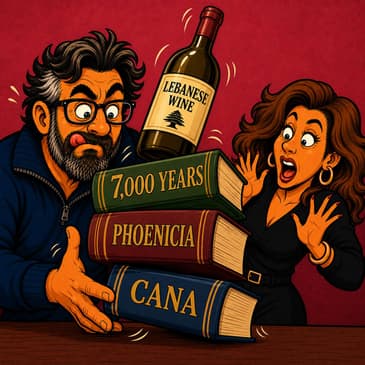
Not only do they make great wine in Lebanon, the country has one of the oldest winemaking traditions in the world! The ancient Phoenicians produced wine there thousands of years ago and helped spread it throughout the Mediterranean. In this episode, we dig into Lebanon’s remarkable wine history and explore how it continues today despite many challenges and repeated threats to its survival. It is a story of extraordinary grit and perseverance. We also taste and review two Lebanese wines, including one from the internationally renowned Château Musar. And, as a bonus, this week’s “Wine in the News” story is totally shocking, and definitely not for the queasy. Don’t say we didn’t warn you. Wines reviewed in this episode: 2021 Massaya Le Colombier Rouge and 2022 Château Musar Jeune Red
Send us a Text Message and we'll respond in our next episode!
Contact The Wine Pair Podcast - we’d love to hear from you!
Visit our website, leave a review, and reach out to us: https://thewinepairpodcast.com/
Follow and DM us on Instagram: https://www.instagram.com/thewinepairpodcast/
Send us an email: joe@thewinepairpodcast.com
Show Notes
Episode #221: Lebanon's Wine Gave Jesus His First Miracle. Does the Modern Stuff Hold Up? 00:00
________________________
KEY QUESTIONS
- What is Lebanese wine?
- What does Lebanese wine taste like?
- Is Lebanese wine similar to French wine?
- Should you chill Lebanese red wine?
- What food pairs with Lebanese wine?
- Is Lebanese wine worth buying?
- Where can you buy Lebanese wine?
________________________
Episode Overview and First Thoughts on Wine Lebanese Wine 00:29
Hello fellow Cellar Dwellers! And welcome to The Wine Pair Podcast. I’m Joe, your sommelier of reasonably priced wine, and this is my wife and my wine pairing partner in crime, Carmela. And we are The Wine Pair!
If you're new to our podcast, here's what we do: Every week we buy wines under $25 with our own money, taste them, and give you our brutally honest opinion on whether they're worth buying. Nobody pays us to review specific wines, we don't accept free bottles from wineries, and we're not afraid to call out a bad wine when we taste one. Decanter Magazine calls us fun, irreverent, chatty, and entertaining - so if that sounds like your vibe, welcome to our tribe of wine lovers.
Yes, once again, the name of the tribe this week comes from Listener Timmy, and so we are very thankful for that, and we are asking you again if you have a name for the tribe for us, send it along and we will ask you if you would like to be on the podcast if you haven’t been on yet.
Ok, Carmela, a little while ago, faithful listener Christene R, AKA Tips2Liveby on the Instagram asked us to consider doing Lebanese wines, and so today, here we are, doing an exploration of wines from Lebanon. Now, we love taking requests from you all out there - it is one of our favorite things to do, but every once in a while, people ask us to do wines from specific areas or specific wines, and it can be a little hard to cover those wines because they are either hard to find or too expensive for the podcast. And that was my expectation when Christine asked us to look into Lebanese wine.
What I am happy to tell you all, and you can probably tell because we are doing an episode on it, that not only were we able to find some, we found some in the price range that we aim for on our podcast. And this is a bit surprising because Lebanon is not a huge producer of wine, although its production is growing. According to information I found on the interwebs, they produce about 15 million bottles a year. For comparison, California produces 600 to 700 million bottles of wine a year, our own state of Washington produces about 200 million bottles per year, the country of Canada produces about 200 million bottles as well, and even though you may not know it, Hungary produces about 300 to 400 million bottles a year.
So, on the global wine producing scale, Lebanon is small, but some call them small but mighty. As I mentioned, wine production in Lebanon is growing. In fact, since 2011, they have more than doubled their annual production. Some of that is because there are more winemakers and wineries opening in the country. As recently as 1998, there were fewer than 10 wineries in Lebanon, but, as of 2025, there were about 60. And, with this growing industry, they are exporting more and more of their wine so people like us will be able to try them.
It probably won’t surprise you to know that they have been making wine in Lebanon for a long time, and we’ll talk more about the history of winemaking in the area in a little bit, but what is interesting is that much of the wine being produced there today is not from indigenous grapes, although many winemakers there are trying to change that. In fact, more than 90% of the grapes used in Lebanese wines today are European, and French in particular, and that is because French Jesuit missionaries in the mid-1800’s introduced those grapes to the region, and because the country spent some time under French rule in the early 1900’s. So, that makes sense.
The most common red varieties are Cabernet Sauvignon, which is the most widely planted, and also Cinsault, Syrah, Merlot, Carignan, Grenache, Mourvèdre, and Tempranillo. So a couple of Spanish grapes like Tempranillo thrown in there for good measure. White grape varieties include Sauvignon Blanc, Chardonnay, Viognier, Muscat, Sémillon, Ugni Blanc also known as Trebbiano, and Clairette. So, again mostly French, but with the Italian grape Trebbiano thrown in for good measure.
Interestingly enough, Cinsault is considered to be the “signature” grape of Lebanon because it has been growing there since 1857 and the grape does well in the sunny, high-altitude vineyards in the country.
There are, however, many indigenous grapes that many winemakers are trying to bring back to create wines that are more distinctly Lebanese, and these include red grapes like Mekassi, Soubbagh, Mourad, Maryameh, and Asmi Noir, and white grapes like Obaideh, Merwah, Zeini, and Hifawi.
Today, we are drinking two Lebanese wines that are blends, as would be expected, that focus on French grape varieties. So, this will be our first exposure to the wines of Lebanon, and in the future I would love to find wines made from the native grapes - however, my expectation is that those are going to be hard to find outside of Lebanon for a little while longer. We are also going to dig more into the wines and winemaking history of Lebanon in a couple of minutes, and we’ll let you know after we try these two wines what our ratings are and if you should run out and buy them . . .
But first . . . we have to do our shameless plug.
Thank you for listening to us and for supporting our show, and know that we buy all of the wine we taste and review every week so that we can give you real and honest reviews. If you like what you’re hearing, please subscribe to our podcast and leave us a five star rating and review so we can grow listeners.
We also love to hear from you and we always respond so you can follow us on Instagram at thewinepairpodcast, and on Bluesky. You can contact us on our website thewinepairpodcast.com, and you can sign up for our email newsletter there and you can also send us a note at joe@thewinepairpodcast.com and let us know about wines your want us to review or just shoot the breeze, we love chatting it up.
And, as we do every week, we’ll tell you someone we think you should recommend The Wine Pair Podcast to - because the best way for us to grow listeners is when you tell your family and friends about us - and this week, we want you to recommend us to anyone who loves classic French wines and wants to explore a new, exciting, and up-and-coming area of the winemaking world, especially if they are stuck in a California Cabernet Sauvignon rut.
Topic: WTF is Lebanese wine all about? 09:17
Carmela, let’s find out more about just what the eff the history of wine in Lebanon is, and what the story of their wine is today, shall we?!?
This probably won’t surprise anyone, but Lebanon is home to one of the world’s oldest winemaking traditions, with a history that spans 7,000 years, dating all the way back to the Phoenicians, which, if you did not know, is the Greek name for the Canaanites. Put that in your effing brain box and bring it out as a party gift. The Phoenicians are credited with transforming winemaking from a local craft into a global industry. Between 3000 and 350 BC, they exported Lebanese wine in clay amphorae to Egypt, Greece, Rome, and as far as Spain. So, at one time, you might argue that Lebanon was the leading wine producer in the world.
And you can find references to Lebanese wine in the Bible. In the Old Testament book of Hosea, there is a line that reads: “They shall revive as the corn, and grow as the vine: the scent thereof shall be as the wine of Lebanon.” Which, although it may not be clear, is an indication of the wine of Lebanon being highly regarded. And, remember that Jesus’ first miracle was turning water into wine? Well, that happened in Cana which just happens to be where the word Canaanite comes from. Are you starting to put it all together now?
After the Phoenicians, the Romans continued the tradition of winemaking in Lebanon, and the Bekaa Valley supplied wine to the Roman army. The Romans also built some amazing infrastructure to make wine, including a two-mile long network of underground tunnels for storing and aging wine. Believe it or not, some of the infrastructure they created is still used today. At a winery called Château Ksara, Roman caves were found and are still being used today.
Following the Arab conquest of the area in the 7th century, wine production was restricted but it was allowed for Christian communities to use in religious ceremonies. This trend continued in the Ottoman Empire in the 16th century, where Sharia law prohibited alcohol for Muslims but allowed Christians to maintain vineyards for religious purposes, and this religious exemption is said to have helped save indigenous Lebanese grape varieties and winemaking from extinction through centuries of prohibition.
Things changed quite a bit in the mid-1800s, which we referred to earlier, when the French missionaries brought French grapes and modern winemaking methods. In the early to mid-1900s, the French were appointed by the League of Nations to basically rule over Lebanon and Syria after World War I. These actions made French wine grapes the default grapes for Lebanese wines, and even today, people speak French and drink wine made from French grapes.
Between 1975 and 1990 there was a Civil War in Lebanon, and all industry, including winemaking really suffered. But resilient and brave winemakers kept things going, and even became symbols of Lebanese resilience. In fact, the legendary owner of Chateau Musar, which is a very highly regarded Lebanese wine, produced wine every year of the war except 1976, and in fact he was named *Decanter’s* first "Man of the Year" in 1984.
So, despite wars, conflict, and being overrun and ruled by other countries and empires, the Lebanese have persevered, and wine has been somewhat of a symbol of that. Even today, if you are following what is happening in the Middle East, the people of Lebanon and the winemakers there are forced to deal with war and conflict. And, on an editorial note, that is one of the reasons why learning about wine and tasting wines from different countries and regions can be so important. We need to support winemakers in these regions, and we learn a ton from studying their history and their cuisine. In many ways, wine is history in a glass. Corny, yes, but true.
For a bit more information on Lebanese wines, about 80%-90% of their wines are made in the Bekaa Valley which is about 3,000 feet above sea level, and are among the highest in the Northern Hemisphere, which is crucial because the altitude brings temperatures down at night after very hot days, which gives the grapes a chance to both ripen and maintain acidity.
Lebanese wines are often described as “not shy” - which I believe to mean they are going to be substantial, probably big bodied, and fruity. They may not be quite our cup of tea, but you will be able to tell from our tasting if they are wines that you will enjoy even if they are not quite our style. Critics also say that Lebanese wines punch above their weight in terms of quality, and Lebanese wines have won several awards. And, there are many boutique wineries popping up that are making good wines and getting good recognition.
So, should we learn a bit more about the wines we are drinking today?
Lebanese Wines We Chose for This Episode 16:44
Usually the wines we have in our episodes are under $25 each, however for this episode, since we are somewhat limited in choice, we have two wines that are just a touch over $25 each. Still close, but just being honest. Both of these wines should be relatively easy to find because I bought them both at wine.com. Now, Lebanese wines are not going to be super easy to find because they just don’t make a ton. There is, as I mentioned, a famous and well regarded winery called Chateau Musar that is a wine you are most likely to find in nice wine shops. And one of our wines today is a Chateau Musar- but not one of their top end wines, so keep your pants on! I would expect you to be able to find Lebanese wines in a good wine shop, in an area of the world with Lebanese immigrants, and, of course, you can always go to your local wine shop, which you should anyway, and ask them to help you find Lebanese wines and they will be more than happy to.
The first wine we are going to drink today is the 2021 Massaya Le Colombier Rouge. This wine comes from the Bekaa Valley, and is a blend of 35% Grenache Noir, 35% Cinsault, and 30% Tempranillo. James Suckling gave this wine a 93, so there’s that.
The tech sheet for the wines says that the grapes are grown in chalky clay soils at 900 to 1200 meters above sea level, or about 3,000 to 4,000 feet above sea level, so pretty high altitude. They say the grapes are hand-picked into crates and sorted on tables outside the vat room. They are fully destemmed, then undergo traditional fermentation for 20 to 30 days in stainless-steel vats. The winery also says to drink this wine young and slightly chilled, so that is interesting. We like a slightly chilled red.
The winery says it is practicing organic, which is nice. For a little bit about the winery, it was founded by two brothers, Sami and Ramzi Ghosn, in the early 1990’s, but was founded as a producer of the traditional distilled Lebanese spirit called Arak which is made from the indigenous grapes Obaideh and Merwah and includes anise, so it is probably a little like Ouzo or Sambuca. Legend has it that the brothers met a cork salesman who introduced them to a winemaker in France who was interested in making wine in Lebanon, and the rest is history. The name Massaya means “twilight” in Lebanese Arabic.
The next wine we are going to drink is the 2022 Chateau Musar Lebanon Jeune Red which also comes from the Bekaa Valley and is a more Cinsault heavy blend of 50% Cinsault, 35% Syrah, 15% Cabernet Sauvignon.
The winery says the grapes are grown organically, and that this is an unfiltered and unoaked wine. They say the wine is produced in a natural wine with what they call non-intervention, and the grapes were fermented in concrete vats at about 27-29 degrees Celsius or about 80-85 degrees Fahrenheit. They said they harvested in September, blended in February, and then bottled in the summer of 2023, so this wine does not sit long before being bottled.
The wine is also said to be vegan, and that is because it is not fined or filtered - remember it is in the fining process that an animal product like egg whites may be introduced to bind fine particles before filtering, so if drinking vegan wine is important to you this could be a wine to checkout. Both of these wines are also relatively high in alcohol with this Musar at 14% and the Massaya at 14.5% They also say that you can serve this wine slightly chilled, so I am expecting these wines to be juicy.
For just a bit more about Chateau Musar, it was founded in the 1930s, and today is run by the grandsons of the founder, and the sons of the legendary Lebanese winemaker Serge Hochar. The are well-known for making natural wines and actually like the fact that they can be inconsistent, they are known to release their flagship wines (not the wine we are drinking today, but their more expensive wines) after 7 years of aging, which is a long time, and they have a famous cellar called The Ghazir Cellars which are underground and house over a million bottles in a naturally humid environment. The Hochar family considers the mold and spiders that inhabit the cellar to be the "spirit" and protection of the wine. Cool, or creepy! You make the call, but I kind of like their style!
But, I think that is enough information - it’s time to get to drinking, but before that we have a quick note for you to tell you about something we think is a great event, and that you can get discounted tickets to!
LINKS TO SOURCES FOR THESE SPECIFIC WINES
- https://www.skurnik.com/sku/le-colombier-bekaa-valley-massaya-2/
- https://chateaumusar.com/wp-content/uploads/2017/07/Musar-Jeune-Red-2022-Tasting-Notes.pdf
2021 Massaya Le Colombier Rouge, 2022 Chateau Musar Lebanon Jeune Red Wine Tasting, Pairing, and Review 24:42
Wine: Massaya Le Colombier Rouge (Click here to find this wine on wine.com. We may be compensated if you purchase)
Region: Lebanon, Bekaa Valley
Year: 2021
Price: $25.97
Retailer: wine.com
Alcohol: 14.5%
Grapes: 35% Grenache Noir, 35% Cinsault, 30% Tempranillo
Professional Rating: JS 93 Vivino 3.8
What we tasted and smelled in this Massaya Le Colombier Rouge:
- Color: Dark red with some translucence in the glass
- On the nose: Very nice, fruity smell, cranberry, pomegranate, raspberry, some heat from alcohol, cherry cordial with liqueur in it. Spicy. Clove. Cinnamon, cayenne, Big Red gum, cinnamon bear
- In the mouth: Spicy, baking spices, dried cherry, inside of a Fig Newton, raisin, juicy, strong, a bit like a cocktail, concentrated cherry juice, a little bit punch-you-in-the-face
Food to pair with this Massaya Le Colombier Rouge: Braciole, cured meats and cheeses, smoked sausages, barbecue, spicy-sweet foods, tri-tip sandwich
As a reminder on our rating scale, we rate on a scale of 1-10, with no half points, where 7 and above means that we would buy it, and 4 and below means that we are likely to pour it down the sink, and a 5 or 6 means we are likely to drink it and finish it, but we are probably not going to buy it.
Massaya Le Colombier Rouge Wine Rating:
- Joe: 6/10
- Carmela: 6/10
Wine: Chateau Musar Lebanon Jeune Red (Click here to find this wine on wine.com. We may be compensated if you purchase)
Region: Lebanon, Bekaa Valley
Year: 2022
Price: $25.97
Retailer: wine.com
Alcohol: 14%
Grapes: 50% Cinsault, 35% Syrah, 15% Cabernet Sauvignon
Professional Rating: Vivino 3.8
What we tasted and smelled in this Chateau Musar Lebanon Jeune Red:
- Color: Dark red, inky, nearly purple
- On the nose: Sour cherry, vegetable, plum, spicy cherry, underripe blackberry
- In the mouth: Tart cherry, does not come across as having alcohol, cranberry juice, grape juice, lots of tannin, Bing cherry juice
Food to pair with this Chateau Musar Lebanon Jeune Red: Cheeseburger, grilled cheese sandwich, Cuban sandwich, Philly Cheesesteak sandwich
Chateau Musar Lebanon Jeune Red Wine Rating: Could be a corked wine
- Joe: 5/10
- Carmela: 5/10
Which one of these are you finishing tonight?
- Carmela: Massaya Le Colombier Rouge
- Joe: Massaya Le Colombier Rouge
The Test: Did we nail the taste profiles expected from Lebanese Red Wine blends? 38:27
- General
- Really depends on the blend
- Generally described as having ripe black fruits like blackcurrant, dark cherry, blackberry, and plum on the nose. Licorice, black pepper, cumin, baking spices, herbs, rosewater, balsamic strawberry. Tend to have good acidity and well-structured tannins
- The oaked and aged wines may have aromas and flavors for leather, tobacco, cedar, warm earth, and incense
- Massaya Le Colombier Rouge
- Winery: A fresh, thirst-quenching wine for everyday drinking, distinguished by hints of spice and pepper.
- JS: A remarkably elegant and light-footed red for Lebanon, with refined red fruit and spicy aromas. The underplayed power and fine tannins deftly underline all this on the medium- to full-bodied palate. Polished and precise finish.
- Chateau Musar Lebanon Jeune Red
- Winery: A traditional Musar Jeune nose with dark cherries and berries, it is all at once juicy and fresh with pomegranate, cranberries and herbal scents of violet and thyme. Dense and energetic on the palate with smooth tannins and lively acidity.
- Dunn & Sons: It delivers medium-bodied structure with juicy dark cherries, blueberries, and pomegranate, supported by gentle acidity and soft, palpable tannins. A hint of Lebanese spice and red licorice lingers on a lively finish.
What is your verdict on Lebanese Red Wine? 40:16
We should explore it more. Not sure we had the best bottles in terms of the cork being bad on the second wine. We need to support Lebanese winemakers!
And now it is time to head over to our news desk so that we can cover our wine in the news this week segment. And this week will be one of our more bizarre stories, and, full disclosure, not for the squeamish.
Wine in the news this week: “Woman Charged With Smuggling After Shoving Wine Bottle in Her ‘Body Cavity’” 41:06
- https://upnorthlive.com/news/local/woman-accused-of-stealing-bottle-of-wine-by-hiding-in-body-cavity
- https://www.vice.com/en/article/woman-charged-with-smuggling-after-shoving-wine-bottle-in-her-body-cavity/
- https://theshaderoom.com/traverse-city-michigan-woman-allegedly-stealing-wine-hiding-bottle-in-cavity/
- https://wrkr.com/chardonnay-theft-traverse-city/
This week our wine in the news comes to us from Ashley Fike writing for Vice. And the article title is quite disturbing, but we have a job to do here, people, and that is to give you all of the wine news we can, good bad, or ugly. The title of this article is "Woman Charged With Smuggling After Shoving Wine Bottle in Her Body Cavity."
You might already be saying “do we need to go on” but we do. Here is the overview. A woman walked into a liquor store in Traverse City, Michigan, got caught drinking alcohol right there in the store at nine in the morning, was taken to the hospital, and then, the very next day, came back to the same store, stole a bottle of Chardonnay, and hid it on her person in a way that only became clear when she got to the jail.
“On her person” is the operative term.
We don't know her name — she is described only as a 48-year-old Traverse City woman. What we do know is that at nine in the morning, she walked into a liquor store on West Front Street, grabbed a bottle of alcohol off the shelf, and just drank it right there. 9 AM in the morning is a little early, even for us. She was caught, and taken to Munson Medical Center for treatment.
Undeterred, the next day, she was back at the same store, and this time she took a bottle of Chardonnay. Employees stopped her on the way out and searched her, including her bag and her coat and found nothing. So they let her go. But police arrested her shortly after, and at the jail, during a search, the bottle was found. Inside her. For the love of Pete, this makes me more than a little freaked out. That is determination, I guess.
She is now charged with two counts of retail fraud, one count of trespassing, and one count of smuggling. Smuggling is sort of interesting. Not smuggling across a border. Not smuggling contraband to a prisoner. She walked into a jail with a bottle of Chardonnay hidden inside her body. Michigan law prohibits bringing contraband into a correctional facility, and apparently, Chardonnay is one of the things on that list.
This happened a couple of weeks ago, and I have no updated information to share, but if we find out more, we’ll let you know.
Carmela, I am not sure what to ask you about this, other than, how is this even possible?
Listener Shoutouts 44:01
We have some fun listener shoutouts for this week, and we are recording this on a bit of a strange day and out of sequence, so we have some shoutouts in this episode, and then we will catch up on people we missed. It’s a long story that I am probably making too complicated. We are just recording this episode a little early because we are doing some traveling and have guests in town.
- Jason T: Wrote us the nicest note to let us know that he is switching from being a CPA to a sommelier, that our podcast helps him study - which we love to hear, that he would like us to look into white Chateauneuf du Pape which we are going to definitely look into but it is expensive so we’ll see, and he let us know he loves Bread & Butter Chard and knew we were going to hate it before we tasted it!
- Adam, who has been waiting for us to do this episode
- Joane mailing list
- Shekar The Nalla met for coffee awesome
Wines coming up in future episodes in case you want to drink along with us 45:40
- Italian Sangiovese, but not Chianti
- 2022 Cantina Roccafiore Melograno
- 2021 Di Majo Norante Sangiovese
- Alsace Pinot Gris
- 2020 Pierre Sparr Pinot Gris
- 2020 Frey-Sohler Vielles Vignes Pinot Gris
- Kirkland Bordeaux
- 2023 Pauillac
- 2023 Saint-Julien
- Kirkland Châteauneuf-du-Pape
- 2024 Châteauneuf-du-Pape
- Kirkland Moscato d’Asti
- 2025 Moscato d’Asti
Outro and how to find The Wine Pair Podcast 46:08
Thank you for listening to us and for supporting our show, and remember, we buy all of our own wine and we do all of the writing and recording and editing to bring you a show every week because we absolutely love doing it, and our small little ask for you is that you please follow or subscribe to our podcast and also please leave us a nice rating and review to help us grow our listeners - and a huge thank you to all of you who have done so already!
You can also follow us on Instagram at thewinepairpodcast, and on Bluesky. You can contact us on our website thewinepairpodcast.com, and you can sign up for our email newsletter there and you can also visit our “Shop Wine” section where you can find links to buy the wines that we rate as buys in each episode. I will also note that on our website, if you are curious about a wine we have covered in the past, we do have a pretty good search functionality, so you can use that find wines you want to know more about.
And we want to make content you care about and you like, so send us a note or DM us and give us some feedback or let us know if there are wines you want us to try or wine making areas of the world you are curious about - and we’ll take care of it! joe@thewinepairpodcast.com
Alright, with that, we are going to sign off, so thanks again, and we will see you next time. And, as we say, life is short, so stop drinking shitty wine.
________________________
FREQUENTLY ASKED QUESTIONS
Q. What is Lebanese wine?
A. Lebanese wine is red, white, and rosé wine made primarily in the Bekaa Valley, a high-altitude plateau in eastern Lebanon. The country has over 7,000 years of winemaking history. The Phoenicians helped spread viticulture across the ancient Mediterranean, and Lebanon still produces wine today despite decades of regional conflict.
Q. What does Lebanese wine taste like?
A. It depends on the blend, but the reds we tried leaned spicy and fruit-forward. The Massaya Le Colombier showed cranberry, pomegranate, dried cherry, and baking spices like clove, cinnamon, and cayenne. The Chateau Musar Jeune was darker and more tannic, with tart cherry, cranberry juice, and underripe blackberry. Both are dry reds with real personality.
Q. Is Lebanese wine similar to French wine?
A. In some ways, yes. Lebanese producers have deep French influence. Chateau Musar was founded by a winemaker trained in Bordeaux, and many Bekaa Valley blends use French grapes like Cinsault and Syrah alongside Spanish Tempranillo. But Lebanese reds tend to be spicier and more fruit-concentrated than their French counterparts.
Q. Should you chill Lebanese red wine?
A. It depends on the wine, of course. The winemakers for the wines we drank in this episode recommended a slight chill. A short chill of 15 to 20 minutes in the fridge can help on a warm day, but these are full reds meant to be served at cool room temperature. The Massaya we tried was 14.5% ABV and carried a lot of spice and concentration. Serve it too cold and you'll mute the best parts.
Q. What food pairs with Lebanese wine?
A. Lebanese reds are built for food. The Massaya Le Colombier would work well with braciole, cured meats and cheeses, smoked sausages, barbecue, and spicy-sweet dishes like a tri-tip sandwich. The Chateau Musar Jeune would land better with sandwiches: cheeseburger, grilled cheese, Cuban sandwich, or a Philly Cheesesteak.
Q. Is Lebanese wine worth buying?
A. Both bottles came in at $25.97 from wine.com, and we'd call that fair value. We both rated the Massaya Le Colombier 6 out of 10 and chose it as the wine to finish. The Chateau Musar Jeune scored a 5 from both of us, though we suspect the bottle may have been corked. Worth exploring the category.
Q. Where can you buy Lebanese wine?
A. Wine.com is a reliable starting point. Both wines we reviewed in this episode were available there for $25.97 each. Lebanese wine is still a niche in most local wine shops, so online is often your best bet for selection and availability.
________________________
RESEARCH ARTICLES AND LINKS FOR THIS EPISODE
- https://en.wikipedia.org/wiki/Lebanese_wine
- https://www.wine-searcher.com/regions-bekaa+valley
- https://www.wineenthusiast.com/culture/wine/lebanon-musar-history/
- https://apollo-magazine.com/lebanon-wine-phoenicia-bekaa-valley/
- https://www.wine-searcher.com/regions-lebanon
- https://en.wikipedia.org/wiki/Massaya
- https://vinepair.com/articles/massaya-wines-arak-lebanon/
- https://www.skurnik.com/producer/massaya-2/
- https://www.skurnik.com/massaya-winery-a-testament-to-lebanons-rich-winemaking-heritage/
- https://www.thewinesociety.com/product/massaya-le-colombier-2021/
- https://www.wine-searcher.com/find/massaya+cls+le+colombier+rouge+bekaa+valley+lebanon
- https://www.wineanorak.com/massaya.htm
- https://en.wikipedia.org/wiki/Chateau_Musar
- https://cluboenologique.com/story/serge-hochar-legacy-lebanese-wine/
- https://www.decanter.com/features/the-magic-of-musar-248198/
- https://cluboenologique.com/story/chateau-musar-in-the-war-years-a-vintage-report-with-a-difference/
- https://quillandpad.com/2022/10/28/chateau-musar-sensational-iconic-wines-from-lebanon/
- https://www.wine-searcher.com/find/musar+jeune+red+bekaa+valley+lebanon
- https://www.decanter.com/features/lebanons-wine-make-wine-not-war-247675/
- https://www.wine-searcher.com/m/2024/10/lebanon-winemakers-pray-for-peace
- https://www.decanter.com/wine-news/torrid-times-for-winemakers-in-the-middle-east-540466/
- https://daily.sevenfifty.com/exploring-the-world-of-lebanese-wine-beyond-chateau-musar/
- https://www.youtube.com/watch?v=uaDEkUdAW1U
- https://www.internationalwinechallenge.com/Canopy-Articles/the-big-lesson-from-lebanon.html
- https://www.wine4food.com/wine/lebanon-wine/
- https://www.eater.com/22369382/lebanese-wine-history-drinking
- https://www.altcellars.com/en/blogs/infos/lebanese-wine-tradition
- https://www.youtube.com/watch?v=qXOP8qkS8U8
________________________
Support The Wine Pair Podcast by heading to our website and shopping for the wines we give our highest ratings to in our Shop Wines section. Just click on this link - you pay the same price, and we may get a small amount of compensation.
You can also support us by clicking on this affiliate link to wine.com and find great wines under $20!
And, if you are looking for a great website builder for your podcast, click on this link to use the service we use and love: Beamly, formerly known as Podcastpage.io
________________________
FULL TRANSCRIPT
Joe: 00:00
Carmela, they've been making wine in Lebanon for a long, long time. True. But we don't hear about Lebanese wines very often, do we?
Carmela: 00:06
Not really.
Joe: 00:07
Well, we're here to tell you Lebanese wines are something you got to know about. Right. We may not have had the perfect tasting this week. We will admit that. But we think Lebanese wines are worth your time. Absolutely. So listen and check it out. Hello, fellow cellar dwellers, and welcome to the Wine Pear Podcast. I'm Joe, your simolier of reasonably priced wine, and this is my wife and my wine pairing partner in crime, Carmilla.
Carmela: 00:40
Hi there.
Joe: 00:41
And we are the wine pair.
Carmela: 00:42
Was that Timmy?
Joe: 00:43
It was.
Carmela: 00:44
I like that one. You like that one? Yeah, I like them all, but that's that was a good one.
Joe: 00:49
Good, I like it. So now, before we get to that, if you're new to our podcast, here's what we do. Every week we buy wines under $25 with our own money. We taste them and give you our brutally honest opinion on whether they're worth buying. And nobody pays us to review specific wines. We don't accept free bottles from wineries, and we're not afraid to call out a bad wine when we taste one. And Decanter magazine calls us fun, irreverent, chatty, and entertaining. So if that sounds like your vibe, welcome to our tribe of wine lovers, cellar dwellers.
Carmela: 01:18
Hmm, pretty fun.
Joe: 01:20
Yeah, you like that.
Carmela: 01:21
You're kind of a cellar dweller.
Joe: 01:22
I I don't know.
Carmela: 01:24
I mean, not as much as my dad. My dad was a total cellar dweller.
Joe: 01:28
Yeah. He wa I mean, like, he would hang out in the cellar.
Carmela: 01:30
Well, he had a little kerosene lamp and he'd go down there. And then he had a big barrel that he'd smoke a cigarette. Yeah. And sip on a little glass of wine and take some notes on it. He was a cellar dweller. Oh, we would be like, Dad, Dad, where are you?
Joe: 01:44
Yeah. And um there he was hanging out in the cellar. See, could be worse. Love it. Okay. And then again, yes, the name of the tribe came from listener Timmy. So we're really thankful for that. And again, if you have an idea for a tribe name and you want to send it over, let us know, and maybe you we'll ask you if you want to be a guest on the podcast. Okay, Carmela. A little while ago, faithful listener Christine R, aka Tips to Live by, one of our most loyal fans on the Instagram. She's on the Instagram. She asked us to consider doing Lebanese wines. And so here we are doing an exploration of wines from Lebanon. And we love to take requests from all of you out there and listening, Lynn. It's really one of our favorite things to do. But every once in a while, people ask us to do wines from specific areas or specific wines. And it can be a little bit hard to cover those wines because they're either hard to find or too expensive for the podcast. And that was my expectation when Christine asked us to look into Lebanese wine. I didn't think we'd be able to find it.
Carmela: 02:42
Oh, really? How'd you do?
Joe: 02:44
Well, what I'm happy to tell you all, and you can probably tell because we're doing an episode on it, that not only were we able to find some Lebanese wine, we found some in the price range that we aimed for on the podcast. Nice. And was it challenging? Well, uh I'll get into that a little bit, but it was a little bit surprising because Lebanon is not a huge producer of wine, although it is growing in terms of how much production it has. According to information I found on the interwebs Carmela, they produce about 15 million bottles a year in Lebanon, which sounds like a lot. But for comparison, California produces 600 to 700 million bottles of wine a year. Our own state of Washington produces about 200 million bottles a year, and the country of Canada produces about 200 million bottles a year as well. Okay. In fact, even Hungary does 300 to 400 million bottles a year. Whoa. So on the global wine producing scale, Lebanon is small, but some call them small but mighty. Kind of like our daughter. Small but mighty. As I mentioned, wine production in Lebanon is growing. In fact, since 2011, they've more than doubled their annual production. Oh my goodness. Good for them. Yeah. They're taking over the wine world. They are. I mean, one bottle at a time. That's right. And some of that is because there are more winemakers and wineries opening up in the country. And as recently as 1998, there were fewer than 10 wineries in Lebanon. But as of 2025, there's about 60. So they really are growing. And with this growing industry, they are exporting more and more of their wine so people like us will be able to try them. And it probably won't surprise you to know that they have been making wine in Lebanon for a long, long time. And we'll talk more about the history of winemaking in the area in a little bit. But what is interesting is that much of the wine being produced there today is not from indigenous grapes. Although many winemakers are trying to change that fact. More than 90% of the grapes used in Lebanese wines today are European and French in particular. And that's because French Jesuit missionaries in the mid-1800s introduced French grapes to the region, and because the country spent some time under French rule in the early 1900s. So that makes sense. Does make sense. Yeah. Now the most common red varieties are Cabernet Sauvignon, which is not a big surprise. It's the most widely planted grape in Lebanon and basically kind of in the world. But they also do Sanso, Syrah, Merlot, Carignan, Grenache, Mouvedre, and Tempranillo.
Carmela: 05:22
Oh wow.
Joe: 05:22
So they got a couple, they got mostly French, but they threw in a Spanish grape like Tempranillo in there for good measure. And it's mostly, you know, French whites, but they threw in a uni blanc, also known as Trebbiano, in there. So they have Sauvignon Blanc and Chardonnay and Viognier and Mouscat and all those kinds of fun things. Okay. Now, interestingly enough, Sanso is considered to be the signature grape of Lebanon because it's been growing there since 1857. That's longer than you and I have been married.
Carmela: 05:50
We need to do a little bath.
Joe: 05:52
And the grape does really well in sunny high-altitude vineyards in the country, which is good because that's you know what you want. Right. Now, there are many indigenous grapes that many winemakers are trying to bring back to create wines that are more distinctly Lebanese. And I'm going to butcher this, but they are known by names red grapes like makasi, sobog, murad, mariama, and asminor. And white grapes like Obade, Merwa, Zieni, and Hifowi.
Carmela: 06:22
Oh boy.
Joe: 06:22
Okay, well, you repeat those now.
Carmela: 06:24
Yeah, I was gonna say there's not going to be a test.
Joe: 06:26
There is a test. You have to at least one of them.
Carmela: 06:28
Wow. I didn't know. I don't know. Okay.
Joe: 06:31
It's okay. We'll keep moving. I mean I shouldn't put you on the spot like that. Right. I'm lucky enough that you showed up today, honestly.
Carmela: 06:37
You were gonna ask me, or I would have paid closer attention and like chosen one, like like really hung on to one so that I could repeat it back. But no.
Joe: 06:44
You should have told her before because that's the only way to do it on the list.
Carmela: 06:49
I just was like trying to hear the next one, so I forgot about the one before it.
Joe: 06:53
No, it's totally fine, Carmela. That's my job. It's not your job, it's my job. Let me do my job. I try today, Carmela. We are drinking two Lebanese wines that are blends, and that probably would be an expectation. And they focus on French grape varieties, so this will be our first exposure to the wines of Lebanon. Cool. Yeah, and in the future, I would love to find wines from the native grapes. Um, because we're not doing the native grapes. And you didn't find those. I didn't. I couldn't find them. Okay. But my expectation is that those are probably gonna be pretty hard to find outside of Lebanon, at least for a little while longer. And then we're also gonna dig more into the wines and the winemaking history of Lebanon in a couple of minutes, and we'll let you know after we try these two wines what our ratings are and if you should run out and buy them. But first, you gotta do our shameless plug. That's right. Thank you for listening to us and supporting our show. And know that we buy all of the wine we taste and review every week so that we can give you real and honest reviews. And if you like what you're hearing, please subscribe to our podcast and leave us a five-star rating and review so we can grow listeners. And we also we do love to hear from you. We always respond, so you can follow us on Instagram and Blue Sky at the Wine Pair Podcast and maybe TikTok as well. You can contact us on our website, thewinepairpodcast.com. You can sign up for our email newsletter there, and you probably just missed it. So you can always email me at Joe at the winepairpodcast.com, and I will personally hand deliver that newsletter into your email inbox by hand.
Carmela: 08:21
Wow. I mean you just click that button.
Joe: 08:23
That's right.
Carmela: 08:24
Submit.
Joe: 08:24
Yeah, and anytime you can reach out to us at Joe at the Winepair Podcast.com and just, you know, shoot the breeze. Whoa. And as we do every week, we'll tell you someone we think you should recommend the winepair podcast to because that's the best way for us to grow listeners when you tell your family and friends about us. And this week, we want you to recommend us to anyone who loves classic French wines and wants to explore a new, exciting, and up-and-coming area of the winemaking world, especially maybe if they're stuck in a California Cabernet Sauvignon rut. I like it. Yeah, because you don't want to be stuck in a rut.
Carmela: 08:54
I mean, do you think any Cabernet lover would like admit to being stuck in a rut?
Joe: 08:59
Maybe they wouldn't admit it, but you know what? Sometimes you just have to coax it out of them.
Carmela: 09:04
Wow, you know, suss it out. Suss it out.
Joe: 09:07
Like be show care, show empathy, and see if you can suss it out.
Carmela: 09:10
Sharing is caring. Sharing is caring. If it's information, education, even better.
Joe: 09:16
It's so true. Yeah. So true. All right, well, Carmela, let's find out more about just what the f the history of wine in Lebanon is.
Carmela: 09:23
Oh my goodness.
Joe: 09:24
And what the story of their fing wine is today, too, shall we?
Carmela: 09:28
No, we shouldn't. Well, no, I think we should. Okay, all right. It's just so aggressive.
Joe: 09:32
It is, it's a little much. It's a little much.
Carmela: 09:33
I'd say so.
Joe: 09:34
Now, this probably won't surprise anyone except maybe me, but Lebanon is home to one of the world's oldest wine-making traditions with a history that spans 7,000 years, dating all the way back to the Phoenicians, which, if you did not know, is the Greek name for the Canaanites.
Carmela: 09:51
Oh wow, Canaanites. I remembered that.
Joe: 09:54
So hang on to that one in your brain box, okay? Okay. Because it will be a good party gift in a minute. The Phoenicians are credited with transforming winemaking from a local craft into a global industry. And between 3000 and 350 BC, they exported Lebanese wine and clay amphora or clay jars to Egypt, to Greece, to Rome, and as far as Spain. Holy moly. I know. So at one time you might argue that Lebanon was the leading wine producer in the whole world. Wow. And you can find references to Lebanese wine in the Bible.
Carmela: 10:25
Oh.
Joe: 10:26
The Bible.
Carmela: 10:27
Did you read it?
Joe: 10:28
Did you pull it out? No, I I no. I I I found this in the interwebs. Oh but listen.
Carmela: 10:34
But did you go back and check?
Joe: 10:35
I I didn't. I probably should have.
Carmela: 10:38
Yeah.
Joe: 10:38
That's that's not good. You're be you're kind of like showing me up. Well, you that's not a great researcher.
Carmela: 10:43
No, no, no, you're a great research researcher, but you definitely will say you need to check AI stuff.
Joe: 10:51
I I don't, I didn't this is an AI. It's just it was didn't come from the Bible. I didn't read the Bible to get it. I got it from articles. You can get a l, you can get links to all the articles and stuff that we yeah, so that's not a lie. Now, in the Old Testament book of Hosea, there is a line that reads this they shall revive as the corn and grow as the vine. The scent thereof shall be as the wine of Lebanon. Oh my. Yeah, come on. Although it may not be clear, this is an indication of the wine of Lebanon being highly regarded. Right. And remember this Jesus' first miracle was turning water into wine, right? Right. Well, that happened at a wedding in Cana.
Carmela: 11:30
Oh my god.
Joe: 11:31
The Canaanites. Come on.
Carmela: 11:33
Oh my goodness, full circle.
Joe: 11:35
I mean, so now you know. Now you know.
Carmela: 11:37
Should we tell everybody that's learning this right now? Yes. The young'uns.
Joe: 11:42
Yes, we should. Get your kids in here to listen to a wine podcast. It's very, it's such good education. It's wholesome.
Speaker 4: 11:50
Wow.
Joe: 11:50
Yeah. Anyway, after the Phoenicians, the Romans continued the tradition of winemaking in Lebanon, and the Becca Valley supplied wine to the Roman army. And the Romans also built some amazing infrastructure to make wine, including a two-mile-long network of underground tunnels for storing and aging wine. So believe it or not, some of the infrastructure they created is still used today. Wow. Yes. In a winery called Chateau Sara, Roman caves were found and are still being used today.
Carmela: 12:21
Isn't that cool? That's amazing.
Joe: 12:23
Now, following the Arab conquest of the area in the 7th century, wine production was, as you may expect, restricted. But it was allowed for Christian communities to use in religious ceremonies. And this trend continued in the Ottoman Empire in the 16th century, where Sharia law prohibited alcohol for Muslims, but they allowed Christians to maintain vineyards again for religious purposes. And this religious exemption is said to have helped save indigenous Lebanese grape varietals and winemaking from extinction throughout centuries of prohibition. Now things changed quite a bit in the mid-1800s, which we referred to earlier, when the French missionaries brought French grapes and modern winemaking methods to Lebanon. In the early to mid-1900s, the French were appointed by the League of Nations, that's not a sports league, that is like for nations anyway, to basically rule over Lebanon and Syria after World War I. And these actions made French wine grapes the default grapes for Lebanese wines. And even today, people speak French and drink wine made from French grapes in Lebanon. Now, between 1975 and 1990, there was a civil war in Lebanon, and all industry, including winemaking, really suffered. But resilient and brave winemakers kept things going and even became symbols of Lebanese resilience. In fact, the legendary owner of Chateau Moussard, which is a very highly regarded Lebanese wine, produced wine every year of the war, except for 1976. And in fact, he was named Decantor's first man of the year in 1984. Wow. So these are, you know, the Lebanese. There's a lot of history around Lebanese winemaking. Amazing. And so despite wars and conflict and being overrun and ruled by other countries and other empires, the Lebanese have persevered, and wine has been somewhat a symbol of that, or at least a part of their culture and part of that. They know what's important. They do. And even today, if you're following what's happening in the Middle East, the people of Lebanon and the winemakers there are forced to deal with war and conflict, and yet they keep going.
Carmela: 14:31
Oh, I love that.
Joe: 14:32
Yeah, it's it's actually pretty remarkable. And on an editorial note, that is one of the reasons why learning about wine and tasting wines from different countries and regions like Lebanon can be so important. We can dismiss it. Oh, I don't know, I'm not gonna try those wines, but I think it's really important. First, we need to support winemakers in these regions because they're going through a lot, and we learn a ton from studying their history and their cuisine. Cuisine is such an important part of culture. And wine is a job, it's it's what people do. So I think it's a really important thing for us to remember. And so, in many ways, this is gonna sound corny, but wine is sort of history and culture in a glass. I love that. And I think that's an important thing to think about. Oh, absolutely. For a bit more information on Lebanese wines, about 80 to 90 percent of their wines are made in the Becca Valley, which is about 3,000 feet above sea level, and are among the highest in the northern hemisphere, which is crucial because it's warm there, and high altitude brings temperatures down at night after very hot days, which gives the grapes a chance to both ripen and maintain acidity. And then Lebanese wines, Carmela, are often described as not shy. What do you think that means? A wine that is not shy.
Carmela: 15:43
They must be kind of bold. Yeah.
Joe: 15:44
So I don't know actually if the wines that we're gonna be drinking today are not shy because because they're actually, they say you can chill them, so actually put them in the fridge. Okay. But in general, that I agree with you. I think uh that would mean they're bold, they're big, they're gonna punch you in the face. Yeah, they're not gonna hide. But we'll see if these wines are that. Those usually are not our cup of tea, but a chillable red we kind of like.
Carmela: 16:08
So we're not gonna pre-judge. No, we're gonna give a chill. Who told you to put them in the fridge?
Joe: 16:13
The the people.
Carmela: 16:13
Oh, the people, the wine people.
Joe: 16:15
Oh, they yeah, they no, but they do say, so these winemakers they do say you can serve chilled. Okay, they recommend serving chilled.
Carmela: 16:22
So this'll be good for us.
Joe: 16:24
Yeah, not ice cold. So I ice cold. I said I said that funny, kind of funny, but I put them in the fridge about 15 minutes, like right as we started recording. Ah, so it's that 2020 rule, you know, put it in about 20 minutes before you serve and it's it's perfect temperature. But anyway, Carmella, should we learn more about the wines we're drinking today?
Carmela: 16:43
Yes.
Joe: 16:44
Okay. Usually the wines we have in our episodes are under $25 each. However, for this episode, since we are somewhat limited in choice, we do have two wines that are just a touch over $25 each. Don't tell Carmela.
Carmela: 16:57
Still close.
Joe: 16:59
Yeah, still close, but I just want to be honest, they are a little bit over $25 each. Both of these wines should be relatively easy to find because I bought them both at wine.com, which is a great sign that they're selling these on wine.com. Right. In general, I don't think Lebanese wines are gonna be super easy to find because they just don't make a ton. But there is, as I mentioned, this really famous and well-regarded winery called Chateau Moussard. And that's probably the wine. If you look for a Lebanese wine, that's probably you're probably gonna find a wine from them if somebody carries a wine. One of our wines today is actually a Chateau Moussard, Carla. Oh, nice, but not one of their top-end wines. Sorry. That's okay. Yeah, but I would expect you to find Lebanese wines in a good wine shop in an area of the world with a lot of Lebanese immigrants, because they're probably gonna bring wine in.
Carmela: 17:45
Okay.
Joe: 17:46
And of course, you can always go to your local wine shop, which you should do anyway, and ask them to help you find Lebanese wines, and they'll be more than happy to help you. The first wine we're gonna drink today is the 2021 Masaya. It's spelled M-A-S-S-A-Y-A, Le Colembière Rouge. So you can already see the French influence there. This wine comes from the Becca Valley and is a blend of 35% Grenache Noir, 35% Sanso, and 30% Temperanillo. Okay. So it's a really interesting blend. And old Jimmy Sucky James Suckling gave it a 93. Buddy. I know it's a high score for old Jimmy James.
Speaker: 18:21
He must have liked this one. He went right off the window.
Joe: 18:24
They paid him extra for this one. Okay, just kidding. The text sheet for the wine says that the grapes are grown in chalky clay soils at 900 to 1200 meters above sea level. So that's about 3,000 to 4,000 feet. So it's pretty high up. So um they say the grapes are hand-picked in crates and sorted on tables outside the vat room. So they went to some hand-picked. Yeah, they went to some trouble to tell us how carefully they picked their grapes. They are fully distemmed, then they undergo traditional fermentation for 20 to 30 days in stainless steel vats. The winery also says to drink this wine young and slightly chilled, like I said. Love it. So that is interesting. We again we really like slightly chilled reds. The winery says it's practicing organic, so I hope it gets it right someday. Oh, no, it does. It is organic.
Carmela: 19:12
We're all just practicing.
Joe: 19:13
It's true. Even life. That's right. And for a little bit more about the winery, it was founded by two brothers, Sammy and Ramsay Gosen, in the early 1990s, but was founded as a producer of the traditional distilled Lebanese spirit called Erach, which is made from the indigenous grapes Obadei. Remember we talked about that? And Merois. And it also includes anise. So it's probably a little bit like an uzo or a sambuka. Maybe a little bit, you know?
Carmela: 19:39
Okay.
Joe: 19:40
And legend has it that the brother, this is a legend. The brothers met a cork salesman who's like, hey, and introduced them to a winemaker in France who was interested in making wine in Lebanon. And the rest, Carmela, is history. That's right.
Carmela: 19:56
Wait, that's so random.
Joe: 19:59
I thought it was interesting. They met a cork salesman.
Carmela: 20:01
And then they said, let's just do this. Let's make some wine. Oh, okay. I mean, that's kind of, yeah. It's kind of funny.
Joe: 20:06
I mean, they were they were already making, you know, some other stuff with wine with with grapes. So I'm like, might as well.
Carmela: 20:11
Now we got the cork. That's right. I mean, you know, if they hadn't thought about the screw cap, they could have done it like years before that.
Joe: 20:16
That's right. Shoot. We should have thought of that. And then one last thing, the name Masaya or Masaya means twilight in Lebanese Arabic. Okay. So there you go. The next wine we're going to drink is the 2022 Chateau Moussard Lebanon June Red, which also comes from the Becca Valley and is more Sanso heavy. It's 50% Sanso, 35% Syrah, and 15% Cabernet Sauignon. So a mix of some different grapes there. The winery also says that their grapes are grown organically, that this is a practicing. Practicing. They didn't say practicing.
Carmela: 20:47
They said they're just practicing. Right. They have nailed it. That's right.
Joe: 20:52
They got the plays down. They know they got the playbook. They're professionals. This is an unfiltered and unoaked wine. They say the wine is produced in a natural way with what they call non-intervention. And the grapes were fermented in concrete vats at 27 to 29 degrees Celsius or about 80 to 85 degrees Fahrenheit. Now, concrete vats is.
Carmela: 21:13
So neither of them are on oak.
Joe: 21:15
No, neither's on oak. Now the interesting about thing about concrete is that sometimes wineries will use concrete because it does it's like a barrel without oak flavor because it's porous. So it lets some oxygen in. So that's a kind of a traditional way of making wine. And so this might have a little, a little oxygen oxidation on it as well. Maybe we'll see. They say they harvested in September, they blended in February, and then they rested. No, then and then bottled in the summer of 2023. So this wine doesn't sit a long time before it's bottled. They kind of get it out there. The wine is also said to be vegan. So again, these are great choices if organic or vegan or those types of things. Remember, vegan usually is called that way because it's not fined or filtered. And in the Finding process, they sometimes use an animal product like egg whites to bind fine particles before filtering. And so when it's vegan, they don't use anything like egg whites. They use they don't fine it, they don't filter it. Fining is that attaching to the particles so they drop to the bottom. So if drinking vegan wine is important to you, this could be a wine to check out. Both of these wines are actually relatively high in alcohol. The Moussar is for no the Moussar is 14%, the Messiah 14.5%.
Carmela: 22:28
Yes.
Joe: 22:29
So there you go. Let's go.
Carmela: 22:31
They like to party there too, maybe.
Joe: 22:33
Wow! And then for just a bit more about Chateau Moussard, it was founded in the 1930s.
Carmela: 22:39
Holy cow.
Joe: 22:40
Yeah, and today is run by the grandsons of the founder. So that's really cool. Also, the sons of the legendary Lebanese winemaker Serge Hocher. I think I'm saying that right. They are well known for making natural wines and actually like the fact that these natural wines can be inconsistent. And they are known to release their flagship wines, which again, not the wines we're drinking today, but they're more expensive wines after seven years of aging. Oh boy.
Carmela: 23:04
Okay, so these are wines that should be aged.
Joe: 23:06
Yeah, these are not the one we're drinking today.
Carmela: 23:08
Right, the ones that they're top and flagship ones. That's right.
Joe: 23:11
And actually, one of our listeners, Adam, he showed a bottle, he sent a picture of a bottle of Chateau Moussard that has some age on it. So excited about that. And they have a famous cellar called the Gazir Cellars, which are underground and house over a million bottles in a naturally humid environment. And the Hortcher family considers the mold and the spiders that inhabit the cellar to be the spirit and protection of the wine.
Carmela: 23:39
Oh boy.
Joe: 23:40
That's kind of fun.
Carmela: 23:41
I mean, yeah.
Joe: 23:42
You probably wouldn't like that. I don't know. Cool or creepy, Carmella? Cool or creepy.
Carmela: 23:46
Well, I mean, I I'm not a huge, like, I'm not like super. You don't love a spider. No, I'm not. I want no, actually, what I was gonna say is I'm not super fearful of spiders. I'm not like, ah, a spider. But um I would just want to get that vacuum out right away.
Joe: 24:00
Yeah, you and I have different approaches when it comes to spiders.
Carmela: 24:03
Right. I mean, I'm happy to just squish a spider. Suck it up, yeah, whatever. I don't know. But what do I do? You like to carefully, you know, barely put them in a little bit.
Joe: 24:13
Let them outside.
Carmela: 24:13
I mean, I've been doing that more lately, but sometimes I'm like, those people, those buddies are fast.
Joe: 24:18
Yeah, but you know what? They're spiders are good. They're gross looking and they freak me out. But they're good.
Carmela: 24:23
We would be swimming in bugs without them.
Joe: 24:26
I don't want that. We know I know. Okay, Carmilla, I think it's enough information. I think it's time to get drinking. So if you have a Lebanese wine or a red wine or any wine you want to drink along with us and compare and share your tasting notes, then please do that, and we'll be right back. Okay, we are back and we are ready to try our first wine. This is the Macea or Masaya Le Colombier Rouge. It's from the Becca Valley in Lebanon. It's a 2021 vintage. It was $25.97 at wine.com. So just 97 cents more.5% alcohol, 35% Grenache Noir, 35% Sanso, 30% tempranio. Sucky James Suckling gave it a 93, Vivino gave it a 3.8. But let's talk about the color first.
Carmela: 25:15
It's very pretty.
Joe: 25:16
It's very pretty. It's a dark red.
Carmela: 25:18
It's pretty dark, yeah. I mean, it is it's bright though. I feel like it doesn't.
Joe: 25:22
I mean, it looks, yeah, it just mostly translucent, but it's darker than like a Pinot.
Carmela: 25:27
Yeah, I think so.
Joe: 25:28
Yeah, but it's pretty. It's a pretty dark red, I think.
Carmela: 25:31
Yeah, but it looks like fresh and bright, and you know, there's no like brown hue. You know, it doesn't look aged either. Not that this one was supposed to be aged, but just to say.
Joe: 25:39
Yeah, very pretty. Okay, well, let's smell it and see what we think. I think it's got a really nice smell.
Carmela: 25:46
I do too. Fruity. I mean, I'm almost like getting some like crunchy red fruit. Yeah. Kind like cranberry, yeah, pomegranate, raspberry, raspberry. Mm-hmm. I'm definitely getting fruit on the nose.
Joe: 26:01
It's got a little heat on it. I will say that, I mean, it's 14.5% alcohol. You can kind of get a little heat. To me, it's got like that cherry cordial, you know, like the chocolate cherry.
Carmela: 26:11
Almost, yeah, cherry cordial, but like a little bit of rum in it, you know. Yeah, yeah, yeah, yeah. A little bit of but it's also uh might maybe even a little spicy on it. I agree. You know, like I don't know if it's like a little hint of like cayenne.
Joe: 26:23
Cayenne. I was thinking maybe a little bit more like clove, but it it is. Oh, oh I'm coughing. Oh, I am with you on the cinnamon, or maybe it's more cinnamon-y, yeah. Something a little with a little bit of heat.
Carmela: 26:34
Okay, yeah, I didn't say cinnamon, you did. I said cayenne.
Joe: 26:37
I know, but I'm saying like I said clove, but maybe it is more cinnamon. Okay, like a big red gum.
Carmela: 26:42
Oh, oh, big red, or even like a cinnamon bear, right? You say that sometimes, and this that's but it's kind of giving me that vibe a little bit. Oh wow, really? Is it the alcohol, do you think?
Joe: 26:54
That's I think so. I don't know what it is. It lifts. You know, the wine nerds they say lifts, it comes out of the glass, like it goes right up your nostrils.
Carmela: 27:01
It does, right. I mean, and sometimes you cannot get that on a certain on certain wines.
Joe: 27:06
100%. All right, should we taste it and see what we think? Yes. All right.
Carmela: 27:12
Oh wow. It is definitely spicy. And maybe it isn't quite cayenne, maybe it's like baking spices.
Joe: 27:19
Yeah. It's not as it's it's pretty dry. Like it's really drying. I kind of feel like the first flavor is almost like dried fruit. Okay, yeah. Like a dried cherry or something. Like maybe that's where that spiciness, you know, fig, almost like a the inside of a fig new.
Carmela: 27:37
Yes, I can get behind that. It does have a little bit of fig on it. I mean, it's raisin-y almost. Yeah. Raisin or currant or yeah, it's yeah, no, it's juicy though, too.
Joe: 27:48
It is juicy, but I I keep getting this like raisin-y dried fruit kind of taste. It's pretty strong. Like I feel like it's got some alcohol kick in it.
Carmela: 27:58
Yeah, you know, it's a little bit like a cocktail. A little bit, a little bit like a spirit. Yeah. You know, because you can. Yeah. I mean, there's just uh there is like a little bit of that hoture, alcohol, liqueury taste to it.
Joe: 28:14
Yeah, it's not as smooth as I from the smell, it's so beautiful. It's not as smooth, but you know, we were I was getting that, I was coughing because I think there was a lot of heat on it. So to me, it's it's a pretty hot wine.
Carmela: 28:24
Yeah.
Joe: 28:25
Um, what other what other fruits might you get?
Carmela: 28:28
Well, I mean, I think the fake Newton is a really good call. Something and raisin, something kind of um rich like that. You know, it's almost like it's been it's concentrated.
Joe: 28:40
Concentrated, you know, like a concentrated juice, like a concentrated cherry juice or something.
Carmela: 28:45
Right. Like you're I mean, something that you're gonna get, yeah, that you're gonna add normally like water to or something.
Joe: 28:51
Um, and I yeah, I think it's strong. Like, so if you like a strong red wine, I think you'll like this. Like it's got kick on it. Yeah, little bit punch you in the face.
Carmela: 29:00
Little bit, a little bit, but not quite. I mean, you're not getting that oak on it though. No, so a little more refreshing, maybe.
Joe: 29:07
I don't know about refreshing. It's just it doesn't have the oak on it, but it does have that powerful, like it's got a kind of a bigger mouthfeel, but it's also got like a just a punch of the alcohol.
Carmela: 29:17
Yeah, I think the alcohol is what's doing that.
Joe: 29:19
Yeah, it's high. Okay, what food would you pair with this Masaya Le Colombier Rouge?
Carmela: 29:24
Well, I feel like you're gonna you could do a lot. Like, I could see doing a lot, like you could do a real garlicky, like rolled flank steak, you know, like at what we call a brajole.
Joe: 29:35
Brajol. Yeah. Brachol.
Carmela: 29:36
You know, you could do that. Or you could have like, I feel like cured meats would be really good with it.
Joe: 29:41
I think it's spot on. Like a like a charcuterie board with some cured meats, really good. Sausages, something smoky would be really good.
Carmela: 29:50
That would be nice. Yes, smoked sausages. Yeah, barbecue.
Joe: 29:54
I think it's be really good with barbecue. No, spicy, sweet kind of stuff would be really good.
Carmela: 30:00
Oh, like a general source chicken.
Joe: 30:02
Yeah, I think it'd be really nice.
Carmela: 30:04
That would be really good with something like because that does have kind of a you know, a saucy, a thick sauce on it.
Joe: 30:10
Yeah, that would be good. Like I'm thinking um a tri-tip tri-tip sandwich would be real good.
Carmela: 30:16
That would be good.
Joe: 30:16
Yeah, I think so. I think this needs a little bit of meat and a little bit of weight on it to really kind of combat this kind of bigger wine. Well, let's rate it. As a reminder on a rating scale, we rate on a scale of one to ten. We don't give half points. Seven and above means we would buy it. Four and below means we're likely to pour it down the sink. Five or six means we'll drink it, we'll finish it. Thank you for serving it to us, but we're not gonna buy it. So, Carmela, what are you gonna give this wine?
Carmela: 30:41
You know, I'm probably gonna give it's hard because it's like if it's a Lebanese wine I'm looking for, and somebody's like, Can you please pick up a Lebanese wine? I'd have no problem picking this up. I haven't had many Lebanese wines.
Joe: 30:51
I don't think we've ever had any.
Carmela: 30:52
So I but I'm not typically gonna buy this. I'm so I'm gonna give it a six.
Joe: 30:57
Yeah, I'm with you. I want to give it a seven. I really want to give it a seven, but I don't think I would buy it. Now, for those of you out there in listening land, this is not an indication that it's not a good wine. And I would say again, if you like a bigger, red, bolder wine, I think you kind of like this.
Carmela: 31:14
Yes, I agree. I agree.
Joe: 31:16
This isn't for the faint of heart. This isn't some like light, you know, like no beautiful, elegant summer sipper. Yeah, no, this is a this is like a serious, you're gonna get punched in the face wine. Right. Like you know, it's serious when you get punched in the face. Wow, it's no joke. When I get punched in the face, I'm like, hey, you're serious, aren't you?
Carmela: 31:34
Well, last time I was punched in the face, it's not a good thing.
Joe: 31:35
When you punch me in the face, you're always it's always because of something important.
Carmela: 31:39
Right. Wow.
Joe: 31:40
It's usually not because oh, you know, the last thing I forgot to mention, speaking of getting punched in the face by Carmella, it's a screw cap.
Speaker: 31:47
Woohoo! Oh my goodness. That's that's just like a pat on the cheek. It's like a little like a love pat.
Joe: 31:55
It is okay. We're gonna take a break again. Like, I feel almost apologetic for giving this wine a six. I agree, but it's just not our style.
Carmela: 32:02
No, it's not.
Joe: 32:03
So, this is a perfect example of a wine that like I think a lot of people would like. It's just not our cup of tea. True. But that's okay. All right, we're gonna take a break and we're gonna try our next wine. Okay, we're back and we're ready to try our second wine, and I just have to be a little bit like this. Is live, people. Well, it's not live, we recorded it, but we we don't do this ahead of time. This is real, like what we're doing right now is real. I went to open the cork on this bottle and it kind of disintegrated, like it just came apart. Like Carmela's like, that cork is not coming out anymore. And so that can be a sign that the wine is not doing well. It smells a little off, but we're gonna give it a shot. It may be corked. We're just gonna give it a shot for right now. But this is the Chateau Moussard Lebanon June Red. It's from the Becca Valley of Lebanon. It's the 2022 vintage, also $25.97. So just over the line. I got it at wine.com, 14% alcohol, 50% Sanso, 35% Syrah, and 15% Cabernet Sevillaon. I couldn't find any professional ratings, but Vivino gave it a 3.8 on Carmela. What is the color? It's dark, it's dark, it's even darker than the last one.
Carmela: 33:12
Pretty darn dark.
Joe: 33:13
It's a different mix, you know, it's a different blend. It's almost not translucent, I would say.
Carmela: 33:18
Right. It's a little purple-y too. I mean, or oh I mean, it's getting close to being a bit inky.
Joe: 33:23
Yeah, it's it shimmers, it shimmers like in the base, but it's it's dark.
Carmela: 33:28
Yeah.
Joe: 33:28
Okay, let's smell it and see what we think. Yeah, it's maybe it's not so bad.
Carmela: 33:32
No, I know. See, there's a little bit like it at first, I was getting a bit of like a sour edge to it, but I think it means it could be just kind of like a tart cherry.
Joe: 33:41
Yeah.
Carmela: 33:42
What do you think?
Joe: 33:43
Yeah, on the swirl, I'm getting a little bit of vegetable and maybe tartness. I'm just we're gonna give it our best shot here. I'm just not it's not a ton of fruit, but I am getting some cherry. Maybe more plum, actually. Maybe a little more plum.
Carmela: 33:58
Let's see. I uh, you know, yeah, it's a little bit hard to I'm not getting the same, you know, like spices, the warmness uh from this bottle, but uh yeah, I'm getting I am getting a little cherry. I am definitely getting cherry.
Joe: 34:11
Yeah, dark cherry though. Yeah, don't you think it's a dark cherry?
Carmela: 34:13
No, I'm kind of getting a little bit of a tart cherry.
Joe: 34:16
I'm getting like a little spicy cherry. I will say if it was corked, we would expect to get like grandpa's basement, but I'm not really you said this, not really getting like dog or like that's why I'm getting getting a little bit of like a sour twinge, which could still be a sign, but it may also just be the wine.
Carmela: 34:34
I think it may be. I mean that's why I'm thinking it almost tastes I mean, it almost smells a little like underripe fruit. Yeah, like an under-ripe, even like blackberry when you ask, you know, or or raspberry or black, yeah, something that you pull off a little bit early.
Joe: 34:47
Early, too early, yeah.
Carmela: 34:48
I don't know. I don't know.
Joe: 34:49
Well, let's try it and see what we think.
Carmela: 34:51
It's very different than the other one.
Joe: 34:52
It's tart, super tart.
Carmela: 34:54
Yeah. I don't know. I mean, it is like a little it's tart cherry.
Joe: 34:58
Yeah, which is like Sanso can be real tart cherry tasting.
Carmela: 35:02
It tastes super young.
Joe: 35:03
It does taste really young.
Carmela: 35:05
It's almost and it's not, I know you said it's 14% alcohol, right?
Joe: 35:08
Yeah, it's 14%.
Carmela: 35:09
It doesn't really taste alcohol-y. It's almost like it's like it doesn't cranberry juice or something that's very tart. And I'm not getting a ton of like the bakings, like again, there's not a lot of warmth on the wine that you might expect.
Joe: 35:25
To me, it's actually kind of grape juicy. Kind of tastes a little bit like grape juice, which all always drives our kids crazy, but it does have a grapey kind of taste to it.
Carmela: 35:34
Yeah, it does. It does.
Joe: 35:35
I'm I but overwhelmingly of of flavors other than grape, it's it's and a grape skin too. It's tannic, but it's cher like cherry, cherry juice. My aunt used to make cherry juice, and that's what it tastes like to me, like a black, like a bing cherry juice kind of.
Carmela: 35:50
I don't love it. And I don't know if it's I mean, it just doesn't it's not like it tastes off.
Joe: 35:55
It doesn't.
Carmela: 35:56
But it doesn't, it I don't know.
Joe: 35:58
I'm not minding it that much, actually. But I think I'm a little tweaked emotionally.
Carmela: 36:02
Because of the cork.
Joe: 36:03
Because the cork. Like I'm not, I just feel like I'm a little off because of it. I feel bad.
Carmela: 36:08
Well, I mean, I've just it's it's it's almost like you said, almost like juice. Like a grape juice. So I'm not it's not there's not a ton of complexity or body or yeah, I kind of kind of one note.
Joe: 36:22
Yeah. I kind of feel like just maybe it is a little off. Like the cork kind of has me tweaked. So I don't think it's quite a quirked bottle, but I there's something about it that just doesn't isn't sick.
Carmela: 36:33
We're not we're not maybe able to give it a fair chance because it's a little bit uh different than it probably would taste.
Joe: 36:39
Yeah. What just in case, what food would you pair with this wine? Um, I think you want something like a cheeseburger grilled cheese sandwich, something sandwichy, Cuban, a cubano sandwich.
Carmela: 36:51
Right, right.
Joe: 36:51
You know, or like I had a Philly cheesesteak the other day in Olympia. We went to Olympia and visited our our oldest son met us there. We went to, what was it called? The Capitol Grill. No, Uptown. I want to say Capitol Uptown Grill. And I had a Philly cheesesteak.
Carmela: 37:06
Yeah, and that would be nice. Would have been perfect with the bread and that type of steak.
Joe: 37:12
You know, a little juice with it. You know, it's good.
Carmela: 37:14
Yeah. I think that would be tasty. What did you have again? Omelette or something? Um, I had a salmon avocado toast. That's right. So salmon avocado toast.
Joe: 37:21
Did you like it? So good.
Carmela: 37:22
So good. Actually, really good.
Joe: 37:24
Would you have that with this?
Carmela: 37:25
And it had an egg on it, too. Oh, an egg. Just what I like.
Joe: 37:27
Would you have it with this?
Carmela: 37:28
Um, I I don't think I would. I don't think I mean, I don't think it would be terrible. I just wouldn't choose to have that. No. I'd probably have some a white wine with what I had, yeah.
Joe: 37:38
Trying to buy some time here while I think about the I just don't there's something about the wine that I just don't believe we're gonna give it a totally fair rating, but let's rate it. I just don't believe it's a totally legit rating.
Carmela: 37:50
Okay, well then maybe we shouldn't rate it.
Joe: 37:51
Well, I'm gonna rate it.
Carmela: 37:52
Okay.
Joe: 37:53
I'm gonna rate it. I'm gonna actually give it a five or a six. I mean, what are you gonna give it?
Carmela: 37:57
I'm gonna probably give it a five.
Joe: 37:59
Okay. I'm gonna give it a five as well. Like, but I just have a sense like maybe it's a better wine than we're giving it credit for.
Carmela: 38:05
Yeah, when the cork does that, it it's a little bit telling. Like there's something a little bit not. I mean, you just don't want a cork to do that.
Joe: 38:12
Right, or the cork because the cork wasn't like quite right. Yeah. And again, being corked and having a bad cork are two different things. Right. But anyway, uh I that's what I think. So which of these wines are you finishing tonight, Carmilla?
Carmela: 38:24
I'm gonna go with numeroum.
Joe: 38:26
A masaya. Yeah, that's right. Okay, well, let's talk about the taste profiles and see if we nailed them from a Lebanese red wine blend. And this is gonna be really hard because it really depends on the blend, but generally they're described as having ripe black fruits like black currant, dark cherry, blackberry, and plum on the nose, which we were getting some of. Lin, licorice black pepper, cumin. That's interesting. Okay. Baking spices, herbs, rose water, balsamic strawberry. Okay, this wine I could almost go with a balsamic strawberry.
Carmela: 38:58
Yeah, because it is a little bit of that vinegary-y, soury kind of taste.
Joe: 39:03
That's almost maybe that's what it's supposed to taste like. The messiah, the winery says a fresh, thirst-quenching, quenching wine for everyday drinking, distinguished by hints of spice and pepper. We definitely got that. And then James Suckey said a remarkably elegant and light-footed, I don't know, red for Lebanon with refined red fruit and spicy aromas. We were getting spice. The underplayed power, underplayed power. It felt like it was being punched in the face. And fine tannins definitely underline all this on a medium to full-bodied palette. I agree with that. Polished and precise finish. I don't, I don't know, man. Um Chateau Moussard, the winery says, a traditional moussar jun nose with dark cherries and berries. It's all at once juicy and fresh with pomegranate, cranberries, and herbal scents of violet and thyme. Well, we were getting some of that. Yeah. Pomegranate, cranberry, absolutely dense and energetic on the palate. I don't know if I call it dense. Smooth tannins, lively acidity. It did have, I mean, it was tart. Dun and Sun says it delivers medium-bodied structure with juicy dark cherries, blueberries and pomegranates supported by gentle acidity and soft, palpable tannins. A hint of Lebanese spice and red licorice lingers on a lively finish. I just don't, I don't believe that this wine was perfect. I just don't think it was the right. I I think we need another bottle of it.
Carmela: 40:16
Okay.
Joe: 40:17
So what's your verdict on Lebanese wine?
Carmela: 40:19
I think we should explore more.
Joe: 40:21
I agree.
Carmela: 40:21
For sure.
Joe: 40:22
I'm a little bit frustrated because I just want I wish that that cork hadn't broken and then I wouldn't feel so weird about this whole thing. But I feel like we It happens though. Yeah, I feel like we have to give it another shot. I really do. I really do. Uh, and I feel like that is again, I'm gonna say it that people in Becca Valley could use our help. So support Lebanese winemakers. And just because we feel a certain way about a wine tasting doesn't mean that that you're gonna feel that way. So anyway. All right. Now it's time to head over to our news desk so that we can cover our wine in the news this week segment. And this week will be one, Carmela, one of our more bizarre stories. Full disclosure, this is not for the squeamish.
Carmela: 40:59
Ooh, okay. More about spiders.
Joe: 41:02
Nope. Worse. Way worse. Wine in the news this week. This week, our wine in the news segment comes to us from Ashley Feich, writing for Vice. Which Vice should tell you something. Uh, the title is disturbing in and of itself, but we have a job to do here, people, and that is give you all the wine news that we can, good, bad, or ugly. So here it is. The title of the article is Woman Charged with Smuggling After Shoving Wine Bottle in her body cavity. No, yes, you might you might already be saying, Do we need to go on?
Carmela: 41:38
Right.
Joe: 41:38
But yes, we do.
Carmela: 41:39
We need some clarification, is what we need.
Joe: 41:41
Okay, here's the quick overview. A woman walked into a liquor store in Traverse City, Michigan, got caught drinking alcohol in the store at nine in the morning, was taken to the hospital, and then the very next day came back to the same store, stole a bottle of Chardonnay, and hid it on her person in a way that only became clear when she was in jail.
Carmela: 42:02
I don't get it.
Joe: 42:03
On her person is the operative term. Okay.
Carmela: 42:06
On her person, on her person.
Joe: 42:08
We don't know the person's name. She is described only as a 48-year-old Traverse City woman. What we do know is again, at nine in the morning, she walked into a liquor store on West Front Street. In case you're from Traverse City or know that city, she grabbed a bottle, a bottle of alcohol off the shelf and just drank it. She just started dranking it.
Carmela: 42:25
9 a.m. in the morning.
Joe: 42:27
That's a little early even for us.
Carmela: 42:28
I think this person's having some trouble.
Joe: 42:30
She was. So she was caught and she was taken to Munson Medical Center, if you know that in Traver City, all you people over there, for treatment. Undeterred, though, the next day, she was back at the same store, and this time she took a bottle of Chardonnay. Now employees stopped her on the way out and searched her. They did search her, including her bag and her coat, and they didn't find anything. But they knew that she had taken a bottle of Chardonnay. So they let her go. But police arrested her shortly after, and at the I don't know why they arrested her, but something happened. And at the jail, during a search, the bottle was found.
Carmela: 43:01
I don't get it.
Joe: 43:02
Inside of her.
Carmela: 43:03
That's not possible. For the love of beats. I don't believe it. It's a lot of things.
Joe: 43:07
It's freaky. It's very freaky. I don't believe it at all. She was determined. She was determined.
Carmela: 43:11
She'd be in the hospital.
Joe: 43:12
Now, this is the best part. She's now charged with two counts of retail fraud, one count of trespassing.
Carmela: 43:17
And she's dead.
Joe: 43:18
And one count of smuggling. So smuggling, I think, is interesting. Not smuggling across a border or contraband to a prisoner. She walked into jail with a bottle of Chardonnay hidden inside her body. I don't believe it. Now, Michigan law prohibits bringing contraband into a correctional facility. And apparently Chardonnay is one of the things on that list. Which I think should be illegal in a lot of places. She did. So this happened a couple of weeks ago. I don't have any up updated information to share, but if we find out more, or you found out more, let us know. I'm sorry. What how is this even possible?
Carmela: 43:53
I I don't think it is. I don't understand it.
Joe: 43:55
I don't This is one where you're just a little disgusted.
Carmela: 43:58
Yeah, yeah. I feel bad.
Joe: 44:00
Yeah, I do too. Sick about it. All right, um, we have some fun listener shoutouts this week. And I do have to say we are recording this on a bit of a strange day and out of sequence because we're gonna be out of town. We got family coming in. So this is like we're recording this like several days, like a more than a week ahead of when we're gonna release it. So we're gonna miss some people in our shout-outs that are gonna get to us in the in-between time, but we'll get to you eventually. And I'm probably making the story really long and complicated, but just understand that we are recording on a different day than we usually do. Don't be disappointed, don't be disappointed, people. You will you'll get it. Jason T. He wrote us the nicest note to let us know that he's switching from being a CPA to a simolier. I love that story. And he said our podcast helps him study, which is awesome.
Carmela: 44:44
So cool.
Joe: 44:45
And he would like us to look into white Chateauneuf de Pop.
Carmela: 44:48
Oh, okay.
Joe: 44:48
So we're gonna do that. It's a little expensive, so we're looking at it. He also let us know that he loves bread and butter Chardonnay.
Carmela: 44:54
Oh, right.
Joe: 44:55
But he did tell us that he knew we would hate it when we tasted it. So there you go. Adam, who I mentioned already, he's been waiting for us to do this episode. Joanne reached out and said, Hey, can you put me on the mailing list? And I said, You got it, Joanne. Did I say Joan or Joanne? I think I said Joan. It's Joanne, but with one N. So it could be either. I don't know. You let us know how to pronounce it Joan, Joanne, and we will get it right. And then Shaker from the Nala, we met up in Seattle. He came up to Seattle. This is a guy who's been listening to the show for a long time. He's got this business called the Nala in Southern California. And he came up and we just had a coffee and hung out.
Speaker: 45:32
That's the best thing. That's what we do. That's so cool.
Joe: 45:35
We love you guys. We really want to hang out. When you come to Seattle, let us know we'll hang out. All right. Now, here's wines coming up in future episodes in case you want to drink along with us. Italian Sangiovese, but not Chianti. Alsace Pinot Gris. We have the Kirkland Bordeaux. Uh, there's a 2023 Paliac and a 2023 San Julien. If you want to pick up those and taste along with us, we also have a Chateau Neuf-de-Pop from Kirkland and a Moscato di Osti. And so we're going to be doing a Moscato di Osti. We we rarely do sweet wines like that. But you know what? People drink it. We're going to do it. But with that, Carmella, we're going to head out. So thank you for listening to us. We got stuff to do. We got a lot of stuff. We got to clean the house. We got to get dinner ready. Clean the house.
Carmela: 46:16
It's cleaned.
Joe: 46:17
Oh, the house is clean, but then we got to pack for our trip, all sorts of stuff. So anyway, thank you for listening to us and for supporting our show. Remember that we buy all of our own wine and we do all the writing and recording and editing to bring you a show every week because we love doing it. And our small little teeny tiny ask is that you please follow or subscribe to our podcast and leave us a nice five-star rating and review to help us grow listeners. And thank you very much.
Carmela: 46:38
Wait a minute. I'm going to hold you to that.
Joe: 46:40
The cleaning the house? Yeah, I knew that was. What the heck?
Carmela: 46:43
What the heck? You want to clean the house?
Joe: 46:45
No, I said we need to do it.
Carmela: 46:47
Wow. I mean, that's even better.
Joe: 46:48
We're going to do it together.
Carmela: 46:49
Wait, I'm holding you to that. Okay. Everybody out there, did you hear that? We are cleaning. We are cleaning.
Joe: 46:56
You're hearing this of like we're in the past. You're in the future by the time you hear this. So you'll know whether I've cleaned the house or whether you're.
Speaker: 47:03
You've just showed been that enthusiastic about cleaning that.
Joe: 47:06
Carmela might actually punch me in the face. I'm just letting you know that. You can also follow us on Instagram and Blue Sky and maybe TikTok at the Wine Pear Podcast. And you can contact us on our website, thewinepairpodcast.com.
Carmela: 47:18
I like how you said made me TikTok.
Joe: 47:19
Yeah. Sign up. Well, maybe I am, maybe I'm not. Maybe we, we, we. Uh Carmela doesn't want to be in the videos. Okay. You can also sign up for our email. It's a real, it's a real bone of contention in our marriage. You can sign up for our email.
Carmela: 47:30
I'm video shy.
Joe: 47:31
She is she is, for whatever reason, she is the more photogenic of the two of us. No. But she is video shy. I don't understand it. Okay. And she doesn't even want to be in pictures. Anyway. Well, no, I like pictures. Not not at the not for us. You don't want to be in forget it. This is too much. We better just have to be able to do that. We gotta get through this thing. You know, on our own. When I'm cleaning with you.
Carmela: 47:51
Anyway, you can find I might be much more agreeable when you're cleaning with me.
Joe: 47:55
I won't in so much trouble. You can sign up for our email newsletter at our website, the whitebearpodcast.com, and you can also visit our shop wine section where you can find wines that we rate as buys and buy them by clicking on links. It's really easy. I don't know if you guys know the way that the internet works, but that's how it works. You click on links. Uh, we'd love to make content you care about and you like, so send us a note or DM us. Give us some feedback. Let us know if there's wines you want us to try or winemaking areas of the world that you're curious about, and we'll take care of it. Again, Joe with thewinefurbpodcast.com. All right, with that, we're gonna sign off. I'm in big trouble, so thank you once again. We'll see you next time. And as we like to say, life is short, so you better help your wife with the housework and stop drinking shitty wine. Bye-bye. Bye-bye.
Carmela: 48:38
And drink too much.