
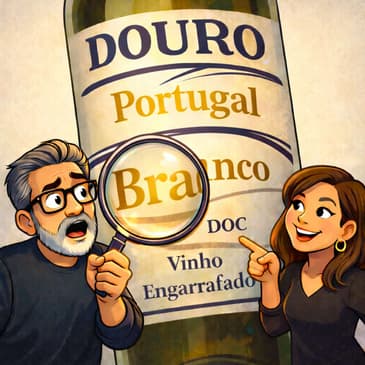
Have you ever picked up a Portuguese wine, stared at the label, and thought... I have absolutely no idea what this means? Same! And here's the thing: Douro Branco might be Portugal's best white wine value that no one is talking about. So this week, we are fixing that! In this episode, we break down what Douro Branco actually means, why the Douro Valley's brutal climate and ancient vines produce some of the most interesting white wines in Europe, and what the heck "field blends" are and why they make this wine so different from almost anything else you'll find on the shelf. We also give you a quick Portuguese wine vocabulary lesson so you can stop being scared of the words on the label. Then we taste and review two Douro Branco wines, both under $15, to find out if either one earns a spot on your dinner table. Spoiler: one of them made the cut! Wines tasted and reviewed: 2023 Quinta Das Carvalhas Douro White Blend, 2024 Symington Family Estates Rio Belo Douro Branco
Send us a Text Message and we'll respond in our next episode!
Contact The Wine Pair Podcast - we’d love to hear from you!
Visit our website, leave a review, and reach out to us: https://thewinepairpodcast.com/
Follow and DM us on Instagram: https://www.instagram.com/thewinepairpodcast/
Send us an email: joe@thewinepairpodcast.com
Episode #208: Portuguese Wine Primer: Douro Branco — Portugal's Best White Under $15? 00:00
________________________________________________________________________________________________
KEY INSIGHTS & FREQUENTLY ASKED QUESTIONS
Q: What is Douro Branco and why should wine drinkers care about it?
A: Douro Branco is a white wine blend from Portugal's Douro Valley — and it might be the most underrated white wine in Europe under $15. Made from indigenous grapes like Viosinho, Rabigato, and Gouveio in the world's oldest regulated wine region, it delivers crisp acidity, mineral complexity, and serious food-pairing versatility at a fraction of comparable European whites.
Q: What grapes are in Douro Branco?
A: There's no fixed recipe — and that's the point. Douro Branco blends vary widely, but the most common grapes are Viosinho, Gouveio, Rabigato, Malvasia Fina, and Arinto. Because of the region's ancient "field blend" tradition, exact percentages can differ bottle to bottle, and sometimes even the winemaker doesn't know the precise mix.
Q: What is a "field blend" and why does the Douro Valley still use them?
A: A field blend means multiple grape varieties grow interplanted together in the same vineyard — not separated by variety. The Douro historically had 40+ varieties growing side by side. Top producers still use these ancient mixed plots because the grapes flower and ripen together naturally, producing wines with built-in balance and a distinctive regional identity you can't replicate in a lab.
Q: What happened in the Jeffry Hill Napa Valley grape fraud case?
A: A Napa winemaker sold fake Napa Cabernet Sauvignon for nearly a decade — and walked with probation. Jeffry Hill of Hill Wine Company charged up to $96 a bottle for wines actually made from cheap Lake County and San Joaquin grapes, running a $2.5 million fraud scheme. Despite a prior 2015 conviction for grape theft, he received three years of probation rather than the 18 months in prison prosecutors requested.
Q: What foods pair best with Douro Branco?
A: Douro Branco is a serious food wine — especially with seafood and anything spicy. Its bright acidity and saline minerality make it a natural match for shellfish, spaghetti with clams, grilled salmon, and fish and chips. The Symington Family Estates Rio Belo and Quinta das Carvalhas both showed well with spicy cuisines like Thai and Indian as well.
________________________________________________________________________________________________
Introduction 00:00
Episode Overview and First Thoughts on Wine Douro Branco 00:43
Hello fellow Bottle Jockeys! And welcome to The Wine Pair Podcast. I’m Joe, your sommelier of reasonably priced wine, and this is my wife and my wine pairing partner in crime, Carmela. And we are The Wine Pair!
If you're new to our podcast, here's what we do: Every week we buy wines under $25 with our own money, taste them, and give you our brutally honest opinion on whether they're worth buying. Nobody pays us to review specific wines, we don't accept free bottles from wineries, and we're not afraid to call out a bad wine when we taste one. Decanter Magazine calls us fun, irreverent, chatty, and entertaining - so if that sounds like your vibe, welcome to our tribe of wine lovers.
Alright, Carmela, I have to tell our faithful listeners that I made a U-turn on the content of this episode literally last night. Because, you were there, and you know. And I’ll tell you why. March came up on us super fast, amiright?!? And in a couple of weeks, you and I are going to be in Portugal for the very first time ever. It’s also been almost a year since we did an episode Portuguese wine, and because of that, I honestly feel unprepared for our trip to Portugal because we have not properly prepped ourselves. I mean, some people focus on figuring out the language, or the sites, or the beaches, or the hidden gems of the places they are visiting. But me, no, I want to know the wines - and foods - of the places we are visiting.
So, again, literally last night I ran to the closest wine shop I knew would be open, and that was Total Wine, not my favorite, but I knew I could find Portuguese wine there, and I did. And, because I want you to get excited about it as well, Carmela, we are focusing on a Portuguese white wine blend called Douro Branco so we can have a few wines that we can feel confident about when we are there. And a shoutout to Jared our listener who asked us to do some more Portuguese wines. So, here you go. See, we do listen!
We are going to talk more about the grapes and the wine and how it is made and all of that fun stuff in a minute, but I thought it would be important to start with what may be the most confusing thing when looking at wines in other languages, and that is just figuring out what the hell is in the bottle, especially if you don’t speak the language. So, let’s break down these two key words that are the wine we are drinking today: Douro and Branco.
Ok, first let’s talk about the Douro, because if you are an aspiring wine nerd, it is a place you need to know about. According to the interwebs, which you know never lies, the Douro is the world's first formally recognized and regulated wine region, established by a royal Portuguese charter in 1756. Now, there have been lots of other regions around the world that have been defined and recognized by borders and were considered official wine regions, but the Douro was the first to be under ongoing oversight and regulations by a government. So there’s that.
The Douro is in northern Portugal, about an hour’s drive east of the city of Porto and is known for having tremendously steep slopes cut through by the beautiful Douro River. In fact the landscape is so special, it was designated a UNESCO World Heritage Site in 2001. Vineyards in the Douro are on steep inclines, at high elevations, and farmers have built narrow stone terraces called socalos to cultivate their wines. This means that all agricultural work, including harvesting, has to be done by hand.
The climate in the Douro is considered to be extreme and is famously described by locals as "nine months of winter and three months of hell" because it has freezing winters and scorching summers. Douro is the birthplace of the famous sweet wine Port, and it is also home to more than 80 indigenous grape varieties, and we will get to more of that in a few minutes. It is also well known for its “schist” soils which are basically flaky rock, so that kind of soil stresses the vines so they have to dig deep to find water, and as we have said many times, stressing out grape vines is good for making great wine.
Ok, now that we know a little about the Douro, let’s talk about the word Branco. Quite simply, Branco means “white” in Portuguese. Which I guess I should have figured out, but I was afraid to commit so I had to look it up. So, the first lesson you can put into your brain box when you are wondering what the eff Portuguese wine is, you know that if you see Douro Branco, that means it is white wine from the Douro Valley in northern Portugal. Boom!
I’ll do you one more. The word Vinho, like in the wine Vinho Verde means wine. Bam! Teaching you all Portuguese. I also know that obrigado is thank you, which is a good word to know. But, back to wine, another word you should know is Tinto, which in Portuguese means red. So a Vinho Tinto is a red wine. Soon, you will be fluent.
Anyway, any time you see Branco on a Portuguese wine label, you know it means white wine. What is not so simple, though, is what grapes are in the wine. Again, we will talk about the white wine grapes from the Douro in a few minutes, but just know that, generally, Douro Branco is a white wine blend, although you may see Douro Branco wines with specific single varietal grapes called out on the label.
So, now, maybe you can be a little less scared about Portuguese wines when you see them.
And, so, very soon, we are going to dig into exactly what makes Douro Branco special, and we have two Douro Branco wines to taste and review to see if they should be on your dinner table this week, or if we should be seeking them out when we are in Portugal in a couple of weeks . . .
But first . . . we have to do our shameless plug.
Thank you for listening to us and for supporting our show, and know that we buy all of the wine we taste and review every week so that we can give you real and honest reviews. If you like what you’re hearing, please subscribe to our podcast and leave us a five star rating and review so we can grow listeners.
We also love to hear from you and we always respond so you can follow us on Instagram at thewinepairpodcast, and on Bluesky. You can contact us on our website thewinepairpodcast.com, and you can sign up for our email newsletter there and you can also send us a note at joe@thewinepairpodcast.com and let us know about wines your want us to review or just shoot the breeze, we love chatting it up.
And, as we do every week, we’ll tell you someone we think you should recommend The Wine Pair Podcast to - because the best way for us to grow listeners is when you tell your family and friends about us - and this week, we want you to recommend us to anyone who is afraid of Portuguese wine because they are intimidated by the unfamiliar words on the wine bottle, because this may be the episode that makes them feel brave and ready to take on the world.
Topic: WTF is Douro Branco? 12:39
Alright, Carmela, it’s time to really get into just what the eff Douro Branco is, all right?!?
So, we have already established that Douro Branco is a white wine from the Douro Valley in Portugal and that they are usually blends, but what is special about them, what grapes are in them, and how are they made? I am so glad you asked!
Well, let’s go back in time a bit. Historically, Douro vineyards were called "field blends," and that means that dozens of different varieties of white wine grapes (sometimes 40+) were interplanted randomly in the vineyards. Yes, that means that there were just a bunch of different grapes growing all over the place like chaos, which is really different from what we see today. Modern vineyards are almost always "block-planted" which means they are set up in plots with single varietals in each plot to allow for more controlled winemaking - because different grapes flower and ripen at different times. So it’s just easier to deal with. However, many top wines in the Douro still utilize these ancient mixed plots to achieve natural balance and unique identity. So, that’s cool.
To be labeled Douro DOC, yes, that DOC designation is the same as you see with Italian wines, wines have to follow rules like adhering to specific yield limits and using only approved indigenous varietals. The most important white wine grapes, and the ones you may see dominating many of the blends, are
- Gouveio: A grape that ripens early and has small potent berries which make rich wines with tropical scents
- Malvasia Fina: Which adds floral notes and some spice to blends.
- Rabigato: Also known as the “cat’s tail” is famous for its bright acidity and minerality
- Viosinho: A low-yielding, aromatic variety often compared to Sauvignon Blanc
- Donzelinho Branco: Commonly used in white Port production.
- Arinto: One of Portugal’s oldest and most popular grapes, that can hold its acidity even in heat
What I found really interesting, because this is pretty unique, there are no fixed mandatory percentage requirements for the allocation of individual varieties in standard Douro Branco blends. Crazy. So that means you can get very different blends depending on the wine. Most blending regions are not like that. A lot of this has to do with the concept we talked about earlier - field blends - because that is a long-standing tradition in the area, and when you have a field blend, the blend could be more or less random from year to year. So, because of that, it is not uncommon for the exact percentages in a blend to be unknown, even to the winemaker.
Another thing I found fascinating is that field blends are actually favored because they provide balance and identity, and since plants generally pollinate and flower together, the ripeness levels remain relatively consistent across varieties. What I found in the wines I was looking at is that there were definitely some grapes that showed up in a lot of the blends, but the number of grapes seemed to be relatively high, and the mixture was really, really varied.
In terms of the history of winemaking and white wine making in the area, let’s talk a little walk through the ages, shall we?!?
White wine has existed in the Douro for as long as wine has been made there. The Romans were cultivating vines in the region by the 3rd and 4th centuries, and during the medieval period Cistercian monks - always follow the monks when you want to know about alcohol - they helped refine viticulture across the valley.
White grapes were always part of that landscape. But for most of the Douro’s history, white wine was secondary to red. Womp womp. We see that a lot, sadly. When the region was officially designated in 1756 it was actually done to protect and regulate Port. Dry white wines were being made, but they were largely for local drinking, not for exporting.
The modern story of Douro white wine is really a story of rediscovery. After Portugal joined the European Economic Community in 1986 and estates gained more control over bottling their own still wines, producers began looking more seriously at what the white grapes could do. Advances like stainless steel fermentation and temperature control helped preserve freshness and aromatics in a region known for heat - because heat is not awesome for acid driven wines (which we love). So, consider that when you are thinking about what wines you want to drink because warm weather areas tend to have lower acid wines.
Over the last twenty years in particular, winemakers started planting whites at higher elevations to protect acidity and they also began isolating indigenous varieties like Rabigato, Viosinho, and Gouveio in more intentional blocks rather than blending everything together. So, what had once been an overlooked category in white wine, or Vinho Branco, is now considered one of the most exciting parts of the Douro.
Incidentally, some have compared Douro Branco to White Bordeaux, which is Sauvignon Blanc and Sémillon based blend, and a wine we did in an episode recently that we really, really liked. So, let’s see if it holds up.
And, on that note, I think it’s time to learn a little more about the specific wines we are drinking today. Whaddya say?
Douro Branco Wines We Chose for This Episode 19:30
As usual, the wines we have chosen for this episode are under $25, and they should be relatively easy to find because I bought them both at Total Wine - thanks again for the assist Hasini. You should not have trouble finding a Douro Branco at a good wine shop and/or one with a strong European or Portuguese wine selection. In your local grocery store, the only Portuguese wine you are likely to find is Vinho Verde which is a wine we like, but it ain’t this wine at all. And, as always, go to your local wine shop and ask them to find you some Douro Branco and they will be happy to help!
The first wine we are going to drink is the 2023 Quinta Das Carvalhas Douro White Blend, and the blend for this one is a little wild. It is 35%Viosinho, 25% Moscatel Galego Branco, 20% Gouveio, 10% Arinto, 10% Fernao Pires. And, honestly, it was really, really hard to find any information about this wine. It is one of the wines that Total Wine calls “winery direct” and based on the fact that I could not find the wine on the Quinta das Carvalhas website, my guess is that they make it just for Total Wine. And that is one of the things that drives me nuts about Total Wine. But I digress
Here is what else I could glean from the bottle. First, it’s a screw cap, and we love a good screw cap. It is 13% alcohol, so a bit high for what is supposed to be a crisp white wine, and the description on the back says “Quinta das Carvalhas is the most emblematic and spectacular property in the Douro Valley. Written references about this magnificent estate can be traced back to 1759.”
The other thing I found is that there were a whole bunch of wines online with the same Quinta das Carvalhas name but tons of different blends and labels and whatever. Very confusing. And, if it is indeed the same wine, which I think it is because they call out the specific Moscatel percentage, Wine Enthusiast gave the wine an 87.
So let’s move onto our next wine which is the 2024 Symington Family Estates Rio Belo Douro Branco, and the blend in this one is a little less wild, but still interesting. It is 25% Viosinho, 25% Malvasia Fina, 25% Rabigato, 25% GouVeio. This one is also a screw cap, hooray! And, I could actually find a tech sheet for this wine, though reviews for the wine were very hard to find.
This is what the winery says about the winemaking process: After destemming and gentle crushing, the must undergoes a clarification process that allows us to achieve the ideal conditions for fermentation in stainless steel tanks at a controlled temperature of around 16°C (that’s about 60 F) During the subsequent aging phase, and until bottling, contact with oxygen is kept to a minimum in order to best preserve the wine’s primary aromas.
I did find it a little odd that the winery is called Symington Family Estates because that don’t sound very Portuguese. Well, according to the interwebs, they are a family of British and Portuguese origin that has lived and worked in Portugal since the 19th century. The family business is run by the 4th and 5th generation of Symingtons. Symington Family Estates itself makes a lot of Port, is the leading vineyard owner in the Douro Valley and one of the top wine producers in Portugal. So, this is a big outfit. Symington owns and runs four of the leading port houses and they have 26 Quintas, they have 26 of those bad boys, and you should know that the word Quinta in Portuguese is the equivalent of château in French, and they say all of the Quintas are managed under a strict minimum intervention policy and they are the largest area of certified organic vineyards in northern Portugal.
So, despite the fact that they are a huge winemaking company, they do at least make a nod to organic farming practices and low intervention.
But, I think that is enough information - let’s get to drinking! We’ll take a quick break and be right back. And, if you have these wines or similar wines, drink along with us to get some participation points, which you can trade-in for free stickers. You just need to send me an email with your mailing address, and I will get those “I drink with The Wine Pair Podcast” stickers over to you!
LINKS TO SOURCES FOR THESE SPECIFIC WINES
- https://www.wineenthusiast.com/buying-guide/quinta-das-carvalhas-2023-white-blend-white-douro/?srsltid=AfmBOorkbQFXsaiRI_sUW8kS2SkQJH_iPvjmlfWlxOzr0tee8b8N5Y1L
- https://frechette.kork.ca/en/our-wineries/symington-family-estates/rio-belo-white-doc-douro/2024
Host Read Ad for Women in Wine Festival 26:11
The Women in Wine Festival, presented by No Wine Left Behind, is happening March 8th at Le Dû Wines in New York City.
It’s being billed as the first completely blind wine tasting festival, all multiple choice, so you don’t have to be an expert to participate. It’s Judgment of Paris–style matchups:Bordeaux versus New Jersey, Napa versus China, and the audience votes on the winner. The top wine gets picked up by the shop, so your vote actually counts!
They’re also bringing in Violet Grgich as a panel speaker, which is a nice direct callback to the original 1976 Paris tasting.
Every bottle at the event is made by women and poured by women, often by the winemakers themselves. Our listeners get 50 percent off either session with the code TheWinePairPodcast.
Just search Women in Wine Festival Le Dû Wines Eventbrite, use the link we put in our show notes, or send me a note and I’ll send it to you.
https://www.eventbrite.com/e/women-in-wine-festival-presented-by-no-wine-left-behind-tickets-1981201587280
2023 Quinta Das Carvalhas Douro White Blend, 2024 Symington Family Estates Rio Belo Douro Branco Wine Tasting, Pairing, and Review 27:28
Wine: Quinta Das Carvalhas Douro White Blend
Region: Portugal, Douro
Year: 2023
Price: $12.99
Retailer: Total Wine
Alcohol: 13%
Grapes: 35%Viosinho, 25% Moscatel Galego Branco, 20% Gouveio, 10% Arinto, 10% Fernao Pires
Professional Rating: WE 87 Vivino
What we tasted and smelled in this Quinta Das Carvalhas Douro White Blend:
- Color: Light yellow, very light straw
- On the nose: Kerosene, natural gas, herbs, rosemary, peach, stone fruit, cantaloupe, melon, tropical fruit, mango, saline
- In the mouth: Fruity on the front, peach, apricot, tropical fruit, citrus, grapefruit mineral, steel, gasoline
Food to pair with this Quinta Das Carvalhas Douro White Blend: A food wine, spicy food, Indian food, Thai food, fish, fish and chips, salmon, spaghetti with clams, grilled shrimp, teriyaki chicken, grilled white meats
As a reminder on our rating scale, we rate on a scale of 1-10, with no half points, where 7 and above means that we would buy it, and 4 and below means that we are likely to pour it down the sink, and a 5 or 6 means we are likely to drink it and finish it, but we are probably not going to buy it.
Quinta Das Carvalhas Douro White Blend Wine Rating:
- Joe: 6/10
- Carmela: 6/10
Wine: Symington Family Estates Rio Belo Douro Branco
Region: Portugal, Douro
Year: 2024
Price: $14.99
Retailer: Total Wine
Alcohol: 12.5%
Grapes: 25% Viosinho, 25% Malvasia Fina, 25% Rabigato, 25% GouVeio
Professional Rating: Vivino
What we tasted and smelled in this Symington Family Estates Rio Belo Douro Branco:
- Color: Very light yellow, like squeezed lemon
- On the nose: Gasoline, glue, saline, tropical fruit, pineapple, POG, citrus, apricot, dried fruit, raisin, grass, thyme
- In the mouth: Grapefruit, lemon, orange, sweet peach, lemon pith on the end, seashell, licking a stone
Food to pair with this Symington Family Estates Rio Belo Douro Branco: A good food wine, spicy foods, shellfish, creamy sauces, pesto, garlic bread, stuffed chicken, lemon chicken
Rio Belo Douro Branco Wine Rating:
- Joe: 7/10
- Carmela: 7/10
Which one of these are you finishing tonight?
- Carmela: Symington Family Estates Rio Belo Douro Branco
- Joe: Symington Family Estates Rio Belo Douro Branco
The Test: Did we nail the taste profiles expected from Douro Branco? 40:24
- General
- Lemon, lime, peach, apricot, green apple, mango, pineapple, passionfruit, wet stone, saline, fennel, wild herbs, thyme, bay leaf, sage. Crisp, vibrant
- Quinta Das Carvalhas Douro White Blend
- Winery: A young, lemon yellow colored wine with beautiful aromatic intensity of fresh floral notes combined with suggestions of lime and white fruit. Flavorful and fruity, complemented with a lively acidity offering a long, lasting finish
- WE: It's the 25% Moscatel that dominates this wine, with its perfumed, floral aroma and ripe white-fruit flavors. It is a rich, refreshing wine that is ready to drink.
- Symington Family Estates Rio Belo Douro Branco
- Winery: The nose is fresh and expressive, combining aromas of citrus, white-fleshed fruits, and white flowers, with a subtle mineral note. On the palate, it offers lively acidity, good balance, and a saline finish that enhances the wine’s freshness. Best served at 10°C. Best enjoyed young, within two to three years.
- Couldn’t find any others
What is the verdict on Douro Branco? 42:28
We will definitely try it in Portugal. A fun wine, great to learn, a great fish wine. We will definitely serve it.
And now it is time to head over to our new desk so that we can cover our wine in the news this week segment.
Wine in the news this week: Napa Wine Cheat Walks With Probation in $2.5 Million Grape Scam 43:22
- mercurynews.com/2026/02/27/i-thought-i-was-in-control-ex-napa-valley-winemaker-apologies-as-hes-sentenced-in-2-5-million-grape-scam/
- https://hoodline.com/2026/02/napa-wine-cheat-walks-with-probation-in-2-5-million-grape-scam/
Our wine in the news this week comes from Ellen Vargas in a publication called Hoodline, and the article is entitled: Napa Wine Cheat Walks With Probation in $2.5 Million Grape Scam. Links in the show notes as always.
So, one thing you kind of hope when you buy wine is that you can trust the label. That when it says Napa Valley on it, you're paying for grapes that were grown in one of the most famous wine regions in the world. Well, this week a guy named Jeffry Hill stood in a federal courtroom in California and apologized for selling fake Napa Valley wine. Like Rudy.
Here is the short version of a very long story. Jeffry Hill ran a small winery called Hill Wine Company in Napa. For years, he sold wine labeled as Napa Valley Cabernet Sauvignon, at prices up to $96 a bottle, but that was actually made from cheap grapes he was buying from Lake County and San Joaquin County. Definitely not Napa. He was also selling wine he called Cabernet Sauvignon that apparently wasn't even Cabernet Sauvignon. He falsified shipping records, he moved grapes between facilities to hide where they came from, and he told his grape suppliers in other counties to never, ever tell anyone they were selling to him.
The scheme ran to about two and a half million dollars in fraudulent sales. Now it is true that a wine in the USA does not have to have 100% of the wine it says on the label, but it has to be within certain Federal regulations. The law says that at least 85% of the grapes in a wine have to come from the region named on the label. So, old Jeffrey was breaking the law, breaking the law.
Now here’s the really irritating part. This was not his first offense. In 2015, Hill spent four months in jail for stealing grapes from a competitor's vineyard. So, this guy has issues.
For this specific case, Hill was actually indicted in Federal court in 2016, but the case dragged through the courts for nearly a decade. However, on February 27th, he finally stood before a judge and was sentenced to, wait for it, three years . . . of probation. Prosecutors had asked for 18 months in prison, but the judge cited Hill's health and his recovery efforts and gave him probation plus at least $500,000 in restitution.
But what he can’t fix with his apology is the fact that people paid big bucks for bottles of wine that were supposed to be high value, and got duped. Someone surely celebrated something, an anniversary, a promotion, a birthday, with a bottle they thought came from one of the most prestigious wine regions on earth, and instead they were drinking something else. Those kinds of things are really frustrating.
So, the case is officially closed, Jeffrey is on probation, and there are probably still some people who have his fake bottles in their cellars. So you better check yourself.
So, Carmela, here is a question for you. How frustrated would you be to find out that what we thought was a really nice, really special, and really expensive bottle wine turned out to be fake?
Listener Shoutouts 48:08
We have some fun listener shoutouts for this week, and we so appreciate when you reach out to use and tell us what you think, or what you are drinking, and so here are some shoutouts:
- Amanda - who took our advice and visited one of my favorite wineries in the Willamette Valley called Audeant, she got a private tasting with the winemaker and really liked the wines.
- Timmy, who sent us an interesting story about uncovering a hidden wine cellar that we may use in our Wine in the News This Week segment
- Christine R who shared her love of Italian wine with us, and we agree, Christine!
Wines coming up in future episodes in case you want to drink along with us 49:05
- Lebanese wines
- Pet-Nat
- Domaine Lingot-Martin Pet Nat Gueule de Gamay
- Lubanzi Rainboat Pet Nat 2024
- German Riesling
- Xinomavro
- Portuguese wines from Alentejo
- Viurna / White Rioja
- High QPR Pinot Noir
- Soter Vineyards Planet Oregon Pinot Noir 2023
- Chehalem 2023 Chehalem Estate Vineyard Pinot Noir
Outro and how to find The Wine Pair Podcast 49:41
Thank you for listening to us and for supporting our show, and remember, we buy all of our own wine and we do all of the writing and recording and editing to bring you a show every week because we absolutely love doing it, and our small little ask for you is that you please follow or subscribe to our podcast and also please leave us a nice rating and review to help us grow our listeners - and a huge thank you to all of you who have done so already!
You can also follow us on Instagram at thewinepairpodcast, and on Bluesky. You can contact us on our website thewinepairpodcast.com, and you can sign up for our email newsletter there and you can also visit our “Shop Wine” section where you can find links to buy the wines that we rate as buys in each episode. I will also note that on our website, if you are curious about a wine we have covered in the past, we do have a pretty good search functionality, so you can use that find wines you want to know more about.
And we want to make content you care about and you like, so send us a note or DM us and give us some feedback or let us know if there are wines you want us to try or wine making areas of the world you are curious about - and we’ll take care of it! joe@thewinepairpodcast.com
Alright, with that, we are going to sign off, so thanks again, and we will see you next time. And, as we say, life is short, so stop drinking shitty wine.
- https://en.wikipedia.org/wiki/Douro_DOC
- https://en.wikipedia.org/wiki/Douro_Wine_Company
- https://www.wine-searcher.com/regions-douro
- https://www.wine-searcher.com/regions-douro+region
- https://www.jancisrobinson.com/learn/wine-regions/portugal/douro
- https://www.decanter.com/learn/advice/portugal-whites-grape-guide-267567/
- https://www.decanter.com/magazine/portugals-white-wines-249769/
- https://www.decanter.com/decanter-world-wine-awards/portuguese-whites-wines-to-look-out-for-508021/
- https://www.winespectator.com/articles/wine-tip-discover-portugal-white-wines
- https://www.winemag.com/2020/05/15/portuguese-white-wines/
- https://www.winemag.com/2022/01/04/douro-superior-portugal-wine/
- https://www.cellartours.com/blog/portugal/guide-to-portuguese-white-wine
- https://www.cellartours.com/blog/portugal/portuguese-wine-labels-explained-a-complete-guide-for-wine-lovers
- https://www.portugal.com/food-drink/douro-wine/
- https://www.masterclass.com/articles/douro-valley-wine-explained
- https://www.thedrinksbusiness.com/2024/09/the-douro-hits-crisis-point/
- https://www.thedrinksbusiness.com/2025/07/wine-producers-in-the-douro-take-to-the-streets/
- https://www.vinetur.com/en/2024061880231/douro-valley-s-winemakers-fight-for-survival.html
- https://www.gilbertgaillard.com/en/magazine/discovery/how-the-portuguese-wine-industry-is-reinventing-itself
- https://www.esmmagazine.com/drinks/portuguese-wine-production-up-8-exports-grow-by-4-247246/
- https://www.viniportugal.pt/en/the-sector/statistics/
- https://www.jancisrobinson.com/articles/perspectives-douro-and-2019-vintage
- https://syrahqueen.com/white-wines-douro-valley/
- https://cycling-centuries.com/blogs/news/a-beginners-guide-to-douro-wines
- https://www.thedrinksbusiness.com/2024/05/why-portugals-fine-white-wines-are-worthy-of-the-worlds-attention/
- https://thewinedetective.co.uk/?page_id=18223
- https://www.wine-searcher.com/m/2019/02/the-douro-valley-in-a-case
- https://aroundtheworldin80harvests.com/2018/03/01/douro-study-guide-fast-facts/
- https://passionatefoodie.blogspot.com/2020/02/wine-soul-field-blends-old-vines-douro.html
- https://www.terroirist.com/exploring-the-wines-of-the-douro-passadouro-and-wine-soul/
- https://www.jamessuckling.com/wine-tasting-reports/top-100-wines-portugal-2023
- https://www.greatwinecapitals.com/wine-stories/winemakers-who-shaped-the-legacy-of-porto-and-douro/
Support The Wine Pair Podcast by heading to our website and shopping for the wines we give our highest ratings to in our Shop Wines section. Just click on this link - you pay the same price, and we may get a small amount of compensation.
You can also support us by clicking on this affiliate link to wine.com and find great wines under $20!
And, if you are looking for a great website builder for your podcast, click on this link to use the service we use and love: Beamly, formerly known as Podcastpage.io.