
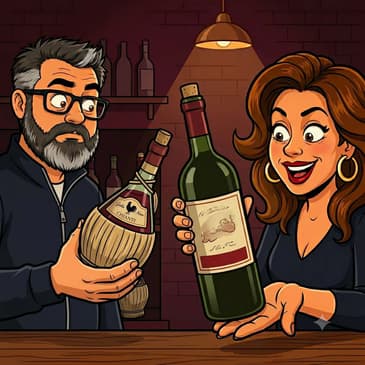
Sangiovese is the classic example of how a wine can taste completely different depending on where it is from and how it is made, and this episode demonstrates that fact in spades. Sangiovese is one of the great Italian wine grapes, but because of its strong association with the wine Chianti, it has a bit of a mixed reputation. In its defense, Chianti is really a food wine which is where its acidity really shines. But Sangiovese itself is an amazing wine grape that can vary from light and fruity like a Gamay to velvety and smooth like a Merlot. On that note, it may surprise you to know that about half of all of the Sangiovese grown in Italy is not grown in Tuscany, and regions like Puglia, Emilia-Romagna and Marche are making fantastic versions of it. In this episode, we taste and review two wines made from 100% Sangiovese from Umbria and tiny Molise, and without spoiling it too much, we can tell you that they are very different wines, almost hard to tell they are from the same grape, and are different than Chianti. In a good way. Join us to find out more! Wines reviewed in this episode: 2022 Cantina Roccafiore Melograno, 2021 Di Majo Norante Terre degli Osci Sangiovese
Send us a Text Message and we'll respond in our next episode!
Contact The Wine Pair Podcast - we’d love to hear from you!
Visit our website, leave a review, and reach out to us: https://thewinepairpodcast.com/
Follow and DM us on Instagram: https://www.instagram.com/thewinepairpodcast/
Send us an email: joe@thewinepairpodcast.com
Show Notes
Episode 223: This Ain't Chianti: Is Italian Sangiovese Better Outside Tuscany? 00:00
________________________
KEY QUESTIONS
- What is the difference between Sangiovese and Chianti?
- Does Sangiovese from outside Tuscany taste different from Chianti?
- What does Sangiovese from Umbria taste like?
- What does Sangiovese from Molise taste like?
- Which Sangiovese wine was the better value in this episode?
- What foods pair best with these two Sangiovese styles?
- Is Sangiovese outside Tuscany worth buying?
________________________
Episode Overview and First Thoughts on Italian Sangiovese That Is Not Chianti 00:41
Hello fellow Pour Decision Makers! And welcome to The Wine Pair Podcast. I’m Joe, your sommelier of reasonably priced wine, and this is my wife and my wine pairing partner in crime, Carmela. And we are The Wine Pair!
If you're new to our podcast, here's what we do: Every week we buy wines under $25 with our own money, taste them, and give you our brutally honest opinion on whether they're worth buying. Nobody pays us to review specific wines, we don't accept free bottles from wineries, and we're not afraid to call out a bad wine when we taste one. Decanter Magazine calls us fun, irreverent, chatty, and entertaining - so if that sounds like your vibe, welcome to our tribe of wine lovers.
This week, Carmela, the name for the tribe came from Ryan, aka rjfergycooks on Instagram, and he sent us a couple and Timmy’s wife gave us a few more, but if you have names for the tribe to share, please send them to us, and if you have not been on the podcast yet, we will ask you if you would like to be interviewed and become world famous by being on our show.
Carmela, this week we are on a version of an Italian wine adventure, and specifically we are going to look into wines made from the Sangiovese grape that are not the ones most people know, namely Chianti and Brunello di Montalcino. As I always say, European wines can be confusing because they often refer to the place, like Chianti, but not the grape, which, again, for Chianti and Brunello is Sangiovese.
And, on that note, there are a few other relatively well known wines from Tuscany in Italy also made from Sangiovese, and a few notable ones are Vino Nobile di Montepulciano, which is a little confusing because in local dialect the grape is called Prugnolo Gentile, as well as Rosso di Montalcino which is made in the same region as Brunello, but is technically a different wine. And is real good.
But we are not here to talk about those wines. We are here to talk about other wines made from Sangiovese that are not these wines, and are not wines made in Tuscany. And here’s why. First, Sangiovese is one of the most important grapes in Italy, but it is commonly very associated with Chianti which has a pretty mixed reputation, and second, it is the perfect example of how the same grape grown in different areas can taste very different, which is a similar story to what we covered last week when we were talking about Alsace Pinot Gris which is a totally different wine than Italian Pinot Grigio, but is exactly, and I mean exactly, the same grape.
So, let’s talk a bit more about Sangiovese in general. Believe it or not, Sangiovese is among the top 15 most planted red grape varieties in the world, and over 93% of it is grown in Italy, and of all the Sangiovese grown in Italy, just over 50% is grown in Tuscany. And, to dig in a little deeper, nearly 80% of the total vineyard area in Tuscany is dedicated to Sangiovese. That is a lot of math, by the way. So there is a very good reason why Sangiovese is associated with Chianti and Brunello and Tuscany, but, by the same token, nearly half of the Sangiovese grown in Italy is NOT grown in Tuscany, and 10% of the total vineyard area in Italy is dedicated to Sangiovese, so there is more to the story that we need to explore.
So, we’ll talk a little bit about Sangiovese itself and some regions where it is grown outside of Tuscany and why we care about it in a little bit, but I did want to address something that we have mentioned before, and that is while Brunello is considered one of the great wines of the world, Chianti has a more mixed reputation.
Some of the reason for that mixed reputation is that for a while, winemakers and distributors in Italy decided to focus on quantity over quality, and produced a lot of that kind of crappy Sangiovese in those wicker bottles that are actually called fiasco, believe it or not. In focusing on quantity, they started planting vines in some areas that were selected for their ability to produce a lot of grapes, but not for the quality of the grapes they produced.
Interestingly enough, previous DOC rules in Italy, and remember DOC and DOCG are the two most significant wine destinations in Italy, are meant to signal the wines are from a specific area and made from a specific quality and in a specific way, and those rules required that Chianti be blended with 10% white wine like Trebbiano which actually diluted the wine and made it more acidic. In 1996, the rules were changed so that Chianti Classico could be made from 100% Sangiovese, and all Chianti wines, Classico or not, are now not required to use white wine grapes, and in fact in some areas can also include grapes like Cabernet Sauvignon in proportions up to 15% of the total. Overall, in Chianti today, it is much more common to find 100% Sangiovese wines.
I will be totally honest, too. While I do like a lot of wines made from Sangiovese, namely Rosso di Montalcino and Brunello among others, I am not super crazy about Chianti, even Chianti Classico and Chianti Classico Riserva, because I can find them to be pretty sharp and acidic. So, a big part of why I wanted to explore Sangiovese from Italy but outside of Tuscany is because I think the grape and wine are misunderstood and deserve a better reputation, and again, because it can really show how the same grape grown in different areas and made from different winemakers can be so different. I will also say Chianti is the classic case of a wine that is really meant to be paired with food and not great for cocktailing. Which is really something that needs to be considered, and something we think about a lot.
On that note, today, we have two Italian wines made from Sangiovese but not from Tuscany, one from Umbria and one from Molise, a place you have probably never heard of, to see how they stack up to Chianti, and if either or both are worth your hard earned money
But first . . . we have to do our shameless plug.
Thank you for listening to us and for supporting our show, and know that we buy all of the wine we taste and review every week so that we can give you real and honest reviews. If you like what you’re hearing, please subscribe to our podcast and leave us a five star rating and review so we can grow listeners.
We also love to hear from you and we always respond so you can follow us on Instagram and Bluesky at thewinepairpodcast. You can contact us on our website thewinepairpodcast.com, and you can sign up for our email newsletter there and you can also send us a note at joe@thewinepairpodcast.com and let us know about wines your want us to review or just shoot the breeze, we love chatting it up.
And, as we do every week, we’ll tell you someone we think you should recommend The Wine Pair Podcast to - because the best way for us to grow listeners is when you tell your family and friends about us - and this week, we want you to recommend us to anyone who is not crazy about Chianti and therefore thinks they are not crazy about Sangiovese because we may have something here that will change their minds
Topic: WTF is Sangiovese Wine That is Not Chianti or from Tuscany? 11:27
Ok, Carmela, I think it is time to find out just what the eff Sangiovese wine that is not from Tuscany is all about.
As we mentioned earlier, while Sangiovese is Italy’s most planted red grape varietal, about 50% of it is not grown in Tuscany. In order from the most Sangiovese to the least Sangiovese grown in Italy by region, the regions are
- Tuscany: 50.6% (47,172.24 ha)
- Puglia: 17.4% (16,204.49 ha)
- Emilia-Romagna: 9.2% (8,561.17 ha)
- Marche: 8.7% (8,136.89 ha)
- Umbria: 4.2% (3,902.87 ha)
- Campania: 4.1% (3,794.90 ha)
- Basilicata: 1.6% (1,461.10 ha)
- Abruzzo: 1.5% (1,356.06 ha)
- Lazio: 1.4% (1,324.83 ha)
- Sardinia: 0.4% (393.13 ha)
- Calabria: 0.4% (373.80 ha)
- Molise: 0.4% (340.43 ha)
- Liguria: 0.1% (136.94 ha)
So, out of the 20 regions in Italy, more than half of them grow Sangiovese.
Puglia coming in at number two is really interesting to us, mostly because we have family in Puglia, and because the big red wine in Puglia is Primitivo, known as Zinfandel in the US. Again, about 17% of the Sangiovese grown in Italy comes from there, however it only makes up about 10% of the total vineyard area in Puglia. In Puglia, it is mostly used as a blending grape for wines grapes like Primitivo.
Umbria, which is where one of the wines we are drinking today comes from, is number 5 on the list of Sangiovese producers, and produces a little more than 4% of the Sangiovese grown in Italy, it accounts for more than 25% of the region’s total vineyard area, so it is an important grape in Umbria. Umbria is known as the “green heart” of Italy because it is such an important agricultural area, and is an area that you might not ever visit. Two of the most famous cities in Umbria are Assisi, the birthplace of Saint Francis, and Perugia, which is famous for chocolate. Back to the wine, Umbrian Sangiovese is gaining a good reputation especially for its quality to price, which can be a bargain, and it can be found in some of the regions more well-known wines, such as
- Torgiano Rosso Riserva DOCG: which has to be 50%–70% Sangiovese
- Montefalco Rosso DOC: where Sangiovese makes up 60%–70% of the wine
- Colli Martani DOC Sangiovese: where the wine must be 85% Sangiovese
- Todi DOC: which is a newer appellation and uses Sangiovese as the basis for its standard rosso (red) wines
In Umbria, Sangiovese can make wines that have big tannins and tangy acidity, and have red fruit flavors like raspberry and strawberry as well as leather. Because Sangiovese can be a rough wine, as we mentioned in the list of wines from Umbria, it is often blended with other grapes to smooth it out.
The other region where we are drinking Sangiovese from is Molise, where only .4% of all the Sangiovese in Italy comes from. Again it is most often used as a blending grape there, particularly in wines made from the grape Montepulciano, and makes up about 5% of all the vineyard area in Molise.
For a bit of background, Molise is really an area you may never visit. It is the second smallest region in Italy, and one of the least crowded regions in Italy, and the most famous towns there, like Campobosso, Termoli, Isernia, and Agnone are probably cities you have never heard of. In fact, Molise is known as Italy’s “last great frontier” and is basically unspoiled by mass tourism. At least until Rick Steves gets his hands on it and ruins it like he has so many other places. It is north of Puglia and east of Naples and Campania, and is on the Adriatic coast. And there is actually a running joke in Italy that the region does not exist.
Back to the wine in the region, the best known appellation is Biferno which typically is made from Montepulciano and Aglianico grapes, and you may also find white wines made from Falanghina there, which is a wonderful white wine that we need to do an episode on. so although it is present, Sangiovese is not a super well known grape from the area, which is part of what makes it so intriguing to me. Because it is grown in a warmer climate than in Tuscany, Molise Sangiovese is known to be warm, fruit-forward, softer, and more plush. So I am very curious to see if the wine we have today fits that bill.
One last note, they are starting to grow some Sangiovese outside of Italy, including in Argentina, California, Washington, Oregon, Virginia, Arizona, and Texas, and other countries including Chile, Mexico, Canada, Australia, and Romania among others.
So, we’ll see what these wines are like, if they remind us of Chianti, and if they are similar to each other. So, let’s do that, let’s find out a little bit more about the wines we’ve chosen for today, whaddya say?!?
Sangiovese Wines We Chose for This Episode 18:02
As usual, the wines we have chosen for this episode are under $25, and they should be relatively easy to find because I bought them at a local wine shop here in Seattle called Esquin. Now, finding wines made from Sangiovese is going to be really easy, because there is so much Chianti around, but I still think, if you give it a good look, you should be able to find wines from Italy and other places made from Sangiovese, especially if you find a wine shop with a good Italian wine selection. And, as always, go to your local wine shop and ask them to help you, and they will be more than happy to.
The first wine we are going to drink is the 2022 Cantina Roccafiore Melograno, and this wine is designated an IGT wine which is a lower designation than DOC or DOCG, but some of the finest wines in Italy are IGT, and it is just a less restrictive designation, but still means that it is officially recognized in Italy. This wine is from Umbria, and I could not find any professional ratings for it. This wine is also farmed sustainably and is organic.
The wine is made from 100% large berry Sangiovese, which technically means that it is Sangiovese Grosso, the same grape that goes into Brunello which is a bigger berry with thicker skin than regular old Sangiovese. The vines were planted in 2004, and the soil is white clay and limestone, which is good for water stress, which winemakers like for their grapes. The grapes were hand picked, gently destemmed, and then it underwent (undergoes?) a semi-carbonic maceration, which sounds dirty, but is not.
Carbonic maceration is when winemakers put grapes in a sealed tank, pump in CO2, and the grapes start to ferment from the inside, which also is said to lead to brighter flavors and less tannin. Semi-carbonic maceration is a variation on that technique, often used in Beaujolais, where grapes are placed in a tank, and the grapes at the bottom of the tank get crushed naturally and start to ferment which releases CO2 which starts carbonic maceration naturally in the other grapes in the tank.
The winemaker for Roccafiore says that they do this technique in whole bunches for 6/7 days, the fermentation comes from wild yeast, they control the temperature, and then they rack the wine and it undergoes malolactic fermentation which helps to tamp down some of the acidity. Then they age the wine for 9 months in stainless steel, and then bottle it and let it age in the bottle for 3 more months before they release it. And, this wine is said to be chillable, so this could be a killer summer wine.
The second wine we are going to drink is the 2021 Di Majo Norante Terre degli Osci Sangviovese, and this one has a couple of professional ratings, including a 90 from Wine Enthusiast and an 88 from Vinous. This wine is from tiny Molise and is 100% Sangiovese as well, and is also an IGT designation.
The winery says the wine was hand harvested, fermented in stainless steel for 10 days, then undergoes punchdown maceration, which either sounds super dirty or super sexy depending on your kink, for 10-15 days, then undergoes Malolactic fermentation. It is aged in both stainless steel and very large oak barrels called tonneaux which are 500 liters for 6 months. They don’t say if it is a 50 50 split, but I am going to assume so, and the tonneaux is going to help bring some oxygen to the wine, but because the barrels are so big, not a ton of oak is going to get to the wine. Then these wines are also bottled and allowed to age in the bottle for 3 months before being released.
This wine is imported by Winebow, and we have said this before, but sometimes you can tell if you are going to like a wine if you like the importer, so that is something to note.
The winery is organic, sustainable, and they practice biodynamic agricultural practices. The winery says they only use natural fertilizers, non-invasive insect repellents, they leave grass and flowers to bloom and aim for balanced soil. They also say they keep yields low and hand prune and harvest. They also are starting to use renewable energy with a goal to be completely energy self-sufficient in the future. But, this is the best part - they say, and I quote: We take care of our vineyards with the maximum attention and professionalism but also with Love.
But, I think that is enough information - let’s get to drinking! We’ll take a quick break and be right back. And, if you have these wines or similar wines, drink along with us to get some participation points, which you can trade-in for free stickers. You just need to send me an email with your mailing address, and I will get those “I drink with The Wine Pair Podcast” stickers over to you!
LINKS TO SOURCES FOR THESE SPECIFIC WINES
- https://www.cantinaroccafiore.it/en/wines/rosso-melograno/
- https://winebow-files.s3.amazonaws.com/public/vintage/techsheets/609426_Di-Majo-Norante_Di-Majo-Norante-Sangiovese_2021.pdf?VersionId=.5YIbb8YXNcFrdYwd8hSQz2LhNPH1RKE
- https://www.dimajonorante.com/en/wines/sangiovese
2022 Cantina Roccafiore Melograno, 2021 Di Majo Norante Terre degli Osci Sangiovese Wine Tasting, Pairing, and Review 25:46
Wine: Cantina Roccafiore Melograno
Region: Italy, Umbria
Year: 2022
Price: $20.99
Retailer: Esquin
Alcohol: 12.5%
Grapes: Sangiovese
Professional Rating: Vivino
What we tasted and smelled in this Cantina Roccafiore Melograno:
- Color: Shiny light ruby red, shimmers, very pretty
- On the nose: Earthy, fruity, cherry licorice, sour cherry balls, strawberry, herbs, Starburst fruit chew, dried mint, grass
- In the mouth: Tastes like a Beaujolais, very bright cherry, fresh, you can taste the maceration, light and fruity, Sour Patch tartness, great summer wine, great for a newer wine drinker
Food to pair with this Cantina Roccafiore Melograno: Grilled food, chicken, cheeseburger, picnic, barbecue, grilled panini, pizza, pasta, meatballs
As a reminder on our rating scale, we rate on a scale of 1-10, with no half points, where 7 and above means that we would buy it, and 4 and below means that we are likely to pour it down the sink, and a 5 or 6 means we are likely to drink it and finish it, but we are probably not going to buy it.
Cantina Roccafiore Melograno Wine Rating:
- Joe: 8/10
- Carmela: 8/10
Wine: Di Majo Norante Terre degli Osci Sangiovese (Click here to buy this wine on wine.com. We may be compensated if you purchase)
Region: Italy, Molise
Year: 2021
Price: $14.99
Retailer: Esquin
Alcohol: 13.5%
Grapes: 100% Sangiovese
Professional Rating: WE 90, V 88 Vivino
What we tasted and smelled in this Di Majo Norante Terre degli Osci Sangiovese:
- Color: Dark purple, almost looks like a Merlot
- On the nose: Dark cherry, plum, dried or stewed plum, raisin bran, fig, leather and clay on the swirl, a little astringent, dark red fruits, smoke
- In the mouth: So different from the last wine, round but with some acidity, a bit more sophisticate, wood, leather, dark cherry, anise or black licorice, grippy tannin, black tea
Food to pair with this Di Majo Norante Terre degli Osci Sangviovese: STeak wine, red meat wine, roasts, fall foods, little lamb chops, barbecued ribs, bolognese sauce, meaty pizza, eggplant parmigiana, lasagna
Di Majo Norante Terre degli Osci Sangiovese Wine Rating:
- Joe: 8/10
- Carmela: 8/10
Which one of these are you finishing tonight?
- Carmela: Cantina Roccafiore Melograno
- Joe: Cantina Roccafiore Melograno
The Test: Did we nail the taste profiles expected from Sangiovese? 39:52
- General
- Acidic, tannic. The hallmark flavor is cherry, but that flavor can vary from red, sour, or dark. Strawberry, red plum, raspberry, cranberry, sometimes tomato, flowers like violet, iris and rose. Tea leaf, anise, oregano. Leather. Potpourri.
- Cantina Roccafiore Melograno
- Winery: Aromas: small red fruits of the forest, ripe plum notes followed by herbs and grassy notes Taste: it has a pleasing taste, with good savory and soft tannins, that make it a very easy drinking red wine, chillable in the hot season
- Esquin: Tones of ripe plums, small red fruits, tobacco, liquorice, a classic central-Italian musk met with a clean elegance. Palate has ample but delicate structure, fine tannins, excellent expression of grape variety and territory.
- Di Majo Norante Terre degli Osci Sangiovese
- Winery: Bright red color, cherry aroma with nuances of mediterranean shrubs and leather. On the palate, this wine is dry and mellow with smooth tannins that make for a crowd-pleasing, easy-to-drink red wine.
- WE: Warm and welcoming on the nose, with bing cherry, vanilla bean and Mission fig. The palate is juicy and rich with mixed berries and then flinty and peppery with top soil and crushed rocks. Tannins are relaxed and approachable
What is the verdict on Sangiovese not from Tuscany? 42:01
Loving it. A great example of how the same grape can taste so differently when it comes from a different area of terroir and different winemakers. Let’s you see how Sangiovese can be so different from Chianti
And now it is time to head over to our news desk so that we can cover our wine in the news this week segment.
Wine in the news this week: Ancient DNA from Tuscan wells reveal origins of modern wine. 42:53
- University of York: https://www.york.ac.uk/news-and-events/news/2026/research/ancient-dna-tuscan-wells-origins-wine/
- Phys.org: https://phys.org/news/2026-06-ancient-dna-tuscan-wells-reveals.html
- Archaeology Newsroom: https://www.archaeology.wiki/blog/2026/06/12/origins-of-modern-wine-revealed/
This week our wine in the news comes to us from the University of York, in York, England, and we don’t have an author, but the title is "Ancient DNA from Tuscan wells reveal origins of modern wine." And what I liked about this article is that it has a bit of tie-in to our episode today.
Evidently, researchers just sequenced 2,000-year-old grape seeds pulled from ancient wells in Tuscany, and what they found is that Chianti, the most famous red wine region in the world, was a white wine region for most of its ancient history.
The site they were doing their research in is a place called Cetamura del Chianti, right in the heart of Chianti country. Apparently, ancient residents had a habit of tossing their grape seeds into deep wells, and because there is no oxygen in the deep mud, the seeds were preserved for two thousand years. A researcher named Dr. Oya Inanli, working on her Ph.D. at the University of York, extracted DNA from 80 of those seeds and sequenced them.
The DNA showed that from around 300 BCE to 300 CE, covering both the Etruscan and Roman periods, a single dominant grape variety ruled the entire region, and it produced white berries, which is really interesting since the region is known today for being overwhelmingly a red wine region.
After the Roman conquest, new grape varieties started appearing at the site, which researchers believe reflects expanding trade networks, and possibly imperial agricultural standardization. But before that, for centuries, white wine was the story of this corner of Tuscany.
One more thing: one of those 2,000-year-old seeds is genetically linked to the world's oldest living grapevine, a vine that is 400 years old and still producing grapes in Maribor, Slovenia. Pretty cool that we can trace all of that history and see how, like people, plants, animals, and all living creatures are basically immigrants. At some point, everything on the earth was living somewhere else. Makes you think.
Carmela, what do you think about the fact that the oldest traceable wine in Tuscany, which was evidently very popular, was a white wine?
Listener Shoutouts 46:14
We have some fun listener shoutouts for this week, and we so appreciate when you reach out to use and tell us what you think, or what you are drinking, and so here are some shoutouts:
- Hasini and Sicily and wines and Rosato (Instagram) and stayed at the White Lotus hotel
- Paul - Wisconsin wine Ledge Blanc (Ledge Blanc is a signature, high-quality white wine and collaborative consortium created by a group of wineries in the Wisconsin Ledge American Viticultural Area (AVA). Modeled after regional wine programs like Nova Scotia's Tidal Bay, every bottle of Ledge Blanc guarantees specific local grape origins and must pass an independent 90-point blind-tasting review), he’s been a chef for many years and some wines he likes are Mixed Meadia, Door 44, American Wine Project and Wollersheim
- Ryan aka RJfergycooks on IG more tribe names
- Janyne - went to Loundoun county Virginia for a bike event with husband and did wine tastings, too. Really liked Walsh Family Wine. The two white wines and the rosé were the standouts of the tasting.
- Ashley - listen to during my commute and when I'm walking dogs at a shelter I volunteer at (the pups are big fans too!). Gave some thoughts on Bogle Petit Sirah and said it tastes great with blue cheese and manchego.
Wines coming up in future episodes in case you want to drink along with us 48:09
- Moscato: 2025 Costco Kirkland Signature Moscato d'Asti, 2024 Saracco Moscato d'Asti
- Kirkland Bordeaux: 2023 Saint-Julien, 2023 Paulliac
- Verdejo: 2024 Marques de Riscal Rueda Verdejo, 2024 Bodegas Vatan Nisia Old Vines Verdejo
- Gigondas: 2023 Crous St Martin Gigondas Les Espaliers, 2023 Notre Dame des Pallieres Gigondas Les Mourres
- Vermentino: 2022 Tommasi Poggio al Tufo Vermentino, 2024 ColleMassari Melacce Vermentino
- Chateauneuf-du-Pape: 2024 Costco Kirkland Chateauneuf-du-Pape, 2023 Domaine du Vieux Lazaret Chateauneuf-du-Pape
Outro and how to find The Wine Pair Podcast 48:45
Thank you for listening to us and for supporting our show, and remember, we buy all of our own wine and we do all of the writing and recording and editing to bring you a show every week because we absolutely love doing it, and our small little ask for you is that you please follow or subscribe to our podcast and also please leave us a nice rating and review to help us grow our listeners - and a huge thank you to all of you who have done so already!
You can also follow us on Instagram and Bluesky at thewinepairpodcast. You can contact us on our website thewinepairpodcast.com, and you can sign up for our email newsletter there and you can also visit our “Shop Wine” section where you can find links to buy the wines that we rate as buys in each episode. I will also note that on our website, if you are curious about a wine we have covered in the past, we do have a pretty good search functionality, so you can use that find wines you want to know more about.
And we want to make content you care about and you like, so send us a note or DM us and give us some feedback or let us know if there are wines you want us to try or wine making areas of the world you are curious about - and we’ll take care of it! joe@thewinepairpodcast.com
Alright, with that, we are going to sign off, so thanks again, and we will see you next time. And, as we say, life is short, so stop drinking shitty wine.
________________________
FREQUENTLY ASKED QUESTIONS
Q. What is Sangiovese wine outside Tuscany?
A. Sangiovese is the grape. Chianti is one famous wine style made from it. In this episode, we tasted two 100% Sangiovese bottles from Umbria and Molise, not Tuscany, and both scored 8/10 from both of us. The big takeaway is simple: same grape, but a very different experience based on where the wine is from and how it is made, and both buy-worthy.
Q. Is Sangiovese the same as Chianti?
A. No. Chianti is typically a Sangiovese-based wine from Tuscany, while Sangiovese is a wine grape grown across Italy. Joe points out that about half of Italy's Sangiovese is outside Tuscany. That is exactly why we did this episode, to show how far the grape can stretch beyond the Chianti profile.
Q. What does Sangiovese from Umbria taste like?
A. Our 2022 Cantina Roccafiore Melograno from Umbria drank bright and fresh, with cherry, strawberry, herbs, and tart candy notes. We described it as Beaujolais-like in feel, light, fruity, and summer-ready. It showed shiny light ruby color, clear freshness, and easy-drinking energy without losing character.
Q. What does Sangiovese from Molise taste like?
A. The 2021 Di Majo Norante Terre degli Osci from Molise was darker and more structured than the Umbria wine. We got dark cherry, plum, leather, black licorice, and black tea grip, with grippy tannin and roundness. It felt more savory and serious, especially next to richer food pairings.
Q. Is Sangiovese outside Tuscany worth buying?
A. Yes, based on this tasting. Both wines scored 8/10 from both Joe and Carmela, which is a clear buy on our scale. At $20.99 for Umbria and $14.99 for Molise, both delivered value. Sangiovese is a great example of a grape that can taste totally different based on where it is from and who makes it.
Q. What food pairs best with Sangiovese?
A. It depends on style. The fresh, fruity style wine works best with grilled chicken, cheeseburgers, barbecue, pizza, pasta, and meatballs. The richer, more velvety style wine leaned into steak, roasts, lamb chops, ribs, bolognese, meaty pizza, eggplant parmigiana, and lasagna. Both are food-friendly, but they point to different dinner plans.
Q. Is Chianti better with food than sipping on its own?
A. In this episode, Joe says Chianti can be food-first and feel sharp when sipped alone. That was the reason for testing non-Tuscany Sangiovese. These two bottles showed different, more flexible expressions, with one brighter and one deeper, and both still anchored in classic food-pairing strength. However, the non-Chianti wines were better for drinking alone than a typical Chianti
________________________
RESEARCH ARTICLES AND LINKS FOR THIS EPISODE
- https://www.youtube.com/watch?v=zz-EUzIcsmQ
- https://www.youtube.com/watch?v=xQYmCE1UBMo
- https://www.youtube.com/watch?v=jIHlXNTfSbQ
- https://en.wikipedia.org/wiki/Sangiovese
- https://italianwinecentral.com/variety/sangiovese/
- https://www.wine-searcher.com/grape-432-sangiovese
- https://www.cellartours.com/blog/italy/sangiovese-wine-comes-of-age
- https://thisdayinwinehistory.com/sangiovese-a-grape-variety-star-from-italy/
- https://vitisdb.it/varieties/show/11183
- https://www.winewithseth.com/winewiki/sangiovese-grosso/
- https://capstonecalifornia.com/study-guides/varieties/red/sangiovese/working_the_land
- https://en.wikipedia.org/wiki/Calabrese_Montenuovo
- https://www.wine-searcher.com/regions-romagna
- https://www.cellartours.com/italy/italian-wine-regions/romagna
- https://en.wikipedia.org/wiki/Emilia-Romagna_wine_region
- https://en.wikipedia.org/wiki/Morellino_di_Scansano
- https://www.winewithseth.com/winewiki/morellino-di-scansano-docg-sangiovese-maremma/
- https://mitchellrabinowitz.substack.com/p/morellino-di-scansano-coastal-sangiovese
- https://www.wine-searcher.com/regions-montecucco+sangiovese
- https://www.thedrinksbusiness.com/2023/04/montecucco-doc-celebrates-25-years/
- https://www.decanter.com/learn/what-is-rosso-di-montalcino-ask-decanter-454786/
- https://cluboenologique.com/story/how-rosso-di-montalcino-emerging-brunello-shadow-wine/
- https://en.wikipedia.org/wiki/Vino_Nobile_di_Montepulciano
- https://www.bighammerwines.com/blogs/adventures-in-wine/understanding-the-difference-between-montepulciano-and-montepulciano-dabruzzo-once-and-for-all
- https://cluboenologique.com/story/super-tuscan-wine-report/
- https://www.wineandspiritiq.com/post/sangiovese
- https://www.wine-searcher.com/regions-umbria
- https://glossary.wein.plus/colli-martani
- https://www.quattrocalici.it/tipologie-vino/colli-martani-doc-sangiovese/
- https://www.tuscanynowandmore.com/discover-italy/wine-other-italian-drinks/7-umbrian-wines-to-discover-guide
- https://www.wine-searcher.com/regions-torgiano
- https://en.wikipedia.org/wiki/Giorgio_Lungarotti
- https://italianwinecentral.com/region-province/molise/
- https://italianwinecentral.com/denomination/molise-doc/
- https://www.wine-searcher.com/regions-molise
- https://wineandtravelitaly.com/wines/molise-doc/
- https://en.wikipedia.org/wiki/Molise_wine_region
- https://www.intowine.com/italys-molise-wine-region-where-di-majo-norante-shines
- https://www.the-buyer.net/tasting/wine/romagna-sangiovese-albana-dean
- https://www.the-buyer.net/insight/part-one-emilia-romagna-between-shadow-and-discovery
- https://www.vinotravelsitaly.com/2016/04/sangiovese-of-romagna-vs-tuscany.html
- https://verovino.com/vero-blog/2024/1/3/sangiovese-red-wine-grape-brunello-tuscany-romagna
- https://sangiovese.io/insight/best-sangiovese-wine-regions/
- https://www.eusommelierassociation.com/post/sangiovese-del-mio-stivale-the-sangiovese-italy-s-most-cultivated-red-grape-variety
- https://www.internationalwinechallenge.com/Canopy-Articles/the-art-of-semi-carbonic-maceration.html
________________________
Support The Wine Pair Podcast by heading to our website and shopping for the wines we give our highest ratings to in our Shop Wines section. Just click on this link - you pay the same price, and we may get a small amount of compensation.
You can also support us by clicking on this affiliate link to wine.com and find great wines under $20!
And, if you are looking for a great website builder for your podcast, click on this link to use the service we use and love: Beamly, formerly known as Podcastpage.io
________________________
FULL TRANSCRIPT
Joe: 00:00
You know Chianti, Carmela.
Carmela: 00:02
I do.
Joe: 00:02
And you have feelings about it.
Carmela: 00:04
Well, sort of.
Joe: 00:05
But what you really need to know is that the grape in Chianti is Sangiovese. You knew that.
Speaker: 00:10
True.
Joe: 00:10
And Sangiovese is a grape that can make wines of incredibly varied styles. And guess what? We found some. Today we found out that exact same thing. We tasted and reviewed two Italian wines made from Sangiovese, but not from Tuscany. And we can tell you that if your only experience with Sangiovese is Chianti, you don't know what you're missing. Right. These wines couldn't be more different, and, well, spoiler alert, both are delicious. Hello, fellow poor decision makers, and welcome to the Wine Pair Podcast. I'm Joe, your simolier of reasonably priced wine, and this is my wife and my wine pairing partner in crime, Carmilla.
Carmela: 00:53
Hi there.
Joe: 00:54
And we are the wine pair. Woo! If you're new to our podcast, here is what we do. Every week we buy wines under $25 with our own money. We taste them and give you our brutally honest opinion on whether they're worth buying. And nobody pays us to review specific wines. We don't accept free bottles from wineries, and we're not afraid to call out a crappy wine when we taste one. And Cantor magazine calls us fun, irreverent, chatty, and entertaining. So if that sounds like your vibe, welcome to our tribe of wine lovers. Yes, sir. And the name this week, Carmela, came from Ryan, aka RJ Fergie Cooks on Instagram. And he sent us a couple. And Timmy, you know, who's been sending us a lot, his wife gave us a few more. So we've got lots of names. We're set. We're set. But if you have names for the tribe that you want to share, please send them to us. And if you've not been on the podcast yet, we'll ask you if you would like to be interviewed and become world famous by being on the pod.
Carmela: 01:51
Poor decision makers.
Joe: 01:53
Poor decision makers. That's right. I mean, I like it. I like it.
Carmela: 01:56
Poor. P-O-U-R.
Joe: 01:57
And I like it too because people say poor like poor, and then you don't know which is which.
Carmela: 02:02
No, you do. Joe just like Joe is like, you know, the grammar police around here and just the way you pronounce things. Like the whole, the whole gamut. He will call you out on it. So yeah, whatever. It sounds weird. Poor, poor, but he thinks that's how you say it. So there you go.
Joe: 02:20
Okay, Carmela, this week we are on a version of an Italian wine adventure. And specifically, we are going to look into wines made from the San Giovese grape that are not the ones most people know. And those are probably Chianti and Brunello di Montolcino. And as I always say, European wines can be confusing because they often refer to the place, like Chianti, but not the grape, which again for Chianti and Brunello is San Giovese. True. Mm-hmm. And on that note, there are a few other relatively well-known wines from Tuscany and Italy, also made from Sangiovese. And a few notable ones are vino nobile di Montopulciano, which is a little confusing because in local dialect the grape is actually called prunolo gentile, just cause just cause, as well as rosso di Montocino, which is made in the same region as Brunello, but it's technically a different wine and it's real good. But we're not here to talk about those wines, Carmelo. No, you said that we aren't. No, we are here to talk about other wines made from Sangiovese that are not these wines and are not wines made in Tuscany. And here's why. First, Sangiovese is one of the most important grapes in Italy, but it is commonly very associated with Chianti, which has a pretty mixed reputation, like me. And second, it is the perfect example of how the same grape grown in different areas can taste very different, which is a similar story to what we covered last week when we were talking about all sauce Pinot Gris, which is a totally different wine than Italian Pinot Grigio, but is exactly, and I mean exactly, the same grape. Oh my god. So, you know, it's like we're we're sticking to a theme, I guess. I like it. So let's talk a little bit more about Sangiovese in general. Now, believe it or not, Carmela, San Giovese is among the top 15 most planted red grape varieties in the wild.
Speaker: 04:07
Wow. In the wild. Wow.
Joe: 04:09
Top 15. Mm-hmm. And over 93% of it is grown in Italy. And of all the Sangiovese grown in Italy, just over 50% is grown in Tuscany. And to dig in a little deeper, nearly 80% of the total vineyard area in Tuscany is dedicated to Sangiovese. And that's a lot of math. That is a lot of math.
Carmela: 04:30
My God, I am I couldn't even keep up with that.
Joe: 04:31
I can't keep up. I don't even know what I mean. You lost me. I lost myself.
Carmela: 04:34
I was hoping I could read that. Do you have like a reader board?
Joe: 04:37
No, but we have show notes, but I won't let you have them.
Carmela: 04:40
No, wait. I mean, I think maybe I'd absorb all this a lot better if I could see, you know, read it over.
Joe: 04:46
Will never happen. So there's a very good reason why Sangiovese is associated with Chianti and Brunello and Tuscany, but by the same token, nearly half of the Sangiovese grown in Italy is not grown in Tuscany. And 10% of the total vineyard area in Italy is dedicated to San Giovese. So there is more to the story that we need to explore.
Carmela: 05:07
Oh my god, unpack it for me, please.
Joe: 05:09
More to explore.
Carmela: 05:10
Wow.
Joe: 05:11
So we'll talk a little bit about Sangiovese itself and some regions where it's grown outside of Tuscany and why we care about it in a little bit. But I did want to address something that we have mentioned before, and that is while Brunello is considered one of the great wines of the world, Chianti has more of a mixed reputation.
Carmela: 05:30
Well, it's out there too. People know Chianti before Brunello for sure.
Joe: 05:35
For sure, for sure. Now, some of the reasons for the mixed reputation is that for a while, winemakers and distributors in Italy decided to focus on quantity over quality and produced a lot of that kind of crappy sandgiovese and those wicker bottles. And those are actually called fiasco, actually the bottles themselves. And in focusing on quantity, as what often happens, they started planting vines in some areas that were selected for their ability to produce a lot of grapes, but not for a lot of good grapes. And so that that happened. And then interestingly enough, previous DOC rules in Italy, and remember DOC and DOCG are the two significant wine designations in Italy. They're meant to signal wines that are from a specific area, made in a specific way and with a specific quality. Anyway, you see those little paper labels on top of the bottle. And those rules actually required in the past that Chianti be blended with 10% white wine. Oh. Like Trebbiano, which actually diluted the wine and made it more acidic. Oh, maybe more affordable too. You know what? It's probably true. But in 1996, the rules were changed so that Chianti Classico could be made from 100% Sangiovese, and all Chianti wines, classico or not, are now not required to use white wine grapes. And in fact, some areas can also include grapes like Cabernet Sauvignon in proportions up to 15% of the total.
Carmela: 07:01
So what did they notice from that?
Joe: 07:02
I think that it became a richer wine, less acidic wine, a little more become more expensive? Probably, yes. I think as the quality got better, because I don't, you know, those cheap wicker basket fiasco bottles were pretty cheap. Right. And so now it's more pretty gross. Pretty gross.
Carmela: 07:19
I mean, because I was drinking back then. I was trying it. No, you weren't. Yes.
Joe: 07:23
Did you?
unknown: 07:24
No.
Joe: 07:24
Do you did your dad ever bring those home?
Carmela: 07:26
Oh maybe. Not that wine, no, but we were trying wine here and there when we were kids. It was just kind of part of the deal.
Joe: 07:32
Yeah, I just think if you went to like some crummy, like Italian restaurant.
Carmela: 07:36
Well, we used to see down at Vince's.
Joe: 07:38
Exactly. Vince's pizzeria.
Carmela: 07:40
If you're from Seattle, you'll know Vince's Pizzeria down on Queen Anne Hill.
Joe: 07:44
I'm telling you, Vince's was pretty good.
Carmela: 07:46
It was awesome. But the wine, I just remember it was I don't know if it was crap or not. I just remember seeing those wicker basket covered bottles.
Joe: 07:53
And that was very common, and that's what gave the reputation.
Carmela: 07:56
That was wine.
Joe: 07:56
Yeah, exactly. Exactly.
Carmela: 07:58
But again, I wasn't really drinking it because I was probably 12.
Joe: 08:02
Right. And you weren't drinking as I was drinking barely born. Was I even born? I don't I don't know, but you were not drinking nearly as much wine back then.
Carmela: 08:10
No.
Joe: 08:10
Okay. Anyway, in Chianti today, Carmela.
Carmela: 08:13
Not as much.
Joe: 08:13
Okay. Sorry. No, it's totally fine. Uh, it's much more common to find 100% Sangiovese wines. It's not not uncommon at all. Now, I'll be totally honest. While I do like a lot of wines made from Sangiovese, namely Rosso di Montolcino and Brunello, among others, I am not really super crazy about Chianti, even Chianti Classico and Chianti Classico Reserva, because I can find them to be like people say, kind of sharp and acidic. So a big part of why I wanted to explore Sangiovese from Italy, but outside of Tuscany today, is because I think the grape and the wine are misunderstood and deserves a better reputation. And again, because it can really show how the same grape grown in different areas and made from different winemakers can be so different, I thought, you know, that's kind of a fun thing to do. I will also say Chiante is the classic case of a wine that is really meant to be paired with food. For sure. It's not really great for cocktailing. No. But it really does shine next to a pizza or pasta or something like that. And so I think that can give it its reputation as well. Because if you just take a swig, you're like, whoa, you know? Whoa. Like the fawns. Whoa. Mono. Yeah. Or Chiana Reeves. Whoa. I don't know. But anyway, I'm digressing a lot. On that note, we have two Italian wines made from Sangiovese, but not from Tuscany. One from Umbria and one from Molise, a place you've probably never heard of, and maybe you've never heard of either of them. And so we're gonna talk about that in a little bit. Okay. And we're gonna see how these wines stack up to Chianti and if either or both of them are worth your hard-earned money. But first, you gotta do our shameless plug. That's right. So thank you for listening to us and supporting our show. And know that we buy all of the wine we taste and review every week so that we can give you real and honest reviews. And if you like what you're hearing, please subscribe to our podcast and leave us a nice five-star rating and review. We don't mind, so we can grow listeners. We don't mind.
Speaker: 10:03
We don't mind a five-star review.
Joe: 10:04
I don't, I like it. In fact, we also love to hear from you. We always respond so you can follow us on Instagram and Blue Sky and TikTok at the Wine Pear Podcast. You can contact us on our website, thewinepairpodcast.com. You can sign up for our email newsletter there. And you can always send me and Carmella a note at Joe, even though it's just Joe, Joe at the winepairpodcast.com and let us know why you want us to review. Just, you know, shoot the breeze.
Carmela: 10:32
Give it to us straight.
Joe: 10:33
Why would you shoot the breeze? No, you were gonna say give it to us straight.
Carmela: 10:37
No, it's all I'm saying. Like, we just want to hear about what is happening. What's happening? It doesn't have to be wine.
Joe: 10:42
It can be about anything. Oh, no.
Carmela: 10:44
I mean, Joe's opened it up. He's like, come on, just how are your dogs out?
Joe: 10:48
Yeah.
Carmela: 10:49
How are your dogs?
Joe: 10:50
We want to know. And if anybody has a Yorkie, please get a hold of us. We actually need to know if you have a Yorkie.
Carmela: 10:56
What do you think?
Joe: 10:57
We're thinking about getting a Yorkie. We'll see. Okay. And as we do every week, we'll tell you someone we think you should recommend the wine pair podcast to, because the best way for us to grow listeners is when you tell your family and friends about us. And this week, we want you to recommend us to anyone who has a Yorkie or who is not crazy about.
Carmela: 11:12
Did you just come up with that one? I did.
Joe: 11:14
I'm so smart.
Carmela: 11:15
That wasn't on the script well, was it?
Joe: 11:16
No, no, it wasn't. But also anyone who's not crazy about Chianti and therefore thinks they are not crazy about Sangiovese, because we may have something here that will change their ever-loving minds. Nice. Yes. Okay, Carmela, I think it's time to find out just what the f Sangiovese wine that is not from Tuscany is all about. Okay. Okay. As we mentioned earlier, while Sangiovese is Italy's most planted red grape varietal, about 50% of it is not grown in Tuscany. So in order, I'm giving now, Carmela, you gotta memorize this because there's gonna be yes, there's gonna be a quiz. In order from the most Sangiovese to the least Sangiovese grown in Italy by region, the regions are as follows Tuscany, then Puglia.
Speaker: 11:56
Oh no way.
Joe: 11:57
Yeah, then Emilia Romagna at 9%, Marche at 8.7%, Umbria, Campania, Basilicata, then Abruzzo. Okay, you've lost me, then Lazio, then Sardinia, Calabria is next, Molise next, and then Liguria. Okay. All these regions we really like them.
Carmela: 12:19
Yeah, beautiful areas.
Joe: 12:20
Yeah, so uh, but out of the 20 regions in Italy, more than half of them grow Singivan. Right.
Carmela: 12:24
I was thinking you were gonna give me like four or five, and so then I stopped. Oh I mean, in terms of like memorizing them.
Joe: 12:30
Repeat them back. No, any of them.
Carmela: 12:32
Well, you said Tuscany, Puglia, Calabria, Liguria.
Joe: 12:37
You did better than I expected. That's pretty good.
Carmela: 12:39
But those are the regions I know well. Exactly. I have more, but that's okay. It's okay. It's okay.
Joe: 12:43
Now, Puglia coming in at number two was really interesting to me, mostly because Carmel has family in Puglia. We visited them. It was just a year ago that we went. And because the big red wine in Puglia is Primativo, which is also known as Zinfandel in the US. Right. But 17% of the Sangiovese grown in Italy comes from Puglia. Amazing. But it makes up only about 10% of the total vineyard area in Puglia. And in Puglia, it's mostly used as a blending grape for wines like Primativo.
Carmela: 13:11
Oh, nice.
Joe: 13:12
Now in Umbria, which is where one of the wines we are drinking comes from today, is number five on the list of Sangiovese producers in Italy. And it produces a little more than 4% of the Sangiovese grown in Italy, which doesn't sound like a lot, but Sangiovese accounts for more than 25% of the region's total vineyard area. So even though they don't grow a lot, it's a big piece of the pie in Umbria. So it's an important grape. Umbria, if you don't know, is known as the Green Heart of Italy because it's such an important agricultural area and is an area you might never visit. Maybe not. But two of the most famous cities in Umbria are Assisi. Right. San Francisco was born. Assisi, Assisi.
Speaker: 13:56
And Perugia. Oh. Yeah. Which is famous for. Ooh, Amanda Knox.
unknown: 14:01
Oh shit.
Speaker: 14:02
I think that's gonna.
Joe: 14:03
Okay, and chocolate. Wow. Wow, we went there. Okay, well, back to you said it. I don't know. Back to the wine. Umbrium Saint-Giovese. Am I wrong? No, you're not.
Carmela: 14:14
I wonder how many people that came to mind.
Joe: 14:16
I don't know.
Carmela: 14:17
Maybe it's just a Pacific Northwest thing, though.
Joe: 14:19
It might be. You know, she was from here.
Carmela: 14:20
I know. That's right.
Joe: 14:21
And telling the folks on the microphone.
Carmela: 14:23
I know you are. That's why it came out. I know. I mean, chocolate is one of my favorite things in all the world, next to wine. But you came up with the colour.
Speaker: 14:31
Oh boy, we're in trouble.
Joe: 14:32
Okay, now again, back to the wine. Umbrian Sangiovese is gaining a good reputation, especially for its quality to price ratio, which can be a bargain. And it can be found in some of the region's more well-known wines like Torgiano Rosso Reserva, Montefalco Rosso, Colimartani, and Todi. And so in Umbria, San Giovese can make wines that have big tannins and tangy acidity and have red fruit flavors like raspberry and strawberry and leather. Because San Giovese can be a rough wine, in that list of wines that I gave you, it's often blended with other grapes. Like in Torgiano Rosso Reserva, it only has to be 50 to 70% sangiovese. So there's a considerable amount of the wine is made from other grapes to kind of blend it out. You know, to balance it. Sure. The other region where we are drinking Sangiovese from is Molisse. And only 0.4% of all the Sangiovese in Italy comes from that little area.
Speaker: 15:32
Oh, why did you choose that?
Joe: 15:33
Well, it's because it was available.
Carmela: 15:35
Oh, it was hard to find.
Joe: 15:36
It was there. It was there at the wine store. So I picked up. Said, hey Joe, will you pick me up? Yeah, exactly. Again, it is most often used as a blending grape in Molise, particularly in wines made from the grape Montepuciano, which is some of you know. And it makes up about 5% of all the vineyard area in Molise. But for a bit of background about Molise, it's really an area you may never visit. It is the second smallest region in Italy. It's one of the least crowded regions in Italy, and the most famous towns there are towns called Campoboso, Termoli, Icernia, and Agnone. Have you ever heard of them? No. That's my point.
Carmela: 16:13
Had you?
Joe: 16:14
No. And in fact, Molise is known as Italy's last great frontier, and is basically unspoiled by mass tourism, at least until Rick Steves gets his hands on it and ruins it, like he has so many other places in Italy. But it's north of Puglia, east of Naples and Campania, and is on the Adriatic coast. And there's actually a running joke in Italy that the region doesn't exist.
Carmela: 16:37
Oh boy, it's so small. It's so you could miss it.
Joe: 16:40
You could miss it or just maybe not visit.
Carmela: 16:42
Right. Yeah. If you're not trying hard, you just may miss it.
Joe: 16:46
Now, along with if you have a Yorkie, if you, your family, or somebody you know or is from Molise, let us know because we want to know. Now, back to wine in the region, the best known appellation is biferno, which typically is made from Montepucciano and Alianico grapes. And you may also find white wines made from Falangina there, which is a really wonderful white wine, and uh one we need to do an episode on Carmella. So although it's present, Sangiovese is not a super well-known grape from the area, which is part of what makes it so intriguing to me, Carmela, because it's grown in a warmer climate than in Tuscany, and Molise Sangiovese, as a result, is known to be warm and fruit forward and softer and more plush.
Speaker: 17:27
Got it.
Joe: 17:27
Yeah, so I'm very curious to see if the wine we have today fits that bill. One last note, they are starting to grow some sangiovese outside of Italy, including in Argentina, California, the great state of Washington here, Oregon, Virginia, Arizona, Texas, and other countries, including Chile, Mexico, Canada, Australia, and Romania. It's catching on. Yeah, among many others. So we'll see what these wines are like, if they remind us of Chianti, if they are similar to each other. So let's do that. Let's do it. Let's find out a little bit more about the wines we've chosen for today. What do you say? Let's do it. Okay, as usual, the wines we have chosen for this episode are under $25, and they should be relatively easy to find because I bought them at a local wine shop here in Seattle called Esquin. Now, finding wines made from Sangiovese is gonna be real easy because there's so much Chianti and Brunella and those kinds of things around. But I still think if you give a good look, you should be able to find wines from Italy and other places made from San Giovese, especially if you find a wine shop with a good Italian wine selection. And as always, Carmela, what do you do?
Carmela: 18:30
You gotta just ask.
Joe: 18:32
Go to your local wine shop and say, hey buddy.
Carmela: 18:34
Right. Or hey hey, buddy. Not out of the gate.
Joe: 18:38
Would you say hey buddy to a woman?
Carmela: 18:40
Um, sure. Okay, hey buddy. Help me find a San Giovese. I would. I'm just saying people might. Well, you're at now is a loaded question. Well, it's kind of like would you call a woman a buddy? I mean, yeah, I have pals. I like to call my friends pals.
Joe: 18:53
But would you call them buddies?
Carmela: 18:55
Um I have to think about this.
Joe: 18:57
This is a lot. Okay, we're getting back to the wine. The first wine we're gonna drink is the 2022 Cantina Roccafiore Melograno. And this wine is designated an IGT, which is a lower designation than DOC or DOCG, but still, some of the finest wines in Italy are IGT. And it's just a less restrictive designation, and it still means that it's officially recognized in Italy. So don't get all fussed up about it.
Speaker: 19:21
Right, don't worry.
Joe: 19:22
Don't, don't, oh God, don't worry about IGT. Don't panic. It doesn't mean like it doesn't mean I was gonna make something up, but I can't think of it on the fly, so let's keep going. This wine is from Umbria, and I couldn't find any professional ratings for it. But I can tell you that the wine is farmed sustainably and is organic. Beautiful. Which we like. The wine is made from 100% large berry sangiovese, which technically means, yeah. It technically means that it's sangiovese grosso. Because grosso means big.
Speaker: 19:51
No, not fat. You don't have to say fat. I don't know. You can just say big. Okay, big is a big grape. I don't understand a big grape.
Joe: 19:58
Well, I'll tell you, I'll tell you, it's the same grape that goes into Brunello, which is a bigger berry with thicker skin than regular old Sangiovese.
Carmela: 20:06
Oh no.
Joe: 20:06
It's kind of like meat, yeah, more flesh.
Carmela: 20:09
No.
Joe: 20:10
No, it's just bigger. It's and the skin is thicker. I want to see one. Okay. We'll go, we'll go looking. Oh, the vines were planted in 2004. I don't know why that's important, but I just said it. And the soil is white, clay, and limestone, which is good for water stress. And remember, winemakers like water stress on their grapes. And the grapes are handpicked, gently destemmed, and then undergoes a semi-carp semi-carbonic maceration, which sounds dirty, but it is really not. Only if you have your brain. Exactly. Now, carbonic maceration is when winemakers put grapes in a sealed tank, pump in CO2, and then the grapes start to ferment from the inside, which is also said to lead to brighter flavors and less tannin. Semicarbonic maceration is a variation on that technique often used in Beaujolais, where grapes are placed in a tank, and this is kind of interesting.
Carmela: 21:04
A holding tank.
Joe: 21:04
A whole like they're just, yeah, they're hit my elbow. They're sealed in there. And then the grapes at the bottom of the tank kind of get crushed naturally and they start to ferment. Why are we feeling like these are like living things?
Carmela: 21:17
I mean, they are. They are, they were until they were picked. Yeah, now I'm feeling kind of sad about this.
Joe: 21:23
Well, when they start to ferment, they release CO2, which starts carbonic maceration naturally. I mean, is it a beautiful thing or like a terrible thing? You know what? It's all about how you feel about maceration. Okay. It can be beautiful, it can be terrible. You just gotta open your mind. Okay, keep it. The winemaker for Rocca Fiore says that they do this technique in whole bunches for six, seven days. It literally said six, seven, six, seven, six, seven. It didn't say six or seven. It was six slash seven. Six, seven days. They're on to it. They're on, they're way ahead. The fermentation comes from wild yeast. They control the temperature and then they rack the wine and it undergrows many. Malolactic fermentation, which is, as we talked about, helps to tamp down some of the acidity. And then they age the wine for nine months in stainless steel. Then they bottle it and let it age in the bottle for three more months before they release it. And this wine is said to be chillable. Nice. So I put it in the fridge. I just put it in the fridge. It's going to get a little chill on it, but it could be a killer summer wine. So we're going to find that out. Okay. The second wine we're going to drink is the 2021 DiMaggio Norante Terre degli Oshi Sangiovese. Now, what's interesting is the name, I think we've done a wine with a J in it from Italy before, but there's technically no J in the Italian alphabet. But this name is Di Maggio with a J. It would normally be M-A-G-G-I-O.
Carmela: 22:44
Right, that's exactly how I spelled it.
Joe: 22:45
Yeah, but it's actually M-A-J-O, which is very odd.
Carmela: 22:48
Hmm. Is it like a trendy thing, you think? I'm gonna throw a J in so the Americans know how to say it.
Joe: 22:54
My guess is it's somebody who moved from like Spain. You know, and it was a family name. And they just put a D in front of it. Di Maggio. So that it sounded Italian.
Carmela: 23:03
My goodness. No, but they would you would think they would research that a little more. But yeah, again, they're probably just trying to make it their own.
Joe: 23:10
Look, I I don't know. I don't know.
Carmela: 23:11
Call them up.
Joe: 23:13
I will right after the show. Okay. This one does have a couple of professional ratings, including a 90 from Wine Enthusiasts and an 88 from Vinius. This wine is from Tiny Little Molise and is 100% Sangiovese as well. And it is also an IGT. Okay. The winery says the wine was hand-harvested, fermented in stainless steel for 10 days, then undergoes punch down maceration, which either sounds super dirty or super sexy. Depending on your kink. Punchdown maceration. Yeah, that could be really fun or really terrible. Okay, anyway, for 10 to 15 days it does that. And then undergoes a lot. And then undergoes malolactic fermentation. It's aged in both stainless steel and very large oak barrels called tonneaux, which are these big 500-liter barrel, oak barrels for six months. And they don't say if it's a 50-50 split between the stainless steel and the oak, but I'm gonna assume that it is. But the tonneau are so big that they bring oxygen to the wine, but they're really not gonna impart a lot of oak or any oak really at all. Interesting. Just to get well, I just I just hit I'm hitting things.
Carmela: 24:19
I'm so excited over there.
Joe: 24:20
I'm so fired up. And then these wines are also bottled and allowed to age in the bottle for three months before being released. And now I will just say this the wine is imported by wine bow importers, and we've said this before, but sometimes you can tell if you're gonna like a wine if you like other wines from the same importer. So that's something to know. This winery is also organic, sustainable, and they practice biodynamic agricultural practices. The winery says they only use natural fertilizers. That's poo-poo. Non-invasive insect repellents, they leave grass and flowers to bloom and aim for balanced soil. They also say they keep the yields low and hand prune and hand harvest. They also are starting to use renewable energy with a goal to be completely energy self self-sufficient in the future. But this is the best part, Carmilla. This is a quote from the website. We take care of our vineyards with the maximum attention and professionalism, but also with love.
Carmela: 25:16
Oh my god.
Joe: 25:16
I mean, what else? Come on.
Carmela: 25:18
Made with love.
Joe: 25:19
Grown and made with love.
Carmela: 25:20
Holy cow. I mean, they get the gold star for these people. They have not missed a beat.
Joe: 25:25
Nope, nope, not at all. But that's enough information, Carmilla. I think it's time to start drinking. So if you have a Sangiovese but not from Tuscany, a wine, a red wine from Italy that's not from Tuscany or any wine, we don't care if it's from Tuscany or not, drink along with us and see if you agree with our tasting notes, and we'll be right back.
Carmela: 25:42
Okay.
Joe: 25:47
Okay, we're back and we're ready to try our first wine. This is the Cantina Rocca Fiore Melograno. It's from Umbria, Italy. It's a 2022 vintage. It was $20.99 at Esquin, 12.5% alcohol, 100% Sangiovese, and no professional ratings or Vivino. But the bottle is kind of cute, don't you think? It's cute.
Carmela: 26:07
Yeah, it's very cute.
Joe: 26:08
Yeah. And uh, okay, so before we smell it, let's talk about the color.
Carmela: 26:12
It's light.
Joe: 26:13
Yeah, I think it's really pretty.
Carmela: 26:14
Yeah, I do too.
Joe: 26:15
When I poured it, it was like shimmering like a ruby.
Carmela: 26:19
Yeah, I mean, it looks almost um, I don't know how to why, I don't know how quite to say it, kind of elegant.
Joe: 26:25
Yes, I agree. I think it's a really pretty color. When the light shines into it, it's like again, like a jewel.
Carmela: 26:32
Sophisticated, I don't know why it it's striking me a little different. Don't you think it's pretty other red wines? It's very pretty.
Joe: 26:40
I agree, I agree. Okay, let's smell it. It's kind of nice bouquet.
Carmela: 26:44
Yeah, it does. It's kind of though, I mean, like uh. No, I think it's a little earthy. I'm not getting it's not like it's a huge, like fruity, fruity for me anyway. Really?
Joe: 26:55
Yeah, because I'm like it's very fruity. It's kind of cherry, it's kind of strawberry, it's kind of starburst fruity.
Carmela: 27:00
I'm getting all of that, but I am getting a little bit of earth on it or herbs on it. I am too.
Joe: 27:05
I am too herb. Herb. What kind of herbs?
Carmela: 27:08
Like herbs. No, um, I'm getting like um hmm.
Joe: 27:12
Oregano? No. No, um like a little mint. Okay, I like that. I like mint.
Carmela: 27:19
There's a little bit of mint on it, but maybe a little bit of like, I don't know. I mean, part of it is almost like a little bit of grass. Okay, really. Like it's I mean, I am getting some mint grass earth. I don't know. Uh, but I'm getting fruit too. I am cherry.
Joe: 27:34
Oh, yeah. I'm getting cherry licorice. I'm getting that like red cherry. Yeah, yeah, I am. And a little bit of sour cherry balls.
Carmela: 27:42
Oh, wow.
Joe: 27:44
But it's very and strawberry starburst, I think.
Carmela: 27:48
Wow, a lot of sweetness on it for me.
Joe: 27:50
Yeah, for me, I don't know. Well, let's taste it and see what we think. Okay. So we did chill it a little bit. This is really reminding me of like a Beaujolais or burgundy. Like an Oregon Pinot, like it's super cherry and bright.
Carmela: 28:06
Yeah, I'm definitely getting cherry on it. Like a right, too. Yeah, it's not exactly like it almost is not young, but it's like fresh. This little freshness on it.
Joe: 28:15
It's super fresh.
Carmela: 28:16
Yeah, I like it.
Joe: 28:17
And I think you can taste the semi-carbonic maceration.
Carmela: 28:21
Oh, absolutely.
Joe: 28:23
No, but because it is reminding me of a game or a beaujolet.
Speaker: 28:26
Yeah.
Joe: 28:26
It's really okay. Remember, we're in San Francisco a couple of weeks ago, and our daughter and her boyfriend, whose last name is Roca. It is Roca Fiore.
Carmela: 28:36
It's not Roca Fiore.
Joe: 28:37
No, but it's just a weird thing because Carmela's dad's name is Fiore. And my brother, and my niece. And your grandfather. My great grandfather. Yeah. Anyway, long story. But we went out to a wine bar and I had a chilled game that everybody liked. Right. It was good. Kind of reminded me of the.
Carmela: 28:54
But I don't think this is very chilled.
Joe: 28:56
It's not. I put it in for like 10 minutes.
Carmela: 28:57
I think it could even be more chilled.
Joe: 28:59
Totally.
Carmela: 29:00
I think this would be a killer for summer wine. I agree. I agree. Everything about it, it's light and bright, and it's fruity tasting. Like it definitely has more fruit on it than for I wasn't getting as much on the nose. Um don't you taste it now?
Joe: 29:16
I am.
Carmela: 29:16
I am tasting it. Cherry sour balls. I don't know if I'm getting cherry sour balls.
Joe: 29:20
You're not getting tartness? I'm getting a lot of things. I am getting tartness.
Carmela: 29:24
I don't know if I would say that.
Joe: 29:25
Sour patch. It's almost sour patch tasting.
Carmela: 29:27
Okay, yeah. But no, I like the tartness on this. It's very it's gonna be a great food wine.
Joe: 29:33
I well, let's talk about that, Carmela. Okay. What food might you pair with this rocafiore?
Carmela: 29:38
Well, I mean, you're talking about summer, and I am thinking about grilled food. Heck yeah. Yeah, I think grilled food would be really nice. I mean, I'm thinking like, I mean, I didn't even think you could do chicken with this.
Joe: 29:48
Chicken? I think it'd be great with a cheeseburger.
Carmela: 29:51
Oh my god. Yeah.
Joe: 29:52
We have a place. Speaking of sour cherry balls, we have a place called Dix here in Seattle. Not related. I'm just being silly.
Carmela: 29:59
You want a Dix burger with this?
Joe: 30:01
Yeah, I want some.
Carmela: 30:02
Oh, you wouldn't have like a fancy. I guess you could have something very this could actually be a pretty casual wine. Totally. 100%. It's it's very beautiful and elegant looking in the glass, but it is definitely like outdoors, picnic, barbecue.
Joe: 30:18
I think if you've got somebody you're trying to impress or a loved one that you need to re-romance.
Carmela: 30:23
Yeah, like a date night. Like maybe like second, third date.
Joe: 30:27
Or, you know, you've been married for 30 plus years and you need to bring back the romance. Whoa! Not that we do, because it's always there. But anyway, you want to go on a little picnic, you make a little sanguine, you bring that out on, you bring up this wine and you say this might seal the deal. Yes, I agree. I I really like it.
Carmela: 30:49
I you can even do a panini with this, like a pressed panini.
Joe: 30:52
Panini, pizza. This is a great pasta, meatballs, like yeah, this is a great this is, I think this is a really nice.
Carmela: 30:59
Italian food wine.
Joe: 31:00
I think so too.
Carmela: 31:01
Yeah.
Joe: 31:02
Well, let's rate it. As a reminder, on a rating scale, we rate on a scale of one to ten, we don't give half points. Seven and above means we'd buy it. Four and below means we're gonna pour it down the sink, and a five or six means hey, we'll drink it. Thank you for serving it, and we'll finish it, but we're not gonna buy it. So, Carmela, what rating are you gonna give the cantina rocca fiore melagrano?
Carmela: 31:21
I'm definitely giving it an eight. I really this is my speed.
Joe: 31:26
Yeah, so people remember like we like Pinot's, we like gonna lighter red peak. Those are our favorites anyway. So this is an eight for me as well. I think it's a great wine.
Speaker 5: 31:35
Yeah.
Joe: 31:36
The big California cab lover in your life will be like, that's fine.
Carmela: 31:40
They'll think it's thin or just not it's not punching them hard enough.
Joe: 31:44
Yeah, exactly. Like it's not punched down maceration, you know.
Carmela: 31:47
Right.
Joe: 31:48
But I it's a it's a really nice wine, it's beautiful in the glass, it'd be really fun to drink. It's not super serious, like you don't have to get all freaked out about it. It's not super serious. It's very approachable. Yes.
Carmela: 31:59
So it's good for like the new wine drinker, too, I'd say.
Joe: 32:02
I think you're totally right. And to me, it's not as like sharp as a Chianti. I agree. I think it lacks that sharpness, which is nice. Okay, we're gonna take a break and we're gonna try our second wine.
unknown: 32:13
Okay.
Joe: 32:17
Okay, we're back and we're ready to try our second wine. This is the Di Maggio Norante Terre degli Oshi Sangiovese. It's from Molise, Italy. It's a 2021 vintage. It was only $14.99. Oh boy. Yeah, so really inexpensive from Esquin, 13.5% alcohol, so higher alcohol, 100% Sangiovese. And this is the one that had a 90 from Wine Enthusiast and an 88 from Vivino. It has a really pretty bottle, I think. It's kind of a more elegant, even though it's less expensive, a more elegant bottle than the other one. The the other one is very like, it looked like a picnic wine.
Carmela: 32:50
Wait, how much alcohol in this guy?
Joe: 32:52
13 and a half. So the last one was 12 and a half.
Carmela: 32:54
Yeah, definitely.
Joe: 32:55
The other thing I'll say right off the bat, I noticed this immediately, and so did Carmela. It is so much darker.
Carmela: 33:01
Yeah, it's much, it looks like a different wine. It does, but it doesn't just doesn't even compare.
Joe: 33:06
It's so dark, it doesn't even really look like uh Sangiov, like it doesn't look like a Chianti.
Carmela: 33:10
No.
Joe: 33:10
It's really, I mean, it's purpley.
unknown: 33:12
Yeah.
Joe: 33:13
It's purple, it's got pretty, but it's dark. It's so dark. It's way darker than I would have expected. It almost is Merlot looking.
unknown: 33:20
Yeah.
Carmela: 33:21
And it kind of well, I know we're gonna talk about the smell, but I think it's very different smelling. It's much more intense.
Joe: 33:26
Well, let's go, because this is the one that was it had some oak and it's a warmer region. So oh yeah, different smell. I think I'm getting more like dark cherry on it and some plum.
Carmela: 33:37
Yeah, and maybe even dried, like dried plums or dried, something stewed in this. I'm just thinking that like you see a raisin almost, like a something that's almost kind of um sugared.
Joe: 33:50
Yeah. Ooh, I like that. You know? Like, like in raisin bran, post raisin bran, where they put the sugar on the raisins for whatever reason.
Carmela: 33:59
I know. I don't know why they do that, but they're so good. So good.
Joe: 34:02
Come on.
Carmela: 34:03
Raisin bran is so.
Joe: 34:04
Raisin bran is like I mean, it's one of the great cereals. I mean, I know some people don't like raisins. Some people don't like raisins, that's why. You know, but like if you like raisins and if you like an oatmeal raisin cookie, like raisin bran is your raisin branch go to.
Carmela: 34:18
It's one of those things that I think when I was young, I could eat bowl after bowl after bowl. And I didn't know.
Joe: 34:23
Especially when it had the sugar on the raisin.
Carmela: 34:24
That's what I mean. And like I don't think, and then you can get But you felt like it was good for you. I thought it was like, because we had really good fruit. We had cereal. No, and I we had cereal, like we my mom only bought Cheerios and Rice Krispies. So we didn't have rice krispies. Yeah, rice crispies.
Speaker 5: 34:39
Yeah.
Carmela: 34:39
So we didn't have sugar cereal. We did. My mom bought that and I thought this must be healthy. And I don't think it was. It was, but anyway.
Joe: 34:47
I think it had the I think it had the connotation of being healthy.
Carmela: 34:50
Couldn't you get like double raisin bran to it? Was it just hell yeah? No, there was something like another. And there was raisin bran crunch, which was like that's what I'm thinking, because it has the pieces of granola in it.
Joe: 35:00
Yeah, I can feel my blood sugar just like rising as we speak.
Carmela: 35:04
Anyway, I guess raisins is what I'm getting at.
Joe: 35:06
It does have a little raisin.
Carmela: 35:08
Maybe it's raisin bran.
Joe: 35:09
Almost a little, now you're making me think like a little fig on it. On the swirl, it's got a little bit of leather, I have to say.
unknown: 35:16
Yeah.
Joe: 35:17
Uh and dirt, like dirt on the swirl. Clay.
Carmela: 35:22
Yeah, let me see. When I first swirled it, and this was right out of the bottle, that's why I asked what the alcohol was because it almost had a little bit of nail polish. Ooh.
Joe: 35:32
I kind of like that actually.
Carmela: 35:33
Yeah, yeah.
Joe: 35:34
There is a little astringency on it.
Carmela: 35:36
Yeah, but I do. I'm like, it's something kind like fig is a good one. I think fig or stewed cherries or plums, raisins. Yeah.
Joe: 35:45
It's a bigger, it's a much bigger, deeper, it's dark cherry, it's like dark red.
Carmela: 35:50
Maybe a little smoke on it too.
Joe: 35:52
Yeah, I agree. Well, let's try it and see what we think.
Carmela: 35:54
Okay.
Joe: 35:55
Okay, yeah. What I really like about this wine is it's so different than the last one. It's totally different. It's richer, it's rounder. It's not, it's still got a little bit of tartness on it, I would say.
Carmela: 36:05
That's what I like again. Yeah. I kind of like that.
Joe: 36:08
It's that acid that will go really well with food, but it's a rounder, deeper wine.
Carmela: 36:12
Yeah, it's a little more sophisticated.
Joe: 36:15
It's got more going on. Like I'm tasting wood. I am tasting wood. I'm tasting a little bit of leather, but I'm also getting like dark cherry, maybe a little bit of like licorice, like dark licorice.
Carmela: 36:25
Yes, like a dark licorice or like a bananas.
Joe: 36:27
Yeah.
unknown: 36:28
Huh.
Carmela: 36:29
Yeah, it's very different. But I do, it's funny. Sometimes these really rich wines feel. I mean, I this is a sipper too. Like you're just gonna sip this and enjoy it with food.
Joe: 36:39
It is, but like it has pretty grippy tannins too. Like the tannin on it is like like tea.
Carmela: 36:45
Yes, it is.
Joe: 36:45
I'm getting that. And do you taste any tea? Like I might even taste a little tea on it.
Carmela: 36:49
Maybe a little bergamot.
Joe: 36:51
Yeah, like a little black tea, you know, like an English breakfast.
Carmela: 36:55
I like English breakfast too.
Joe: 36:57
I know. But don't you feel like it could taste a little bit?
Carmela: 37:00
Mm-hmm.
Joe: 37:01
I I mean, it's uh this is exactly what I wanted to experience. Not maceration, but just different styles of sangives. They couldn't, I mean, you can tell, I guess at a really high level it's the same grape, maybe, but if you tasted them side by side, I don't think you'd say, well, that must be the same grape. No. Super fun.
Carmela: 37:21
Yeah, that's what exact I feel like these are very different.
Joe: 37:23
Yeah, it's super, that's exactly what I wanted to have happen.
Carmela: 37:26
It's a great wine. I did it. What are you gonna eat? What are you gonna eat with this, honey?
Joe: 37:30
This is uh more of a steak wine. Yeah, I agree. Maybe more fall food. Roast yeah, roast. I mean, like grilled, a nice grilled steak. You know what would be good too. Tell me, tell me.
Carmela: 37:42
The lamb sickles, lamb sickles.
Joe: 37:45
So with those little lamb chops, you fire them up on the grill for about three months.
Carmela: 37:48
From Costco, or we get them from Costco.
Joe: 37:49
Yeah, they're that would be so good. I think anything barbecued food, like actual barbecue, like barbecued ribs would be really nice.
Carmela: 37:58
Ribs would be really good with this. Yeah, it's definitely a meat wine. Meat, potatoes. I mean, you could do like a bolognese, like a rich swass like that.
Joe: 38:08
Totally. Good, like a meaty pizza wine. Really good. A really this would be good with lasagna. This would be good with eggplant parmigiana. I think a heavy red sauce would be really nice. I do too. So this is a good wine. So um, geez, um, what is your gonna be your rating on this? This is kind of tough. Yeah, they're so different, these wines. Um, it's not tough. The rating, what what?
Carmela: 38:33
I just think I'm gonna give it an eight. I think I like them both equally, equally but differently, like we say about our children.
Joe: 38:39
Yes, or each other.
Carmela: 38:41
Wait, wait, there's only one of us, though.
Joe: 38:43
I don't know. I came home today and she was like, Who is it? I'm like, who are you expecting?
Carmela: 38:47
Well, I was expecting somebody, not in the house. I know, that was what kind of freaked me out a little bit. Our camera went off, and I was like, oh dear, somebody's at the door.
Joe: 38:55
Oh dear, and we got these wasps coming in our room. That's very weird. It's a whole thing. Anyway, I'm giving it an eight as well. But I'm totally with you. It's like eight, I'm both same rating, totally different wine. Right, for different reasons. Now, which one of these are you finishing tonight? That's super tough.
Carmela: 39:12
I feel like tonight, I'm always feeling like something.
Joe: 39:15
Feel it. I feel yourself, don't touch yourself, but feel yourself. Oh, we're gonna be able to do it. You can do that if you want. It's okay.
Carmela: 39:21
Enough.
Joe: 39:22
All right, sorry.
Carmela: 39:23
Now I will call you buddy. Anywho, I'm just being open-minded. Okay, yeah, you know, weird tangents.
Joe: 39:30
I know.
Carmela: 39:30
Anyway, tonight, given that it's like an 80-degree day, and I'm gonna go with the first one.
Joe: 39:37
I'm totally with you. But I love them both. And if your dad was coming over, I would not serve the first wine. I would serve this wine, and I think he'd be like, wow, this is good.
Carmela: 39:45
I think so. Yeah, I think we're just gonna go. Maybe this week. I mean, yeah, maybe this weekend.
Joe: 39:49
Yeah, it'll be the Father's Day wine.
Carmela: 39:52
Oh my gosh.
Joe: 39:53
Okay, well, let's talk about whether or not we we nailed the taste profiles expected from Sangiovese. It can be acidic and tannic. The Hallmark flavor is cherry, but the flavor can vary from red cherry to sour cherry to dark cherry. Gosh, we tr we got all of those, I feel like. Strawberry, red plum, raspberry, cranberry, sometimes tomato. Tomato's good.
Carmela: 40:11
I say, you know what?
Joe: 40:13
You wanted to say tomato.
Carmela: 40:14
Well, at one point I was thinking that the first one had a little vegetable on it, but then I kind of was like, hey, backed off. Well, I kept thinking maybe it's more earth. I was anyway. Okay.
Joe: 40:23
Flowers like violet, iris, and rose, tea leaf, anise, oregano, leather, and potpourri. So we got a lot of those. Yeah. The Cata Raccafiore, the winery says aromas of small red fruits of the forest. Totally agree. Ripe plum notes, followed by herbs and grassy notes. You said grass. I did. You totally said grass. A pleasant taste, good savory, and soft tannins. It did have soft tannins, easy drinking wine, totally agree. Chillable in the hot season, totally agree. Esquin said tons of ripe plums, small red fruits, tobacco, licorice. I got a lot of licorice, a classic central Italian musk, met with clean elegance. Palette is ample but delicate. In structure, fine tannins, I agree. And an excellent expression of grape variety and territory. I agree. Like it's kind of cool how different it is.
Speaker 5: 41:09
Got it.
Joe: 41:10
The DiMaggio, the winery says bright red color. It wasn't bright red at all. It was like a dark red red, yeah. Cherry aroma, agree. Nuances of Mediterranean shrubs and leather. Was getting some of that. Leather we got. On the palate, the wine is dry and mellow with smooth tannins. I think they're grippy tannins, make for a crowd-pleasing, easy-to-drink red wine. I do think it's easy to drink. It was nice. Yes. Wine enthusiasts said warm and welcoming on the nose. I agree. With bing cherry, vanilla bean.
Carmela: 41:38
Ah.
Joe: 41:39
And mission fig.
Carmela: 41:40
Okay. Fig is a good one.
Joe: 41:42
I don't know what a mission fig is, but fig.
Carmela: 41:44
You said fig.
Joe: 41:45
Yep. The palette is juicy and rich with mixed berries and then flinty and peppery. Pepper. We didn't. With topsoil and crushed rocks. Interesting. Yeah. Tannins are relaxed and approachable. I thought again, I felt like it was I like a relaxed tannin. I know, but I didn't feel like it was really relaxed. Okay, Carmela, what is your verdict on Sangiovese that's not from Tuscany?
Carmela: 42:06
I'm loving it. I'm down to try more. And I like these bottles right here. What do you think? I'm totally with you. This is exactly what I wanted to have happen.
Joe: 42:15
It's like you taste a grape and you you associate it with a specific wine and you have an ex a specific expectation. I feel the same way about Cabernet Sauvignon. I generally don't love it, but a lot of it has to do with it's the California style that I don't love. But if you have it from other places, it's a totally different wine. And so Sangiovese, I feel the same way. It's a fabulous Italian wine. It's one of the most famous grapes and wines in the world, but most people associate it just with Chianti, and that can be misleading.
Speaker: 42:44
Yeah. So I like trying to open minds here.
Joe: 42:47
Exactly. Like it. Yeah. Okay, now it's time to head over to our news desk so that we can cover our wine in the news this week segment. Wine in the news this week. This week our wine in the news comes to us from the University of York in York, England. And we don't have an author, but the title is Ancient DNA from Tuscan Wells Reveals Origins of Modern Wine. And what I liked about this article, Carmela, is that it has a nice tie-in with the episode directly. Right. Come on.
Speaker: 43:22
You just happened upon this? I happened upon it. Or did you search? I did not search.
Joe: 43:27
I happened upon it.
Speaker: 43:28
It just came out.
Joe: 43:29
Okay. Evidently, researchers just sequenced 2,000-year-old grape seeds pulled from ancient wells in Tuscany. And what they found is that Chianti, the most famous red wine in the region, as we have been speaking about, was a white wine in the region for most of its ancient history. Wow, mind blown. Isn't that crazy? Yeah. But you know, it's a little bit similar again to last week, where Pinot Noir and Pinot Gris are genetically twins, but one is just a lighter version. Fraternal twins. You c keep saying that. I know. But I don't know. Now the site they were doing their research in is a place called Setamura di Ki del Chianti, right in the heart of Chianti Country. And apparently ancient residents had a habit of tossing their grape seeds into deep wells. And because there's no oxygen in the deep mud in a well, the seeds were preserved for two thousand years. And a researcher, a researcher named Dr. Oya Inanli, working on her PhD at the University of York, extracted DNA from 80 of those seeds and sequenced them. She had nothing better to do, I guess.
Carmela: 44:32
I guess not.
Joe: 44:32
The DNA showed that from around 300 BCE to 300 CE, covering both the Etruscan and Roman periods, a single dominant grape variety ruled the entire region and it produced white berries, which is really interesting since the region is known today for being overwhelmingly a red wine region. Weird. Yeah, after the Roman conquest, new grape varieties started appearing at the site, which researchers believe reflects expanding trade networks and possibly imperial agricultural standardization. But before that, for centuries, white wine was the story of this corner of Tuscany. And one more thing, one of those 2,000-year-old seeds is genetically linked to the world's oldest living grape vine. This is totally random. A vine that is 400 years old and is still producing grapes in Maribor, Slovenia.
Carmela: 45:20
Wait, how are I don't get that.
Joe: 45:22
I I don't know either, but it's pretty cool that you can trace history all the way back there and see how like people, plants and animals and all living creatures are basically immigrants, Carmela.
Carmela: 45:32
Amazing. We're all immigrants.
Joe: 45:35
I love that. Of course we are. Yes. And at some point, because at some point everything on the earth was living somewhere else. Makes you think. Anyway, Carmela, what do you think about the fact that the oldest traceable wine in Tuscany, which is evidently very popular, was a white wine.
Carmela: 45:49
I'm still so surprised. Do you think people would would challenge you on that?
Joe: 45:54
Um probably. Yeah.
unknown: 45:56
Yeah.
Joe: 45:56
What do you think? I think it's kind of amazing. It's just amazing how things change and evolution.
Carmela: 46:02
And what you don't know? What you don't know can't be. Ignorance is bliss. Right. Right. That's right. No, but really, we're going to be able to do that.
Joe: 46:10
That's why I'm so happy all the time. Yes. Whoa. Yes. Very surprised. Okay, Carmelo, we have some fun listener shout-outs for the weekend. We appreciate it when you reach out to us and tell us what you think or what you're drinking. So here are some of the shout-outs. Hassini.
unknown: 46:23
Wow.
Joe: 46:24
She went to Sicily and she stayed at the White Lotus Hotel. Amazing. Which was the best part. She sent us pictures, and I was like, hey, I recognize that. It was one of those heads from White Lotus. It was so awesome. She was like, Yeah, we just happened to stay in. And she sent pictures of like her husband at the hotel. It was awesome. And she in Sicily, she tried all these different wines that we had talked about, but she really loved the Rosado, which we didn't do, which is the rose. Paul from Wisconsin reached out and he talked to us about Llege Blanc. Ledge Blanc is a high-quality white wine and collaborative consortium created by a group of wineries in the Wisconsin Ledge American Viticultural Area. I just had to say that because I didn't know what it was. But Paul has been a chef for many years and he loves these wines and he wanted us to know about them and he talked about wines that he likes, like Mixed Media, Door 44 American Wine Project, and Wallersheim. So thanks, Paul, for that. I think it's awesome. Ryan, we already said he gave us some tribe names. Jam it. Yep. Janine went to Loudoun County, Virginia for a bike event with her husband, but really it kind of feels like it was a wine tasting event.
Carmela: 47:28
I love that.
Joe: 47:29
And she really liked the Walsh family wine. And the she liked the two white wines and the rose, which she said were the standouts of the tasting. And then Ashley, Ashley reached out to us. She is a relatively new to the podcast. She listens during her commute and when she's walking her dogs at a shelter. Oh she volunteers at a shelter. That's very cool. Is that awesome? And the pups, she says, are big fans too of the podcast. What kind of pups are they? I don't know. I hope they're Yorkis. Anyway, she gave us some thoughts on Bogle Petit Syrah and thought that it tastes great with blue cheese and manchego. And I told her Bogle for being one of the least expensive wines is actually pretty good most of the time. Kind of like Chateau Saint-Michel. Nice. Anyway, wines coming up in future episodes if you want to drink along with us. We're going to do Moscato, including the Costco Kirkland 2025. And by the way, if you want to see these specific wines, go to our show notes and we have links. We're doing Kirkland Bordeaux, including the 2023 Saint Julien and the 2023 Polyac, Verdejo, Gigondas, Vermentino, and the Kirkland Chateauneuf de Pop. And we're going to compare it to another Chateauneuf de Pop. So this will be really fun. Yeah. So go to our website, look for this episode, and you can see the wines, and you can even see the exact wines, the vintage, everything. And we would love it if you'd drink along with us and let us know. But with that, we're going to go. So thank you for listening to us and supporting our show. And remember, we buy all of our own wine and we do all of the writing and recording and editing to bring you a show every week. And because we love doing it. And our small little ask and favor for you is that you please follow or subscribe to our podcast. And also please leave us a nice five-star rating and review to help us grow listeners. Again, we won't mind it. And a huge thank you to all of you who have done that already. It means a ton to us. You can also follow us on Instagram at Blue Sky and TikTok at the Wine Pair Podcast. You can contact us on our website, thewinepairpodcast.com, sign up for our email newsletter there. You can also visit our shop wine section where you can find links to buy the wines that we rate as buys in each episode. Cool. And that's a great way to support the show, by the way. And we want to make content that you care about and you like, so send us a note or DM us and give us some feedback. Let us know if there's wines you want us to try or winemaking areas of the world that you're curious about, and we will take care of it if we can. And you can reach us at Joe at the wineprep podcast.com. But with that, we're gonna sign off. So thank you. Once again, we'll see you next time. And as we like to say, life is short. So stop drinking shitty wine. Bye-bye.